Share your story. Help someone else start theirs. Share Now


Listen, Watch & Subscribe on:



Researcher with Bipolar Shatters Stigma
Listen
About the host

About the guest


Bret:
Welcome to the Metabolic Mind Podcast, where we’re working to revolutionize the treatment of mental illness by providing information and resources at the intersection of metabolic health and mental health. I’m your host, Dr. Bret Scher. Metabolic Mind is a nonprofit started by Roblox founder, David Baszucki, and his wife, Jan, after their son, Matt, sent his psychiatric symptoms into remission with a metabolic intervention, called nutritional ketosis.
Our goal is to help families like theirs learn about this new approach to treating mental disorders, and to offer a message of hope. Freedom from the burden of mental illness is possible. In today’s episode, we’re talking with a researcher with bipolar disorder who’s helping shatter the stigma, and this researcher is none other than Dr. Iain Campbell from the University of Edinburgh.
If you have any interest in better understanding bipolar disorder, the diagnosis of it, the mechanisms, the treatment, and also what it feels like to live with bipolar disorder. What are the challenges? Where can you find hope? Then, you’re in the right place because you see Dr. Campbell’s not just a PhD scientist researching bipolar disorder, Iain also lives with bipolar disorder.
And that combination gives him such unique insight from the lived experience and the research experience, and it makes him a shining role model for those living with bipolar disorder or any mental illness. Personally, I’m thankful to have Iain not only as a colleague and a mentor, but also as a friend. So, it’s with great pleasure that I announced that Iain was recognized by the Baszucki Brain Research Fund and given a four-year fellowship at the University of Edinburgh to study bipolar disorder, specifically this intersection of metabolic and mental health using ketogenic diets as a treatment for bipolar disorder.
In this interview with Dr. Campbell, we talk about the importance of his lived experience, why he’s so vocal about living with bipolar disorder. Also, if he was afraid of the reaction he might get when he started talking about his experiences, and how he sees the stigma of mental illness and so much more. And near the end, we get to what he says is his favorite question he’s ever been asked. So, that’s cool to hear. So, stick around for that.
But before we get to the interview, here’s a little background about why it’s so important to talk about bipolar disorder. It’s estimated that 4% of adults in the United States will experience bipolar disorder at some point in their lifetime. It’s most common in the 18 to 29 age group with 4.7% of that population annually experiencing bipolar symptoms. That’s 4.7% every year. And it’s also pretty common in adolescents at about 2.8%. So, that’s a big percentage of the population.
But here’s the other part about how serious it is. 83% of those individuals living with bipolar disorder will experience serious impairment, 83% with serious impairment. If those statistics don’t show the devastating nature of this illness, then I don’t know what does. And that’s why the message that Dr. Iain Campbell, and the message that we’re providing here at Metabolic Mind, that’s why this message can be so important for anybody living with bipolar disorder.
So now let’s hear from Iain. And the first topic we discuss is the use of medications for treating bipolar disorder. There’s no question that if someone’s acutely, manic or psychotic, then, they’re experiencing a serious, and potentially life-threatening, situation that will likely need to be treated with medications. But there comes a point in treatment when the acute phase has resolved, and the shift in care can change towards optimal long-term treatment.
What do we mean by that? Optimal for what? Optimal for preventing recurrences of the mania or psychosis? Sure, absolutely. But I would also argue that optimal quality of life has to be one of the top considerations. But frequently, the medications used for bipolar disorder, for mania, for psychosis, they frequently don’t allow people to function fully from a mental, cognitive, and emotional state. Thus, can prevent optimal quality of life. So, it can be a tricky balance in a way for physicians and treating clinicians.
And, Iain speaks to this topic so well because he lived it, and I always find it inspirational to hear how his quality of life changed when he started following a ketogenic diet as part of his lifestyle treatment.
Iain:
The treatments we have for bipolar are based on primarily on epilepsy treatments, anticonvulsants. And they seem to turn down the activity of the brain, which in acute scenarios can be extremely helpful.
If someone’s in a manic episode or they’re hospitalized and they need to be brought down, this can be lifesaving. In the long run, though, many of us, when you go to bipolar support groups, are really struggling to function. Struggling to hold down a job. Struggling to have normal relationships or family or friends, and you really feel that your brain is suppressed.
And I am an advocate for medication in these acute scenarios, and even for some people in long-term, it can be beneficial. But it nobody feels like they’re thriving. In the groups that I speak to and the support groups, there are some people who do very well on particular medication, especially like lithium.
Some do very well lamotrigine. But in general, when I speak to support groups, people are struggling to have enough energy just to get through the day. And my personal experience with medication is this. That it has been that the antique convulsants are very suppressive of your brain function, and they will stop you from going too high. But they also hold you in a place where it’s very difficult to function in normal society for long periods of time.
The difference I experienced, so I went on a diet purely to lose weight. I was, I’ve spoken to you about this, but I was saying to my wife, if I’m going to be very super depressed, I’m going to try and just at least be thin and depressed. So, I went on a, I went on a very strict Atkins diet to try to lose weight.
And I went into ketosis. And I remember sitting on the bus one day, about three days into this, and I remember feeling the light switch back on in my brain. The first time I’d ever experienced in my life, and I remember thinking like, I know that this is what normal people feel like. I’ve never experienced this.
I’ve never known, and I knew that this is what normal people feel because I was enjoying things. I was looking out the window and enjoying looking at nature. I felt hopeful about the day. I felt like I am looking forward to today. And with bipolar, you’re normally just trying to protect what little energy you have by retreating and being isolated. And you’re just scrambling by with a small amount of energy that you have.
And I felt for the first time that, oh, normal people have this abundance of energy, which they go out to meet the day with. They’re excited to engage with the day, and they actually are looking forward to all the challenges it brings instead of trying to keep away from them. So, I knew that something was fundamentally different. Just suppressing my brain versus it having the proper energy it needed to do its normal function.
Bret:
So, as I mentioned, not only is Iain a scientist, but he has this lived experience of living with bipolar disorder. And when you’re a scientist, you know the importance of studies, right? Of outcome data, and as a clinician, I know that importance as well. Right there, you’re not going to make changes in guidelines or become quote-unquote “standard of care” without research to support it.
But there’s power in individual experience. There’s power in anecdotal stories. There’s power in understanding people’s lived experience. But there’s also a bit of a risk in sharing your lived experience or your personal experience, right? There’s the power of inspiring others, but there’s the risk of how you’ll be seen.
Now, if you’re sharing that you’ve had cancer, have you had diabetes, type II diabetes or high blood pressure, high cholesterol, it doesn’t quite come with this stigma, right? But with mental illness, there is a real stigma that can impact people. So, it almost brings up the question, why would somebody share what they’re going through?
And I think the important part is to share it for your own benefit, and for the benefit of others to be that light people can look to, to see what someone’s gone through. See that there’s hope, to see that there are challenges, but to see that people can overcome that and be inspired. And Iain definitely serves that role.
Iain:
So, I guess the first thing I mentioned is that people, like myself, don’t normally talk about being bipolar because the stigma is real. It really affects your social life. It affects your career. It affects your options for what you can do in the future with your life. There’s certain things that will never be open to me because of speaking openly about this.
And that the only reason someone with bipolar would talk about this is because they feel that there’s something that would really help other people with bipolar. That would be the only reason that it would be worth doing this because it does come with consequences, and I experience them all the time.
And the reason that I feel like it’s worth it is because I experience something that so fundamentally changed the way my mind works, that I can live a normal life and complete my PhD and become a researcher and have a family and two kids. And these are some things that I would have considered almost impossible.
And for many people with bipolar, they seem completely out of reach. And so I have been successful in a private company and have earned my own living, and I could have had a very comfortable life for the next 10 or 20 years and probably had a very comfortable life. And I at one point decided I need to leave that behind.
And I need to talk about this publicly because if I don’t, I’ll always feel that I didn’t, if I was 16 years old, I would want someone to tell me if they find something like this. And I’d want them to take every effort to try and find something like this. So, I have this personal experience. But I’m also, where it’s my anecdotal experience, and the thing that really moves the needle is randomized controlled trials.
It’s randomized controlled trials that influence psychiatrists. That influence decision makers and policy and health policy. And we need to have the standard of evidence, randomized controlled trials, to show this. So, I decided if I’m going to do this, the best thing I can do is contribute towards a randomized controlled trial.
So, I’ve put all my focus there, and we’re doing a pilot trial, funded by the Baszucki Brain Research Fund that is attached to Metabolic Mind. And we are doing 25 patients with ketogenic diet for eight weeks. And they are going into ketosis, and we’re measuring mid markers. We’re taking MRI scans. We’re doing metabolomics. And we’re trying to find out what physically shifts in the body when someone is in ketosis.
Because this is a intervention that has a hundred years of clinical use, comp reviews, several randomized controlled trials for epilepsy, and it’s very effective at stopping seizures. So, clearly, there’s a profound effect it has in the brain, and we want to find out what this does to people’s bipolar.
Bret:
And as part of sharing his experience, Iain doesn’t just share it with the general public to be an example, but he shares it with scientists.
And we were at a conference together, in Denver, which had some of the leading experts in bipolar research. And Iain was part of a lived experience panel, and here he was sharing his experience with the people doing the research. And that was such a powerful and moving moment and so important, right?
Because someone doing research may not quite understand the end result of their research or the human connection that their research may eventually have. But hearing from Iain, a scientist, who’s doing the research just like them, I think it proved so powerful for him to share that and for people to really understand why they’re doing this. Why they’re doing this research to help people, exactly like Iain, to get to the point where he is with a family, with a child, with a very important high-cognitive functioning, high executive functioning job to be able to live that kind of life.
What people would call a quote-unquote, “normal life,” right? To be able to live that life, which for so many people with bipolar disorder is a pipe dream that they can’t do. Whether it’s because of a side effect of the medications or not adequate treatment, or whatever the case may be, that they can’t get to that point. Iain shows you can. And he’s showing the researchers why it’s so important.
Iain:
The thing I felt I wanted to communicate, I want, I felt if I had the opportunity, as someone with bipolar, to be in front of all the top researchers in the world looking at this.
And I wanted to say one thing. I was trying to think what would, if I was really thinking about what the bipolar community would want to say, I was thinking about what would that be? And I was communicating that the fundamental feature of bipolar for us is energy dysregulation. So, if you go to any bipolar forum or website, and even if you go on TikTok and look and search bipolar, you’ll see these videos of people where the one side of the screen the room is a complete mess.
The house has gone into disarray and the other side, they’re being hugely productive. They’re cleaning the whole house. They’re sweeping everything. They’re doing DIY, and this is the constant dynamic of someone with bipolar. And when you visit friends who have bipolar or you live with people that have bipolar, they go through this constant cycle and even have terminology for it.
They call it the depression den. Then, when they’re going through depression, their whole house, this descendant to chaos around them. And then, they have this spring clean when they become manic and everything is organized and put in its place. And so, I was trying to communicate that. And I was also trying to communicate the urgency. Because when the states of bipolar depression and mania haven’t ever been well described in any writing that I’ve ever found, they’re much, much more severe physiological states than people are aware of in any written format that I’ve ever seen.
The states of depression are, it’s like being held in a vice. You’re really, your whole physiology is unbearable to people. And this is why we have such high suicide rates for bipolar and similar mania. The psychosis and the things that happen to people are almost unimaginable. And so I was trying to, I feel very much like I’ve escaped from a sinking ship.
And I’m trying to warn people about how serious this is because very few people are able or given the opportunity to communicate that. So, I feel extremely fortunate to have opportunities like that with the Milken and with this BD Squared meeting to try to show, just to try and communicate, that urgency of people are really suffering. And we need to move quickly to try and fix this.
Bret:
And finally, talking more about his, sharing his experience, he hosts a podcast, called Bipolar Cast with Matthew Baszucki. And this is probably one of the biggest upcoming podcast about bipolar disorder with Matt and Iain discussing with individuals their experience with bipolar disorder and using ketogenic diets as well as discussing with clinicians their use of metabolic therapies, including ketogenic diets to treat bipolar disorder.
And it’s this openness and this forum that really has changed a lot about the way people share their experiences. And there’s this question of why would people do this? Why would people share their experience? So, Iain definitely helps address that. And I think it comes back to being that light to help people and feeling that responsibility to share the knowledge of what they have.
And look, we talk a lot about ketogenic diets as therapy, and that’s not the only therapy that exists. But in Iain’s experience in the in a number of the people he’s talked to and the clinicians, there is a building amount of enthusiasm. And experience that shows it can be helpful, and that’s what he’s really helping accomplish with his Bipolar Cast.
Iain:
I think the first thing is that this has never happened. People with bipolar have never really come out in any significant numbers and publicly reported their experience, apart from through a scheme or through a program, but people are voluntarily posting about their experience. The first paper I published on bipolar and keto was looking at online forums and it was finding 174 reports of people talking about this.
And this is an intervention that’s not well-known or recognized or recommended by any psychiatrist. So, it’s really unusual that so many people are talking about this, and this has only increased in the four or five years since that study was published. And so, the first thing is, why are people with bipolar doing this? Why would they talk publicly about their illness?
We definitely experience stigma. And so the, and the reason is because we found something that is having a fundamentally different effect to anything that we’ve tried before. And we recognize that, and we feel a responsibility to communicate that to other people with this condition in the same way.
That if you were on a sinking ship and you find some liferaft, you would feel an ethical responsibility to tell people about the liferaft. It really is that kind of a simple decision process for us. So, I think that just recognizing that this is unusual. People with bipolar don’t normally talk online. And if you go on Twitter or Reddit or Facebook, you’ll see many people talking about this.
Now, not just myself, but many people with this condition.
Bret:
One other thing Iain is working on is an online survey, and it’s about bipolar disorder. People with bipolar disorder who’ve used ketogenic diets to help as part of their treatment. Now the caveat is, of course, this is an online survey. It is not a randomized trial.
It’s not hard scientific evidence. There’s definitely a selection bias for the people who participate. But all of that aside, they’re all there. It seems like there’s probably a time with every emerging therapy, especially like a lifestyle type therapy, where the experience and the excitement is ahead of the research.
Now, at Metabolic Mind and the Baszucki Brain Research Fund, we’re certainly trying to have help the science catch up, right, with our funding. And so, many studies going on, at least at the time of this filming, five different studies being funded, looking at ketogenic diets, metabolic therapies for mental health. But it is clear ,as of 2022, the experience and the excitement is ahead of the research and that’s okay.
It’s not something to deny people’s experiences or to say it’s not important, but it is something to acknowledge that experience is different than research. But that’s what’s important about this online survey that he’s doing to get people to open up, to get people to share their experience, to show everybody out there that this is not a one-off thing.
That there is a pattern that is establishing, and to then help the clinicians and the researchers understand that this is a thing. That this is something that can help their patients because that’s what really what a clinician should be after whatever they can do to help their patients. And if this is something, if they can see this online survey and connect to that, then that could help hundreds, thousands, hundreds of thousands, if not millions of people with their mental illness symptoms.
Iain:
It’s been remarkable to see how many people are responding to this survey. Because this is not an intervention that’s recognized in any way for bipolar or recommended by anyone. But receiving many case studies, and they’re coming in almost every day now of people reporting effect that are very significant.
And now, obviously, we’re to some extent, we’re working with probably a bias sample, because people have a good experience want to talk about it. But it’s still remarkable the number of people that are reporting this as a non-recognized intervention for bipolar, and that this is having effects on many areas of their life, from sleep to their energy levels to mood improvements, mood stabilizations. And many of them are also reporting being able to come off significant amounts of medication.
So, we’ve never seen this before. There has to be some explanation for why bipolar people are coming forward publicly to talk about this. Why they’re reporting it in large numbers in these surveys. And also the significant effects, the reporting on mood stabilization and energy and other things.
And it seems like too much of a coincidence that we’re treating bipolar with these anti-epileptic drugs, and this was a intervention that developed for epilepsy. And some people are really, and not okay with the idea that a diet can affect mental health. But if you look at the actions that the diet has, it has anti-inflammatory effects.
It has insulin sensitizing effects. It has weight reduction, BMI reduction. It has improvements in cardiovascular function. And all these things are extremely relevant mechanisms for bipolar and the comorbidities involved with bipolar. So, there’s every scientific reason, and perhaps the main one that obviously has been highlighted recently in Chris Palmer’s book, is that it improves mitochondrial function. It improves the energy in the brain.
So, I think these are all very reasonable reasons to expect this could be helpful. And now, we’re seeing this reported by patients as well.
Bret:
Now, again, I feel the need to reiterate that, right? This isn’t a study. it’s not research that he’s doing that is going to change guidelines or clinical care. But at the same time, it doesn’t mean we can dismiss it.
So, there are people out there who are going to be critical of it because it’s not research, but that’s okay. It has to start somewhere. And this is a great place to start while research is ongoing. Next, I discuss with Iain the fellowship he recently received from the Baszucki Brain Research Fund. It’s a four-year funded fellowship at the University of Edinburgh for him to study metabolic health and mental health, ketogenic diets as treatment for bipolar disorder.
And anytime you receive a grant like this to do studies, there are going to be some challenges and some opportunities that come with the, especially this specific field, people with bipolar disorder and ketogenic diets. But it’s an incredible honor for Iain to receive this and well-deserved. He’s clearly a leader in this field. So, let’s hear what it means to him to be recognized with this fellowship.
Iain:
It really means a tremendous amount. So, I was very fortunate to be given this Baszucki Fellowship in Metabolic Psychiatry that I’ll be doing at Edinburgh University.
And Edinburgh is currently one of the top 15 universities in the world. We have head of psychiatry that’s very supportive of this, and a team that is really senior and fantastic, that my father is involved with. He’s an MBE in a very senior scientist, Dean of Medicine at Edinburgh. And so, we’re extremely fortunate to have people interested in metabolic psychiatry at this level.
And so, I’m trying to do everything I can to facilitate this and move this forward. And I will be working towards the design of a randomized controlled trial for a ketogenic diet for bipolar disorder. So, we’ve got a very active and exciting team that are really making progress on lots of different fronts in this, and the main one being ketogenic diet through our pilot trial.
So, I feel extremely fortunate to have this because I had, for seven years, I’ve had this personal experience. And I’ve known about these scientific reasons to believe this could be useful, but it’s very difficult to, it’s been very difficult to find any support of any kind. I applied for normal grants through the normal means, and we were always turned away. And it was very disheartening for a number of years.
So, for about five years, we’re being turned down for grants and trying to build a team. And just in the last two years, the Baszuckis have come along and just reignited this field. And they’ve supported our pilot trial and this fellowship for me to work on. So, we’re extremely fortunate to be able to do this work because it’s outside of the kind of normal streams of psychiatry.
And so, we’re extremely fortunate to able to be working this so early.
Bret:
So, as part of his trial, it’s interesting to hear him talk about it because there’s a misunderstanding, maybe or a improper focus, of what is a cause of bipolar disorder and how just that focus can really direct research.
I think a perfect example is Alzheimer’s disease, right? The plaques and the tangles that we’re seeing in the brain. And there was, because that was seen, there was so much focus on that, as they as the cause and the research focused on that, when really it’s been incredibly underwhelming, the results.
So, maybe it’s because the concept of cause, the concept of the root cause, was just simply incorrect, and we need to look somewhere else for that? So, maybe metabolic health, nutrition, brain energy utilization could be the same for Alzheimer’s disease? Same analogy applies for bipolar disorder. Is it just neurotransmitters or does it have to do with the health of the cell, the mitochondria, the energy balance of the brain? The metabolic health of the body and the brain?
Glucose utilization versus alternative fuels, right? If all of a sudden we’re open to other alternatives, then we can focus our research in different ways. And that is what Iain is helping accomplish.
Iain:
I think the ketogenic diet is, for anyone who’s experienced it and talks about it online, you know that it does something very fundamental that’s different to anything for many people, at least, that you’ve tried before.
And so, I think what it points to is that the way we’ve been conceptualizing bipolar has been wrong. We’ve been looking at neurotransmitters and neurochemical imbalances. And if you conceptualize illness as a neurochemical imbalance or a neurotransmitter imbalance, and you’re naturally going to develop all your treatments to rebalance the neurochemicals and the neurotransmitters.
And so, we have lots of studies, endless studies, on serotonin receptors and dopamine receptors. And they’re very targeted, specifically, to these things. But actually, the experience you have when you go into ketosis is that the energy to your brain is restored, and you feel like a normal person, probably for the first time in many decades.
And I think this points to this mitochondrial function aspect of bipolar, and this energy deficit, that there’s an energy deficit in the brain. And so, metabolic psychiatry is looking at all the ways you can improve energy in the brain, and one of the most direct is ketogenic diet. Because we have a hundred years of use in epilepsy, randomized control trials and a Cochrane Review showing that this is beneficial.
And even in Alzheimer’s, now we have a small trial showing that it restores brain energy and helps with metabolism in Alzheimer’s. So, I hope that we will establish a randomized control trial for ketogenic diet. But also look at other, there’s indications that metformin, for example, can be quite useful for bipolar disorder.
And so, I hope we can find combined therapies using ketogenic diet as a base for improving metabolic health. And then, for really hard cases and people that need it, applying other therapies, perhaps ketone esters or using MCT oils and using other metabolic interventions?
Bret:
And now, we get into what Iain says is his favorite question that he’s been asked, and it’s about this sort of intersection, I like using that word intersection, maybe I should use it less? But it’s about this concept of, look, people like being hypomanic and even manic, right? There’s a ton of creativity and a ton of energy.
And, so Ray Dalio’s son, Paul Dalio, made this film called, Touched by Fire, a movie, Touched by Fire, which is really good, really worth watching. And it’s mostly autobiographical about his own, Paul’s own, journey with bipolar disorder. And he really shows the power, and the sort of the seductiveness, of the mania or the hypomania and the creativity that can come along with it.
And it’s something that people want to maybe hold onto, and that’s part of the treatment that we talked about in the beginning. If you give a treatment that really just brings down the energy, the brain energy, and really limits the degree of emotions, then you’re really going to squash that creativity.
But some people would say, if that is what you have to do to prevent the dangerous mania and the psychosis, then okay, so be it. But is there this middle ground of treatment where you can still allow a natural cycling of energy, of brain energy, of creativity to still be able to tap into some of that part that’s so exciting and seductive for some people without the danger?
Could a ketogenic diet or other nutritional and metabolic therapies help with that? Possibly, but I want to hear Iain’s perspective on that as well, both from his lived experience and his scientific knowledge about that combination of, again, finding the optimal treatment. Not just throwing as many drugs as you can to really squash the energy and the creativity and the excitement, but to help people live the lives they want to live in a safe and controlled way with appropriate, or optimal, variations in their brain energy.
Iain:
This might be my favorite question I’ve ever been asked about bipolar because it’s always written off as completely negative. And when you speak to people that experience hypomania, they regard it as amongst the most meaningful and significant experiences of their life.
It’s allowed them to be productive, to create things they never would’ve normally been able to create. And the experience, so mania is different. You can have psychosis and end up in hospital, and it’s awful. It’s really terrifying, actually. But if you have hypomania at just the right level, it really feels like you have access to the full resources of your brain to think through things and to come up with creative ideas.
You have energy and confidence, and people have done great things like this. It helped, historical examples of people, like during very dark periods of history, World War II, Winston Churchill was bipolar, and he had these up periods that helped him through this. And there’s a lot of composers, Beethoven, and Schumann ,and many of the kind of composers had every sign of having this dynamic of manic depression.
Even in the rock world, Kurt Cobain and Jeff Buckley, and people like this. And so, I think the problem is that the hypomania is a bit like a candle that’s burning too brightly, and the brain is just being flooded with energy. And it’s given its full resources, and people experience that as creativity.
They feel like I can really create something now, but it’s also burning the candle down at a much faster rate. And you’re losing gray matter every time you have a manic episode. So, it is a trade off. It’s the, it’s a “live fast, die young” trade-off where, if you are having these manic episodes, you’re losing gray matter and you’re losing brain cells as apoptosis occurs.
But you’re also sometimes creating things that are really adding to your life. And I’m always conflicted. I don’t know how to resolve those two. If we didn’t have manic episodes, we wouldn’t have some great pieces of art. But then, the people did suffer for these, and, you have to be very careful to preserve your brain function as you get older.
So, it’s very difficult. I feel like there must be ways to enhance the state in a much safer way and allow people to have productive and controlled hypomania. I don’t know if if you even call it hypomania, but elevated periods of creativity and productivity. And I feel like those are really beneficial for people with bipolar.
I’ve always really benefited from them, and it’s brought really good things into my life. I’ve never, but then I haven’t got bipolar 1 where the mania goes very high, and you can become psychotic. So, I can’t really speak to that.
Bret:
Now, I want to clarify. We’re not saying it’s okay or healthy to be manic or even hypomanic, but we’re using that as an example of this balancing act of treatment for safety versus treatment for thriving. And hypomania, or even just experiencing creativity and high energy and swings in your emotions, can serve as a perfect example.
So, that’s why it’s important to bring up. I hope you enjoyed this interview with Dr. Iain Campbell, the recent recipient of a four-year fellowship from the Baszucki Brain Research Fund to do research on ketogenic diets and bipolar disorder. And, like I said, he’s a colleague, he’s a mentor, he’s a friend.
And he has tremendous experience personally and scientifically, and I hope he can be a role model for anybody living with bipolar disorder or anyone who has a family member with bipolar disorder. He is someone to listen to and to look up to and to respect. Thank you for joining us here at the Metabolic Mind Podcast.
If you found this episode helpful, please consider subscribing so you’ll get updates of all our new episodes. And please share it with your family, your friends, your clinicians so we can reach as many people as possible and, help as many people as possible. because that’s our goal here at Metabolic Mind.
You can also find us on YouTube at Metabolic Mind and on our website at metabolicmind.org. Please remember, that our channels for informational purposes only. We’re not providing individual or group medical or healthcare advice or establishing a provider-patient relationship. Many of the interventions we discuss can have dramatic or potentially dangerous effects of done without proper supervision.
Consult your healthcare provider before changing your lifestyle or medications. Thanks again for joining us, and we’ll see you here next time at the Metabolic Mind Podcast. Thanks for listening to the Metabolic Mind Podcast. If you found this episode helpful, please leave a rating and comment as we’d love to hear from you.
And please click the subscribe button so you won’t miss any of our future episodes. And you can see full video episodes on our YouTube page at Metabolic Mind. Lastly, if you know someone who may benefit from this information, please share it as our goal is to spread this information to help as many people as possible.
Thanks again for listening, and we’ll see you here next time at the Metabolic Mind Podcast.
Listen, Watch & Subscribe on:
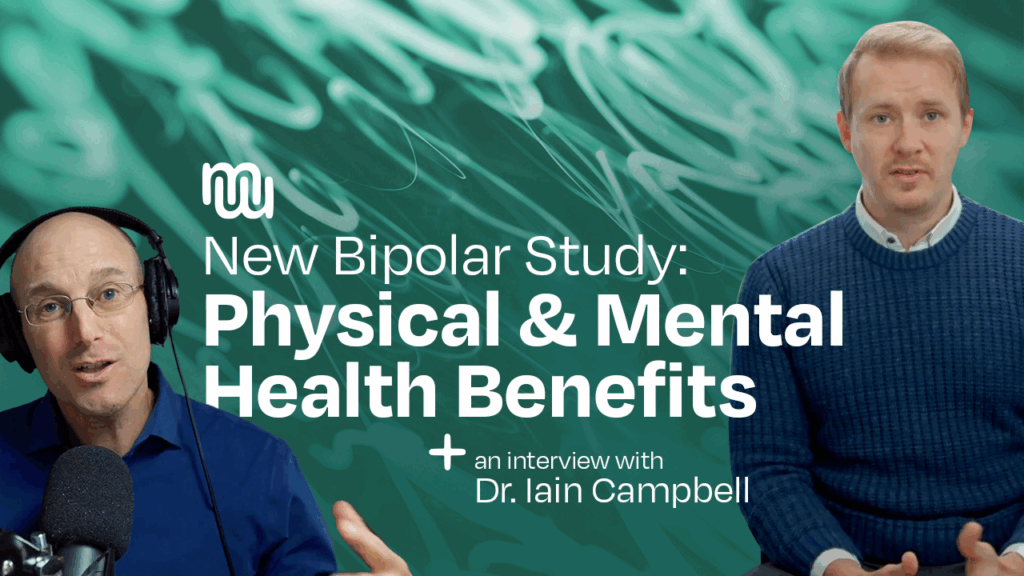
Ketogenic therapy for bipolar disorder shows promise: in a University of Edinburgh pilot led by Dr. Iain Campbell, daily tracking linked higher blood ketones—especially above ~2.0 mmol/L—to better mood, energy, and lower anxiety/impulsivity. Brain MR spectroscopy also showed notable glutamate reductions, hinting at a mechanism. The study and a new Metabolic Psychiatry Hub highlight growing evidence that targeted ketosis may aid mood stabilization while improving metabolic health.
Read more

Subscribe to this YouTube podcast where Dr. Iain Campbell and Matt Baszucki host peers and experts on the use of ketogenic therapy for bipolar disorder.
Learn more
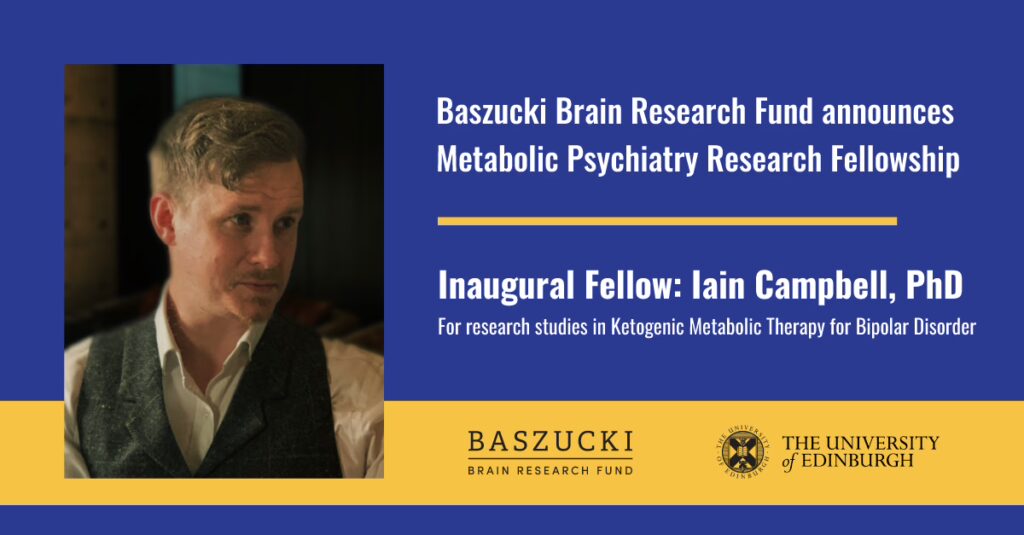
Dr. Iain Campbell will lead pioneering studies of Ketogenic Metabolic Therapy for Bipolar Disorder at the University of Edinburgh, one of the United Kingdom’s leading research centers
Learn more
Many “brain-healthy food” lists for bipolar disorder are based on poor evidence. In this Metabolic Mind episode, Dr. Bret Scher reviews Healthline’s claims about grains, fish, nuts, and chocolate, explaining why these foods aren’t proven to help bipolar disorder and how ketogenic therapy offers a far more powerful, evidence-backed way to improve brain metabolism and mental health.
Learn more
Ketogenic therapy for bipolar disorder shows promise: in a University of Edinburgh pilot led by Dr. Iain Campbell, daily tracking linked higher blood ketones—especially above ~2.0 mmol/L—to better mood, energy, and lower anxiety/impulsivity. Brain MR spectroscopy also showed notable glutamate reductions, hinting at a mechanism. The study and a new Metabolic Psychiatry Hub highlight growing evidence that targeted ketosis may aid mood stabilization while improving metabolic health.
Read more
Subscribe to this YouTube podcast where Dr. Iain Campbell and Matt Baszucki host peers and experts on the use of ketogenic therapy for bipolar disorder.
Learn more
Dr. Iain Campbell will lead pioneering studies of Ketogenic Metabolic Therapy for Bipolar Disorder at the University of Edinburgh, one of the United Kingdom’s leading research centers
Learn more
Many “brain-healthy food” lists for bipolar disorder are based on poor evidence. In this Metabolic Mind episode, Dr. Bret Scher reviews Healthline’s claims about grains, fish, nuts, and chocolate, explaining why these foods aren’t proven to help bipolar disorder and how ketogenic therapy offers a far more powerful, evidence-backed way to improve brain metabolism and mental health.
Learn more