Share your story. Help someone else start theirs. Share Now


Listen, Watch & Subscribe on:



What Happens When Kids Try Keto for Bipolar? featuring Elizabeth Errico
Listen
About the host
About the guest

Elizabeth:
One parent said to us recently, this is an extraordinary opportunity that saved my child’s life. They’re seeing tremendous change in their child’s quality of life, in their family’s quality of life, in the reduction of their child’s symptoms.
Bret:
Welcome to the Metabolic Mind Podcast. I’m your host, Dr. Bret Scher. Metabolic Mind is a nonprofit initiative of Baszucki Group where we’re providing information about the intersection of metabolic health and mental health and metabolic therapies such as nutritional ketosis as therapies for mental illness.
Thank you for joining us. Although our podcast is for informational purposes only and we aren’t giving medical advice, we hope you will learn from our content and it will help facilitate discussions with your healthcare providers to see if you could benefit from exploring the connection between metabolic and mental health.
Alyssa Elizabeth Errico from Children’s Mental Health Resource Center joins us to talk about a groundbreaking new study that they’re doing in a real world setting, implementing ketogenic therapy for kids age six to 17. And the whole thing about the family structure and what do they need to be successful and what kind of outcomes are they having?
It truly is a unique study, and Elizabeth is here to tell us all about it. So here’s the interview with Elizabeth Errico.
Elizabeth Errico, thank you so much for joining me on Metabolic Mind.
Elizabeth:
Hi, Bret. Thank you for having me. I’m very excited to be here.
Bret:
Yeah, me too. I’m so excited to talk to you about CMHRC so everybody can learn what it is, about your work with kids with bipolar, and especially the work now with ketogenic therapy and what you’re doing around that.
So we have a lot of exciting stuff to talk about. But before we get into all that, why don’t you give us just a little bit of background of who you are in CMHRC and kind of bring us up to date.
Elizabeth:
Sure, we’re the Children’s Mental Health Resource Center and we were founded as a response to the fact that so many kids with bipolar disorder are being misdiagnosed with other illnesses.
Their bipolar is often not recognized in children, and as a result, there’s a significant treatment onset delay that families experience. And so we are here to, what I like to call, do bespoke case management, where we take families under our wing, put our arms around them and say, look, we’re going to walk you through this complex mental health care system so that you can get the treatment and services that you need.
But at the same time, we also recognize that doesn’t happen quickly and families really need the resources to be able to reduce symptoms and improve quality of life right now at home while they wait to get in to see those experts, are going to be able to provide other areas of support.
Bret:
Yeah. So as your name implies, The Resource Center, and as you mentioned, you’re supporting the family. So important to differentiate that you’re not a group of psychiatrists providing psychiatric care, but you’re really helping the patients as they try to navigate their way through psychiatric care, even before they get there.
And then once they’ve established with psychiatrists, there’s still a lot to navigate from a family standpoint and a research standpoint. So that’s where CMHRC really comes in. Is that right?
Elizabeth:
That’s correct. We do not provide treatment.
What we do is we are mental health professionals who are guiding families through the process of seeking mental health care. We do a lot of work with parents and young adults who are newly on their own and responsible for their own medical and mental health care.
Bret:
Yeah, and I really like the point you made about children and adolescents often misdiagnosed.
Sometimes they need a resource to go to look for other opinions or guidance of how to get other opinions or seek other forms of treatment. So I’d imagine that’s a big role you play. And the other thing though is that you’re really a national organization. Is that right?
Elizabeth:
That’s true.
We are entirely virtual and have folks who work with us all across the country. In fact, participants in our programs come from all 50 states and 22 countries around the world.
Bret:
Wow. And how long have you been doing this?
Elizabeth:
We’ve been doing this work for a very long time. Collectively I think those of us on staff have about a hundred years worth of experience in mental health. But as under this umbrella, we came together three years ago in order to be able to provide these services to parents and to providers because we do a lot of education around diagnosing and treating bipolar in children for anybody who’s in the mental, physical, or educational systems.
Bret:
Yeah, that’s a great point.
That the education isn’t just for the individual or the family, but sometimes the providers need a little extra education as well. And, there’s so many resources on your website that you have. But I’m curious also about this new endeavor about offering ketogenic therapy and metabolic therapy to your families.
So what put that on your radar screen first?
Elizabeth:
We really pride ourselves in being responsive to the needs of our community. And so what we were hearing from a lot of families was we need something that we can do at home. We need to be empowered to have something that we can control that’s not just giving our kids medications at certain times of day.
So it came on our radar because there was a need in our community, and they started asking about it. We did a lot of research. We took a training for mental health professionals with Dr. Georgia Ede, and we just realized the enormous potential that this had for our community to give parents tools that they could implement immediately at home that were low risk and potentially very high reward.
This dovetails with all of the other things that we do from our parenting classes to our education around sleep and temperature and trauma. And so we invested ourselves entirely in making sure that we could bring this new opportunity to our community, and it’s been met with a tremendous amount of appreciation and success.
Bret:
Yeah, so tell us a little bit about that appreciation and success. And I want to get into the details of how you implement it and maybe some of the challenges and opportunities that you saw. But first, let’s jump to the end. What kind of results and reaction have you seen so far?
Elizabeth:
We are currently in the middle of our research studies. So, I really can’t reveal the data yet. It has yet to be finished being collected and analyzed. But I can tell you, anecdotally from the parents, the feedback that we’re getting from those who are in the study, it’s profound.
For example, one parent said to us recently, this is an extraordinary opportunity that saved my child’s life. And, that’s, it’s pithy, but it is demonstrative of what we’re hearing from folks. That they’re seeing tremendous change in their child’s quality of life, in their family’s quality of life, in the reduction of their child’s symptoms.
And for children who have not been given accurate treatment for bipolar disorder before, to suddenly have something that is actually reducing their symptoms without producing a lot of unnecessary side effects is truly transformational. And there are a number of them who suffer with suicidal ideation.
And since starting ketogenic therapy, being in ketosis consistently, that has fallen away for them. And that is just, the importance of that cannot be overstated.
Bret:
Yeah, that is remarkable. That really is remarkable. And so great to hear the families giving such powerful feedback.
And just to clarify, you mentioned your research study. You implemented this and you’re collecting data, but you’re not a research institution. You’re not like a group of researchers. You’re group of mental health clinicians supporting families, but decided to take the step and actually collect data and have some objective determination of what’s happening.
So what led you to that part?
Elizabeth:
All of us who work at CMHRC have been involved in research in the past, even though we are a community organization. We really felt that quantitative data was absolutely essential in order to be able to demonstrate that ketogenic therapy can be effective for children, and part of that comes from the fact that we are very focused on only promoting research-backed information.
And so that is a bedrock of what we do. So, if we could participate in gathering that data, we wanted to do that, but we also felt it was extremely important to be collecting qualitative data on what do families actually need in order to be able to implement this therapy effectively.
Because there’s a lot of misinformation out there about keto. Everything from that it is just a high protein diet to the idea that it is only for adults to the fact that it’s only for weight loss. There’s so many misconceptions that implementing it correctly was something that we knew families who live with the chaos of mental illness in their homes wouldn’t be able to just do all by themselves.
And so we developed a study that is very much also about building community so that the parents and the young adults in the study have the ability to get support and ongoing psychoeducation from those who are trained in the implementation of ketogenic therapy.
Bret:
Yeah. Wow. that’s fantastic to hear.
And it’s so interesting about when you think about the Pediatric population, the young children, without having much data for, or any data at the moment, for ketogenic therapy for bipolar disorder, where ironically that’s where ketogenic therapy started as a brain-based intervention for epilepsy in kids.
But here we are for mental illness without that. So that’s why it’s so important that you are gathering that data, and it shows that studies and data can take many forms. It doesn’t have to be in ivory tower academic institution taking years to enroll people and do a study. It can be someone who’s just ready to go like, you and say, let’s implement it.
Let’s gather data and see how we go. And I really like the part about the qualitative data of what people need because especially when you’re talking about young individuals. If you’re 8, 10, 15, you’re not cooking for yourself most of the time. It’s your family doing the cooking.
So you’re not just educating the individual, you’re indicate educating the whole family and the whole family has to be involved. And you mentioned a lot of the maybe the misconceptions and the myths that people have about ketogenic therapy, but what are some of the things that you’ve seen, like oh, people need this?
If you put this into place, it’s going to increase, the adherence and the success with implementing the diet. Now what are some of those things that fit that?
Elizabeth:
I mean there’s some that we didn’t come up with. They need recipes, but they also need help with figuring out how to menu plan.
They need help figuring out how to grocery shop for this because it is for most families a totally new way of eating. And so figuring out not just what a recipe that is keto-compliant is because there are so many out there that purport to be keto-compliant, but when you look at them and look at their macros, you realize, oh, no, this doesn’t work.
And so they need that support around how to convert their favorite family recipes. How to be educated when they’re looking at recipes online. They need help on how to read labels in grocery stores. Again, labels can be very misleading. How do you flip over the box and read the ingredient list?
How do you look at the nutrition panel and Know whether or not this is going to be compliant for you? How do you successfully and safely test your own bioindividuality to determine what level of carbohydrates you need? What level of carbohydrates your child needs? How do you determine your specific bioindividual macro ratio for a given meal or a given day? And it’s those kinds of details along with a certain amount of handholding, if you will. And I don’t mean that in any sort of derogatory way, but this is a huge paradigm shift for most parents to think that it’s okay that I’m feeding my child fat.
We’ve had parents who’ve really struggled with feeding their child enough fat and being able to have that sort of routine, constant, consistent reinforcement from not only our program staff, but also from the other participants that, no, it’s okay. You aren’t harming your child. The fact that we are there to be able to provide all this fantastic information.
Places like Metabolic Mind and from Dr. Ede who wrote a wonderful white paper for us on the connection between keto and any sort of cardiovascular health. And the fact that keto does not increase cardiovascular risks, we’re able to provide that not only for their intellect, but we’re able to be there to coach them through it as their emotional side comes in and second guesses them.
Bret:
Yeah, it’s just amazing after you’ve heard for decades and decades that fat is bad, fat is bad. And incorrectly so as we’re learning that it’s so hard to overcome that though. So yeah, I can see how people would need quite a bit of support for that. And I really like how you said finding ways to make their favorite meals keto.
And that’s important, too, because it’s not like everybody, all right, everybody just eats steak and avocado and some zucchini, and you’re fine. Everybody will be in ketosis. It doesn’t work that way, especially for kids who might be picky eaters or have certain specific tastes, and they all want their pizza and their pasta and their bread.
So, important to find keto versions of that so they don’t feel completely deprived. And adults feel that way, and I would imagine kids even more feel that way. Do parents report that was a hurdle? That this feeling of like deprivation are the kids like missing certain foods and really having to work on that?
Elizabeth:
A little bit, but I would say that we took some very important and good guidance from our dieticians who are advising us, and they said do it slowly. Don’t have any of these kids flipping over their whole diet overnight. And so the way we have structured our study is that they transition only one meal at a time per week.
So the first week they’re changing just one meal, and it can be whatever meal they choose. Then the second week, the second meal, the third week, the third meal, and the fourth week, they change their snacks. And that was really very intentional design to not only make it easier for the children to transition, but also specifically easier for them to give up some of those foods and tastes that they had really become emotionally connected to and dependent on.
And we’ve found that by the time they get to the point of transitioning their snacks, which are very often the most emotionally laden eating of the day, those snacks, they don’t want them as much as they did at the beginning because their taste buds are already starting to transition.
At the same time, we also do deal with kids who have, not only are they picky eaters, but they’re selective eaters. So they have ARFID, avoidant restrictive food intake disorder. And so those are real conditions that need to be addressed very specifically beyond, here’s your food list, stick to it.
And so that requires a lot of one-on-one attention from our program staff for the kids and their parents.
Bret:
Yeah, all very good points about how not all the populations are the same and not every kid is the same. And there’s a lot of individual individualization that has to be brought into that.
Elizabeth:
And not every family is the same. We have, in our study so far, we have children who are only children, with two parents. We have only children with a single parent. We have children who have one or two siblings. We have children who have five siblings. We have very, a great variety in those household makeups.
And so we’re seeing even within that, how much can change in terms of success with complying with the treat, with the food plan based on those dynamics. For example, when there’s another person in the household following the food plan with the child, the child is more successful in staying on it. And so no matter how your family is comprised, having one other person in there doing it with them makes a huge difference. And that’s really a lot of what we are looking for in terms of the qualitative data because we want to be able to put together, through this study information, a program that will work for families everywhere.
Bret:
Yeah, such a great point.
And I could really, I could totally imagine, a kid who doesn’t have to be in ketosis, who’s eating his cookies and his candy and his pizza and his sibling having to see that could really make things challenging. So having the structure or the, at least the guidance, for how to handle those types of situations could be so important ahead of time so you don’t find out after the fact that, oh yeah, that’s what kind of maybe derailed the program.
Before we continue, I want to take a brief moment to let our practitioners know about a couple of fantastic free CME courses developed in partnership with Baszucki Group by Dr. Georgia Ede and Dr. Chris Palmer. Both of these free CME sessions provide excellent insight on incorporating metabolic therapies for mental illness into your practice. They’re approved for a MA category one credits, CNE nursing credit hours, and continuing education credits for psychologists, and they’re completely free of charge on mycme.com.
There’s a link in the description. I highly recommend you check them both out. Now, back to the video.
Yeah, now I also want to ask you about how you help the families engage with their clinicians, with their psychiatrists, with their prescribing physicians. Because I’d imagine the majority of them are not working with psychiatrists who know about ketogenic therapy and metabolic psychiatry and may not be all that open to it or certainly all that aware of it.
So how do you help the families in that interaction?
Elizabeth:
We have had that. We’ve actually lost a couple of people who were ready to go, been through the screening process and got to the point of talking to their provider about it and were told absolutely not. And in every case it has been because of cholesterol concerns. And we are not in a position to be able to contradict their provider, or try to convince them to participate when their provider has said no. But what we do is we provide, as I said, this beautiful white paper that Dr. Ede wrote for us. We provide other resources, videos that they can watch.
Original source research papers that talk about the fact that this isn’t really a concern that will be significant enough to prohibit, participation, not necessarily now, but at some point in the future. And we have had conversations with providers about it. And we did, in fact, have one family that got through the screening process for our first cohort, and then we’re told no. We provided the information, let them talk about it with their provider again, and then they came back and they’re in our second cohort. So we were able to provide that education that was so necessary for them to be able to participate.
But we’ve had other families who were not so lucky as to have their provider be open to exploring this with them, and we’re very specific that their medical care continues with their provider. So the provider has to be on board. And so we’re hoping that with the findings from this study, when they’re eventually, the study active portion is completed and we’ve done the data analysis, will be something that supports families in making the case to their providers that, no, we really, we want to do this.
Bret:
Yeah, I would love to see the providers who told their patients not to do it. When they see the results of the study, see if they’re changing their mind once they see it. That’d be so powerful.
And that’s why you collect the data. That’s why you go for the publication. That’s why you make it official because you could do it. It’d be so much easier to do it without collecting all the data and just implement it and just, you could expand it so much faster probably. And collecting the data slows you down and there’s more work.
But that’s why it’s so important, so great that you’re doing it. And I imagine you have people in the cohort that are being treated. Are there people also outside of the cohort within CMHRC, who are you’re recommending ketosis to but not following the data? Or is it all within the cohorts at this point?
Elizabeth:
What we decided to do at the halfway point, there were a lot of folks who were interested in participating who were outside the parameters of the study. For example, our study is on bipolar disorder in children ages six to 17. We were getting folks who were saying, but my child’s going to turn 18 halfway through the study period.
We were having people who were saying, my child is 14, but they don’t have a bipolar diagnosis. They’re diagnosed with disruptive mood dysregulation disorder. We, by the nature of those facts, had to exclude them from the study. So, about halfway through, we realized that it really wasn’t ethical of us to be turning away people who wanted help.
And so we decided to allow those folks to come in and experience the psychoeducation experience, the community building experience, the ongoing support from program staff, as well as from other members, but not have them collecting data that we’re, and submitting it to us. So, you could say we’re actually looking at three cohorts, one of which isn’t doing all of the data collection, but because we have the ongoing connection with them, we’re able to still track how they’re doing. And honestly, some of them have offered to do the data collection for us anyway, just so that we have it in case it’s necessary, which is lovely of them. But we’re certainly not including that in any of our study data.
Bret:
Yeah, that’s wonderful that you’re still offering it to those individuals.
And I just can’t express enough how important it is for this type of data to be collected and this type of implementation. And earlier I said, the ivory tower academic institution, as if they’re all bad and they’re not. The research being done at academic institutions is fantastic and so important.
And we have so many studies in our community being done now on metabolic, psychiatry, ketogenic therapies. And, it not going to be become more mainstream without those academic institutions doing what they’re doing. And it’s so crucial and we’re so thankful for that. And at the same time. So important, so thankful for what you are doing as well.
And I can’t wait to see the results of this study, but I’m so glad that you could share some of the experiences that you’re having in some of the qualitative feedback that you’ve gotten so far, which seems fantastic. And so tell us what’s next at CMHRC, and if people want to find out more about you, where they should go.
Elizabeth:
Sure, our goal around keto is to be able to develop a long, longstanding permanent program around ketogenic therapy implementation. Not only are we going to use all this qualitative data that we’re collecting for publication purposes, but also to design a program that families can come to and use.
That is affordable, that is accessible to the maximum number of people and can give parents all of the supports that we are learning now are necessary in order for them to not only be able to implement, but maintain long-term. So our goal on the keto front is definitely to be able to provide that kind of sustainable long-term programming.
Otherwise, as I said, we focus a lot on improving quality of life right now. Today, for example, we’ve developed a parenting course, specifically for parents of children who have mental illnesses. The truth is that the modern parenting paradigms and the popular books out there on parenting are really mostly designed for neurotypical children and the interventions that are recommended, strong limit setting, consistent discipline, reward charts, they just don’t work for kids who have mental illness. And so we’ve developed a parenting approach that works for children with mental illness and it also happens to work for neurotypical kids. But, we have a live parenting class that meets for nine weeks.
We have an on-demand self-guided video course. It’s called Palliative Parenting, and the focus there is not on fixing children who have mental illness. Our focus is on reframing the parents’ thoughts away from being an authoritarian disciplinarian, but into thinking about parenting as a relational process and that it is bidirectional, and that by providing the kind of support that their children need, instead of disciplining them for something they have no control over by accepting them.
By respecting them, by finding ways to meet them where they are, they actually decreased symptom presentation. They increase quality of life for their child and for the whole family because we all know that a child who’s actively symptomatic is going to be disruptive to the entire family unit without wanting to be.
So our program addresses all of those issues in very real ways and supports the parents in terms of being able to, again, implement this at home today and for the future. We also do a lot of work around helping families and providers understand mood disorders in children. And a big part of that work is bipolar disorder, but it does include other mood disorders, and the newly identified phenotype of bipolar, which is known as FOH, or BD-FOH, which has a component related to thermoregulatory disturbance. So, we do a lot of education around thermoregulation, around sleep cycles, sleep regulation. We do a lot of work with adoptive and foster families because we have found in our community a disproportionate number of families have children who have been adopted or come from foster care, who have mental illness, and they have unique needs that we work very hard to address.
We also do a lot of consultation with families around, oh no, we’ve just gotten this diagnosis and we don’t understand it. Unfortunately, because of the way the mental healthcare system works these days, providers don’t have the time to spend really explaining the details of a disorder with their patients.
They tend to be given a prescription or the provider is going to follow a prescribed, treatment modality like CBT, which doesn’t work with children who are symptomatic. And so we come in and we educate the family on how to intervene at home. We work with a psychiatrist. We work on best practices, again, all research-backed. We work with therapists on what types of therapeutic interventions are going to be most effective in a kid who has a mood disorder or bipolar.
And we really work in a holistic way to get each child’s team coordinated around best practices for treating mood disorders and bipolar in kids. And we also do, we also believe very strongly in interdisciplinary contact amongst providers. And so we run an interdisciplinary, professional discussion group that let meets once a month for six months, and it is entirely focused on bipolar disorder.
And so those providers, everyone from occupational therapists to nurses to masters-level clinicians to physicians, they all come together and learn together about how to identify bipolar in kids, how to treat it effectively. How to understand FOH. How to really take a holistic approach in terms of the fact that when you’re treating a child who has bipolar disorder, you’re really treating the whole family, not just an individual and working with folks not only to understand.
The diagnostic criteria and how to identify it, but also how to work collectively with the other members of that treatment team.
Bret:
Wow. We focus this discussion on ketosis, but there’s so much, obviously, so much more that you offer that CMHRC offers. So I highly recommend everybody who’s interested go to cmhrc.org where they will be able to learn all about this.
And I just want to say thank you. Thank you for all the work you’re doing in your organization, and I cannot wait to see the results of this study and everything you’re going to do in the future. So thank you for joining me and sharing your journey.
Elizabeth:
Thank you so much. And thank you for blazing the trail here. We know that Metabolic Mind is so important in getting this information out to the wider community, and we’re grateful that you’re doing that. Great, thanks.
Bret:
Thanks for listening to the Metabolic Mind Podcast. If you found this episode helpful, please leave a rating and comment as we’d love to hear from you.
And please click the subscribe button so you won’t miss any of our future episodes. And you. Can see full video episodes on our YouTube page at Metabolic Mind. Lastly, if you know someone who may benefit from this information, please share it as our goal is to spread this information to help as many people as possible.
Thanks again for listening, and we’ll see you here next time at The Metabolic Mind Podcast.
Listen, Watch & Subscribe on:

This piece was originally published in the San Francisco Chronicle on May 23, 2023. At 4 a.m. the Friday before Christmas, I lay curled up and crying on…
Read more
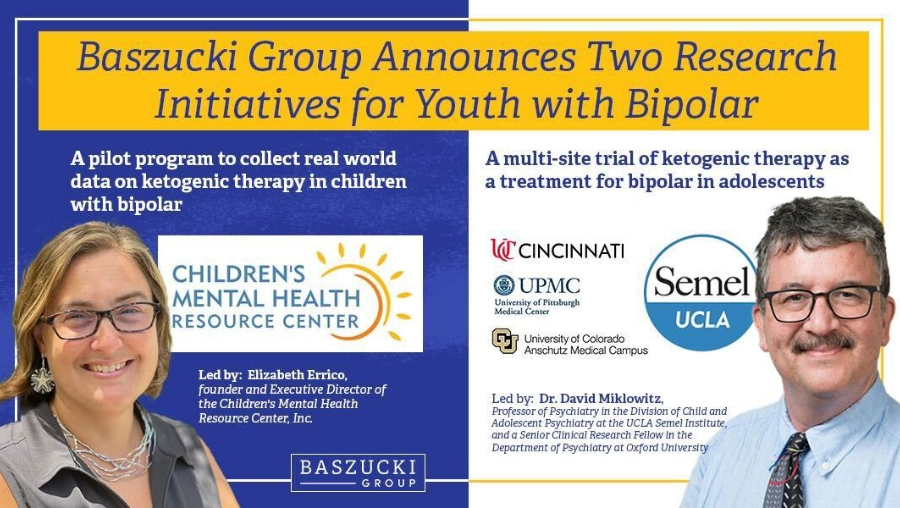
Baszucki Group today announced the launch of two new initiatives across multiple sites exploring the effectiveness of ketogenic therapy for children and adolescents with bipolar disorder. The participating…
Learn more
Matt Baszucki endured years of debilitating bipolar disorder before discovering ketogenic therapy; now, he is dedicated to sharing his story and elevating the voices of others.
Learn more
Ketogenic therapy for mental illness is changing lives. And now, it’s becoming more accessible than ever. Dr. Bret Scher chats with licensed mental health counselor Nicole Laurent about her innovative online program and nonprofit initiative aimed at providing low-to-no-cost metabolic therapy support to people with serious mental illness.
Learn more
This piece was originally published in the San Francisco Chronicle on May 23, 2023. At 4 a.m. the Friday before Christmas, I lay curled up and crying on…
Read more
Baszucki Group today announced the launch of two new initiatives across multiple sites exploring the effectiveness of ketogenic therapy for children and adolescents with bipolar disorder. The participating…
Learn more
Matt Baszucki endured years of debilitating bipolar disorder before discovering ketogenic therapy; now, he is dedicated to sharing his story and elevating the voices of others.
Learn more
Ketogenic therapy for mental illness is changing lives. And now, it’s becoming more accessible than ever. Dr. Bret Scher chats with licensed mental health counselor Nicole Laurent about her innovative online program and nonprofit initiative aimed at providing low-to-no-cost metabolic therapy support to people with serious mental illness.
Learn more