Get the latest on metabolic psychiatry. Subscribe.


Listen, Watch & Subscribe on:



Treating Bipolar with Keto – 100 Self-Reports with Dr. Iain Campbell
Listen
About the host

About the guest


Bret:
Welcome to the Metabolic Mind Podcast. I’m your host, Dr. Bret Scher. Metabolic Mind is a nonprofit initiative of Baszucki Group where we’re providing information about the intersection of metabolic health and mental health and metabolic therapies, such as nutritional ketosis as therapies for mental illness.
Thank you for joining us. Although our podcast is for informational purposes only and we aren’t giving medical advice, we hope you will learn from our content and it will help facilitate discussions with your healthcare providers to see if you could benefit from exploring the connection between metabolic and mental health.
Today, I have the pleasure of having another interview with Dr. Iain Campbell. This time, I caught up with Dr. Campbell at the 8th Global Symposium on Ketogenic Therapies, which is an international conference, really discussing the science and the clinical nature of using ketosis as a therapeutic intervention for various conditions, including mental illness.
And Iain is a Baszucki Brain Research Fellow at Edinburgh University, where he is doing research on using ketogenic therapies for serious mental illness. But Iain is unique in that he also has lived experience. He lives with bipolar 2 disorder and has used ketogenic therapy as a mainstay of his treatment and has really transformed his life.
Today, in this interview, we get to talk more about this online survey he’s done, which is really remarkable. He is had over a hundred individuals with lived experience of using ketogenic therapies for their serious mental illness and bipolar disorder to fill out a 45-minute survey about their experience.
And as you’re going to hear, it’s really inspiring. Now, with all the caveats, this isn’t a randomized double-blind, placebo-controlled trial, right? That’s not that level of evidence, but we’re not expecting that right now. This is how early science starts. And Iain really started with this survey, and the results are very dramatic and very inspiring. But now remember, this is for informational purposes only.
We’re not establishing a provider-patient relationship/ and none of this is group or individual medical or healthcare advice. Please consult with your healthcare provider before making any changes, but we hope this information helps you learn about ketogenic therapies for mental illness and inspires you that there is hope for another way of treatment.
Now, if you want to know more about Iain Campbell, you can find him on Twitter or x at I-A-I-N-C-A-M-P-B-E-L-L- P-H-D, at IainCampbellPhD. So with that, we hope you enjoy this interview with Dr. Iain Campbell.
All right. Dr. Iain Campbell, my friend, my colleague. So, great to see you again.
Iain:
Great to be here. Great to see you.
Bret:
Now, of course, we did that whole podcast interview, which I really appreciate and has gotten such great feedback. So, anybody who wants to know more about Dr. Campbell, I recommend they go to that episode.
But, of course, a researcher in Edinburg doing research on the ketogenic diet for bipolar disorder. Having lived experience, which you’ve been very vocal about for bipolar disorder as well. But now, you have so many different projects going on. There’s so much to talk about. Now, we have this new project about this survey that you’ve done.
So, give us a little background in some of the excitement around this survey.
Iain:
Yeah, so there’s a lot of people with bipolar disorder using ketogenic diet. You can see this on online forums. And we did this analysis a couple of years ago where we looked at online forums and how many people are posting about doing this.
And we did a text mining analysis where we crawled through all these forums and got all the responses of people, and we found 174 people talking about this. And this was when virtually nobody even considered this as a medical intervention for keto, but in the community, people were chatting about it.
So, we tried to analyze the response. And generally, most people are having a very good experience with extended periods of mood stabilization. And then, so with this study, we wanted to look back the community again, but in more depth. So, we asked them about 50 plus, maybe 60 plus questions. Ketone levels, glucose levels, what were the medications you were on? What kind of comorbid conditions do you have?
We’re really trying to find out all the information that would be good for trial design and for future use of this diet. We just passed a hundred responses to the survey, which alone, I think, is very interesting because there’s a hundred people willing to do a 45-minute survey that have bipolar disorder and are doing a ketogenic diet.
The Venn diagram of that is very tight once you get into all those categories. So, I’m glad that there’s that many people interest in this. But what’s even more interesting is the very significant reduction in symptoms they’re reporting the things that you would see traditionally. I would say, actually, they’re unprecedented type of reductions.
They’re mentioning extended remission, for years at a time. The longest remission was seven years, where someone’s been on the diet. And most people were doing it more than a year. I think about over half of people were doing it for more than a year at the time. So, it’s not like people are trying this. They’re really sticking to it as a long-term strategy to manage their symptoms.
And what’s very interesting about that, I think, is the responses they’re describing. There’s a huge decrease in suicidal thinking. They report when they’re on the diet, a decrease in depression, decrease in mania and hypomania. And one of the most interesting findings is it seems to be particularly strong for depression.
So, it seems to lift people out of the depression particularly strongly, and people reporting less existing problems with mania because the existing treatments are, they have some efficacy for bringing people out of mania, like in hospital and so forth. But there’s very little you can do for bipolar depression. And about 80% of the time, a bipolar 2 person is in depression.
So, this is a real need is to have a long-term therapy for the 80% of the time people are in these depressed days. It’s not just the 20%, they end up manic or in hospital. So, I think it is really been interesting to see this, and I think it’s unheard of. This number of patients reporting this kind of response with a dietary intervention.
So, it obviously requires explanation of why that would be.
Bret:
Yeah, it’s so interesting the way you explain that the focus really is on the mania because that’s what gets a lot of the attention. That’s what’s acutely dangerous. But also the hypomania, also the seductive part, which we’ve talked about before.
But depression gets less of the attention.
Iain:
Yes.
Bret:
And maybe part of that is because it’s more difficult to treat? And it’s just the advice generally, like you got to live with it and deal with it to a degree?
Iain:
Yeah, certainly with bipolar 2, you’re mainly depressed almost all the time.
Like 80% of the time, you’re in this state of depression. But that’s the times that you’re just in your room hiding away from the world, not communicating with people. And so, you never hear about this. And it’s never raised as a priority because you’re not, you’re essentially not causing any disturbance of any kind.
Whereas when people are manic, it’s quite amazing the amount of trouble one can get oneself into in a manic state. And so, this is when people get treated for it, and they go to hospital. So, all the attention goes on the manic state of illness, and there’s very little evidence for existing treatments for depression.
There’s some that do seem to have some efficacy, but it’s really the manic states that they’re very effective for these treatments. And I’ve experienced that taking them, is that they really suppress the function of your brain. But that also makes your life almost impossible to live in many ways for a lot of people because you’re just struggling to function at the level you normally would.
So, I think that when people are using this, they’re using it alongside their medications. And we got detailed analysis of what medications they’re using it with. But this has been an effective strategy, just adding it on to what they’re already doing, which is really interesting to see.
Bret:
So, you said you had a hundred people fill out a 45-minute survey.
So, anybody to sit down and do a 45-minute survey is pretty impressive, but let alone a hundred people. But so to be upfront right away, there is a selection bias, right? If somebody didn’t have a positive experience with ketosis, tried it and stopped it, they’re unlikely to have done this. But so, I’m curious though, were there some people who did the survey and said, ah, no, it didn’t really work for me, or it didn’t have the dramatic effects?
Iain:
Yeah, of course, there was all kinds of responses. People had great responses in between. Some people had no effect, some people didn’t like it. But I would say, the vast majority in this survey were positive, saying that this has really helped them. Like you said, there’s probably some selection bias. But the fact that a hundred people with bipolar are using a therapy that’s completely unrecognized at the moment for bipolar disorder and having these experiences with it, I think is remarkable.
And people should see this as something that we need to understand more about as a priority because clearly, this is a hundred very motivated patients to do this survey. But there’s many more that are doing this in the wild, and we should try to understand this therapy and how to engage with them.
Bret:
Yeah, that’s a great point on how to interpret it. You could just say, ah, it’s just a survey, selection bias. Forget it. It doesn’t mean anything. That’s not quite helpful. Or you can say, look, there is a signal here, a hundred people, and this is helping. And that’s just probably the tip of the iceberg.
So, how can we learn from this and go forward? So, you said the initial, I guess the initial impetus, was to learn about trial design and what to include. And so, what are some of your takeaways from what you’ve gotten from the survey?
Iain:
So, the main thing is just how much people care about this. The questionnaire is 45-minutes. But at the end of the survey, I left these two questions that said, if you would like to, would you like to describe your experience in your own words or add some additional information?
People are probably exhausted by this time answering all these questions. And they were writing paragraphs of descriptions about their experience, and often saying how much this has changed their family life, their social life, their career, their health, their general health, their physical health.
These are really long descriptions, and I’m really trying to publish these in full along with the paper to show the full range of what people experience with this. So, it is quite remarkable how much people want to talk about this. And they want other people to know about it because this is the difference that it’s made for them.
So, I don’t think there’s ever been this sort of thing happening in psychiatry, where such a number of patients have taken on their own health in a way that they feel has really helped, and reported this. So, I think that’s something quite remarkable. And I think that the patient community will really want to see response from psychiatrists and from carers to understand this better.
Bret:
Yeah, it’s so interesting to think a psychiatrist, who maybe doesn’t know about ketogenic therapy, if they were to read this and see these descriptions of how this is so profoundly transformed people’s lives. How could they not pay attention? How could they not want to learn more?
Iain:
I think this condition that’s treated by anti-seizure medications, bipolar is treated with, primarily with, anti-seizure medications.
And we have this connection to epilepsy where ketogenic diet was developed as a therapy for epilepsy until, to a large extent, in the early days. But it’s not only that. In our pilot study, we saw the markers that you see in epilepsy improving in people with bipolar brain. Glutamate, serum lactate, these are markers of kind of mitochondrial dysfunction and energy disruption and hyperexcitability.
And so, the fact that we’re seeing in an anti-seizure treatment, the markers of an anti-seizure response plus this patient response from the qualitative data, I think to me, paints a picture of something that is important here.
Bret:
Yeah, and I’m glad you brought that up. And we started talking about your survey, but what we haven’t talked about is the pilot trial that you ran. Which you have the result of and are submitting for publication now, at the time of this recording, which is really exciting. So you, like you’re saying, you have both, you’ve got the quantitative and the qualitative data.
So, can you talk about some of the main findings from the study that you ran, too?
Iain:
Yes, we had 27 patients on a ketogenic diet. And we were examining this as a euthymic patients to look at the response over a six to eight week ketogenic diet trial. And what we saw, which I think is one of the most interesting findings, is that in epilepsy studies, we’ve seen that ketone level is correlated to seizure reduction.
So, the higher the ketone level, the more likelihood of seizure reduction. And we saw this with our daily psychiatric measures with our patients, that the ketone level was correlated with improved mood, improved energy, decreased anxiety, and decreased impulsivity. So, this is very interesting because it points not only to ketones being, ketosis being significant, but actual ketone level is a kind of mechanism behind the action.
And then, we actually plotted the graphs of their daily mental health measures alongside ketones. And you can see a clear, covariation where there’s a sort of, at 14 days where they go into the diet and their markers improve. And then you can see a disruption of that when they come off the diet at they end in the washout period. And we did an actual Granger causality test on this, and this was significant for mood and for anxiety and for energy.
So, these are really interesting findings because they point to not just that this is the qualitative descriptions from patients that responded well. You know, I’ve played them at conferences and people have this. We went to ISPD this year. I think it’s fair to say that those are unprecedented type of responses. But also when you look at the ketone levels, it shows a kind of, it shows a possible causality with these changes that makes it, I think, very interesting.
Bret:
So, what kind of ketone levels are you talking about?
What did you see? Were you talking about like the ones and the twos or the fours and the fives? Or give us some perspective.
Iain:
So, we were aiming to get people in a sort of epileptic therapeutic range, which would be like one to three millimolar for adults. But we saw increasing benefits going up the ketone range, and especially above two.
It appeared there might be a kind of threshold effect about two millimolar. And in epilepsy in children, four millimolar has been noted as a threshold for seizure reduction. So, I think there might be a similar effect, but we really need to do larger studies to really understand what this might be.
But it certainly appears above two millimolar, there’s a much stronger response.
Bret:
Yeah, and I’m curious in the survey, I think you mentioned, you asked about if they were testing and what kind of levels were they at. Did you see something similar in the survey that the people with positive experiences were in that two plus level?
Iain:
This is what we’re working on at the moment, to stratify the ketone level and their response by that. But we saw the range of ketone level was generally 0.5 to three for most people. Like at a very upper range was the highest rating was seven. The lowest was sort of 0.3. So, people are in that kind of one to two range. And I get the sense from speaking to a lot of people that do this, that the people who get the best results are doing a bit of a higher range.
And again, that depends on how far they are with illness. Maybe younger people with less metabolic damage don’t need as high levels, or maybe they need higher levels as in epilepsy? We really don’t know yet. So, it’s very interesting to see there’s this kind of relationship between ketone level and response.
But the other thing I should mention with the pilot is that we saw brain glutamate reducing in two of the three brain regions we scanned. And this is really interesting because this is considered a sort of putative marker to treatment response in anti-seizure medication. So, in Lamotrigine, all the shared treatments we have with epilepsy and bipolar, this is considered a marker. And we’re showing that this other anti-seizure therapy is reducing glutamate in the brain.
And actually, we tried to compare this to existing studies, and it does seem to be a substantial reduction even in just in eight weeks on a diet, which is, I think, very interesting and speaks to the mechanistic side of this, that we’re seeing this similar response with this anti-seizure medication.
Bret:
Yeah, it’s interesting. We just interviewed Dr. Susan Masino here at the global, I keep forgetting, I keep mispronouncing the name, but the Global Ketogenic Therapy Symposium. So, we just interviewed Dr. Susan Masino. And her talk, she talked about the pleiotropic effects of the ketosis, and how it’s not just one thing.
So glutamate, decreasing glutamate could be one of the multiple mechanisms by which ketosis works. The effect of the ketones themselves, the effects of the metabolic health, and actually helping regulate neurotransmitters and decreasing glutamine. Which is so fascinating to think of because that it’s unlikely to happen by calorie restriction or by eating a Mediterranean diet or eating, you know, better, which certainly can help your health and your mental health.
But is it going to be enough to change neurotransmitters to really have this effect? So, you’re starting to see part of the mechanisms and the clinical benefit.
Iain:
Yes.
Bret:
Which is so powerful.
Iain:
And we also saw the markers of mitochondrial function improving reduced lactate. So, people with these mitochondrial disorders, and epilepsy typically have increased serum lactate, which is an indicator that the body is struggling to make energy. You could think of it almost like if you’re running a marathon, you get this lactate buildup on your muscles.
The body is exhausted, but people are like that sitting on their sofa watching TV with these conditions. There’s clearly something disturbed with energy production, and we saw this decrease significantly on the ketogenic diet in eight weeks. So, I think that’s also really interesting because ketogenic diet, aside from epilepsy, the other thing it’s used for is mitochondrial disorders.
So, we’re seeing this marker of mitochondrial function improving. So, the scientific picture is really painting something significant, combined with the qualitative descriptions we now have in quite a large sample size of a hundred patients. I think this really is something that needs to be understood a lot more.
Bret:
You’re doing a fantastic job of compiling so many different areas of data. One, the clinical efficacy. Two, possible mechanistic pathways based on the different markers you’ve measured. And then three, the qualitative, just how much has impacted people’s lives. You really have hit all three of those with your beginning studies, and I’m sure there are more to come.
Iain:
Yes. I think it is just coming from the patient community. I’m trying to represent something that patients are really interested in. My first ever study was a survey of patient reports online. And so, I’m trying to honor that by sharing their perspective, but also giving it the scientific rigor that it deserves to make the case for this.
And so, I’m trying to publish all of these qualitative descriptions and fuel to show that here’s patients in their own words describing this, which is something actually we rarely hear in science, as patients in their own words describing their response to their treatment. How do they feel about it?
So, I think that’s something I’d love to encourage is to have patients speak in their own words about the response of these treatments.
Bret:
Yeah, and that, it’s really interesting. I think how important that is. But yet, how many will dismiss it and say an anecdote isn’t science, or a description of how you feel isn’t science. But yet, that doesn’t make it any less important.
And that’s what you’re advocating here, huh?
Iain:
Absolutely. And we were playing these patient experiences at scientific conferences. And you rarely hear these unfortunately, but when we did play them, the conference burst out into applause because it’s the, we’re really starved of that feedback from patients in their own words describing how they feel.
And this patient, who was on her pilot trial, was describing a complete turnaround in her life. That she’s back to work, she’s reconnecting with her family. Her whole life has improved, her physical health. She’s more stable than she’s been in 20 years with any other treatment. And these sorts of experiences need to be shared in people’s own words.
We shared a letter from the 15-year-old daughter of a study participant, who was describing her family experience with this. And it was quite moving the way she describes how this has improved her family life. So, I always want to give patients their own voice because there’s a lot that’s lost in statistics that can make things seem, that there’s a lot that’s lost in there.
Bret:
That’s a great point. It’s easy to lose those personal stories and statistics.
Iain:
Yes.
Bret:
That’s so powerful to share. So, we’ve just heard about two different projects that are being, almost ready for publication now. So, what’s next?
Iain:
We’re going to an RCT. So, we’re preparing our protocol for randomized control trial, applying.
Then this year for this, we’re setting up a metabolic psychiatry scientific hub in Edinburgh, which will be, it’s a bunch of universities that we’ve got together with that want to research this and prioritize it. And I think that’s really exciting. We have a talk to the Royal College of Psychiatrists a couple weeks ago, and there’s actually great interest in this.
People are really starving for new approaches, and things that don’t have the side effect profile of existing treatments. And so, I think there’s a real interest in this and it will continue to gather momentum. But the RCT is our main focus, metabolic psychiatry hub, and continue to share patient experiences.
Bret:
Yeah. Fantastic. Thank you so much for sharing all the work you’ve been doing, and we look forward to seeing more from you.
Iain:
Thank you very much. Thank you.
Bret:
Thanks for listening to the Metabolic Mind podcast. If you found this episode helpful, please leave a rating and comment as we’d love to hear from you.
And please click the subscribe button so you won’t miss any of our future episodes. And you can see full video episodes on our YouTube page at Metabolic Mind. Lastly, if you know someone who may benefit from this information, please share it as our goal is to spread this information to help as many people as possible.
Thanks again for listening, and we’ll see you here next time at The Metabolic Mind Podcast.
Listen, Watch & Subscribe on:
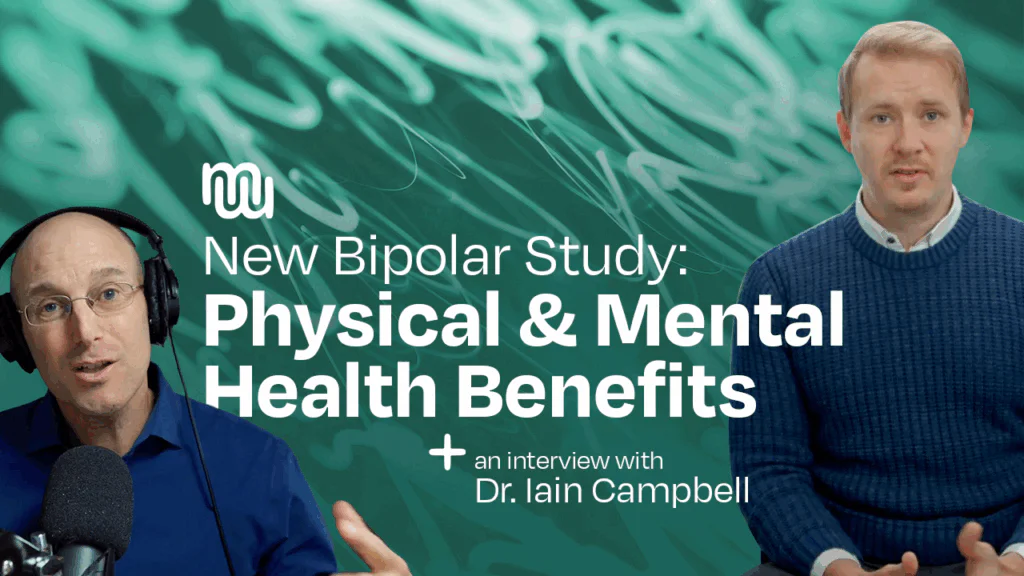
Ketogenic therapy for bipolar disorder shows promise: in a University of Edinburgh pilot led by Dr. Iain Campbell, daily tracking linked higher blood ketones—especially above ~2.0 mmol/L—to better mood, energy, and lower anxiety/impulsivity. Brain MR spectroscopy also showed notable glutamate reductions, hinting at a mechanism. The study and a new Metabolic Psychiatry Hub highlight growing evidence that targeted ketosis may aid mood stabilization while improving metabolic health.
Read more

MetaMood is the first app to connect the dots between your mind and body — tracking mood, sleep, movement, ketones, metabolism, and more to power mental health through…
Learn more
Each year on March 30th, World Bipolar Day brings together individuals, families, and professionals to raise awareness and foster understanding of bipolar disorder. This day is dedicated to…
Learn more
A Nuanced Guide to Understanding Bipolar Mood Disorders, Why They’re Often Misdiagnosed, and How Personalized Treatment Is Reshaping Lives. Bipolar mood disorders are complex and often misunderstood mental…
Learn more
Ketogenic therapy for bipolar disorder shows promise: in a University of Edinburgh pilot led by Dr. Iain Campbell, daily tracking linked higher blood ketones—especially above ~2.0 mmol/L—to better mood, energy, and lower anxiety/impulsivity. Brain MR spectroscopy also showed notable glutamate reductions, hinting at a mechanism. The study and a new Metabolic Psychiatry Hub highlight growing evidence that targeted ketosis may aid mood stabilization while improving metabolic health.
Read more
MetaMood is the first app to connect the dots between your mind and body — tracking mood, sleep, movement, ketones, metabolism, and more to power mental health through…
Learn more
Each year on March 30th, World Bipolar Day brings together individuals, families, and professionals to raise awareness and foster understanding of bipolar disorder. This day is dedicated to…
Learn more
A Nuanced Guide to Understanding Bipolar Mood Disorders, Why They’re Often Misdiagnosed, and How Personalized Treatment Is Reshaping Lives. Bipolar mood disorders are complex and often misunderstood mental…
Learn more