Get the latest on metabolic psychiatry. Subscribe.


Listen, Watch & Subscribe on:



Ketogenic Therapy: How 3 Patients Put Depression and Anxiety in Remission with Dr. Lori Calabrese
Listen
About the host

About the guest


Lori:
We saw depression go into remission as early as seven weeks. That’s amazing. That is as good as, or better, than any antidepressant medicine we have that’s FDA-approved. Period.
Bret:
Dr. Lori Calabrese, a Connecticut-based psychiatrist, just published a case series showing complete remission of depression and anxiety in three of her patients using ketogenic interventions.
So let’s hear from Dr. Calabrese about these amazing results.
Welcome to The Metabolic Mind Podcast. I’m your host, Dr. Bret Scher. Metabolic Mind is a nonprofit initiative of Baszucki Group where we’re providing information about the intersection of metabolic health and mental health and metabolic therapies, such as nutritional ketosis as therapies for mental illness.
Thank you for joining us. Although our podcast is for informational purposes only and we aren’t giving medical advice, we hope you will learn from our content and it will help facilitate discussions with your healthcare providers to see if you could benefit from exploring the connection between metabolic and mental health.
Dr. Lori Calabrese, thank you so much for joining me again here at Metabolic Mind.
Lori:
Thank you. It’s a pleasure, Bret.
Bret:
Yeah, it was wonderful to have you on as part of that group interview where we talked about the five-patient case study of using ketogenic diet and ketamine for treating anorexia. But now you’re here because of a new publication that you have a three-patient case series using ketogenic therapy to treat depression and anxiety in three of your patients.
And I want to start by just saying, why depression and anxiety? Why did you pick those as the starting point for this case series?
Lori:
I think for two reasons. The first is that this is what we say, even my work really comes out of what I do. And the most common psychiatric diagnoses that we see across the board are major depression as unipolar depression and practice and anxiety as what I will call a conglomerate of anxiety disorders.
So, generalized anxiety, panic, OCD. What I really wanted to showcase and really look at is in real life patients, real world patients that we see who walk in the door with a lot of different things going on these days. Comorbidity is the rule, not the exception. In real life, real life people, do they get better?
Can they get better? How quickly do they get better? And what happens when they’re very complex? Because in the studies published so far, diagnoses have been isolated without comorbidity. I see and we treat people who have many different things going on. So, what I chose to really do was highlight a real slice of life, as I call it.
And these patients were patients all in their early thirties, who they each had five different psychiatric diagnoses going on. They all have major depression. They all had generalized anxiety and then they had three, at least three different other things.
Bret:
Yeah, and you mentioned in the paper they all had ADHD as well.
And I think that’s such an important point you’re making. Randomized controlled trials, even non-randomized intervention trials, have inclusion criteria, exclusion criteria. Whereas for a case series like this, someone may say, oh, it’s not research, it’s not a randomized controlled trial. But it’s the case series of the inclusion criteria being just, being in the real world, and seeing the psychiatrist.
And that’s what you see. So, I think it’s so important to have that evidence in addition to the randomized controlled trials. And they both play a role, and both are so important. So, tell us about the intervention that you did with these individuals.
Lori:
I think the intervention starts with an assessment, right? It starts with really a comprehensive diagnostic look at what someone is carrying when they come in through the door. That’s what we did. We started with a comprehensive psychiatric assessment, a comprehensive nutritional assessment. And then what I call joint feedback, which is a chance for all of us on the team to sit down with the patient at a Zoom at that point so that we’re all on the road at the same time and talk about what their goals are and how to get them to those goals.
So, these patients were patients who had all been treated before, but had not responded or their treatment had stalled or they were sick of treatments that they’d been on before. And they were really very interested in seeing if they could use a different kind of approach. So, I would say the treatments that we offer are everything that I offer, not just a metabolic therapy.
And so in this case, the question was, would you like to see if we might try something very different to really switch up your whole brain energy, the way your brain works, the way it functions, and see if we can get the anxiety in remission, the depression in remission? But to do it with food instead of with another medicine.
So, the intervention was then, yes, that’s what I want to do. And then, it starts at yes. So, it starts at getting the informed consent, comparing this to everything. That’s what we did. We obtained informed consent, and we reviewed all of their other options. And then we did a lot of looking at labs, at body composition, at the amount of skeletal muscle, at visceral fat, and at all of the like really exciting things that psychiatrists don’t usually order like advanced lipid panels, like insulin resistance scores, like all of those things.
So, that I could say, not just did we miss anything psychiatrically, but where are you metabolically? Because we’re going to see that improve, too. So we did that as a start. And then, working with what their preferences were.
Our preference actually, when we’re using ketogenic metabolic therapy or when we’re doing metabolic psychiatry is to use a very personalized dietary intervention using whole food. So not powders, not mixes, not keto foods. Not that stuff, but real food and transition people from where they are carbohydrate-wise into a very low carbohydrate diet with healthy fat, with adequate protein to meet their skeletal muscle needs so that they don’t lose muscle.
For people who wanted to so that they built a muscle. Or for a couple of people in the case series who were already exercising or wanted to get back into exercising to take all that into account, and we personalize that diet. And we started. Starting means they start the eating, they start transitioning their food and then we really interact with them and watch them.
So what does that, what does that mean? That means we meet with them twice a week, short little meetings, like 15 minutes by Zoom or in-person. We invite them to Zoom groups where they can meet other patients. We invite their families and friends to a Zoom group just for families and friends. And I always say it’s so that let them fight with us instead of fight with you.
They don’t like it, they disagree. Like invite the families and friends. So, we host a Zoom group just for them. We we give them, we actually give them, we buy and we gave them, a meter, a glucose ketone meter because we wanted them to use it and we wanted to make it easy and we wanted it to not be cost prohibitive.
We gave them an app so that they could take pictures on their phone. And photo journal so that we could see what they were doing and high-five them, or thumbs up them as they were going. And then we started offering them drop-in walking groups. So, we walk four times a week, half an hour, 45 minutes in at beautiful sort of little nature-based places.
A nature preserve, a wonderful park near a dog park. And we invited patients to come out and walk with us just to meet each other and just to move. So the intervention, I would love to say was the ketogenic diet because it’s the main intervention. But what we really wanted to do, I think, I really think was not to bring our team in but create a tribe.
Because I like to say it takes a team and it takes a tribe. And if you don’t have a tribe at home, we’ll see if we can create one for you so that you feel part of a community and supported. So, that’s what we did. That’s how we did it.
Bret:
And all that sounds wonderful. it sounds like such a fantastic holistic intervention to just help people in so many different ways.
But, of course, the critics would say you have no idea if it was the diet that did the benefit or if it was the walking groups or if it was the feeling of belonging. But you used a word, remission. You said you wanted to see if they wanted to put their condition into remission. In your paper you said all three of them put their anxiety and their depression into remission.
So, how often do you see in your practice without ketogenic interventions, with other types of interventions and therapy and medications and community building, how often do you see remission in that setting versus in this setting where you did use a ketogenic diet?
Lori:
Not often. Not often.
I’ve been in practice for a long time with a lot of patients that I followed over time who don’t go into remission. They get better, but they don’t fully say it’s gone now. I’m well now. Oh, my gosh, I’ve never felt so good before. So, one of the things, one of the really important ways that I start my assessment is to kind of ask a question that most people say they have never been asked before.
And the question is, when was the last time you were really at your best self for a good year, top of your game? When was that? What were you like then? What was your best self? Were you anxious? Were you, did you have an irritable edge? How’d you sleep? Best self? And it really gets people to understand that, wow, over the last X number of years, despite their treatments, they might have improved.
They haven’t ever gotten back to their best self. And so the goal is really to get to that best self as you are now years later, right? With kids or family or bills or taxes. Do like to just see what that best self could be like? So, remission for me really means not just the numbers on the rating scales, but it means really being able to say, I am at my best self.
I’m functioning as well as I can given everything that I have on my plate, as well as I want to be functioning.
Bret:
Boy, I think that is such an important point, and I’m so glad you brought that up because we hear time and time again that someone is treated. We mean they’re safe. They’re not in the hospital, maybe they’re not having suicidal thoughts, so they’re treated.
But that’s very different than being your best self and really engaging in society in the way that you want to do that. That should be the treatment goal. So, I’m so glad you brought that up. And that’s what we’ve seen in all in number of anecdotal reports and now with some research showing as well, that’s where ketogenic interventions can be so beneficial to get people to that next stage of their best self.
So, tell us a little bit about the timeframe that you saw in this case series of these individuals improving and getting into remission.
Lori:
So, we opened this up because these were our patients and we didn’t know. So, when we started offering this, we didn’t know how long it was going to take.
We didn’t know what had happened in a couple days. Would it happen in a week? What are we really able to look at? And so, in part, we embarked on this treatment course with them looking at everything all the time or trying to look at everything all the time along the way. And what we saw across the board was or what we, let me back up.
What we decided a priori was that we wanted to see if response and remission correlated to serum ketones because that is what’s missing in the literature. You can see things, you might see it. Now, some of the current studies going on are like wonderful at doing that. But in the past when you look even at case reports, you couldn’t find that kind of correlation or it was missing or it was urine ketones or it was breath acetone.
So, we wanted to really say, let’s measure ketones and measure them every day, twice a day if we can get them, and start looking at rating scales individualized for the patient for generalized anxiety, for PHQ-9, for OCD, and figure out at what point do they hit therapeutic ketosis, that’s consistent therapeutic nutritional ketosis, that’s consistent.
And then, how long does it take from them to get better or to get into remission? So, the timelines that we put together showed that we wanted to see like, what gets better fast? You know what gets better fast? Anxiety. Does anxiety get better fast? And It’s striking to patients that their generalized anxiety gets better fast.
And it’s striking to us. I like to say that they stop calling us. So, that then it’s not the email, it’s just the, oh, it’s like they feel so much better in terms of obsessive brooding, generalized anxiety, social anxiety even. And guess what? Then they start like coming on the walks and joining the groups. And depression takes a little bit longer, but here’s the surprising thing.
We saw depression go into remission as early as seven weeks. That’s amazing. That is as good as, or better, than any antidepressant medicine we have that’s FDA-approved. Period. And in one of the cases, it took a little longer. And I like to say it’s because some people like take a little longer.
They screw around a little bit. They’re not exactly consistent or because something else gets in the way. And in this case, it was just that if you delay early screening, sometimes you find out something a little bit too late that you would’ve fixed earlier that maybe would’ve helped everything earlier.
And so one of those, one of those labs, was something that the minute that we jumped in on and addressed and got that good, got that into a good place, boom. Like remission happened, like in a heartbeat. You’ll see that in the like timeline.
Bret:
Yeah, I think that’s amazing that depression took a little longer, but still was in that seven to 12 week period, which isn’t really that long.
That’s really impressive, yeah. And also want to go back to something that you said before that you checked all these things that psychiatrists don’t usually check and don’t usually monitor for. And that’s on the one hand, understandable, because a lot of this isn’t taught in psychiatry training and residency.
You know, metabolic health and metabolic mental health connection, the importance of measuring and monitoring metabolic health. What do you think it’s going to take to change that? Will a case series like this and talking about it and publicizing it, is that enough to start getting into the psyche of psychiatrists to make them realize they need to start changing this?
Or what’s it going to take?
Lori:
I think what you’re doing, and what Metabolic Mind is doing is a huge first step. Patients all over are talking about this. You see the buzz. You see the social medias. You see the excitement. And then when I think, you know what? People, patients out there, adults out there, sometimes adolescents are looking for this and are reaching out to say, I want to learn about this.
I want to do this. Patients will come to their doctors and they’ll say, I want this. And I think that will help drive physicians who don’t know a lot about it, to learn more about it. Certainly that was my, certainly that was my case. You know what, this was something that I came to from very traditional psychiatric training with psychopharm, interventional work, all different kinds of things.
And then I realized oh, this is the coolest science out there. This is something that we should know about. We should know about mitochondrial health. We should understand this. We should go back and figure out how we can optimize how the brain works, and we can do it with food.
It’s like you teach a man to fish, right? And you teach him to fish, and then he can feed himself for life. And so that’s what’s so exciting about this kind of thing. And it’s what’s exciting about the follow-up because I had a couple of responses, and emails so far saying, hey, do you know anything about what happened here?
And I said, yeah, because I still see all three. And so I can see like what they’re doing on their own, who said, thanks so much. We worked with you for a little while, and now we’re doing this on our own, but still follow me for my Vyvanse or whatever.
So, I see that, and I see the maintenance, the ability to maintain and to flourish.
Bret:
Yeah, that’s fantastic. Now, in the beginning, you mentioned how everybody had five diagnoses coming into this to see you. And from a drug perspective, you’ve got one drug for mania, one drug for psychosis, one drug for depression, one drug for this, and you got your little silos in your drugs.
But here we’re talking about ketogenic therapy addresses it all, which on the one hand sounds like amazing. And on the other hand, a skeptic would be like, no, I can’t work that way. So, how do you reconcile that instead of one drug for everything, we’ve got one therapy for brain health and mental health.
How do you reconcile that?
Lori:
I reconcile that by going back to the science rather than looking at drug efficacy studies. So, we have a lot of efficacy studies for different medicines that were based on theories, and some of those are now outdated, right? If we look at the science of what happens, actually with brain energetics or what ketones can actually do at the level of the gut, at the level of the gut microbiome, at the level of intracellular health, and especially in the brain.
What we find is that they not only affect metabolism, but that they affect signaling. And so ketone bodies, like beta-hydroxybutyrate, do something like super cool. So, when I dial this down and explain it, what I say is they change the energy that your brain runs on. And that allows your brain to experience so much more energy than it ever used to be able to produce, and it tamps down the abnormal firing that produced panic or obsessive thinking or explosions of anger, right?
So, it does both. It elevates the energy. It tamps that down. How does it do that? I could show you the science. So, sometimes I’ll show patients the science and then I’ll say, and it does something else really cool. It can actually change the way your mitochondria work, and it can turn on new genetic expression.
It can turn on new genes that were quiet. So it changes your future. Why? Because it changes the way your mitochondria are going to be for you in the future. There is nothing else that we have that does that. We don’t have anything else that does that. So, when you can do that, and then you can do it for yourself, and you realize what a powerful tool. What happens is, I see the mom, then the dad comes in, then the kid comes in, and then everybody in the house says, show us how to do this.
Bret:
Yeah, it is remarkable that the science behind it. And then on top of that, just the improvement in metabolic health. And that plays into the whole scheme of how the brain works as well.
So, it’s so impressive, the many different constellations of how it works. But I guess the other pushback is, oh, it’s too hard to do, especially for someone who’s living with depression and or anxiety. It’s just going to be too hard for them to do. So. What did you find, or what do you find in your practice about the efficacy of people being able to start it and stick with it?
Lori:
So, that’s a really common misperception. It’s the wrong belief. I just spoke to someone this morning, with one of the patients that I was seeing in follow-up who has early Parkinson’s, who went to her doctor and depression. And she’s seen me for a while, and when she got diagnosed with Parkinson’s and panicked, she’s what can I do?
And I said, ketogenic diet. Now, finally you’ve been seeing, so she went back and her doctor said, oh, it’s so great that you’re doing this and yes, yeah. And in fact, you have less tremor, and yes, you actually look really good. And he said, I don’t really talk to people about this because like it’s too hard for people to do.
What we found is that’s actually not true. And the reason it’s not true that it’s hard for people to do, is because education opens the way to making this easy. And so one of the things that we assess when we’re talking to people is not just their like readiness and interest, but we assess their learning style.
Why? Because some people really learn better visually. They want to see a picture. They want to see the food. They want to, they want us to show them their, like portions of what’s good for them in their macro ratio. Some people want the papers. To the patient with Parkinson’s disease, I actually center five different research articles on the ketogenic diet and Parkinson’s.
Some people really just need to hear it. So, we have a book club so that patients can hear from other patients as we’re reading books because they don’t learn by reading. They learn auditorily. So, I think if you think about ,could you do this? How do you do this? What do you do? You have to meet people where they are, and teach them what might work for them in terms of the diet.
You have to let them adapt at a level and at a pace that they want to. So, some people say, just tell me what to do. And other people say, wait. Like I’ve got to get my restaurant eating under control. I’ve got to figure it out. So, if you can be flexible with them to do that, they learn, they do.
And then, when they really feel good, they say, oh my gosh. I’m just not, yeah. I just never want to go back.
Bret:
Yeah, it seems like there’s a clear divide, like those people who just don’t really know a lot about it or have much experience with it, say it’s too hard to do. And those people who have really looked into it and know about it and have experience with it know that it’s not too hard to do, especially for the patients that see dramatic benefit.
And as we can read in this case series, these three individuals, their lives are completely changed now forever and improved so dramatically. So, it’s clear from an individual standpoint, people can change their lives. But what about you and your medical practice? Has instituting metabolic and ketogenic therapies changed how you see your medical practice or your joy for practicing medicine?
Lori:
Oh, totally. Totally, it’s changed. I have three arms to my practice, and this is where the future is. What’s happened, in fact, even in patients that I see with medicines in my own patients and patients that I treat with other interventional treatments, when they say, what can I do to get even better?
It’s metabolic. It just goes to metabolic. So, if they’re appropriate, and they don’t have a contraindication to a metabolic therapy, then this is a way to think about, use this as your treatment. Don’t do it as a diet. It’s not a diet. It’s not like a time limited thing. It’s a way to say, if you could change your, if you could change your future, why wouldn’t you do it?
Why don’t you try it? So, it’s been exciting, and it’s been fun because actually, we’re for the first time really, patients see me like in tennis shoes. They’ve never seen me in tennis shoes. If we’re out walking in the woods, they see me in tennis shoes and in leggings.
And it’s a very different way of saying, we live this way, too. We cook this way. We live this way. We can help you because we’ve seen it. We’re doing it.
Bret:
Well, thank you so much for joining me today. It’s been wonderful to hear your experience and to dig into the paper a little bit more.
And I know you’re a very busy clinician. So, I know it’s not easy to take time out to prepare a case series and submit it for publication. And to take that extra step because you want to contribute to the field and contribute to the science and contribute to the literature and help others understand that this can and should be a way people practice and integrate it in your practice.
So, I really appreciate you taking the time for that. And where can people go if they want to find out more about you and, follow what you’re doing?
Lori:
Oh, I think they can go to my website. It’s just my name, loricalabresemd.com.
Bret:
Great. Great.
Lori:
So, thank you for having me.
Bret:
Oh, my pleasure. Thanks, again.
Lori:
Thank you.
Bret:
Thanks for listening to the Metabolic Mind Podcast. If you found this episode helpful, please leave a rating and comment as we’d love to hear from you. And please click the subscribe button so you won’t miss any of our future episodes. And you can see full video episodes on our YouTube page at Metabolic Mind.
Lastly, if you know someone who may benefit from this information, please share it as our goal is to spread this information to help as many people as possible. Thanks again for listening, and we’ll see you here next time at The Metabolic Mind Podcast.
Listen, Watch & Subscribe on:
Psychiatrist Lori Calabrese explains how ketogenic diets affect psychiatric medications, sometimes amplifying their effects, and outlines a thoughtful approach to safe medication tapering. She discusses distinguishing side effects from relapse, stabilizing metabolism first, and using lifestyle tools like exercise and sleep to make deprescribing smoother and more effective.
Read more
College can be a time of rapid growth, but also intense pressure. For many young people, college is the first time they are setting out on their own….
Learn more
Research indicates that following a keto diet can be an effective form of metabolic treatment for depression, particularly atypical and treatment-resistant forms. Dr. Erin Bellamy has seen ketogenic…
Learn more
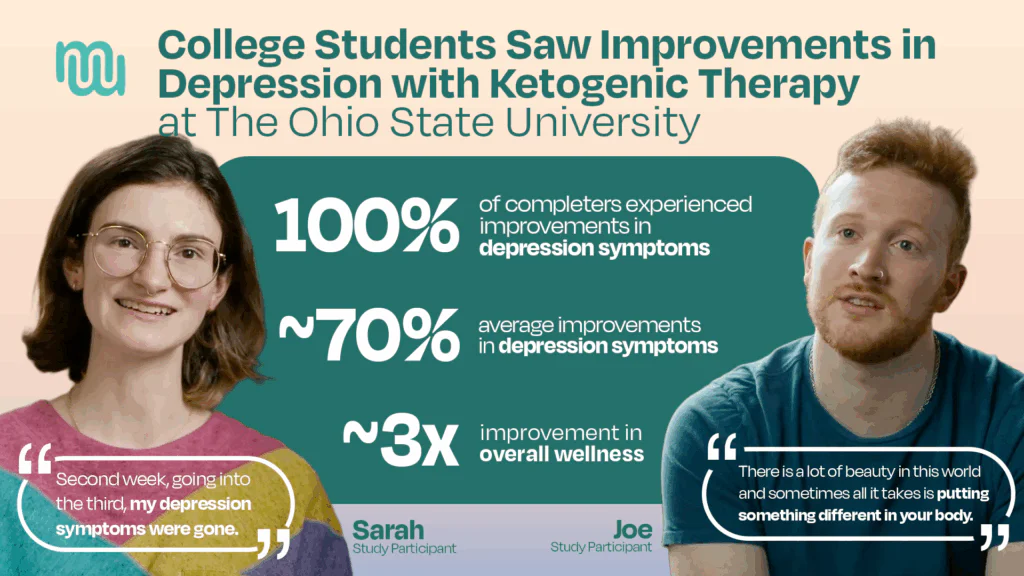
A new study shows an association between at least 10 weeks of following a well-formulated ketogenic diet and a roughly 70% decrease in depression symptoms among a small…
Learn more
Psychiatrist Lori Calabrese explains how ketogenic diets affect psychiatric medications, sometimes amplifying their effects, and outlines a thoughtful approach to safe medication tapering. She discusses distinguishing side effects from relapse, stabilizing metabolism first, and using lifestyle tools like exercise and sleep to make deprescribing smoother and more effective.
Read more
College can be a time of rapid growth, but also intense pressure. For many young people, college is the first time they are setting out on their own….
Learn more
Research indicates that following a keto diet can be an effective form of metabolic treatment for depression, particularly atypical and treatment-resistant forms. Dr. Erin Bellamy has seen ketogenic…
Learn more
A new study shows an association between at least 10 weeks of following a well-formulated ketogenic diet and a roughly 70% decrease in depression symptoms among a small…
Learn more