Get the latest on metabolic psychiatry. Subscribe.


Listen, Watch & Subscribe on:



Keto-CTA Study Confusion: Addressing the Misunderstandings with Dr. Budoff
Listen
About the host

About the guest


Matt:
We proved that the keto diet specifically did not cause the plaque progression. We looked at the interaction between the induced LDL and the change in plaque, and we could not find a relationship.
Bret:
Welcome to the Metabolic Mind Podcast. I’m your host, Dr. Bret Scher. Metabolic Mind is a nonprofit initiative of Baszucki Group where we’re providing information about the intersection of metabolic health and mental health and metabolic therapies such as nutritional ketosis as therapies for mental illness.
Thank you for joining us. Although our podcast is for informational purposes only and we aren’t giving medical advice, we hope you will learn from our content and it will help facilitate discussions with your healthcare providers to see if you could benefit from exploring the connection between metabolic and mental health.
You’re on a ketogenic diet and your LDL goes sky high. Are you at higher risk of heart disease? A new study suggests that any presence or change in plaque is not related to the degree of LDL elevation in this population. But here’s the issue: a lot of people are commenting that the evidence still shows that plaque progressed in this population, which it did.
But the way people are interpreting it is that it’s progressing far more than any other population. So let’s take a step back and say, wait a second. How are we getting to these conclusions and are they accurate? Part of the problem is the metrics used to measure plaque and one is PAV, which Dr. Budoff is going to explain, but even people who use CT angiogram all the time in their practices aren’t necessarily all that familiar with PAV. So I’m sure the rest of the world is not that familiar with PAV. So luckily we have Dr. Matt Budoff, who is the expert in CT angiogram research and was the primary investigator of this trial.
He’s here to help us better understand the metrics used in this study, how do interpret them, and what does it really mean for the risk assessment of this group of people, lean mass hyper-responders? I hope you enjoy this interview and that it really helps clarify this study and how we can interpret it.
Dr. Budoff, thank you for joining me again, back up on Metabolic Minds.
Matt:
Oh, it’s a pleasure. Thanks for having me.
Bret:
Yeah, so we just had the video where you discussed the results of the keto CTA study focusing on lean mass hyper-responders, and the coronary CT angiogram. And there’s been a lot of discussion about it, which is great.
Anytime you put out novel research, it should stimulate some discussion. I think there’s been a lot of, I don’t know, misunderstanding, misrepresentation or just confusion about what a lot of the results mean, specifically the CT specific results. You’re one of the experts in CT angiograms and have been studying it for such a long time.
I think it’s great to have you come back on to help us clarify what these results really mean and what we’re even measuring. For starters, can you define PAV? Because one of the big questions is that supplemental table showing the change in PAV, but I think a lot of us don’t even really understand PAV.
So let’s start from the basics.
Matt:
Yeah. So PAV stands for plaque atheroma volume. And when you calculate it as a percent, that means that you’re calculating it as a percent of the total volume of artery measured. The reason we measure it in that way, PAV percent, is because a lot of the early data came from intravascular ultrasound where they only measured one or two segments of the artery.
Where on CT angiography we can measure all of the coronary tree. So the amount of volume measured is much higher. So you don’t want to just know how much plaque there is, but how much plaque there is relative to the amount of arteries that you’re measuring. And that’s why we use PAV percent as a primary endpoint in many trials because it’s translatable to all of the interventional work that’s been done over the past 20 and 30 years.
Bret:
Yeah, and I’m glad you brought that up because a lot of the CT angiogram studies, I guess you could say, are relatively new. Whereas the past couple decades, we’d had a put a catheter in somebody’s artery actually, in the artery itself, to do an ultrasound from the middle of the artery, which now we can do this non-invasively.
So would you say with PAV, those studies are relatively translatable that we can compare one to the other?
Matt:
if you use PAV percent, you certainly can. There’s still some differences. The intravascular ultrasound people only look at certain plaques, only look at certain types of plaques, whereas we looked at all types of plaques.
So there are still some intrinsic differences, but I think it does help give us more broad understanding of what we’re seeing, and we can also compare it to other interventions that haven’t yet been done with CT that have been done with intravascular ultrasound. So it opens the door for a broader look at our results.
Bret:
Okay. Yeah, that’s very interesting. All right. Now, if we, now that we have a background of PV, and I guess is it, safe to say, the analogy is you take the house and you have your total square foot of the house is, 2000 square feet and there’s 200 square feet of mold in the house, then you would say that’s, you would calculate your, PAV is 10%.
I guess is, that sort of a good, analogy? Exactly right. And
Matt:
then. But if you had a huge house, it would only be 1%.
Bret:
Yeah.
Matt:
That’s why we like to look at percent PAV because it depends on how much of the, of that, what you’re measuring and compared to how much is, present in the overall. A patient.
Bret:
Yeah. Yeah, so, now if we look at supplemental table one from the keto CTA study and we look at the all comers that with the baseline PAV is 1.6 and the delta PAV is 0.8 and that’s for all 100 participants. Some people are interpreting that as saying that is a 50% relative increase, which is higher than any trial has ever shown, and is incredibly concerning.
And if you look at the numbers, they are correct. It is a 50% relative percentage increase. So how do you interpret that type of change?
Well,
Matt:
one, you can’t do it based on a percent because the denominator was very low. The denominator was lower than most other trials. So when you have a low denominator, any number looks big.
For example, if I tell you had a calcium score of one and it went up to a calcium score of three. You might, say, that’s great. One and three are both very low calcium scores, and therefore, I’m in great shape. And over two years or one year, that was a minimal change. If you calculate a percent change, that’s 200%.
And if I tell your plaque is going up by 200%, you should be panicked, and you should. So I think misinterpreting the data, we don’t calculate a percent PAV percentage change over time because the denominators are so important when you think about those things. The other thing that you have to remember with the keto study is we took in patients who were across all types of plaque, but were on no other medical therapies.
So they weren’t on anti-hypertensives, and they weren’t on statins, and they weren’t on anti-inflammatories or aspirin. So we took a natural history, a treatment naive population. Said, what is the effect of a high LDL induced, by the keto diet on plaque progression? And we found that it was not related to the LDL.
So that is the answer of the question. The fact that some of these patients had a lot of plaque, and should be on a statin or that they had a lot of plaque and they should have been on other therapies to slow down plaque progression is a whole nother question. And we have recommended that they go on other therapies once we identified them as having plaque.
But this was a true treatment naive population that was just using keto diet for overall health. And we thought that they were all lean, healthy people and some of them had a lot of plaque at baseline, which to me was, I think, a difference between the other studies. All the other studies use 2, 3, 4, 5 background therapies to treat patients.
You can’t say a treatment naive population progressed more than a treated population and be surprised. That’s just too naive to even think about.
Bret:
Okay. Yeah, that’s a really good point. And so I, it also speaks to lean mass hyper-responders are not all the same. There are some who are going to be lower risk, some who are going to be higher risk, and plaque definitely did progress.
But as you’re saying, the study did not suggest that it was due to the LDL. So there are other reasons for plaque progression, but let’s talk about the absolute plaque progression. So those who had a baseline calcium score of zero started again, like you’re saying, a very low PAV of 0.6, which is much lower than any of the other comparator studies and then increased by 0.5. So what does that mean for an absolute delta PAV of 0.5? How do you put that into perspective?
Matt:
So 0.5 is what we achieve on treated populations. If you looked at that supplemental table 1, they didn’t put in the interventions, but these are populations of patients that were largely on statins or on other lipid lowering therapies, on antihypertensive therapies, and we achieved a PAV of just 0.5 in some of these populations.
So the 0.5 and even the 0.8 in the overall trial represents pretty similar to an on-treatment population of patients who are being treated with multiple therapies. So the fact that they only went up by 0.5 or 0.8 on no therapies at all, no background therapies is actually quite good. And I think reassuring that that, yes, some of them had plaque and some of them need to be treated.
And those that are progressing more rapidly should be treated with other therapies. I think the keto diet is wonderful for a lot of good health reasons, but there were many things that drive atherosclerosis in our body and, we can’t address all of them with any one intervention. So some of these patients need to be treated for other atherosclerotic risk factors.
Bret:
And I guess part of the issue with comparing to other studies is we don’t do a lot of studies on normal healthy people with CT angiograms. That’s a rare thing. But is it safe to say that it is expected and shown that even normal healthy people without other comorbidities and high risk will progress with plaque when you’re using the sensitive measurement, such as Cleerly and PAV?
That is normal to expect some progression.
Matt:
And we actually have done that. So, we remember, we compared the keto population, a healthy asymptomatic population, to the Miami Heart Study, a healthy, asymptomatic population. And they showed there’s no difference between these two groups. Now, we didn’t have progression in the Miami Heart Study, but we’ve already established that these patients were very similar to another cohort of healthy, asymptomatic people.
And you’re right, none of the other plaque progression trials ever done have been done in healthy, asymptomatic people. That’s not who we typically study in medicine because that’s not the study group of interest for most of our interventions.
Bret:
Now, I want to get back to the Miami Heart in a second. But just to finish up on the supplemental table, you also show those who have a calcium score greater than a hundred, which sort of ran from a hundred up to, even as high, higher than 400, in that range.
And there were only 17 individuals, but they had a pretty big delta PAV of 2.4, where I think in general, anything greater than one is considered higher risk. Small numbers, was 17 people and they all had calcium scores above a hundred. So how do you interpret that when compared to, again, some of the other studies which showed lower for the entire cohort lower progression.
Matt:
I think it definitely points out that patients, so imagine, if I had a patient in my practice net a calcium score above a hundred, and I said, okay, we’re going to do no interventions, and we’re just going to see what happens to your score. We know what that happens. It goes up a lot and we can look at change in calcium score as well, which we have an incredible amount of data with showing that some people are very rapid progressors.
I think in those patients we have to look for inflammation. We have to look for tightening blood pressure control. We have to look at other factors. And to be quite honest, irrespective of this group, they came in with a lot of plaque at baseline, meaning likely, before they ever went on the keto diet, they had atherosclerosis that was going untreated. And we need to make sure that we take these patients who have plaque and look for ways of intervening, to lower their cardiovascular risk. And we didn’t do that purposefully in this one year trial. But now I’m recommending to many of them that they look more carefully at their cardiovascular risk factors and that they make sure that they’re treating these other factors that were going untreated up until now because they were unrecognized as having plaque. They didn’t know that they had the disease. So they didn’t, they weren’t treating the disease. They, we identified that with our CT angiogram.
Bret:
And I guess a lot of people want the answer of, then what’s causing the plaque? Which is an unanswerable question for one cause. But could, can you say that it, the keto diet itself, is contributing to the plaque progression based on what we see in this study?
Matt:
So I think that’s what we sought out to prove. And we proved that the keto diet specifically did not cause the plaque progression. We looked at the interaction between the induced LDL and the change in plaque, and we could not find a relationship.
So we know it’s not the keto diet causing the plaque progression. We know that plaque begets plaque. That’s been known for a long time, and we reestablish that. And I would suggest to these patients that despite doing all of this wonderful stuff that they’re doing for their own health with the ketogenic diet that they look towards going on other therapies that are proven to help with atherosclerosis. And I actually do take my keto patients who are, have a lot of plaque based on, I do a CT angio and all of my patients who are on the keto diet, and if they have a lot of plaque, I recommend an aspirin tablet at low dose.
I recommend tight blood pressure control, and I do recommend a statin for those patients, not to treat the keto induced LDL, to treat the underlying plaque that they have. Because we know that we can slow down plaque progression regardless of the cause with a statin. Statins work even in low LDLs to lower plaque burden.
We’ve studied that extensively. So I do recommend treatment of these patients, but I let them continue the keto diet as long as we can control the other cardiovascular risk factors and make sure that they’re not progressing and in, these and remain untreated.
Bret:
Yeah. Thank you for that clinical insight.
I think that’s really helpful. So, now let’s rewind for a second. You brought up the Miami Heart Match, which showed in a matched cohort for metabolic health, despite drastically different levels in LDL, the group on keto with very high LDL did not have higher plaque scores than the Miami Heart, but so now I think it gets a little confusing because we’re also using different measurements. So it was reported as total plaque score and the coronary calcium score.
So tell us how those differ from the plaque atheroma volume.
Matt:
So, the Miami Heart population, oh as far as your turn about, like the way we assess the plaque at baseline, right? Compared it to Miami Heart so compared to this?
Bret:
How is total plaque score different from PAV? What differentiates that?
Matt:
So total plaque score is a very adapted tool without quantitative-AI measurement of the atheroma. So when we read the study, we read each plaque and each segment for, is there plaque present? Is it mild, moderate, or severe? Then we sum up all of the plaque in a semi-quantitative way to get to a total plaque score.
It’s been exceptionally well validated. It predicts outcomes, and before we had these AI tools, it was the simplest way of looking at all of these metrics. So we had, we didn’t have PAV, percent measured by Cleerly in the Miami Heart population. So we couldn’t compare plaque volumes in this way, but we could compare total plaque score, and we looked very carefully.
They were all read by my lab. All QA’d by my lab and by me so very reliable measurements. And we saw no significant difference between the baseline keto scores, those patients who were on keto for an average of four years and their amount of plaque, and the Miami Heart population, despite the Miami heart population having a much lower LDL.
Now, both of them had some plaque and both of them probably deserved some other therapies in those that did have plaque. But again, this was a population-based study, Miami Heart versus an asymptomatic population, the keto CTA trial. And I think it was a very fair comparison to show that they had similar plaque volumes.
So again, another point of proof that it wasn’t the keto diet driving the plaque, but it was other underlying risk factors. Remember, there’s probably 50 risk factors for heart disease, right? We know many of them and diabetes and hypertension and Lp(a) and inflammation and would go on and on.
And we’re not controlling all of them with any one intervention. So looking at the natural history of plaque and showing that it wasn’t driven by this LDL induced change in keto is the primary answer. And I think we answered that question very definitively.
Bret:
Yeah. And will there be future papers from this cohort looking at Lp(a) and looking at inflammatory markers and looking at other or other blood tests and risk factors that you did monitor?
Matt:
Absolutely. We did extensive blood testing. Dave Feldman actually flew the blood over to the lab personally to make sure it didn’t get lost in transit. We put it on ice and shipped it to make sure that the samples were received and that we have a complete dataset.
And we now have numerous biomarkers that we’re going to look at, including Lp(a). We also have a lot of work to do on noncalcified plaque volume. There was some increased there as well as PAV, and we want to look at that and compare that. And also now of interest, we have the Cleerly study, Cleerly measurements in Miami Heart.
So we can now go back and look at the PAV percent in the keto group and the PAV percent in the Miami Heart group. Compare the two, not only look at total plaque score to look even for more nuances between the differences between the two groups and to further answer this question. So there’s a lot more to come.
I don’t think people should criticize a first paper when clearly there’s multiple papers being planned and multiple answers and there was nothing hidden here. These tables, if anything, were too explicit, I could tell you that. This was a very incomplete list in this supplemental table 1, which has received a lot of criticism. But I just presented the extra trial on Colchisine and in the placebo group, the Delta PAV change was 1.4 in the placebo group, the Delta PAV was 1.4 in one year.
So one, that’s very similar to the Keto CTA group if you look at the people who had higher risk and these patients were at higher risk. It was almost identical, and there was no outcry that’s a large PAV change. And we didn’t calculate PAV percent change, percent from baseline change. We didn’t do percent of percent changes because that’s not how we analyze the data.
But, so I think people who are naive, this happened with my evaporate trial. People who are naive to plaque progression make the wrong calculations and make a big deal about nothing. And I think we just have to ignore the non-scientists and the non-clinician. Unfortunately, Twitter lets everybody comment, and sometimes that’s a detriment.
That’s why in the medical literature in PubMed, you see mostly scientists addressing scientists so that the, one, it’s a civil discussion, and two, it’s scientifically based. And I think we lose that a little bit with Twitter or now known as X.
Bret:
I think the one benefit of the discussion though is it’s spurring deeper conversations like this.
The whole world now is hopefully going to learn a lot more about PAV and interpreting PAV, which they didn’t know before. And I, hopefully that’s a benefit. But that’s interesting. That
Matt:
No, I just don’t, I don’t like the negative. I don’t like the negative context and some of the, dare I say, immature comments, that are made as there’s no reason to get personal.
I don’t know these people and I don’t need personal attacks on my integrity or my science based on somebody who’s never done research, who’s never published a paper. That’s fine, you want to point out a scientific point. Let’s keep it, let’s keep it positive, right? Let’s, engage without casting dispersions on people.
Like that is totally necessary, and I wish they could ban that kind of banter as well. It’s just not helpful.
Bret:
Yeah, that’s a very reasonable response for sure. But just to summarize, so the, that your EXTERM trial, the baseline, the placebo group, which was similar in baseline to the higher risk keto CTA, also had a 1.4 PAV change in one year.
So very similar, with no outcry for that. So that is certainly interesting. And now you also brought up the end..
Matt:
And I just want to say the extra patients in baseline were treated with many therapies that was not a treatment naive population. They were treated with statins, they were treated with aspirin, they were treated with blood pressure medicines, and they still had a 1.4 PAV percent change in one year.
So that’s, they had multiple therapies on board and had the same PAV change as the higher risk keto CTA patients who had no therapies on board. So again, it’s still apples to oranges, but should be reassuring to everybody that this is not outrageous. And this has not been a novel finding or something that’s never been seen before as it’s being bantered about. This is common to see plaque progression in high risk people.
And we saw plaque progression, and all we were looking to do was saying what caused the plaque progression. We weren’t trying to say that plaque can’t progress. We didn’t, I didn’t expect that everybody in the keto trial who had any plaque would have zero scores that the keto diet was liquid draino and would clear out the coronaries.
I think we established our goals in a very safe and scientific way.
Bret:
Okay. Excellent, and so you brought up the now noncalcified plaque volume, NCPV. So tell us how that differs from PAV. Let’s again, start from the basics, and then we’ll talk about the what changed.
Matt:
So PAV is total plaque, very simply, it’s all the plaque.
It’s calcified plaque, it’s fibrous plaque. It’s non, it’s fibro fatty plaque. It’s low attenuation plaque. It’s all the different plaque changes, plaque volumes across the spectrum. Noncalcified plaque volume excludes the calcified plaques. So it’s not all of the plaque volume, it’s only that volume that we deem is, It’s soft, if you will. That’s a term we often use soft plaque or noncalcified plaque.
Bret:
And that’s because that’s thought to be higher risk plaque. So is that the reason for focusing on it?
Matt:
we think it’s more amenable to change. sometimes calcified plaque doesn’t change much and, rarely, if ever can go down.
So we look at, to a noncalcified plaque is a more, perhaps more modifiable plaque for a target for treatments. For example, if we were putting somebody on an intervention. We would look for, noncalcified plaque, often as a primary to see does the, what changes? because the calcified plaque doesn’t change as much.
Bret:
So does it tend to go in step then with PAV as PAV changes, noncalcified plaque changes? It in general, loosely correlated?
Matt:
Yes. Unless something causes specifically a high calcification rate, they should be very parallel. And that’s and, because there’s so much outcome data with PAV and PAV percent changes.
We wanted to focus on that as an endpoint. The noncalcified plaque volume went up similarly, went up parallel, and we’re going to have a whole nother paper coming out that’s going to delve into some of these other plaque volumes that we looked at in the keto trial. Fibro fatty plaque, noncalcified plaque, fibrous plaque, low attenuation plaque and, total noncalcified plaque as well.
We couldn’t put everything in the first paper. and it certainly wasn’t being hidden as some people suggested because it was in the supplemental material, or is in that table itself, in the paper. We were forthcoming, but we couldn’t focus on everything on this first paper.
And we certainly are going to look at that change in noncalcified plaque volume in much more detail, and compare that to other, to the baseline noncalcified plaque volume to the Miami Heart population as well. So we’ll have a more quantitative look as I mentioned earlier.
Bret:
Oh, that’s great.
I really look forward to that. Yeah, because if you look at figure one in the paper, it does list the delta non-calcified plaque volume. And for people who aren’t used to looking at this, it’s listed for each individual and some are going to have steeper, one person has a very steep line, other people have very shallow lines.
I guess it’s hard to know exactly how to interpret that, but what’s your take on that change? And then I guess it’s, couched with the comment that more is coming with future papers as well.
Matt:
I think the purpose of figure one, which I thought personally was very clear, is that the figure A.
The change in noncalcified plaque volume was identical and slow to the PAV, which was on the right. That was the reason for putting it in the paper, was to show that it’s identical as a, if anything, the PAV was a steeper. Slightly steeper curve upward. So you could argue that we put our worst foot forward if we were trying to, do anything here by couching this in PAV instead of noncalcified plaque volume.
because I, it looks, at least visually, the slope looks steeper in, in PAV and that’s what we reported as our, endpoint. Again, we chose PAV because we have so much data with PAV from so many other interventional studies, and we don’t have the same with noncalcified plaque volume. We just don’t have that same, wealth of data, but we will be presenting that as well.
But I think if anything, people should be reassured that non-calcified plaque volume is similar or better than PAV. So what we presented for PAV should be encompassing non-calcified plaque volume.
Bret:
I think this has been a wonderful tutorial on just these measurements by themselves, but then also how it relates to this paper and the interpretation of the paper.
And safe to say that we can’t say keto protected everybody, and we can’t say keto made everybody worse. It does appear that the plaque change was not associated with LDL, but that doesn’t answer questions as to what it is associated with. And there are many future papers to come looking both at this and the non-calcified plaque volume, other risk factors and higher, lower risk groups within this lean math hyper responder phenotype. So there’s much more to come. And I appreciate you very much giving us this very reasonable explanation about all this. Any other last words to sum up?
Matt:
I would just say I welcome comments, criticisms, and other thoughts. Just please, let’s just keep it civil, and have civil discussions. And I’m glad to engage people in more healthy debate about what we found and what it implies and what it means and what we should do for our patients who are on the keto diet who do have this induced LDL change.
Bret:
Yeah, and I, guess that’s a good point, just that I would like to finish with is this has real world implications, right? We’re talking about this because we want to help these individuals and nobody else has studied this. So that’s the thing.
We also have to put in perspective, this discussion would never have happened without this study. And these patients are, when I see these patients in clinic, they’re constantly saying, is there any evidence about what to do? And now we’re starting to get evidence and there’s much more to come, but none of this would’ve ever happened without your efforts and the efforts of your team.
That deserves recognition. So, thank you for that.
Matt:
Thank you. And that’s why I took the study in the first place is I thought I, was totally, I was, I had no stake in the game. I had no preconceived notions about what we would find. I took the study because I thought it would not only answer an important question, but hopefully lead to better treatment for patients who are benefiting from the keto diet, who are seeing an induced LDL change.
And what we can do about it and what the implications are of it. And I think we’re going to learn more. But I applaud all of those people who crowdfunded this study who are able to make this happen, and put in a huge amount of effort to get this published and to get this out into the community.
And again, I hope we can continue to engage in civil dialogue and learn from it. And we’re going to continue to publish more and hopefully inform people about the true implications of this, and how it impacts our coronary arteries.
Bret:
I hope this interview was helpful. I sure got a lot out of it, and I really think we have a better understanding of what these measurements are, and I guess the drawbacks of trying to ask too much of one publication in one study.
Fortunately, there are many more to come. We also have a lot of other material about this study. So if you’re interested in some of our other interviews, both with Dr. Budoff and with Dave Feldman, and then a video I did on myself, they will be listed in the description below with any other material that comes up in the meantime.
So, I hope this was helpful and look, the science is not settled. We will continue to learn more, but I think we’ve learned a lot up to this point. I want to take a brief moment to let our practitioners know about a couple of fantastic free CME courses developed in partnership with Baszucki Group.
By Dr. Georgia Ede and Dr. Chris Palmer. Both of these free CME sessions provide excellent insight on incorporating metabolic therapies for mental illness into your practice. They’re approved for a MA category one credits, CE nursing credit hours, and continuing education credits for psychologists, and they’re completely free of charge on mycme.com, there’s a link in the description. I highly recommend you check them both out. Thanks for listening to the Metabolic Mind Podcast. If you found this episode helpful, please leave a rating and comment as we’d love to hear from you. And please click the subscribe button so you won’t miss any of our future episodes.
And you can see full video episodes on our YouTube page at Metabolic Mind. Lastly, if you know someone who may benefit from this information, please share it as our goal is to spread this information to help as many people as possible. Thanks again for listening, and we’ll see you here next time at The Metabolic Mind Podcast.
Listen, Watch & Subscribe on:


In this video, board-certified cardiologist (and Metabolic Mind’s Medical Director) Dr. Bret Scher dives into the latest science of triglyceride-rich particles and their impact on metabolic health. Learn…
Read more
A cautious, and nuanced editorial about elevated LDL cholesterol while on a keto diet. Read more here!
Learn more

Keto Mojo is a brand of blood ketone and glucose monitoring kit designed for individuals following a ketogenic diet. It provides a convenient way to track ketone levels…
Learn more
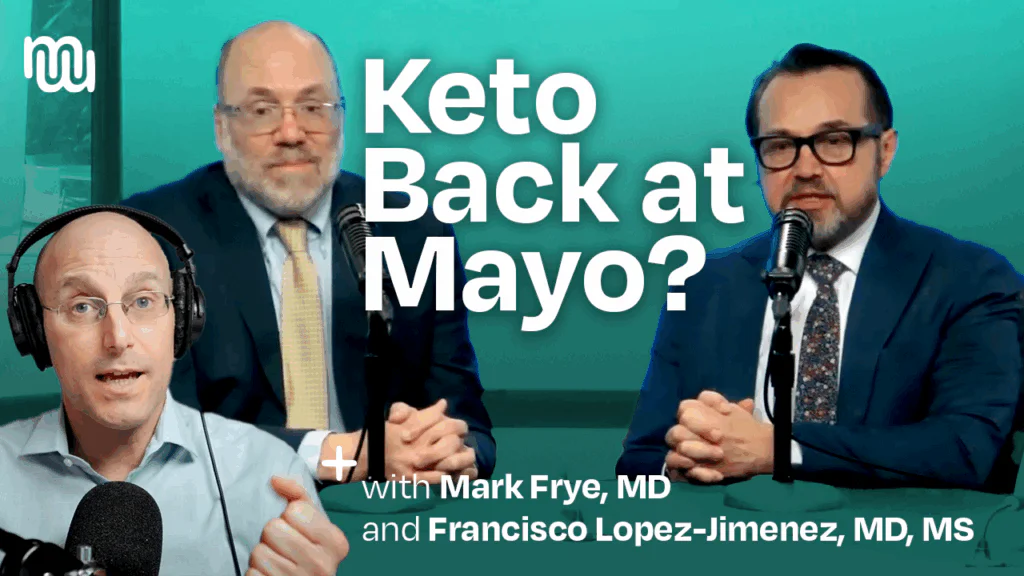
Can ketogenic therapy improve both cardiovascular and mental health? A new study at Mayo Clinic is exploring that question. This research marks a powerful full-circle moment: the ketogenic diet was first used to treat epilepsy at Mayo Clinic over 100 years ago. In this episode, we sit down with two leading physician-scientists from Mayo Clinic: Dr. Mark A. Frye (Psychiatry) and Dr. Francisco Lopez-Jimenez (Preventive Cardiology). Together, they explore how nutrition—particularly ketogenic therapy—can play a role in treating bipolar disorder, improving cardiovascular health, and addressing shared metabolic pathways that impact both heart and brain health.
Learn more
In this video, board-certified cardiologist (and Metabolic Mind’s Medical Director) Dr. Bret Scher dives into the latest science of triglyceride-rich particles and their impact on metabolic health. Learn…
Read more
A cautious, and nuanced editorial about elevated LDL cholesterol while on a keto diet. Read more here!
Learn more
Keto Mojo is a brand of blood ketone and glucose monitoring kit designed for individuals following a ketogenic diet. It provides a convenient way to track ketone levels…
Learn more
Can ketogenic therapy improve both cardiovascular and mental health? A new study at Mayo Clinic is exploring that question. This research marks a powerful full-circle moment: the ketogenic diet was first used to treat epilepsy at Mayo Clinic over 100 years ago. In this episode, we sit down with two leading physician-scientists from Mayo Clinic: Dr. Mark A. Frye (Psychiatry) and Dr. Francisco Lopez-Jimenez (Preventive Cardiology). Together, they explore how nutrition—particularly ketogenic therapy—can play a role in treating bipolar disorder, improving cardiovascular health, and addressing shared metabolic pathways that impact both heart and brain health.
Learn more