Get the latest on metabolic psychiatry. Subscribe.


Listen, Watch & Subscribe on:



Is Ketogenic Therapy Safe for Children? – with Dr. Matthew Calkins
Listen
About the host

About the guest

Bret:
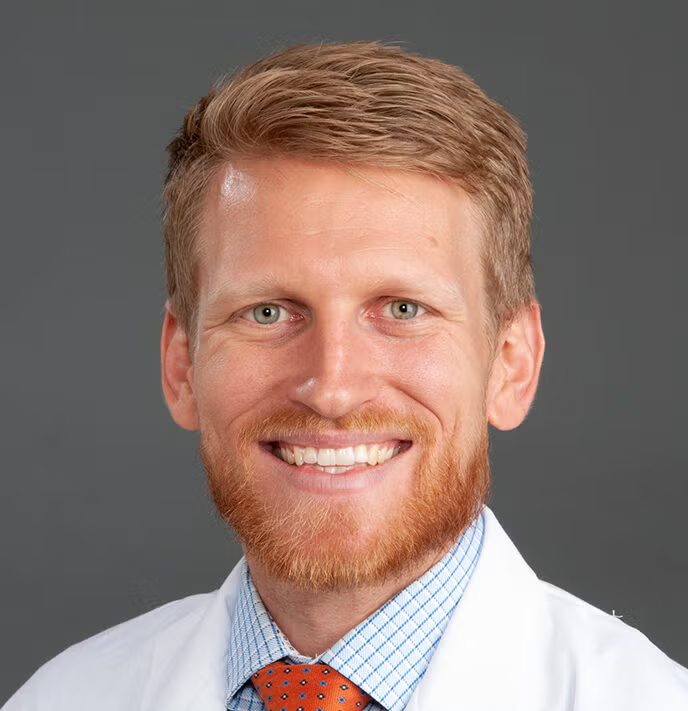
Is ketogenic therapy or even eating a ketogenic diet safe in a pediatric population? Dr. Matthew Calkins, Board Certified in both Family Medicine and Obesity Medicine, joins us to talk about this and the paper that he, along with others, wrote to counteract some of the misconceptions from the American Academy of Pediatrics.
Welcome to the Metabolic Mind Podcast. I’m your host, Dr. Bret Scher. Metabolic Mind is a nonprofit initiative of Baszucki Group where we’re providing information about the intersection of metabolic health and mental health and metabolic therapies, such as nutritional ketosis as therapies for mental illness.
Thank you for joining us. Although our podcast is for informational purposes only and we aren’t giving medical advice, we hope you will learn from our content and it will help facilitate discussions with your healthcare providers to see if you could benefit from exploring the connection between metabolic and mental health.
Dr. Matthew Calkins is a board-certified physician in both family medicine and obesity medicine, and he runs a metabolic health clinic at Atrium One Health. And he’s also the chair of the advocacy committee for the Society of Metabolic Health Practitioners. So, he is all in on metabolic health and has been ever since his residency.
So, we’re going to hear about his experience that led him to focusing on metabolic health and on ketogenic interventions. But also the key about, is this safe for a pediatric population, which is something that maybe we don’t know as much about as we should. But the American Academy of Pediatrics came out with a statement about using ketogenic reduced diets in a pediatric population.
It had a lot of caution, and as we’re going to hear from Matt, some errors as well. So, let’s find out about these errors, and how he thinks we need to see this a little bit differently to address the safety and efficacy of ketogenic interventions in a pediatric population.
Dr. Matt Calkins, thanks so much for joining me today at Metabolic Mind.
Matt:
Thanks for having me.
Bret:
Yeah, i’m excited to get into this paper that you recently published with a number of co-authors. But as we’ve heard in the intro, you are all in on metabolic health with a big focus on metabolic health, that started in residency and and continues to today.
So, I’m curious if you could just give us sort of the brief overview of how you got so invested in metabolic health as a physician. And then, from there, we’ll jump into the paper and talk more about that.
Matt:
Of course. So, I think it all started, I got into medical school, and actually met my now wife, Laura Buchanan, pretty quickly in medical school.
We met because we both were working out at five o’clock in the morning before we went to classes. And really just hit it off from there. And we’ve both been just very active individuals, very interested in our own health. That started medical school in about 2015. But around 2018, we really started to just through random chance, mainly because we are active people, happened upon podcasts that talked about low-carbohydrate diets.
A lot of the times in medical school, there’s this kind of prevailing thought from medical students that, oh, patients can’t stick with lifestyle changes. And really, you see that a lot even nowadays, is physicians saying, oh, lifestyle changes aren’t durable. Things like that. And it’s easy to get into that mindset.
But when we started hearing all of these amazing results that other physicians have been having on these podcasts, and you’re one of the podcasts we definitely listened to back then. Thank you for all you did, all you’re doing.
Bret:
Thank you.
Matt:
It really shifted our perspective on what it actually means to be healthy, and the ability to not just prescribe medicine, and to actually improve people’s lives and get them off of medicine. So, it was a little bit late for me. So, Laura matched into family medicine. I actually went into medical school wanting to be an emergency medicine doctor. And so I matched into that. And excellent field. Like I have the utmost respect for emergency medicine physicians and providers.
They have one of the toughest jobs in the hospital, in my opinion. But I realized fairly quickly that was not going to be filling my cup, long-term medicine. I felt like I was a thousand yards downstream of those chronic medical conditions with those end-organ, end-stage diseases. And I really wanted to be a thousand yards upstream telling people not to get into the river.
Laura was coming home every day, essentially, and in residency clinic, no less. Was improving people’s A1Cs, from like double digits down to 8%, even only the first three months. And then, eventually, normalizing those A1Cs completely within a year. And basically getting people off of medications.
And her experience was infectious, and it’s really hard to change residencies. I don’t know, a lot of people don’t really know exactly what the training is like for physicians, but it’s not like you can just go up and choose another job. I had to go through the match again, and I was incredibly supported by my entire administration, thankfully matched where my wife, Laura, was doing family medicine as well.
I haven’t looked back since. Residency clinic was amazing, helping people with basically therapeutic carbohydrate reduction to improve their health. And I was fortunate enough to get a job working at a clinic where I initially had a pilot metabolic health clinic in my larger clinic system.
And now it’s pretty much just its own kind of entity at this point. Actually, it was funny, there’s a pitch deck. I made this resource for the Society of Metabolic Health Practitioners about how to discuss therapeutic carbohydrate reduction with your administration. And I used it first, but so I kind of field tested it.
And I went down to give the pitch to the C-suite. And I’m very fortunate, the clinic where I work for, the CEO, the CMO, the Chief Technology Officer, they’re all physicians. So, it’s just me talking to five physicians. And at the very end, one of them actually said, I’ve actually lost and kept off like 50, 75 pounds with South.
So, they already, it was the easiest sell ever, which is great. And they’re all for it. And yeah, it’s awesome. You’re taking people off of insulin, helping them drop their BMI and continuing to just improve their metabolic health.
Bret:
Yeah, what a journey, and we can dig more into the journey about your experience in residency and as a new physician and hurdles and opportunities. But before we go down that road though, I want to get to this paper. Because at Metabolic Mind, we talk a lot about metabolic therapies, about ketogenic therapy for treating brain-based disorders. And a lot of that is rooted in sort of the experience, both clinical and research experience, about ketogenic therapy and epilepsy, which traditionally was what’s called this four-to-one ketogenic diet, a very high-fat, low protein, and very low-carb intervention.
But you wrote a paper recently, along with Dr. Westman and Dr. Cucuzzella and Dr. Kalayjian and others, that carbohydrate reduction for metabolic disease is distinct from the ketogenic diet for epilepsy. And I think this is important for metabolic health, in general, for brain-based disorders, when we’re talking about a ketogenic diet within the medical framework, what are we even talking about?
So first, let’s start with the background. Why did you feel it was necessary to even write this paper?
Matt:
Excellent question. This paper was published in October of last year, 2023. And I think one of the awesome things about being a family medicine doctor is that we take care of the seconds old infant all the way up through the end of life.
So, I’ve taken care of pregnant women with gestational diabetes. I’ve taken care of men and women with almost every metabolic disease imaginable, and we can take care of children and adolescents, teenagers up through palliative care. So, I have a foundation of knowledge that I use to basically assist my adult patients to improve their metabolic health.
And so I was really interested in hearing what the American Academy of Pediatrics, which is the governing body, it’s the professional organization for the entire pediatric, it’s at least the largest one in the us. And it basically sets the guidelines for pediatricians, what you, what kind of, we can get into what the standard of care is, but you can. The guidelines aren’t always like the end all, be all for standard of care, but they can help guide that discussion.
So, I was really interested because I think we have now amazing and excellent data on metabolic therapies using therapeutic carbohydrate reduction in adults. And there’s also been a couple of really fascinating papers in children that we can talk about.
But unfortunately, when you read through this paper, it is fairly obvious almost immediately that there should have been at least a consultation and maybe just an acknowledgement. You don’t have to necessarily be an author that, they should have had a clinician that uses therapeutic carbohydrate reduction in practice to actually say, yeah, these are good points or actually, these points are a little bit off, if you guys need to rethink this in this kind of framework.
And there’s really four major concerns with the biggest one is, as you already said, the kind of this conflation, and we’ll talk about this, of a four-to-one ketogenic diet to a well-formulated ketogenic diet.
And really, I’m totally, I’m optimistic now because I think a couple years ago it would’ve been harder, much harder to get a perspective like a rebuttal out. But now, we were able to do it through the Journal of Metabolic Health. Because what we originally did is all of our co-authors, essentially we submitted two comments to the article, and a comment could have gotten chosen for an editorial.
And that’s what we were hoping for. They could choose our comment, published the editorial inside the Journal of Pediatrics, and then we could have a discussion with the authors. But they never chose to do that. So, we had to take matters into our own hands and really say, we should pump the brakes on some of the things you’re saying.
Because actually, that’s not what it actually is in clinical practice.
Bret:
Yeah. So first off, great that they’re even talking about it, right? Like we need to acknowledge that it’s awesome that they’re even talking about carbohydrate reduction as a possible intervention. But if we were going to get down to the root of the problem, would it be safe to say that the main issue was they were really tiptoeing around it? Like, we’re not sure if this is safe. You got to be really careful if you do this and have all these markers, test all these things and have all these safety measures in place. Is that a little over the top, a little accurate description of the feel of how they wrote about it?
Matt:
Yeah. I am the first to always acknowledge that we have a large lack of evidence in pediatric patients and in pregnant women. Those are just two classic populations that have just been historically very difficult to get, have research done on. And I feel like the tide is turning, but there’s this, I want to talk, we can talk a little bit about what the current outcomes are and what the current prevalence of some of these diseases are. Because I think you really, when you do anything in medicine, you really need to weigh the, what’s the probability of harm versus what are we doing now and what’s the probability of benefit?
What is the current trend of our outcomes? And I wish the paper actually took the time and the introduction to say, hey, this is actually what we recommend for type one, type two, and obesity. And then, here are the outcomes of what we’re currently recommending, and then you weigh those.
It’s the same thing with everything we do on medicine. If you’re going to start a new medicine for heart failure, you should really have an in-depth conversation with the patient about the possible risks and the potential benefits. I found the discussion of the benefits unfortunately lacking, and I found the, we will talk about this, the risks that they discussed to be not entirely founded in reality.
Bret:
Yeah, and you bring up a great point. What are we doing now and how’s that working for you, so to speak? And then the rates of obesity and metabolic dysfunction, in general, but also in the pediatric population are just going up and up. So it’s clear what we’re doing isn’t working and something needs to change.
But interestingly, if according to some publications recently, what the Academy of Pediatrics thinks may be the thing that needs to change is more GLP-1s because now the GLP-1 agonist medications are now approved and part of the recommendation for treating obesity and metabolic dysfunction in a pediatric population.
I haven’t done a side-by-side comparison, but I’d be really interested to see the language they use discussing the GLP-1 versus the language they use discussing a carbohydrate-reduced diet. If it’s coming from a similar perspective of openness or if they’re more open to the drug, less open to the diet?
That’s my speculation. I’m curious, my guess is you’ve probably read it all. So. What do you think about the way they approach the diet versus a drug?
Matt:
Yeah, basically some of the things they discussed in the paper are a lot of cautioning against eating disorders and health concerns or mental health concerns, which is, as you’re very well aware, I wouldn’t even call it emerging evidence.
Now, there’s excellent evidence that a therapeutic carbohydrate reduction approach, a ketogenic diet approach, can improve almost, like from the studies that I’ve seen, the most printed out study I have because I like to give patients. I print out studies and I get them to patients if they want to know more.
And the most printed out study that I find is that the basically French in-patient psychiatric ward study where they took.
Bret:
Dr. Albert Danan, yeah.
Matt:
Yeah. Half of the very, very concerning, very severe treatment-resistant refractory mental health concerns, like schizoaffective disorder, bipolar I and MDD with suicidal ideation, half those went complete remission.
Everybody improving their symptoms. So, I don’t know what kind of more data you need to actually have at this point to say that we have these people who failed every medicine there was out there, including some of the, probably some of the antipsychotics, like clozapine, which are very, have a lot of side effects, very concerning high risk.
And that’s how we got to look again at those possible benefits and those possible risks. And I feel like I would have to look at the the wegovy recommendation there. I actually reviewed that paper for my residency, and gave a talk on it. The specific wording I felt was a little bit more downgrading on the risks for that, especially compared to this because, as we get into this, they basically recommended about six blood draws over the first year for a total of 14 different laboratory measurement trends, just for a low-carbohydrate ketogenic diet in children.
Bret:
Wow, that’s remarkable. And do they recommend the same for a vegan or a plant-based diet? How’s that compare?
Matt:
No. We actually, Laura and I, were looking this up this morning, too, because we definitely wanted to compare and contrast. It looks like the last time the AAP took an official, it’s more of an umbrella review, I think it was actually in the 2000s. So, they’ve been largely, from what I’ve seen, silent. Of course, if any of the listeners want to send me any of their current papers.
Because I really focused in on this particular paper, and I basically, I went through every single one of their citations. So, I ended up reading, I don’t know, I think it’s 60 or so other pub papers to really make sure that I wasn’t being wrong. And we can talk about what I saw on the citation review as well.
But yeah, I think the AAP has been largely, largely mum on those dietary patterns. I do know that the American Academy of Nutrition and Dietetics, I believe, says that the vegan diet is okay and safe in children, essentially.
Bret:
Yeah, that’s remarkable because it gets to the one of the points you brought up, the nutritional adequacy or deficiency of a diet, where nobody would argue, I think at this point, that a vegan diet is nutritionally-deficient.
Now, you can overcome that with supplementation, but there’s the argument that a ketogenic or a very low-carb diet is nutritionally-deficient. Some will make that argument, and that’s part of what was brought up by the AAP. So, how do you, how did you investigate that and what’s your take on that?
Matt:
Yeah, so that’s probably, one of the concerns we had about this paper is one, the monitoring. So, we believe it’s essentially needless medicalization of one of the most nutrient-dense eating patterns that you can possibly have. Interestingly enough, history kind of repeats itself. Their main citation, if you go to this paper, there’s a table that has essentially all of the recommendations in it in the middle of the paper.
Their main citation for that table comes from a 2021 paper on medical management guidelines for children with type 1 diabetes that are on ketogenic diets. So this, there’s actually guidelines published, now three years ago, and the hope would be perhaps if there was like a rebuttal at that time, then this current paper wouldn’t even have been made.
So, that’s also additional, that was an additional impetus for us to get this out there. So, three years from now, there won’t be another ketogenic diet paper, hopefully, by the AAP that kind of repeats these same mistakes. But the most important thing is when I looked through all of these citations for the monitoring for the ketogenic diet, they all were essentially on a four-to-one ketogenic diet.
And, essentially, the one of the main concerns is there’s a conflation of a four-to-one ketogenic diet and the whole well-formulated ketogenic diet. So, we’ll talk about what that means first. A four-to-one ketogenic diet was classically used to treat kids with epilepsy, which is seizure disorder, essentially recurrent seizures.
And it’s, essentially, four grams of fat to about one gram of total protein and carbohydrate. So, that works out to be about 90% fat, and they frequently do the induction phase of this diet in the hospital. But there’s also, I will say nowadays a lot more research being done on other diets that do produce high ketones, but aren’t necessarily even four-to-one.
And three-to-one is, essentially, a step down from that, where you have three grams of fat to one gram of protein and carb. There’s now, basically, low-glycemic index diets. And there’s also high MCT oil diets that really they give you that critical threshold buffer where you want to keep your ketones above that critical threshold in order to reduce seizures, and now we also know like mental health concerns as well.
The paper, this paper specifically asked a question though of ketogenic diets for type 1 diabetes, type 2 diabetes and pediatric patients at risk of type 2 diabetes, which they defined a little bit nebulously, but it’s basically obesity.
I would argue if you have any one of the five criteria of metabolic syndrome, you’re going to be at risk of type 2 diabetes. So, honestly, this kind of paper, one of the problems is it’s not just a very small cohort of patients they’re doing these recommendations for. I would argue that it’s almost the vast majority of pediatric populations now, specifically, the prevalence of type 2 diabetes has increased by a 100%.
Essentially, over the past 20 years, type 1 diabetes has increased by about 50%, and the actual prevalence currently of obesity is just above 20% in children. That means to have a diagnosis of obesity, you have to be greater than the 95th percentile. Currently, more than 20% of kids are greater than the 95th percentile in terms of their weight.
Bret:
Yeah, so no question. It’s an epidemic that we have to deal with that what we’re doing now is not working. And the same could be said for mental health diagnoses and psychiatric diagnoses in a pediatric population. But we don’t have a lot of data either on ketogenic interventions in a psychiatric setting for pediatric populations.
So, I can understand, first, do no harm, caution. But what about this concept of a ketogenic diet is nutritionally-deficient and not nutritionally adequate? What is your response to that?
Matt:
I think if you look at a well-formulated ketogenic diet, which is based on a modified Atkins diet, one of the most popular forms of this ketogenic diet is Dr. Eric Westman’s, what he uses in his clinic at Duke, which is the page for kind of diet. And you can get five servings of vegetables per day, which fulfills the AAPs recommended vegetable servings on that diet, additionally, for even I would even say, a three-to-one or a four-to-one ketogenic diet.
As long as you have close monitoring with an excellent healthcare team that knows basically what to monitor, what to look out for, that you can still create a very nutritious, four-to-one ketogenic diet. Actually, one of the best resources that I sometimes point patients to is, there’s Nick Norwitz did a write-up.
I think it was on Keto Mojo. I have to double check that. But he made a write-up on a four-to-one ketogenic diet, and you can actually look and see the the plates on the bottom of that write-up to see what is a four-to-one ketogenic diet, and the plates are just look nutritionally complete. There is basically leafy green vegetables, there’s salmon, there’s olive oil, and it looks like the standard meal that anybody should be eating, regardless of their metabolic health.
Bret:
Yeah, so I think it’s safe to say there really is no credible evidence, especially when using modern day ketogenic diets, that it is nutritionally-deficient.
We have clear evidence that a vegan diet is nutritionally-deficient in certain areas. Again, that some people would say you can overcome with supplementation, but the same is not true for ketogenic diets. So interesting that they leaned into that as a concern, and I think it shows the inherent bias against ketogenic diets for whatever reason.
But again, coming from the position of listen, we have to protect our kids and protect our patients and make sure we, first, do no harm. But as you point out in the paper, that’s misguided here and going overboard, and I think the same is true for disordered eating. This concept of if we promote a carbohydrate-reduced diet within a pediatric population, what we’re doing is breeding a whole group of people who are going to turn out to have eating disorders. Again, with no evidence to support it.
But this, I don’t know, overly cautious concern. So, how did you respond to that point in your paper?
Matt:
So, three or four issues with the paper would be the eating disorders. And I really wanted to take time, I actually have all of the papers here printed out. And I went through them again and highlighted things just to make sure that I was on the same page, that I was, even when we wrote this back last year.
And essentially, so I wanted to, there’s a quote I want to say, from the paper itself. And it, essentially, is that dietary restriction of any kind can be associated with physical, metabolic, and psychological consequences, including risk for disordered eating. And then immediately, in almost the next sentence, they say, actually, you should follow a Mediterranean diet or the DASH diet or a low-fat diet, or the dietary guidelines for Americans.
Those are the four different recommendations they gave throughout this paper. And the way they’re framing this is any recommended eating pattern based on their definition puts a child at risk for an eating disorder. And obviously, this is not correct. So, if you dig down deeper into this, the Academy of Nutrition and Dietetics for their pediatric weight management product project says that there is zero evidence that weight management interventions result in worsening quality of life, anxiety or depression, eating disorder risk, or other psychosocial outcomes.
So, in my opinion, the American Academy of Pediatrics and their nutrition committee is not actually practicing evidence-based recommendations for their guidelines. Here’s another organization on nutrition dietetics that say, actually, there is zero risk.
And what we’re talking about here is physician or clinician recommended changes in a patient to improve metabolic health. Their underlying citations for what they recommended are three main citations. So, the first one is a cohort study of about 3000 kids, and essentially the net of that paper was that diet culture is associated with dysregulated eating.
However, the way they define diet culture, again, Mediterranean diet, DASH diet, et cetera. All of these would fall under dietary, diet culture. And there is nothing special necessarily about a low-carbohydrate ketogenic diet that would. The other one, two of the three, the second one would be this review actually on from a 2021 paper, specifically on low-carb and eating disorders in patients with type 1 diabetes.
This paper, I think, makes another fundamental error, which is frustrating for us as clinicians that use this, in that they say the low-carb ketogenic diet is restricted. Like the restrictive diets are going to predispose to eating disorders, but there’s no data. And in fact, in this paper, they say there is zero evidence, per se, that low-carbohydrate diets cause eating disorders.
But I even want to compare this to something they do recommend. If your listeners can, or after the end of this, they can google a the stoplight diet. And this is one of the diets that I’ve talked with the kids that I’ve taken care of in residency and beyond about. This is what I’ve seen counsel, essentially, in practice from other providers.
And it is essentially a list of green foods and it’s a list of yellow foods and it’s a list of red foods. And the main concern this paper had about a low-carb diet is that some foods are forbidden. Yet, this stoplight diet, to me, red foods is very close, if not synonymous, with being forbidden, and green foods are okay.
You can eat as much as this as you want. It’s the same exact kind of mental process for both diets. They’re just coming to wildly different conclusions. And at the end of the day, I just want them to be like, I want them to be intellectually consistent. It’s either a problem for all of these or it’s a problem for none of these.
And the last one was just a systematic review on mental health and diets that basically looked at unhealthy eating patterns. There’s now, I just looked at the CDC website, 10% of kids have anxiety, 5% have depression. I think it’s a lot higher than that, especially when you just talk about anxiety traits and depression traits.
But essentially, they saw that the meta-analysis said unhelpful eating patterns are associated with poor mental health, which I could have told you. But literally, there was nothing about a low-carb diet there. So, I’m unsure of why they even included that third citation.
Bret:
Yeah, so I think it’s safe to just wrap up this part of the discussion and say, look, in a pediatric population, is a ketogenic diet, ketogenic therapy, carbohydrate reduction, is it safe to do?
Matt:
Yes.
Bret:
Alright and now, so for part two, though. I mean you just finished your or you recently finished your residency, started in practice. So you have a fresh experience of the medical training and the quote unquote “real world” of medical practice, and you’ve seen academy recommendations.
So why? Why is there this misrepresentation of a carbohydrate-reduced diet of a ketogenic intervention when we know there is evidence it can have significant medical benefit, but yet, it’s portrayed in a way where there’s a significant hurdle or bias against it? So, how would you sum that up?
Matt:
Ooh, that is a lot to unpack. And I think you could ask, yeah, you could ask my co-authors, and you’ll probably hear, I think, we had, five co-authors on this and you’ll probably hear five different answers.
I like to be conciliatory, like I like to extend the olive branch at the end of the day. If I had a crystal ball and I could look into it and see that a patient would improve their life, their outcomes, stop through going into a nursing home, stop the diabetic foot amputation, improve their mental health, like I would support any healthful heating pattern.
Like I just, I’m in this to help patients improve. The data behind a ketogenic diet, I think, is by far the most, it’s by far the most persuasive that I think this is the way to get it done, and especially in my patient population, more in rural North Carolina. I’ve had amazing success with patients that have been able to do this and stick with this.
I looked through all of the nutrition committee and the two primary authors on this paper because I really wanted to see what their backgrounds were. Did anybody even use therapeutic carbohydrate reduction in their practice? And there were a couple of pediatric endocrinologists, which is good.
I think they were more interested in like loop systems, which are amazing technologies. Basically, you have a CGM and a insulin pump, and they talk to each other and you can dose insulin more effectively, amazing new technology. They had, I believe, a pediatric cardiologist who’s very interested in nutrition for congenital heart diseases.
Again, very important. And then a pediatric gastroenterologist who I think was interested in short gut syndromes in neonatal nutrition. But I didn’t see a single, I didn’t see a single emphasis or just idea that they, anybody practiced low-carbohydrate or recommended low-carbohydrate. So ,I would hate to attribute something due to a nefarious purpose that could be just explained by ignorance.
I’ll say, you got to be really outside the loop now to not look at Virta Health. To not look at Westman’s papers in 2000s where he cites exactly what kind of diet he does. You got to be out of a loop to not look at the A to Z trial, which showed a large improvement, statistically significant, for the ketogenic diet.
You have to really not look hard for these data that’s out there and basically make these mistakes and make these recommendations in the pediatric literature. And I’ll say one other thing because I think this is actually the most, this is probably the most frustrating thing for me about this entire paper, is there was a 2018 paper published by Lennerz and Bernstein and Hallberg and Westman and Yancy and Ludwig, among others.
And those are like the heavy hitters. Those are the people that are doing a lot of great work in the low-carb space and have done great work. And essentially, this paper pulled, it was a survey, so there’s limitations in that, of course, of 300, both kid, parents of kids and young adults that had type 1 diabetes.
They said, what’s your A1C and how are you guys doing? And to put this into perspective, the average A1C of somebody with type 1 diabetes right now is 8.2%. The average in this study was 5.7 over 300 people exactly. And we didn’t even talk about, there’s the, actual outcomes that people are experiencing.
Just a quick tangent, because this is the other thing. this is all frustration building on frustration here at the moment. When somebody is diagnosed, a child is diagnosed with type 1 diabetes, they have on average of 15 year less life expectancy that somebody who does not have Type 1 diabetes.
So average life expectancy is about 72 years old. They’re expected to probably pass away in their later fifties, around there. After about a decade of having Type 1 diabetes, about 60% of kids will have neuropathy, meaning they’ll have the pins and needles sensation in their hands and their feet.
About 25% will have retinopathy, which is the beginning stages of blindness, and about 5% will have nephropathy, which means their kidneys are affected, they’re spilling protein in their urine. And that’s the beginning stages of end-stage renal disease, which requires dialysis, which is probably a couple years to a decade off at that point.
And this is the status quo. So, when they argue against new modalities to treat these metabolic conditions, they’re essentially arguing for these outcomes because they’re not providing another, they’re not providing another intervention. At this point, they’re just saying, you should, could do this.
And so, this other paper, 5.7% A1C. The thing that was most striking to me is that this, AAP paper said they used this paper to say that you have to be careful with patients on ketogenic diets because a quarter of people that were surveyed said they did not tell their clinician, and 50% said they did not feel supported.
So, I think that’s the most striking thing to me, is that the pediatrician saw this data and said, patients are doing this, and they’re not telling us. We got to monitor out their free and total carnitine. We got to monitor their CMP and their liver function and their platelets and all these other things.
But, in reality, the patients are incredibly unsupported even though they are improving their A1C by 1.3% more than what the standard of care is. And I feel so bad for those patients because they put in the hard work, and they’re not going to die 15 years earlier, that they’re compatriots that don’t have type 1 diabetes. And yet, they’re just incredibly unsupported by the medical environment.
Bret:
Yeah, so instead of using that paper as a caution to the general public about doing low-carb diets, they need to use that paper as a wake up call to the medical professions to say, we need to start supporting people with these dietary interventions. And I think the same is likely true for mental health as it is for metabolic health because of that connection.
So, why don’t we wrap then by talking about the future and getting more physicians to be open to supporting carbohydrate reduction knowing that there’s ongoing data that’s coming out all the time showing beneficial results, but always with caveats from the medical community. But it wasn’t long enough.
But you got to compare it to something else. But you know all these but buts because it goes against common practice right now, which change happens slowly. So, in your world as a young physician with the your whole career ahead of you, what do you see as the opportunity and the hope for the future of carbohydrate reduction, ketogenic therapy for improving metabolic health, and all the constellations of things that go along with metabolic health, including mental health?
Matt:
Yeah, I am incredibly optimistic, Bret. I, having just come into this space, finishing residency, just finishing training, I don’t really worry about what the 2005 AHA guidelines are or what happened in 1980.
Just show me what’s happening now. And the explosion of positive research that is happening for low-carbohydrate ketogenic diets is, I think again, it’s the most persuasive thing that I’ve seen for almost any intervention, for almost any disease, honestly. You have amazing work through the Metabolic Mind of Baszucki Group.
You have metabolic psychiatry now taking off. You have the, so that’s more, that’s the mental health component of this. You have the Society of Metabolic Health Practitioners, who at their low-carb conferences, they typically, we try to now focus the first day on specific concerns. So, we did food addiction, type 1 diabetes, mental health, and so we’re getting the word out that way.
I think that even the difference between me randomly finding low-carb in 2018 from a podcast to where we are today, it’s this positive feedback loop where more residents, more med students, more even old physicians or physicians that have been practicing a while, I should say, wise physicians, will find this and they can incorporate it into their own practice.
It’s grassroots because I think there’s this holdover, just as an outsider coming in from medicine. I was a physics major an undergrad. I was going to go to physics, get my PhD, when I decided that I really liked talking to people more than I would’ve done in that field. But the intellectual aspect that I loved about that field is present in medicine, and that’s why I love this current research.
You have these, I would argue if somebody is failing multiple psychiatric medications for a severe mental health concern that they’ve had for years, at this point, do you need a control to show that another drug is going to fail versus you putting half the people on just complete remission of these severe diseases?
No, and I know I saw on your social media that you’re at the American Psychiatric Association, American Psychiatric Association meeting. And that’s where we need to go to. We need to, I think we need to go to the state medical, state medical society. So, for me, there’s a North Carolina version of the American Academy of Family Medicine. And our family practice, and we need to go present and say, hey, these are what I’m seeing.
I took somebody off 62 units of Lantus, his A1C improved from 9% to 6.5%. And he is on his way to getting a hip replacement because his BMI is almost below 40, when he started at about 50. And that’s a patient that I have in clinic. And that, I think, continuing to reach people where they’re at and continuing to give the message that the downsides are based on not the best evidence.
We don’t need to go in that because I listened to your Georgia Ede podcast as well, and she went into a lot of the the nutritional epidemiology stuff. I think that using population health data on an individual patient in front of you is the wrong thing to do. It should not really inform you of the choices you make with the patient in front of you and really getting that message out there that look at the benefits, the risks. Let’s re-evaluate the risks. And the more you have that conversation, I think the more people are going to get it.
Bret:
Yeah. I think the future is bright with physicians like you and your wife, Laura Buchanan, and the team at Society for Metabolic Health Practitioners, and just more of a focus on metabolic health.
And again, it doesn’t even have to be a focus on keto, but a focus on metabolic health and certainly the role that carbohydrate reduction and ketogenic therapy plays in the adult population and in the pediatric population. That’s why I’m so thankful that, you and all your co-authors wrote this paper to clear up a number of the misconceptions and misunderstandings because yes, we need to be careful when we’re recommending things to pediatric population.
They’re not just small adults. Their bodies are different. They react differently, but we still have to come with reputable and supportive evidence, which it seems like the recommendation didn’t do as well as they could have. Hats off to you and all your co-authors for pointing that out.
And thank you so much for joining me today, and you have a very bright future ahead of you and I look forward to seeing what you do next and hopefully having you on again in the future for updates.
Matt:
Thanks, Bret. I’d love to come back. Thanks for having me.
Bret:
Thanks for listening to the Metabolic Mind Podcast.
If you found this episode helpful, please leave a rating and comment as we’d love to hear from you. And please click the subscribe button so you won’t miss any of our future episodes. And you can see full video episodes on our YouTube page at Metabolic Mind. Lastly, if you know someone who may benefit from this information, please share it as our goal is to spread this information to help as many people as possible.
Thanks again for listening, and we’ll see you here next time at The Metabolic Mind Podcast.
Listen, Watch & Subscribe on:
Youth mental health refers to the emotional, psychological, and cognitive well-being of children, adolescents, and young adults. This period of life is marked by rapid brain development and…
Read more

A groundbreaking study from The Ohio State University shows that ketogenic therapy may *dramatically* reduce symptoms of major depression in college students. Dr. Volek has decades of experience conducting research on ketogenic therapy. The Volek Low Carbohydrate Laboratory is one of the best in the game at conducting quality ketogenic science.
Learn more

Youth mental illness is on the rise, and treatment options are often limited, especially for kids with bipolar disorder. In this interview, Elizabeth Errico, founder of the Children's Mental Health Resource Center (CMHRC), shares how her organization is implementing ketogenic therapy in a real-world setting for kids aged 6 to 17. The year-long study is part of a larger initiative supported by the Baszucki Group to expand mental health care options through metabolic approaches.
Learn more

Psychiatrist Lori Calabrese, MD, shares practical lessons from using ketogenic metabolic therapy with adolescents facing serious mental illness. She explains how family buy-in, teen engagement, tailored teaching styles, and a skilled dietitian drive success; why teens often enter ketosis faster than adults; and how to navigate social life, medications, and flexible “ketone targets” without triggering disordered eating. Real-world cases span first-episode psychosis, major depression, bipolar disorder, OCD, anxiety, autism, and ADHD—highlighting a patient-centered approach that can change a young person’s trajectory for life.
Learn more
Youth mental health refers to the emotional, psychological, and cognitive well-being of children, adolescents, and young adults. This period of life is marked by rapid brain development and…
Read more
A groundbreaking study from The Ohio State University shows that ketogenic therapy may *dramatically* reduce symptoms of major depression in college students. Dr. Volek has decades of experience conducting research on ketogenic therapy. The Volek Low Carbohydrate Laboratory is one of the best in the game at conducting quality ketogenic science.
Learn more
Youth mental illness is on the rise, and treatment options are often limited, especially for kids with bipolar disorder. In this interview, Elizabeth Errico, founder of the Children's Mental Health Resource Center (CMHRC), shares how her organization is implementing ketogenic therapy in a real-world setting for kids aged 6 to 17. The year-long study is part of a larger initiative supported by the Baszucki Group to expand mental health care options through metabolic approaches.
Learn more
Psychiatrist Lori Calabrese, MD, shares practical lessons from using ketogenic metabolic therapy with adolescents facing serious mental illness. She explains how family buy-in, teen engagement, tailored teaching styles, and a skilled dietitian drive success; why teens often enter ketosis faster than adults; and how to navigate social life, medications, and flexible “ketone targets” without triggering disordered eating. Real-world cases span first-episode psychosis, major depression, bipolar disorder, OCD, anxiety, autism, and ADHD—highlighting a patient-centered approach that can change a young person’s trajectory for life.
Learn more