Get the latest on metabolic psychiatry. Subscribe.


Listen, Watch & Subscribe on:



Can Keto Put Schizophrenia in Remission? A Case That Shocks Experts
Listen
About the host

About the guest


Moira:
There’s a quote, I think, in the case report where he says that he’d rather eat ground beef for the rest of his life than go back into the mental health system.
Bret:
Welcome to The Metabolic Mind Podcast. I’m your host, Dr. Bret Scher. Metabolic Mind is a nonprofit initiative of Baszucki Group where we’re providing information about the intersection of metabolic health and mental health and metabolic therapies, such as nutritional ketosis as therapies for mental illness.
Thank you for joining us. Although our podcast is for informational purposes only and we aren’t giving medical advice, we hope you will learn from our content and it will help facilitate discussions with your healthcare providers to see if you could benefit from exploring the connection between metabolic and mental health.
It’s incredible to see, but there’s another published case report of an individual transforming his life and putting his mental illness into remission with ketogenic therapy. But what makes this one kind of stand out is this individual was in and out of homelessness. He had a tremendous socioeconomic challenge, and we often think that a ketogenic diet is really expensive and hard to do.
Here’s an individual, who was living in a hotel with a hot plate or a microwave, or living in a shelter and was still able to achieve sustained ketosis and put schizophrenia and psychosis into remission despite those circumstances. Such a dramatic example. So. I’m joined by Moira Newiss, who’s a registered nutritional therapist and health coach, who had the opportunity to meet this individual and work with him and took the step to publish his case report.
Now, it’s a correct to say, oh, this is one case report. This is not a study. But that’s not the point. The point is, this was an individual who was deeply embedded in psychiatric care in the UK and was taking his medications and was seeing his doctor and was in and out of the hospital and wasn’t getting better.
And it wasn’t until he was in sustained ketosis that he was really able to achieve treatment success, and eventual, remission of his psychosis. So, a dramatic case report that I think tells us a lot about what is possible with ketogenic therapy. So, I hope you enjoyed this interview with Moira Newiss.
Many of the interventions we discussed can have potentially dangerous effects of done without proper supervision. Consult your healthcare provider before changing your lifestyle or medications. In addition, it’s important to note that people may respond differently to ketosis, and there isn’t one recognized universal response.
Hi Moira. Thanks so much for joining me at Metabolic Mind.
Moira:
Yeah, it’s a pleasure to be here. Thank you for inviting me.
Bret:
Yeah, of course. As soon as I read the case report that you published, I just wanted to reach out right away and really understand more about this case, which is so dramatic, about a person, who is homeless and in and out of the hospital and very challenging socioeconomic circumstances. But somehow was able to really thrive on a carnivore-based ketogenic diet, and go and put a schizophrenia into remission.
Like all these grand things happened with challenges, and so I’m so excited to talk to you about it. Before we get into the details, tell us a little bit more about you. How did you get into this field of ketogenic therapy and ketogenic diets to help people change their lives?
Moira:
So, my own story is that I was a senior manager in the NHS, the UK Health Service, for 20 years. I burnt out but ended up with four different mental health conditions myself, tried to get better, quit my job as part of that process. And along the way, discovered nutrition. And then, decided to retrain in nutrition.
I wasn’t a 100% better at the time. I was getting towards the 70, 80%. And I discovered ketogenic diets in the first year of my three-year nutrition diploma and got fascinated, basically fascinated, by ketones and mitochondria and the whole metabolic health aspect of things. I basically did a ketogenic diet myself for three months as a trial, and I’ve never come off it really. I’ve pretty much been constantly on it for six years.
Never had a remission of any of my symptoms, really, for not any kind of significant relapse at all.
Bret:
Yeah, so it’s a story we hear. I never know whether to say, fortunately or unfortunately, that you discovered this on your own, and it wasn’t recommended by a doctor. It wasn’t recommended by a dietician or a therapist or a coach or you had to find it on your own.
And that’s what we’re really trying to break down that barrier because so many people have found their way to health through ketogenic therapy on their own, and we want it to be so much more widespread. But interestingly, that sort of plays into this case study, too, that you reported.
So first, give us the background. How did you meet this individual? And give us the background of this individual.
Moira:
So he had come, he had difficult social economic circumstances, had become homeless at various times, was hospitalized at times. But during one of the spells when he was homeless, he read a book called Tools of the Titans by Tim Ferriss, which is really a book to help you improve your life. It’s not really a nutrition book.
Bret:
And it’s a huge book. It’s like super thick.
Moira:
Yeah, It’s a big book. And one of the things that he was recommending in there is something that might help improve your life was a three-day fast started on the Thursday evening with a low-carb meal followed by three days of fasting, and it was to get ketones produced. That was the point of it. And I believe that, I think, actually, I haven’t read the book fully, myself, I have to admit, but I believe Dominic Agostino was involved in writing part of that.
And he, you will know who he is I’m sure of, but he was researching human and machine cognition. So, this was all about trying to improve not just your mind, it was your life really. And so, that’s what he came across, and decided to try that. Because, actually, fasting’s quite easy to do in difficult socioeconomic circumstances for a start.
So he was, that was really what started the process, I think. And he was, and then from there on, he just learned more and more. And by the time he got to me, he already knew about you guys. He knew about people like, Georgia Ede, Chris Palmer and the Brain Energy book and things like that.
So, by the point he come to me, he’d actually been trying to implement a ketogenic diet himself but was having difficulties. He wasn’t able to get stable high enough ketones and stable blood glucose at that point in time.
Bret:
Yeah, and the underlying problem here, or not one of the underlying challenges he had, was he was diagnosed with psychosis and schizophrenia.
So, he’d been in and out of inpatient treatment. He’d been on multiple medications. So, give us a little bit of about his psychiatric diagnosis background.
Moira:
Yeah, absolutely. So he had that diagnosis. He also was suffering a bit of anxiety and worry about things.
And he was struggling with day-to-day life at times, just because of the circumstances he was in. If you’re homeless, you need housing, you’re out of work. So, money’s a problem. So, there were several other factors involved in this particular case. And he’d been in and out of acute hospital care for his mental illness for, on several occasions, over the previous three years.
And he’d been under the care of a psychiatric team for all that period of time and still was when he came to me. So, he had been recently deemed more stable, had been in a rehabilitation inpatient setting still. But that was where he actually began to restart his diet. At that point in time, he hadn’t been able to do it.
He tried things like longer fasting to try and keep his ketones up whilst in hospital. That’s how serious he was about trying to do it. But, of course, you can’t sustain that. It’s impossible to carry on fasting. And every time we went back to eating standard NHS food, it was problematic for him. So, he was in this kind of boom and bust cycle all the time.
But at the point where he got into the rehab, he was able to cook for himself. So, that was the start of him trying to get his ketogenic diet established on a more regular basis at that point. And then he was discharged.
Bret:
Yeah. So, back to the point where he was trying to do his longer fast to get his ketones up.
Did he tell you like it was clear cut? When my ketones were up, I felt better. I felt clear. What did he notice or was it maybe less dramatic in the beginning?
Moira:
I think it was. There were, there was a definite, I don’t think he necessarily was measuring right at the beginning. So, he didn’t really know what his ketone levels were.
So, we’re not entirely sure how well into ketosis he was, to be honest. But he was reporting that, at those points in time, he would notice a massive difference when he went back onto the carbohydrates. That’s probably the most significant difference, and he was because he’d been reading various books that said you could do this for three days, and then you could have cheat days and things like this.
So, he was having actually quite a lot of high-carbohydrate food in between doing the ketones. So, I don’t think he saw any significant benefit for any periods of time because he wasn’t really doing it for long enough.
Bret:
Yeah, that makes a lot of sense. And the other point this brings up though is that what is, what is a treatment success?
And for a busy psychiatrist who’s got a lot of patients, goal number one is, are they a threat to themselves? Are they a threat to others? And if they’re not, then that can be deemed a treatment success. But I think if you asked this individual, is that a treatment success?
He probably would’ve said no because not really. Doesn’t have a job, doesn’t have a home. Isn’t well enough to be able to participate in the society the way he probably would want to. So, it’s interesting about that different definition of treatment success. So you, I know you work with a lot of clients.
I’m curious, do you find a big discrepancy about what is the definition of treatment success between what your clients think and what the medical system as a whole thinks?
Moira:
Absolutely, and obviously, I’ve seen the way the NHS works. I’ve worked in it for 20 years. So ,I’m very familiar from both primary care and acute settings.
I’ve worked in those different areas. Mental health is no different really to something like diabetes, which obviously people in general practice, GPs, and people are much more familiar with. And they’re beginning to see the difference that they can get with reversal of diabetes, for example.
But we’re not familiar enough yet with what can happen if you can potentially reverse some of the underlying factors that are driving mental illness, if it’s from the metabolic side. Absolutely, I think that for me, both personally and with my clients, success for me means that not only can you get your life back, which is quite significant, normal functioning in society.
And that’s definitely what this particular client wanted was to be able to function normally in society. That’s not a big ask, if you ask me. That should be a given. And anything on top of that, in a way, becomes a bonus for somebody who’s been in this situation, I feel.
So, he is getting back into volunteering in the mental health service to support other people, and that’s a big thing. He’s very keen to offer support to other people. And also. I’m sure, to help sell a message about ketogenic diets, and the potential benefits of them. But for somebody like my, this particular client, he obviously needs to get housing. Income’s an issue.
There’s a lot of other things that need to be sorted that perhaps for most clients who are coming to somebody like me, they’re not perhaps in such a difficult situation. They’re probably better off financially a lot of the time. Otherwise ,they wouldn’t be coming to me in the first place. So, their definition of success might be slightly different.
it might be about getting back to a job that pays well. It might be about being able to engage in lots of different kind of social activities. I guess, so everybody’s definition might be a little bit different, I think. But I think certainly if you’ve got to rock bottom, then actually getting back to normal functioning.
It is success, in itself, I would say, as well.
Bret:
Yeah, and I really like that point that everybody’s going to have their own definition of success. And I think that’s something that we, in the medical field as a whole, are really lacking is finding what that definition of success is and working tirelessly to help someone achieve that, as opposed to saying, okay, we’ve reached the basic definition of success. So, good enough. And let it be there.
But anyway, that’s a little soapbox statement. But tell us, so tell us more about this individual because I could see that someone could be like, I’ve tried this fasting. I’ve tried this keto thing, and it just didn’t work for me with the caveat that he was having cheat days and maybe in his mind he thought he was doing it and it didn’t work, quote unquote.
So, I could see a lot of people doing that. But no, he persisted. So, tell us more about his journey.
Moira:
Yeah, so somewhere, I’m not entirely sure when, but somewhere along that path, his path, he began to research more about ketogenic diets on his own volition.
And he started to read, blogs and information that was out there in the public domain. He was watching Metabolic Mind YouTube channel, and he started to gather that information. So, I think that gave him the the motivation and the impetus to try again, but knowing by that point that it needed to be much more sustained.
And it needed to be potentially at a higher level than just getting into ketosis trying to get to a therapeutic range. So, when he came to me, one of his aims actually was to get off medication. Obviously, I’m not a prescriber. So, I don’t do that. I have to liaise with his team. But, yes, I think by that point he was very much in ketosis.
When he came to me, it just wasn’t stable. So, he’d already got himself to the point of kind of knowing roughly what he should be eating, but it needed to be tweaked to make it, I was aiming to get him up to a 2-to-1 ratio to get him into a therapeutic state of continual ketosis above.
Two millimoles, within that kind of range. And actually, because he was knowledgeable already, it was actually very easy to do so very quickly. He got into that range and pretty much stuck to it most of the time. We had one or two little ups and downs at the beginnings. One of the reasons was that he was fasting quite a lot still, and we had to get that in check because these ketones were going a bit high at times.
But pretty much, with a pretty basic diet, he didn’t eat a lot of different ranges of food. It was pretty, pretty simple to prepare.
Bret:
Yeah. So, tell us about the foods because we see these videos of your grass-fed ribeyes and your, maybe your organic low-carb veggies and your pasture-raised eggs.
Sure, that’s a wonderful way to eat. But when you don’t have a job and you don’t even have a home, there’s no way you’re going to eat like that. So, what were some of the food choices that he was able to use to maintain ketosis?
Moira:
So, when he first came out of hospital, he was staying at a family member’s house.
And so, he had a bit more variety of food available to him. So, he was eating things like ribeye, avocado. So, more things that we are used to talk about. But when he became homeless again, he had very restricted finances. So, he basically reverted to eating what I would call 25% fat ground beef mints. I think in the US it’s the other way around.
So, you say 75% lean or something? I’m not sure. But high fat mince, which, with added beef tallow, in the UK, if you buy 500 grams of 25% fat mince, that cost you around three pounds a day, which is I think about five and a half US dollars.
Bret:
Psychiatrists and even primary care doctors receive extensive training in how to prescribe medications, but almost none on how to safely reduce them. And yet, for millions of people, tapering psychiatric medications is an essential and often overlooked part of their treatment plan.
Georgia:
There is a real art and a science to reducing psychiatric medications. That if you reduced too quickly, then you could have serious withdrawal symptoms on your hands. Sometimes, medications will help at first, and then they’ll lose some or all of their effectiveness over time.
Bret:
So, in part one of this series, we’ll explore why so many people face this decision, and what risks and misunderstandings surround it.
So, this concept of relapse versus withdrawal of how do you help people approach that to try and determine is it a recurrence of the symptoms and the diagnosis, or is it a withdrawal from the medication? And then in part two, we’ll dive into the how, the principles, the pitfalls, and what it really takes to taper safely.
Tapering psychiatric medications isn’t about rejecting treatment. It’s about redefining success. Because sometimes fewer medications, or even none at all, can mean a fuller, healthier life. So, join us October 1st for this two-part series on tapering psychiatric medications, an honest conversation clinicians were never taught to have, and patients desperately need.
Moira:
Plus, maybe a pounds worth of beef tallow. So, you’re looking at a day’s worth of food costing around four pounds or four and a half, five and a half US dollars. That’s 28 pounds a week or around 38 US dollars a week. So, it’s affordable. And it worked, and he was able to do that with only very basic utensils.
So, a microwave and a spoon would do the job effectively whilst staying in, at one point, he was in a hotel room, which was what he was provided with is a homeless person. It was one single room with a microwave in it. It’s amazing really that he, and he stuck to that.
And there’s a quote, I think, in the case report where he says that he’d rather eat ground beef for the rest of his life than go back into the mental health system.
Bret:
Yeah. And I think about that quote that someone who is well has a thousand wishes and a thousand dreams, and someone who is not well has one wish in one dream and to be well again.
So, someone could look at that and be like, oh, I can’t eat mince for the rest of my life as the only food. How boring is that? As opposed to his perspective like, I don’t want to be in the hospital again. I don’t want to experience psychosis again. I can eat mince for the rest of my life. A really different perspective, and I think a pretty powerful one as well.
But you mentioned the fasting, which I think is really interesting. So, in the beginning, he was using long fasts to help get into ketosis. But now that he was in ketosis, nutritionally, you’re saying some of his longer fasts may have been hurting him or counteracting some of the benefits?
So, tell us about that.
Moira:
Yeah, so he was getting ketones, up to seven, eight millimoles, even higher at times, which I felt were too high really, and that we were risking problems there. And I think that was to do with a combination of things, but including the longer fasts. And that was fairly easy addressed, to be honest.
And the strategy we came to was eating two meals a day, which also keeps things very simple when you’re in that kind of situation. Three meals gets more complicated, again, to keep things very simple. So, we still having periods of time where he wasn’t eating, and extended overnight fast as part of that.
So, the intermittent fasting is a good strategy, actually, to fit in with ketogenic diet in these kind of circumstances. It adds a bit of extra flexibility to the situation, I would say. And it just seemed to work well, really, in this setting.
Bret:
Yeah. And interesting to see where someone can find their sweet spot for making sure they’re getting adequate calories, adequate nutrition, adequate protein, getting enough fat. And then, how that affects their, not only their, mental health, but their overall metabolic health and their overall energy, right?
All these things are intertwined and sometimes the concept of fasting can go too far to prevent that. So now, there was also some substance use, which is unfortunately very common in the mental health field. And so, he was using cannabis on and off it sounds. And we’ve heard things about ketosis, maybe improving addiction, certainly for alcohol, maybe can cross over to cannabis.
So, how did the cannabis use interplay and affect his mental state and his ability to function independently?
Moira:
Yeah, so I think actually the cannabis possibly contributed to the higher ketones with the fasting as well. Just to put that point in there because there is some literature suggesting that could be the case, but very limited because I did try and research and there’s very limited research. So, you know, that was also an impetus to try and draw back on the cannabis.
But I think, in those circumstances, sometimes it’s a coping strategy, and people have to tackle one thing at a time sometimes. But he has been able to reduce that input. It was also, it’s also been a strategy that’s helped to keep his stability in his life a bit more by managing that.
So, he was aware of that, but he was also at the point that I came to know him, it was a coping strategy that was for sure. I can’t really say a lot more about that. Unfortunately, Bret, there’s not much more I know about that side of it, to be honest.
Bret:
No, but it’s a really good point, right?
So, ketosis can help a lot of things, can impact a lot of things. But like you’re saying, the coping strategy. So, he would need a substitute, right? It would be hard to just stop cannabis if you really feel that helps you cope and helps you in so many ways. You need a replacement, right? So we, a lot of people say, eating a ketogenic diet isn’t going to fix everything, and that could be absolutely right.
You still may need therapy. You still may need other behavioral changes. There are still a lot of things that may need to fall into place. But certainly for him, he had no chance of addressing any of those when he’s in and out of the hospital and in and out of psychosis.
So, you kind of absolutely have to stabilize that part first before he can then address the other parts of his lives. I know Nicole Laurent always says she’s noticed people can do so much better and deeper, more productive work and therapy when they’re in ketosis as opposed to before.
So, I’m curious how you work with your clients on that. If you have to help them with behavioral changes and how you see the ease of that happen when they’re in or out of ketosis, and how they’re doing mentally?
Moira:
Yeah, so I think often, it’s a lot. I would totally agree with Nicole. It’s a lot easier, quite often, to get other behavioral changes in place, other lifestyle changes in place, when people are in ketosis. Sometimes, also, if you just take something like exercise as an example, often, some weight loss helps as well.
People get more mobile and that kind of thing because there are other benefits that kind of come into play at the same time. But I would say that, I always start with a ketogenic diet. So, I probably don’t often do it the other way around. So, I’m speaking from a slightly, yeah, biased perspective on this.
But I would always start with nutrition and the ketogenic diet before I try and get other things into play. Because usually, you can get people into ketosis quite quickly. And then, other things have become easier to do because if people have more energy, if the brain fog’s clearing, if they’ve got less pain, if their mood is more stable, all these things are better.
It’s much easier to make other lifestyle changes, whether it’s going to the gym or exercising or whether it’s tackling difficult relationships or just trying to get outside more. All these other things that I would be encouraging people to do, it just get easier. I would totally agree with that.
Bret:
Yeah, now I’m curious about some of the response that you’ve had to publishing this case report. I saw it was included in something in Washington State and in a journal that they did. And some people could, say, ah, it’s just one case report. It doesn’t tell us much.
Another could say, wow, this is so dramatic with this person’s circumstances, how this helped. Do you have a feel for what the response has been?
Moira:
It’s been generally positive. The review process was a little bit interesting when I did the publication because I did, there were some questions that came up during that about, is this a healthy diet?
And concerns about fat intake and this kind of thing, but overall, I’ve actually had a positive response. Very interesting, within my own profession, there’s been a hugely positive response. So, I’m one of the first nutritional therapists to publish a case that is using a carnivore diet as well and a ketogenic diet.
Yeah, absolutely. There’s a lot of interest there. We, I’ve just actually recently presented at my profession’s annual conference on using ketogenic diets for brain health. And, yeah, there was a really interesting uptake in discussion around all of that really. So, I think there’s growing interest in professional ranks as well.
As from people want to do it themselves, which is great to see really. So. I’ve had positive response. Once or twice on social media, might have had the odd comment that’s been questioning a bit more about things. Had one just the other day from somebody saying, is this, is this something that you should be recommending from a nutrient perspective?
And my answer is, there’s no evidence suggests a ketogenic diet can’t be well-balanced from, a nutrient perspective. Maybe the carnivore side is a little bit more controversial? But there are certain foods that are, you want to add in, ideally, in that scenario, to just broaden out the eating as much of the animal as possible.
So, this particular case report when we were, when he was just eating ground beef with tallow, I would say that could be more ideal. There might be other things that you could consider adding in it. But actually, we also know anecdotally from other people that many people actually do quite well just eating meat and fat, and who have done it for many, years.
So, I suspect part of the difficulty is we don’t really have very much research on this. And when we do set nutrient targets for the population to consume, they based on certain populations. And they’re not, we don’t do testing on people who eat a carnivore ketogenic diet, and then set a nutrient intake reference rate for them, do we?
So, I think that’s part of the problem. And if you just take something like vitamin C, for example. Fresh meat’s been used to prevent scurvy in the past, but you wouldn’t think of that as the obvious choice would you for providing vitamin C. So, there are lots of these debates that haven’t really been fully answered, I would suggest in the nutrition world.
Bret:
Yeah, you need a tall glass of orange juice for your vitamin C.
Moira:
Yeah.
Bret:
That’s the only way to get it, it seems. But it brings up the double standard, right? If this had been a vegan diet, which is clearly nutrient deficient, right? It’s by definition is nutrient deficient and needs to be supplemented.
People would just say, oh, that’s okay. You can supplement it and be fine. But with the carnivore diet, that’s not the response. It’s not, oh, you can take supplements and still be okay. But there’s this fear against it. But you’re, I don’t know, I’m not seeing case reports of this type of remission, of psychiatric disorders with a vegan diet, with a Mediterranean diet.
I’m not seeing that. I’m seeing it with a ketogenic diet, with a carnivore diet. So, I really think we need to embrace that rather than push against it.
Moira:
Yeah, and you know what? One thing I always try and explain to my clients is I like to take them back to like ancestral health perspective.
What did we do as hunters and gatherers? What were we eating? It was probably mainly fatty meat with a few tubers, if you could find them in the summer when they had leaves. Those things die off in the winter in the UK. Maybe a few berries in the summer?
Plenty of fish and seafood. Probably, eggs. You only get eggs actually when the birds are nesting. They don’t appear all year round like we do now with hens eggs. So, actually, when you start to take people back to an ancestral diet perspective, most people get that and realize it was more nutrient dense.
It was probably, we were probably in ketosis at least several months of the year. And that’s what I believe as well. And there’s a lot of anthropologists supporting that view as well. There are mixed views, but we definitely weren’t eating a vegan diet. I don’t think there’s any tribe in the world that eats a purely vegan diet.
And then, you’ve got all this stuff about when we started moving into agriculture, brain sizes shrunk and there were nutrient deficiencies for the first time really. So yeah, we could go on forever about that, I think.
Bret:
Yeah, the whole anthropological topic opens up a whole can of worms about that but super interesting to dive into. But the fact remains, though, that when you’re seeing somebody change their lives and transform their life in a way that they have otherwise not been able to, and not for lack of trying, right? This, like this wasn’t an individual, who was disenfranchised and out of the institution and not getting care.
No, quite the opposite. He was deep into the institution getting care and still wasn’t able to transform his life, but he did it with a meat-based ketogenic diet. We should all be embracing that. Even if we think it’s the such an unhealthy diet, even that’s our bias.
We should still be able to sit back and say, wow, this guy transformed his life. Maybe I should think more about this and learn more about this? And that’s what I hope this case report really helps people do. To say, huh, maybe I should re-look at this when I see how this person has completely transformed his life?
So, I thank you for publishing it. I thank you for taking the time because I know it’s not easy, and going through the review process with, I’m sure, reviewers who have an anti-keto bias in a way. But you stuck it out and published the case report and really helped this individual change his life.
So, thank you. And if people wanted to learn more about you, the work you’re doing, where can we direct them to go?
Moira:
Yeah, sure. So my website, which is my name, moiranewiss.co.uk, which is moiranewiss.co.uk. And I have a few, quite a few, interesting blogs on there as well, which might be helpful for people.
And yeah, you can reach out to me from there.
Bret:
Great.
Moira:
Thank you very much, bret.
Bret:
Thank you.
Thanks for listening to the Metabolic Mind Podcast. If you found this episode helpful, please leave a rating and comment as we’d love to hear from you. And please click the subscribe button so you won’t miss any of our future episodes.
And you can see full video episodes on our YouTube page at Metabolic Mind. Lastly, if you know someone who may benefit from this information, please share it as our goal is to spread this information to help as many people as possible. Thanks again for listening, and we’ll see you here next time at The Metabolic Mind Podcast.
Listen, Watch & Subscribe on:
THINK+SMART is a community-inspired resource that provides a framework for ketogenic and metabolic strategies like those that have helped our son and so many others recover mental wellness.
Read more
Healing isn’t just about symptom relief—it’s about transformation. THINK+SMART offers a roadmap for recovery, helping individuals reclaim their lives. THINK+SMART, a practical and powerful framework grounded in metabolic…
Learn more

Can’t find a metabolic psychiatrist? In this Metabolic Mind episode, Hannah Warren shares how to start ketogenic therapy for mental health safely when expert help is scarce—covering risk mitigation, labs and medication monitoring with your current clinician, using keto coaches for targeted consults, building family and peer support, and personalizing diet and lifestyle to sustain therapeutic ketosis.
Learn more
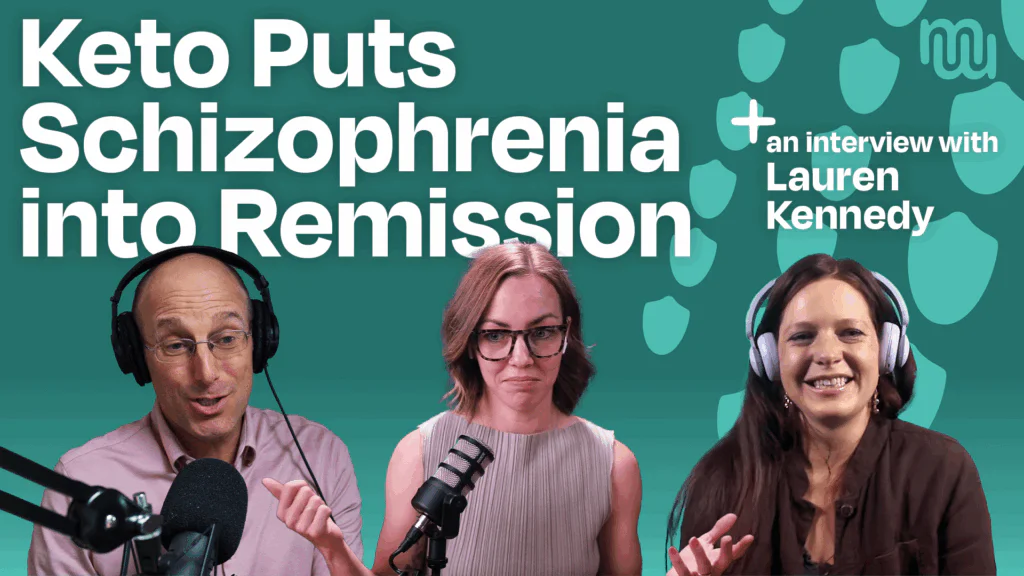
After seven months on a medical ketogenic diet, YouTuber and advocate Lauren Kennedy West reports full remission from schizoaffective disorder and freedom from psychiatric medications. In conversation with Dr. Bret Scher and Hannah Warren on The Metabolic Mind Podcast, she reflects on how metabolic therapies transformed her life, the shortcomings of conventional psychiatry, the importance of patient self-advocacy, and the power of lifestyle and nutrition in restoring both mental and physical health.
Learn more
THINK+SMART is a community-inspired resource that provides a framework for ketogenic and metabolic strategies like those that have helped our son and so many others recover mental wellness.
Read more
Healing isn’t just about symptom relief—it’s about transformation. THINK+SMART offers a roadmap for recovery, helping individuals reclaim their lives. THINK+SMART, a practical and powerful framework grounded in metabolic…
Learn more
Can’t find a metabolic psychiatrist? In this Metabolic Mind episode, Hannah Warren shares how to start ketogenic therapy for mental health safely when expert help is scarce—covering risk mitigation, labs and medication monitoring with your current clinician, using keto coaches for targeted consults, building family and peer support, and personalizing diet and lifestyle to sustain therapeutic ketosis.
Learn more
After seven months on a medical ketogenic diet, YouTuber and advocate Lauren Kennedy West reports full remission from schizoaffective disorder and freedom from psychiatric medications. In conversation with Dr. Bret Scher and Hannah Warren on The Metabolic Mind Podcast, she reflects on how metabolic therapies transformed her life, the shortcomings of conventional psychiatry, the importance of patient self-advocacy, and the power of lifestyle and nutrition in restoring both mental and physical health.
Learn more