Get the latest on metabolic psychiatry. Subscribe.


Listen, Watch & Subscribe on:



Can Keto Help Pediatric Bipolar? Groundbreaking Trial Begins
Listen
About the host

About the guest


David:
If we can make big changes in people’s lives through a fairly straightforward dietetic intervention, why not, rather than chasing around with one medication after another?
Bret:
Welcome to the Metabolic Mind Podcast. I’m your host, Dr. Bret Scher. Metabolic Mind is a non-profit initiative of Baszucki Group where we’re providing information about the intersection of metabolic health and mental health and metabolic therapies such as nutritional ketosis as therapies for mental illness.
Thank you for joining us. Although our podcast is for informational purposes only and we aren’t giving medical advice, we hope you will learn from our content and it will help facilitate discussions with your healthcare providers to see if you could benefit from exploring the connection between metabolic and mental health.
The first ever trial of ketogenic therapy for pediatric bipolar is enrolling, and Dr. David Miklowitz joins me to talk about not just the trial, but why we need to think about bipolar disorder in teenagers and in kids differently, how it presents differently, how the treatment might be different, and therefore, why it’s so important to study it.
And what role the family has and so many other factors that they may be a little bit different for the pediatric population. So I’m really excited to have this discussion with Dr. David Miklowitz, and we do get into the details of the trial as well to see if maybe you’re in an area where you could be enrolled or enroll a loved one.
So I hope you enjoy this interview with Dr. David Miklowitz.
Dr. David Miklowitz, thank you so much for joining me today at Metabolic Mind.
David:
Thank you, Bret. Very good to be here.
Bret:
I’m really excited to talk to you about this new study, a multicenter study with pediatric bipolar role of ketosis and other interventions. But first, before we get into that, tell us a little bit about who you are and your background just so we’re all on the same page.
David:
Thank you. So I’m a, my title is Distinguished Professor of Psychiatry. I’m in the UCLA School of Medicine, what’s called the Semel Institute, which is the psychiatry division at UCLA. I’ve been here since 2009. I was previously University of Colorado. I did my, going backwards in time, did my degree at, UCLA earlier, and I’ve always been interested in bipolar disorder.
That’s been my focus really since graduate school. So I’ve been studying it for close to 40 years. Our particular approach is to work with the family and the person with the disorder to understand their illness better, work with their family to communicate about it, to know how to recognize early warning signs of illness, to know why the medications are important, how not to contribute to stigma of the illness.
And we found in multiple studies that in families in the treatment of bipolar disorder, alongside of medications, is reduces rates of recurrence, that you can see lower rates of recurrence, particularly depression, less severe depressive symptoms over time when you can work with the family and improve that family environment.
So our approach has been what we call psychoeducational, really trying to get people to understand the illness and what affects it and what helps it go well. What helps it, what interferes, what are risk factors, and our interest in ketogenic diets is in that same vein.
Bret:
Yeah, such an important approach and I really like to hear that you have the data showing a decrease in recurrence by bringing the family on board.
I think something that maybe is not emphasized enough, but also specifically focusing on pediatric bipolar disorder, and in teenagers and even younger individuals. Tell us some of the pitfalls maybe or where maybe psychiatry has a little bit to learn about bipolar disorder in this specific population.
David:
Yeah. I’m glad you asked that because that’s a very big issue. First, when we talk about kids, we’re really talking about two groups. We’re talking about children and adolescents, and there’s generally been agreement that bipolar disorder can hit in adolescence, it might present somewhat differently.
For example, moods may be more unstable, even in between episodes. We see more what we call shifting of polarities. So in the same episode, a kid can look manic at one point and depressed at another, even in the same episode. And we see a lot of cycling back and forth in that sense in teenagers. We see a lot of depression, particularly in girls.
But the more controversial point is whether it can hit kids, and we really don’t do much with kids in the sort of 6 to 10 age bracket. There are other programs that do what we tend to see when kids present in that age range is some of the signs of bipolar disorder, but they also have other comorbidities like ADHD, sometimes, irritability, conduct disorder, or oppositional defiant disorder, eating disorders, anxiety.
A lot of these things coalesce in childhood, and we don’t always know is this on per kid on a bipolar track? We have an index that suspicion might be because of family history, but until they’ve really had a full depression and either a hypomanic or manic episode, we don’t really know. I think where the ambiguity in the field is where do you draw the line between what is and isn’t bipolar disorder.
But adolescence is where we put our focus. And in the study we’re proposing, we’re starting at age 12, going all the way up to age 21. And this is often shortly after the diagnosis has been established. So they’ve had one or two episodes, maybe sometimes more, but it’s more of a reality to them that they have this disorder.
Of course, the family is very important during that age range because they’re the ones who take care of the kids’ healthcare, sometimes even well into late teens, early twenties, before their fully independent. That’s why the family’s involved. I should just mention, our primary treatment is still medications.
That’s the first line of defense with bipolar disorder for adolescents or adults is, he works with mood stabilizers, second generation antipsychotics, sometimes antidepressants, other agents in combination. And sometimes kids get on multiple medications and have to in order to stay stable.
Bret:
Yeah. So I’m glad you brought that up because that was going to be my next question, that there’s clearly some differences in diagnosis between adolescents and adults, but what about treatments as well? Is it just, if we’re going to treat the adolescent like a young adult and use the same sort of treatment paradigm and the same algorithm of which drugs to use, or do you have to consider very unique circumstances and different medication or lifestyle approaches in a adolescent or pediatric individual?
David:
Hopefully any treatment is going to involve the psychosocial evaluation, meaning that you learn about the environment of the person as well as their symptoms. And sometimes psychiatry becomes too symptom focused and they say, I see elation and grandiosity, therefore lithium, no matter what the age, or I’m seeing agitation and anxiety.
So I’m going to recommend an antipsychotic or delusional thinking. Now, the only differences we tend to see is lithium seems to be being used less with children and adolescents. I’m not sure that’s a good thing, but that seems to be the bias of doctors is not to use as much lithium, but to use more drugs in the antipsychotic class, which have their pros and cons, too, because of weight gain, metabolic effects.
On the other hand, they can be quite effective. You have a kid who’s severely depressed or suicidal or is acting out, not going to school, doing drugs, getting in trouble. Sometimes in medication like that will really stabilize someone. But I think with adolescents you really have to take into account first what is, what’s normal?
Adolescence, a normal adolescence, has things like mood changes, risk taking is typical, family conflict, striving for independence. All those things can be exaggerated in bipolar disorder, and you have to figure out what’s the line between which ordinary teen behavior and what’s bipolar behavior.
Bret:
Yeah, I can see how that can be challenging.
David:
Yeah, and the best way to do that is to ask, is there more than one symptom here? if at all it is irritability and mood swings, we don’t know. But if it’s irritability with sleep disturbance and grandiose thinking and suicidality and racing thoughts and whatever else, then we start thinking this is more bipolar disorder.
Bret:
And I can see how treatment could be challenging based on the side effects as well. A teenager may not have the insight they need necessarily about their disease, but they certainly are going to experience the side effects and probably have insight into the negative aspects of treatment, which may make them much less likely to want to be treated and more non-compliance.
You could say with the treatment, I imagine, that’s a another unique challenge to the teenagers.
David:
It’s interesting, there are some teenagers I would say probably are on the younger side who say, hey, bipolar, that’s my parents’ thing. That’s what they think I have and I have to take these medicines because they help my mood, and I do it because my parents tell me how I have to. And you wonder if that same kid when they turn 17 or 18 is going to blow the whole thing off.
And that’s a risk, of course. That’s why we want to educate them. Here’s what it is you have. There are others who may react to parents’ disagreements about medication. What if dad doesn’t believe in medication and mom does? Or maybe they’re a split household and dad says, you don’t have to take that when you’re in my house because we know this is all about not getting along with your mom, or something like that.
And that’s, I’m not ragging on dads. It can be the other way around, of course, too, the mom. But we have to make sure the parents are on the same page, otherwise the kid gets the mixed message that you really don’t have to do this, or it’s only one parent’s opinion.
We want them to have a united front about that.
Bret:
All the more reason to get the family involved, like you’re saying. And then, as we’re going to transition to this study here, how did you start to become interested in ketogenic interventions for teenagers and pediatric individuals with bipolar disorder?
And what kind of benefits do you think it might have?
David:
Yeah. I got interested in, if I remember right, it was at the International Bipolar Society meeting, the ISBD International Site from Bipolar Disorders, which I’ve been going to for years really since the organization was incorporated.
And I started seeing posters and then talks about ketogenic diets and metabolic theories of bipolar disorder. At first, I wasn’t sure what to believe, whether it was going to be one of those things that came and went. But then I started seeing more and more on it, not only in bipolar disorder but depression, of course.
There had been that longstanding data on epilepsy in children. There wasn’t really much on kids at all except for in epilepsy. There was increasing data in adults and particularly hospitalized adults. Cochrane set these studies, for example, were starting to show these really nice effects of ketogenic diets in combination with medications.
And I think, by the way, that’s something that may get misunderstood is this is not a substitute for medications. It’s an adjunctive, just like psychotherapy is an adjunctive medication for two medications. And I’m taking a very open mind about it and saying, maybe these metabolic theories have some justification.
There’s a lot we don’t know about the etiology and course of bipolar disorder. And if we can make big changes in people’s lives through a fairly straightforward dietetic intervention, why not, rather than chasing around with one medication after another? My hope is over time we might be able to show that you can get away with lower dosages of medications if you’re on a ketogenic diet.
We don’t know that yet, of course, but this one things we’ll find out.
Bret:
Yeah, I think that’s really an important point about its use as an adjunctive treatment to medication, to therapy, to other treatments. They don’t have to be mutually exclusive, but the potential to get away with less medication, less side effects, with similar or even better overall treatment.
The potential is there and that’s why we got to do the study. So, one of the things that I find most exciting and unique about your study is it’s a multicenter study in teens and pediatrics. So, tell us about the other institutions involved and specifically what you are you’re looking at and who you’re looking to enroll?
David:
Sure, Baszucki Group was very generous in funding what we call the Child Bipolar Network or Child and Adolescent Bipolar Network. It has the acronym, CABIN, so we can all remember it. And what this is a collaboration between four universities, five actually, because one of them is not involved in the keto study, but there are five universities, all of which have specialty clinics in bipolar disorder for kids and adolescents.
And these are some of the top names in the field: Boris Birmaher, Melissa Delbello, Bob Post, Ben Goldstein, Chris Schneck, Danella Hafeman. These are all people who’ve been doing research for a long time on bipolar disorder, and we decided we would basically develop a collaborative.
And we started meeting every couple of weeks and talking about mutual interests and developed a proposal. First, just to follow kids over time who see if we diagnosed them the same way, if we use the same medications, if we had the same algorithms in mind looking at some of these biological, metabolic indicators.
And that study was successful and that led to us proposing the current study, which is the ketogenic diet study. Given that I knew Baszucki Foundation was, or Group, was very interested in studies that extended beyond epilepsy in children and looked at other populations.
I do think it’s, there are some challenges to treating kids and adolescents that may not come up with adults, of course, which is they, you don’t know if the kid is really bought into the whole plan or if it’s just that the parents are saying, here’s what you’re going to eat from now on. It could end up being like that.
Or you could have kids who are cheating on the side when they go out with their friends because they don’t want to be stigmatized as the one who’s only eating this, and that’s why, of course, we do the the finger prick tests. They have to test their blood every day and upload their glucose and insulin levels to a server that we can observe and make sure they’re sticking with the diet, the hopes of getting into ketosis.
But to do that, I think we really need to develop an alliance with the kid and the family, educate them about this, where the psychoeducation comes back in. What is it? Why are we recommending this? Why is it that you can’t have a lot of cake or french fries or burgers and fries like your friends or pancakes or whatever? How you have to substitute this or that?
We remind them it is only for a 16 week period, which is four months. It’s a study they could do during the summer, for example, or in the fall semester. it’s not forever, but it’s something we want them to try. And if it works out well for them, they may want to stay on it, but and that’s the hope, right?
Bret:
That is such a powerful and impactful treatment that they would want to stay on it. But you can definitely see the stigma. Look, there’s a stigma with mental illness in itself. And then the stigma of being the person who has to eat differently than everybody else. And that can be challenging for a teenager.
So, I think we will learn a lot from the study about how people stick with it and what are the factors that help them stick with it, as well.
David:
Some ways, Bret, it’s like the issues that kids have to decide about when they, are they going to drink or use drugs, there are friends that are doing it, their friends may think they’re being, uncool if they don’t get high with them or don’t drink with them. They have to decide, this is what I want for my health, and my health is important. And that’s a tough choice for kids to make.
Bret:
Yeah. Yeah. That’s a very good point.
Before we continue, I want to take a brief moment to let our practitioners know about a couple of fantastic free CME courses developed in partnership with Baszucki Group by Dr. Georgia Ede and Dr. Chris Palmer. Both of these free CME sessions provide excellent insight on incorporating metabolic therapies for mental illness into your practice. They’re approved for a MA category one credits, CNE nursing credit hours, and continuing education credits. Psychologists and they’re completely free of charge on mycme.com, there’s a link in the description. I highly recommend you check them both out. Now back to the video.
Good point. Now, you mentioned a number of names for your co-investigators, but so what about the institutions? There’s UCLA and then three others. So what are the other institutions?
David:
So UCLA is the coordinating institution, University of Cincinnati is one of them that’s run by, Melissa DelBello and Rodrigo Patino Duran, two psychiatrists who work in the child bipolar area. University of Colorado, in Denver, the Anschutz Pavilion Campus. That’s Chris Schneck, Aimee Sullivan and others. The University of Pittsburgh, they actually are one of the central sites for many of the studies on children in with a and adolescents with bipolar disorder. That’s Danella Hafeman and Boris Birmaher, to central people in this area. So, those are the four university sites. And then we also have advisors: Ben Goldstein at Toronto, Bob Post, who used to be with the NIMH and is really one of the world’s experts in mood disorders.
We meet regularly. We share information about cases. Would you call this kid bipolar given that they have this comorbidity or they’ve only been manic for two days and it’s not, doesn’t meet the criteria for this or that? Those are the kinds of conversations we have, and it’s really quite stimulating for me.
Bret:
And now you’ve already mentioned a couple aspects of the study. One that it’s 16 weeks, one that it’s individuals with a diagnosis of bipolar disorder. So it sounds like maybe not newly diagnosed, but they’ve had the diagnosis and already on treatment. Give us a little bit more the details there.
David:
So, they can, they’re again, they’re between the ages of 12 and 21.
It can be their first episode. So if they’re, if they have had a manic episode, you know that by definition they would be met, they would have bipolar one. It’s a little trickier if they’ve only had depression. We probably wouldn’t diagnose bipolar disorder unless we’d seen clear evidence they had hypomania or mania in a previous iteration or time.
So, we do a diagnosis first. That’s always the first line is just, and to take our time with that. We interview the kid, we interview parents, we get secondary reports, put it all into a consensus discussion and decide do we think this is bipolar, we think it’s ADHD, or is it some sort of combination of different disorders?
If they have bipolar one or two, or this group we call unspecified, which often presents in kids, more of a border condition, then we will enter them into our clinics, start them on medications, if they’re not on medications already. So with one of our expert psychiatrists who are used to seeing kids, there’s a stabilization period where we make sure their medications are stable before we start the diet.
And, of course, they have to agree to be on the diet for 16 weeks. They have to agree to be doing the finger prick tests and all that. And then when we start the diet, there’s a two week ramp up period where we don’t just start them right away on a full keto diet. They start with one meal a day, maybe it’s breakfast and see how that’s going.
And we ramp up to two a day, and then eventually, we start the trial and the clock starts ticking for 16 weeks. And during that time, they’re meeting with a dietician every week. And it’s a pretty well known dietician, denise Potter or her, one of her associates, Jacqueline Miklowitz, who are both involved in alternative ketogenic therapies.
The organization and they’ve agreed to meet with the kids weekly and problem solve their diets. And if they have any side effects, help them manage it with supplements or back off of this or take more fluids or they have a whole series of kind of strategies they use and sometimes it involves nursing care or doctor care if the side effects are extreme.
But, generally they’re fairly mild and we’re going to be also tracking their moods along the way. Separate person interviews a kid and every month to see what, how they’re doing with depression, mania anxiety, how they’re functioning in school. That’ll be for 16 weeks, and also they’re going to be asked in this part, we’re hoping works out to take pictures of their meals one day a week.
So not every day of the week, but to upload pictures of their meals one day a week. So there are a couple of apps involved. There’s the app involving the Keto-Mojo app where you prick your finger and give a drop of blood and it, you come out with a glucose and insulin value.
And then there’s also a something,
Bret:
Glucose and ketone value.
David:
Right. Yeah. And see if you’re in ketosis or getting towards ketosis. And then there’s a FoodView app. Also, now intermixed with all this is a fair amount of, kind of counseling, handholding, education.
You know what are the problems you’re running into this with this? Or are you starting to believe this is going to help? Or you’re dealing with side effects? Now that might be because it’s, you’re at the beginning and that might clear in a week or two. So people need to know what to expect. People always do more, are more compliant with treatments, when they know what to expect.
I think where get off is when some side effect occurs and they get panicky and, say, this is terrible. it’s ruining my body or something, and then impulsively stop. So we want to prevent that from happening.
Bret:
Man, you mentioned some of the outcomes that you’re measuring, a lot of the mood outcomes, but also the ketones themselves, adherence.
And what about blood work and metabolic parameters? Are you following those as well?
David:
Yes, we are measuring HOMA-IR, which is the glucose insulin, kind of combination metric. We’re going to measure some inflammatory markers, particularly c-reactive protein, which has been found to be affected in adolescents with bipolar disorder.
Ben Goldstein’s group have shown that, we’re measuring the usual, cholesterol, lipid, blood lipids, renal functioning, there’s a whole battery and we’ve gotten it down one blood test at the beginning and one blood test at the end because kids are not real fond of having their blood drawn.
So we’re just doing it at baseline and end of this, of the trial, that’ll allow us to look at, are there changes in these biomarkers? Let’s say insulin sensitivity, for example. Does that change? Does that change correlate with whether they show improvement in mood at the same time or the amount of time they’re in ketosis?
Is that correlated with their mood?
Bret:
Yeah. So many different factors to say, not just do they respond, who can you predict, who’s more likely to respond and why? And so a lot of more of the details there. Now does everybody go on the ketogenic diet or is there a randomization.
David:
Yeah, no, that’s a good point because this is the first stage of this research.
We consider it an open trial, or a feasibility study, really to show that we can do it and there’s a signal for getting better and that we can measure these. There’s variability in these blood markers and that maybe that there’s some correlations with mood improvement. That’s all in the sort of the first stage.
Then if that’s very successful, I think we’d want to randomize probably to a different diet. that would be my, either eating as usual or some other diet like Mediterranean perhaps, to really get at the mechanisms. That’s when you’re more getting at the mechanism of is it specifically what keto does versus the structure of being on a diet and effects on sleep, wake cycles, and all the things that go along with.
Losing weight and or being on a structured eating routine.
Bret:
Yeah, but I think that’s a really good point. You’re the first one to do this type of a study in the pediatric population. So you, it makes sense to do the feasibility and sort of the pilot study first, prove that it can be done and then build upon that with the randomized trial later.
I think this is, oh, go ahead.
David:
I was just going to say that’s what we did with our family therapy, too. When we developed family therapy, we did an open trial first, saw whether or not families wanted it, whether they showed up to sessions, whether they got better. And once we found that, then we were in a position to flip the coin and find out who did better or whether subgroups did better.
This is only in a sample size of, we’re hoping to, enter 60 kids with the hope of having 40 complete and do everything. So 10 completers per side is our aim for this stage. It’s not a large study, might be done within two years.
Bret:
it’s certainly going to contribute significantly to the field of ketogenic therapy and metabolic psychiatry.
And we’ll link to the website, but the Max Gray Child and Adolescent Mood Disorder Program and Research Center. So anybody living in LA or Cincinnati or Denver or Pittsburgh should definitely check it out if they would like to enroll. And I can’t wait to have you back soon, hopefully relatively soon, to talk about the results.
Any other last words before we part?
David:
I would like to mention I have a book out called, Living Well with Bipolar Disorder, which is really for, with the disorder on what do you do on a day-to-day basis to manage mood and sleep and not get involved in substance abuse? How do you talk to your family about it?
How do you choose a therapist? It’s really the how-to of living with bipolar disorder. So an additional resource people can consider.
Bret:
Yeah, and a great resource like you’re saying, the how to not just here’s your medicine, see you later, but what do you do with the rest of your life?
Which doesn’t stop just because you’re being treated and you got to learn how to navigate all that. So such an important resource. And we’ll link to that as well. Great. Thank you so much for joining me. I really appreciate it.
David:
Thank you, Bret. This was really fun. Thanks.
Bret:
Thanks for listening to the Metabolic Mind Podcast.
If you found this episode helpful, please leave a rating and comment as we’d love to hear from you. And please click the subscribe button so you won’t miss any of our future episodes. And you can see full video episodes on our YouTube page at Metabolic Mind. Lastly, if you know someone who may benefit from this information, please share it as our goal is to spread this information to help as many people as possible.
Thanks again for listening, and we’ll see you here next time at The Metabolic Mind Podcast.
Listen, Watch & Subscribe on:
Youth mental health refers to the emotional, psychological, and cognitive well-being of children, adolescents, and young adults. This period of life is marked by rapid brain development and…
Read more
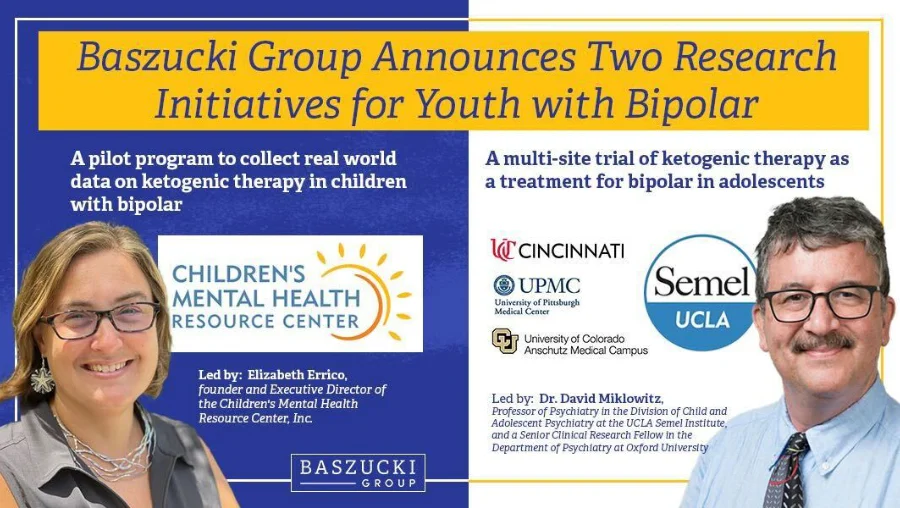
Baszucki Group today announced the launch of two new initiatives across multiple sites exploring the effectiveness of ketogenic therapy for children and adolescents with bipolar disorder. The participating…
Learn more
Subscribe to this YouTube podcast where Dr. Iain Campbell and Matthew Baszucki host peers and experts on the use of ketogenic therapy for bipolar disorder. View Channel
Learn more

Youth mental illness is on the rise, and treatment options are often limited, especially for kids with bipolar disorder. In this interview, Elizabeth Errico, founder of the Children's Mental Health Resource Center (CMHRC), shares how her organization is implementing ketogenic therapy in a real-world setting for kids aged 6 to 17. The year-long study is part of a larger initiative supported by the Baszucki Group to expand mental health care options through metabolic approaches.
Learn more
Youth mental health refers to the emotional, psychological, and cognitive well-being of children, adolescents, and young adults. This period of life is marked by rapid brain development and…
Read more
Baszucki Group today announced the launch of two new initiatives across multiple sites exploring the effectiveness of ketogenic therapy for children and adolescents with bipolar disorder. The participating…
Learn more
Subscribe to this YouTube podcast where Dr. Iain Campbell and Matthew Baszucki host peers and experts on the use of ketogenic therapy for bipolar disorder. View Channel
Learn more
Youth mental illness is on the rise, and treatment options are often limited, especially for kids with bipolar disorder. In this interview, Elizabeth Errico, founder of the Children's Mental Health Resource Center (CMHRC), shares how her organization is implementing ketogenic therapy in a real-world setting for kids aged 6 to 17. The year-long study is part of a larger initiative supported by the Baszucki Group to expand mental health care options through metabolic approaches.
Learn more