Get the latest on metabolic psychiatry. Subscribe.


Listen, Watch & Subscribe on:



Keto Diet and Heart Disease: What New Research Reveals About Cardiac Risk with Dr. Bret Scher
Listen
About the host


Bret:
Does eating a very low-carbohydrate or a keto diet increase the risk of heart disease? Many healthcare practitioners believe the answer is unequivocally yes, but the evidence suggests the opposite. That ,in fact, there’s no automatic increased cardiac risk from eating a ketogenic diet. And a new study lends further support to this notion, and this is crucial to understand so that a false misconception doesn’t prevent people from using ketogenic therapy to treat their diabetes, or depression, bipolar disorder, or other brain-based disorder.
So, watch this video, and share it with your healthcare provider so we can all learn more about fighting these misconceptions. Welcome to Metabolic Mind, a nonprofit initiative of Baszucki Group, transforming the study and treatment of mental disorders by exploring the connection between metabolism and brain health. Thank you for joining us on this journey.
Now, as I mentioned, it’s crucial to understand that keto diets don’t, by definition, increase cardiac risk. Yet, the misconception is likely the number one reason why doctors and healthcare practitioners are hesitant to recommend ketogenic therapy for their patients.
Now, one way I like to look at this is to realize that diabetes, hypertension, and metabolic dysfunction are primary contributors to heart disease. And as it turns out, ketogenic therapy is very effective at treating and even putting these conditions into remission. So, the assumption should be that ketosis is beneficial to cardiac health, but an unwarranted fear of dietary fat and a reliance of low-quality nutrition epidemiology studies that’s led many to the opposite conclusion.
But before we get into all the details, please remember that our channel is for informational purposes only. We’re not providing individual or group medical or healthcare advice. We’re establishing a provider-patient relationship. Many of the interventions we discussed can have potentially dangerous effects if done without proper supervision.
So, consult your healthcare provider before changing your lifestyle or medications. In addition, please recognize that people may respond differently to ketosis, and there isn’t one recognized universal response. So, this recent study that I wanted to discuss, along with others that I’ll mention afterwards, it’s titled The Impact of Very Low-Carbohydrate Ketogenic Diets on Cardiovascular Risk Factors Among Patients With Type 2 Diabetes Grade Assessed Systematic Review and Meta-Analysis of Clinical Trials.
Whew, that’s a long title that has published in Nutrition and Metabolism. So, what they did, the researchers reviewed 29 clinical trials that studied a low-carb diet with carb intake less than 50 grams per day. And these details are important because right off the bat, we see these are clinical trials, right?
Not the weaker observational studies, and they strictly define low-carb as less than 50 grams per day. So, it’s not one of those misleading studies that says low-carb is less than 20 or 40% of calories, which can be like 150, 200, or even more grams per day. So, 50 grams is a much better definition. Even if some people still won’t be in ketosis, it’s still pretty close for most people.
Then, they went one step further and evaluated the studies using the GRADE, G-R-A-D-E, GRADE technique, which is a way to assess the strength of the studies rather than just assuming all are high-quality studies. Okay, so what did they find? Overall, the studies demonstrated improved blood sugar hemoglobin A1C, which is a marker of insulin resistance, lower triglycerides, increase HDL, lower blood pressure, all that are expected and substantially beneficial results for overall and cardiac health.
But here’s the key. There was no significant increase in either total cholesterol or LDL, something that’s contrary to popular belief. But these studies demonstrated as a whole, there was no increase.
Now, as with most DIA trials, the study quality was a little lower since they weren’t blinded and there was some, what they call heterogeneity, meaning some differences among the studies. But the overall result was clear. There was beneficial glucose and metabolic changes without concerning lipid changes.
And this isn’t the only study of its kind. We’ve mentioned previously the study by Drs. Weiss and Little, that demonstrated an overall decrease in LDL particle number for those on a ketogenic diet. The study from Virta Health demonstrated a 10% increase in LDL at one year, but with no change in ApoB, which is a more impactful measure of cardiac risk and an overall 12% reduction in calculated cardiac risk.
And that’s pretty similar to what Dr. Sethi found in her study treating individuals with bipolar disorder and schizophrenia with ketogenic therapy. There was a small increase in LDL with a net decrease in calculated cardiac risk. So, I want to emphasize again how the data don’t support the blanket belief that ketogenic therapy and keto diets increase cardiac risk.
It’s my belief that no one should be denied the opportunity for ketogenic therapy because of a generalized cardiac concern. Of course, there is this subset of people who see a dramatic rise in their LDL and ApoB, lean mass hyper responders. But we should understand these are the minority, not the majority.
And we have interviews with Dave Feldman and another with Dr. William Cromwell that go into more detail for this nuanced topic. So, if your doctor or other healthcare provider tells you that you shouldn’t start ketogenic therapy due to increased cardiac risk, please share this video with them and mention the references that we have in the description.
Hopefully, it will help them have a more informed conversation to decide if ketogenic therapy is a potential treatment option for you. It still may or may not be, but at least it’s not this assumption of cardiac risk preventing it from being. So, if you found this helpful, please and subscribe as it helps others find our content.
And please leave a comment as we’d love to hear about your personal experiences. Alright, thanks for watching. I’m Dr. Bret Scher, and we’ll see you here next time at Metabolic Mind, a nonprofit initiative of Baszucki Group.
Listen, Watch & Subscribe on:
A one-year prospective study found that very high cholesterol in 100 otherwise metabolically healthy individuals on a ketogenic diet for an average of 5 years did not correlate…
Read more

Is high LDL cholesterol always a red flag for heart disease? New research says… maybe not. Transcript: Keto is bad for the heart, right? Well, new research suggests…
Learn more
Why should we rely on a blood test to assess heart disease risk when we can see the disease itself? Transcript: Introduction to Carotid Intima-Media Thickness test (CIMT).Have…
Learn more
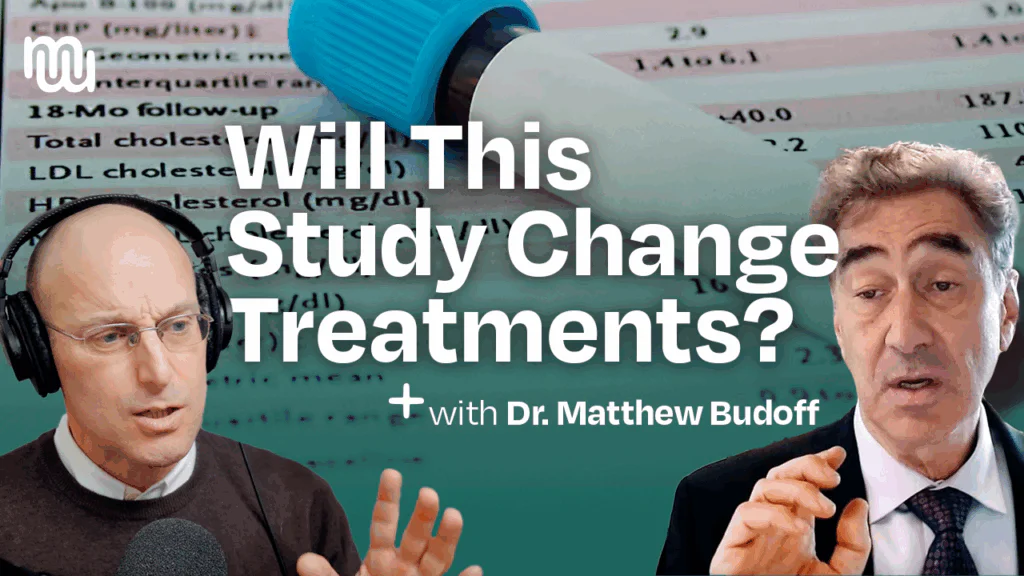
This episode features cardiologist Dr. Matt Budoff on a one-year CT-angiography study of lean, keto-adhering “hyper-responders” with very high LDL/ApoB. Headline finding: no clear link between higher LDL/ApoB and coronary plaque progression; instead, baseline plaque burden predicted who progressed. Some participants even showed plaque regression despite LDL >200 mg/dL, underscoring wide individual variability. Takeaway: ketogenic diets weren’t shown to accelerate heart disease; use CAC/CTA to assess plaque and treat existing atherosclerosis per standard care, independent of diet.
Learn more
A one-year prospective study found that very high cholesterol in 100 otherwise metabolically healthy individuals on a ketogenic diet for an average of 5 years did not correlate…
Read more
Is high LDL cholesterol always a red flag for heart disease? New research says… maybe not. Transcript: Keto is bad for the heart, right? Well, new research suggests…
Learn more
Why should we rely on a blood test to assess heart disease risk when we can see the disease itself? Transcript: Introduction to Carotid Intima-Media Thickness test (CIMT).Have…
Learn more
This episode features cardiologist Dr. Matt Budoff on a one-year CT-angiography study of lean, keto-adhering “hyper-responders” with very high LDL/ApoB. Headline finding: no clear link between higher LDL/ApoB and coronary plaque progression; instead, baseline plaque burden predicted who progressed. Some participants even showed plaque regression despite LDL >200 mg/dL, underscoring wide individual variability. Takeaway: ketogenic diets weren’t shown to accelerate heart disease; use CAC/CTA to assess plaque and treat existing atherosclerosis per standard care, independent of diet.
Learn more