This peer-reviewed randomized controlled trial by Abram et al., published in Schizophrenia Bulletin, was conducted by researchers at the University of California, San Francisco (UCSF), and funded by the National Institutes of Mental Health (NIMH) and Baszucki Group. It is the first of its kind to publish results of a ketogenic diet intervention in people living with schizophrenia-spectrum disorders or bipolar I disorder with psychotic features.
Research has shown that metabolic abnormalities can appear before psychosis develops and are present in people with schizophrenia even before antipsychotic treatment begins.[*] This points to metabolic dysfunction as a potential factor in the biology of these conditions, and raises the question of whether interventions like ketogenic therapy that alter metabolism might offer therapeutic benefit.
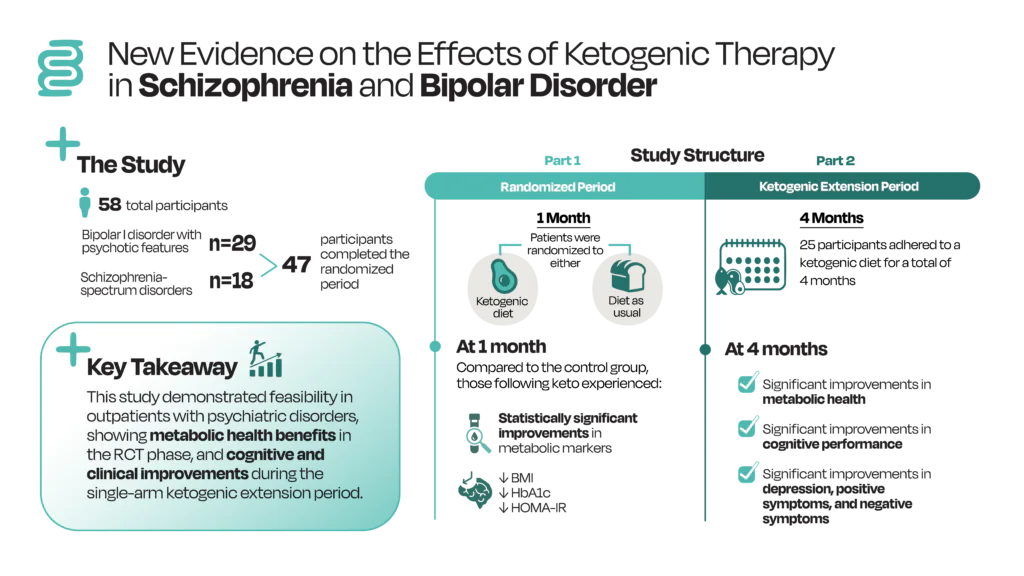
The study unfolded in two parts. In the first part of the trial, 58 participants, of whom 47 completed the study, were randomized to either a ketogenic diet or a diet-as-usual comparison group for one month. The ketogenic diet group received structured meal support, prepared foods, and dietary coaching. The diet-as-usual group did not receive equivalent support, which is worth keeping in mind when comparing outcomes between the two groups.
Upon completion of the one-month RCT, participants from both groups were offered the option to continue with a ketogenic diet extension. Those who had been in the ketogenic diet arm were offered an additional three months of support, extending their total intervention period to four months. Those in the control group who chose to continue were offered a full four months of ketogenic diet support. As a result, all participants who opted into the extension (25 participants total) ultimately received four months of ketogenic therapy.
At the one-month mark, participants on a ketogenic diet showed statistically significant improvements in metabolic markers compared to the control group. There was also a trend toward reduced psychiatric symptoms, though these improvements did not reach statistical significance. This is not entirely surprising as one month may not be long enough to see meaningful psychiatric changes in these conditions. Many of the trend-level improvements observed at one month became statistically significant in the four-month single-arm ketogenic extension period.
Among participants who completed the four-month extension, significant improvements were observed in metabolic health, cognitive performance, and psychiatric symptoms compared to where they started. These early findings add to a growing body of evidence suggesting that ketogenic therapy may have transdiagnostic potential, meaning it could be relevant across multiple psychiatric conditions.
This study builds on earlier pilot work by Dr. Shebani Sethi at Stanford in bipolar disorder and schizophrenia, and Dr. Iain Campbell at the University of Edinburgh in bipolar disorder, both of which first demonstrated feasibility and early clinical signals in these populations. The replication of key findings strengthens the case that ketosis may be a meaningful therapeutic mechanism. Larger, longer randomized controlled trials, already underway, with consistent support across groups and rigorous ketone monitoring, are needed to confirm these findings and determine how best to deliver ketogenic therapy in real-world psychiatric care.