New Results: First RCT for Schizophrenia & Bipolar Disorder. Learn more.


Listen, Watch & Subscribe on:



RFK Jr. Sparks Debate: Can Keto Help Serious Mental Illness?
Listen
About the host


Bret:
Welcome to the Metabolic Mind Podcast. I’m your host, Dr. Bret Scher. Metabolic Mind is a nonprofit initiative of Baszucki Group where we’re providing information about the intersection of metabolic health and mental health and metabolic therapies, such as nutritional ketosis as therapies for mental illness.
Thank you for joining us. Although our podcast is for informational purposes only and we aren’t giving medical advice, we hope you will learn from our content and it will help facilitate discussions with your healthcare providers to see if you could benefit from exploring the connection between metabolic and mental health.
HHS Secretary Robert F. Kennedy, Jr. Just made headlines after stating studies show that the ketogenic diet can cure schizophrenia. Of course, as has been discussed, the word cure isn’t an accurate description, but the discussion has really helped shine a light on this really crucial topic. What this moment highlights is that there is encouraging and growing research, as well as mounting clinical experience, suggesting that ketogenic therapy may be a potential add-on treatment for serious mental illness.
And that includes not only schizophrenia, but also bipolar disorder, major depressive disorder, and other psychiatric diagnoses. A ketogenic diet isn’t just a fad weight loss diet. It’s a metabolic therapy, a way of shifting the body into a state called nutritional ketosis where the body, and importantly, the brain, can use predominantly ketones instead of glucose as its main fuel source.
And this matters because the brain is an energy hungry organ. And increasingly, we’re learning that many psychiatric symptoms may be influenced by underlying metabolic dysfunction, including impaired glucose metabolism, neuroinflammation, mitochondrial dysfunction, and insulin resistance. I know those are big terms, but they all basically mean a dysfunction in the metabolic regulation and pathways of your body and brain.
And this is the foundation of a rapidly emerging field known as metabolic psychiatry, and we already have several early pilot studies showing real promise. For example, Dr. Shebani Sethi at Stanford published a single-arm pilot trial demonstrating a ketogenic diet was safe and effective for improving symptoms of bipolar disorder and schizophrenia.
And at the University of Edinburgh, Dr. Iain Campbell and colleagues show a similar impact for bipolar disorder, suggesting that the magnitude of benefit may correlate with the degree of ketosis. And at the Ohio State University, Dr. Jeff Volek and colleagues published the KIND trial, a pilot study demonstrating ketosis was beneficial for depression symptoms in college students.
Now, these studies are small single-arm, early stage trials, but they’re exactly the kind of early signals that should lead to larger, more detailed studies, and that is what’s happening. Randomized controlled trials are being conducted right now as we speak, investigating ketogenic therapy in schizophrenia, bipolar disorder, and major depressive disorder as well as other psychiatric diagnoses.
In other words, this field is moving quickly. And it’s moving towards higher quality evidence, but the research is really only part of the story. There’s also a rapidly growing community of individuals and families sharing their lived experiences. People who have struggled for years, sometimes even decades, with severe depression, bipolar disorder, or schizophrenia.
Often after trying multiple medications, multiple hospitalizations, people like Matt Baszucki, the son of Metabolic Mind founders, Jan and Dave Baszucki. We acknowledge that personal stories are not the same as gold standard evidence. Of course, anecdotes alone cannot prove causation. But when enough people report similar patterns and when early clinical trials align with those stories, it becomes something that science and medicine should want to explore, not ignore.
And here’s another key point worth emphasizing. The ketogenic diet is not new. It’s been used as a medical therapy for over 100 years, particularly as a well-established treatment for drug-resistant epilepsy. So, when we talk about ketogenic therapy in psychiatry, we’re not talking about an experimental drug with unknown risks. We’re talking about a dietary metabolic intervention with a long history in clinical medicine.
One that could be implemented under proper medical supervision. And while it might not be a solution for everyone, it very well may be an important tool, providing hope for people who have been told their symptoms are unlikely to improve. And importantly, current studies aren’t using ketogenic therapy as a replace for standard psychiatric care. They’re using it as an add-on treatment to the standard of care. And for many people, that can mean better symptom control, improve quality of life, and possibly even a path towards long-term stability.
Thanks for listening to the Metabolic Mind Podcast. If you found this episode helpful, please leave a rating and comment as we’d love to hear from you. And please click the subscribe button so you won’t miss any of our future episodes. And you can see full video episodes on our YouTube page at Metabolic Mind.
Lastly, if you know someone who may benefit from this information, please share it as our goal is to spread this information to help as many people as possible. Thanks again for listening, and we’ll see you here next time at The Metabolic Mind Podcast.
Listen, Watch & Subscribe on:
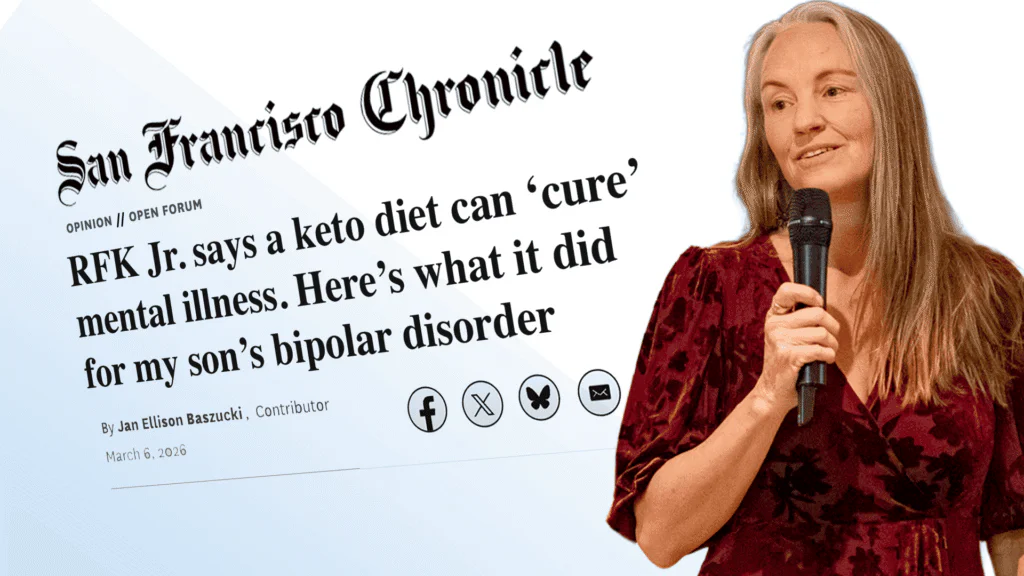
This piece was originally published in the San Francisco Chronicle on March 6, 2026. Ten years ago, at age 19, our son Matthew experienced a manic episode that…
Read more

Could a shift in brain metabolism unlock better outcomes for schizophrenia? Discover how ketogenic therapy is reshaping our understanding and treatment of serious mental illness.
Learn more

In this Metabolic Mind Podcast episode, Dr. Bret Scher speaks with registered nutritional therapist and health coach Moira Newiss about a striking case report: a man with schizophrenia and psychosis who achieved remission through sustained ketogenic therapy while facing homelessness and major socioeconomic barriers. They discuss how fasting first introduced him to ketones, why early keto attempts failed due to carbohydrate cycling, and what changed when he stabilized therapeutic ketosis with a simplified two meal routine and affordable foods like high fat ground beef and tallow. The conversation explores real world implementation, medication system “success” versus patient defined recovery, and why this case challenges assumptions about cost, feasibility, and the potential of metabolic approaches in serious mental illness.
Learn more
In this Metabolic Mind Podcast episode, Dr. Bret Scher speaks with registered nutritional therapist and health coach Moira Newiss about a striking case report: a man with schizophrenia and psychosis who achieved remission through sustained ketogenic therapy while facing homelessness and major socioeconomic barriers. They discuss how fasting first introduced him to ketones, why early keto attempts failed due to carbohydrate cycling, and what changed when he stabilized therapeutic ketosis with a simplified two meal routine and affordable foods like high fat ground beef and tallow. The conversation explores real world implementation, medication system “success” versus patient defined recovery, and why this case challenges assumptions about cost, feasibility, and the potential of metabolic approaches in serious mental illness.
Learn more
This piece was originally published in the San Francisco Chronicle on March 6, 2026. Ten years ago, at age 19, our son Matthew experienced a manic episode that…
Read more
Could a shift in brain metabolism unlock better outcomes for schizophrenia? Discover how ketogenic therapy is reshaping our understanding and treatment of serious mental illness.
Learn more
In this Metabolic Mind Podcast episode, Dr. Bret Scher speaks with registered nutritional therapist and health coach Moira Newiss about a striking case report: a man with schizophrenia and psychosis who achieved remission through sustained ketogenic therapy while facing homelessness and major socioeconomic barriers. They discuss how fasting first introduced him to ketones, why early keto attempts failed due to carbohydrate cycling, and what changed when he stabilized therapeutic ketosis with a simplified two meal routine and affordable foods like high fat ground beef and tallow. The conversation explores real world implementation, medication system “success” versus patient defined recovery, and why this case challenges assumptions about cost, feasibility, and the potential of metabolic approaches in serious mental illness.
Learn more
In this Metabolic Mind Podcast episode, Dr. Bret Scher speaks with registered nutritional therapist and health coach Moira Newiss about a striking case report: a man with schizophrenia and psychosis who achieved remission through sustained ketogenic therapy while facing homelessness and major socioeconomic barriers. They discuss how fasting first introduced him to ketones, why early keto attempts failed due to carbohydrate cycling, and what changed when he stabilized therapeutic ketosis with a simplified two meal routine and affordable foods like high fat ground beef and tallow. The conversation explores real world implementation, medication system “success” versus patient defined recovery, and why this case challenges assumptions about cost, feasibility, and the potential of metabolic approaches in serious mental illness.
Learn more