New Results: First RCT for Schizophrenia & Bipolar Disorder. Learn more.


Listen, Watch & Subscribe on:



Q&A: Cholesterol, CRP, & Ketogenic Therapy — A Cardiologist Weighs In
Listen
About the host

About the host


Bret:
We hear that a lot, this concern about cholesterol.
Erica:
Do you have a recommendation for how often people should be testing their LDL levels? I also wonder if it is possible to reach ketosis on EVO without animal fat. What are the recommendations on limits in terms of saturated fat intake? How else can I check whether or not I’m producing ketones if I can’t afford the measurement devices?
Bret:
Welcome to the Metabolic Mind Podcast. I’m your host, Dr. Bret Scher. Metabolic Mind is a nonprofit initiative of Baszucki Group where we’re providing information about the intersection of metabolic health and mental health and metabolic therapies, such as nutritional ketosis as therapies for mental illness.
Thank you for joining us. Although our podcast is for informational purposes only and we aren’t giving medical advice, we hope you will learn from our content and it will help facilitate discussions with your healthcare providers to see if you could benefit from exploring the connection between metabolic and mental health.
Welcome back to Metabolic Mind. We have a bit of a treat for you today. This should be an interesting one. I’m getting the mic turned on me. We’re going to do a mailbag Q and A, and I’m going to be the guest for this one answering the Q and A questions. And I’m pleased to be joined today by Erica Gerard, who’s one of the producers on our show, and she’s going to take the mic as the interviewer reading the questions.
So, thanks for joining me today, Erica.
Erica:
Oh, it’s such a pleasure to be here. How does it feel to be in the hot seat?
Bret: It feels good. It feels good, you know, I mean it. On the one hand, it’s nice to sort of be in control and sort of be able to decide which way the questions are going. But the other hand, it’s good to have the opportunity to really answer the questions.
I mean, I’m so thankful, first of all, for all the questions we have been getting. It’s great to see this level of engagement. And it confirms, you know, people have a lot of questions out there, and they really want some guidance. And so, I’m just grateful that they’re turning to us here at Metabolic Mind to get those questions answered.
Erica:
Yes, agreed. Thank you all so much for these wonderful questions. It seems like you’re really enjoying these mail back episodes. We love doing them, so keep ’em coming. if, again, if you have a question and you’d like to submit it to us, there’s many ways you can do that. You can go to metabolic mind.org/questions, and you can send us a question there, or you can leave a comment on whatever platform that you are either listening or viewing this episode from, whether it be YouTube or Twitter.
We do go through the comments and we can pull your questions that way.
Bret:
Many of the interventions we discuss can have potentially dangerous effects of done without proper supervision. Consult your healthcare provider before changing your lifestyle or medications. In addition, it’s important to note that people may respond differently to ketosis and there isn’t one recognized universal response.
Erica:
So, why don’t we jump in and get started?
Bret:
Sounds good. Let’s do it.
Erica:
Okay. So, this first question comes from vamosindeed9466 from YouTube. And the question relates to cholesterol. He says, “I wish you’d go into cholesterol. I could feel like never before, healthy, strong, invincible even, but my blood markers, especially cholesterol, all of them are out of range.”
Bret:
We hear that a lot, this concern about cholesterol. And as a cardiologist, that’s very near and dear to my heart. You know, I guess, pun intended, no pun intended. But it’s really an important topic, one that I spend a lot of time thinking about and talk to patients about. So, a couple things here.
I mean, you know, it’s actually frustrating when someone sees all these amazing changes already, feel better than I’ve ever felt before. And I put my type two diabetes into remission or my bipolar disorder into remission. I’ve gotten off my medications, whatever the case may be, but my doctor says I have to stop because of my LDL.
I mean that, and that’s a little frustrating for individuals, and for me as a cardiologist because I think the discussion needs to be a little deeper. Now, what gets me on this one is that he mentions all of my cholesterol markers are abnormal or have gone wrong. So, that makes me a little concerned because usually what we see on ketogenic diets, and when people improve their metabolic health, is HDL goes up, triglycerides go down, which are a great sign of improved metabolic health.
And then, LDL for most people, if you’re using ketogenic therapy to lose weight or to treat type 2 diabetes, most people don’t see much of a change in their LDL or may see a very small change. But there’s a percentage who see a larger increase in their LDL. And those people tend to be the more metabolically healthy, the leaner, the more physically active.
They’re more likely to see a higher increase. Not a hundred percent, you know, it is not always that way but that’s on average. So, the way to answer this question though is if someone sees their triglycerides go up, their HDL go down, and their LDL go up, that is definitely an unusual circumstance.
So, when he says, all my cholesterol markers were wrong, that makes me worried because that’s not the normal response. So, something is going on there and that absolutely needs to be looked at. Now, if it is just the LDL that goes up with improved metabolic health, this is where the discussion gets super interesting, very nuanced, and can be uncomfortable for a lot of doctors.
I mean, one way to do it is to use the what we call the ASCVD calculators. Basically, it’s a calculator that you plug in your information, and it spits out your calculated 10 year risk. What is the percentage risk of having a heart event in the next 10 years? Of course, it’s not perfect. No calculator like that’s going to be perfect.
But it gives you an idea. And some of the research, whether it was Dr. Shebani Sethi’s research of Stanford or some of the research from Dr. Sarah Hallberg and Virta Health. They both in their studies showed that LDL went up like between 10 and 15%, but the calculated cardiac risk went down by 12 to 15%.
And what that shows is when you’re improving these other markers, your triglycerides, your HDL, your blood pressure, your blood sugar, your weight, your body composition, right? When you’re improving all these other markers, you can have a net benefit to your cardiac risk, even if your LDL goes up a little bit.
So, that’s the discussion that really needs to be a little more nuanced. And then we can get into other things that you can do, like calcium scores or CT angiograms or carotid ultrasounds. All these other tests that can give you more details. That’s sort of the next step. But the first step is really just having that broader discussion about cardiac risk as a whole rather than just focusing on LDL.
Erica:
Got it. Okay, and I’m just curious, when thinking about getting tested, do you have a recommendation for how often people should be testing their LDL levels?
Bret:
Yeah, and that’s actually a really good question. So, other research has shown that your LDL can go up in the first six months of starting a ketogenic diet or ketogenic therapy, and then, can come down again. Not in everybody, but there’s this subset of people in whom that happens.
So, really important to maybe kind of see if you are one of those people or talk to your doctor to see if that’s maybe how your lab results are reflected. So, I encourage everybody to get it at baseline. And then probably, you know, maybe at the eight week mark or so to see any changes, you know, maybe three months? Somewhere in there.
But then depending on what you see, that determines when you check it next. If the LDL is going up and everything else looks great, you know, maybe one option is you check it again at six months and then at nine months and at 12 months. I can’t give blanket recommendations because everything is so personalized and individualized.
But that’s the problem when we just look at a guideline, when we look at a one number and we don’t individualize it. So, you know ,how often you check it is going to be determined by what the value is and really does need to be individualized.
Erica:
Right, that’s helpful though to think about at the very least, when you start on a ketogenic diet.
And then you said around the eight week mark. Is that right?
Bret:
Yeah, around the eight to 12 week mark. Eight to 12 week mark is probably a good time to check it again. But again, it depends what the baseline values were, right?
Erica:
Of course.
Bret:
Of course, if the baseline values were markedly abnormal, you’re probably going to check it a lot earlier.
Erica:
Great. Well, thanks for the question. The next one also has to do with cholesterol.
Bret:
Mm-hmm.
Erica:
It comes from mishar8889 from YouTube, “I also wonder if it is possible to reach ketosis on EVO without animal fat?” EVO I’m assuming means extra virgins olive oil, is that right?
Bret:
Yeah.
Erica:
Okay.
Bret:
I think that’s right.
Erica:
“When I include tallow or lard to my diet, my cholesterol goes up to 700. I’m not exactly sure, but I might have a FH. I’m surprised people do not ask that question often.” Dr. Scher, what is FH, please?
Bret:
Yeah, so this is a great question. And you know, it’s funny to hear him say, I’m surprised people don’t ask that question often because I get it all the time.
But that’s who I see, right? As a cardiologist specializing in metabolic health and ketosis, those are the people I see. So, I get this question all the time, but I can see that a lot of people can be, concerned about this and confused. So, FH is familial hypercholesterolemia, which just means you’re born with a genetic defect or genetic mutation, I should say, in something that affects your cholesterol, whether it’s the LDL receptor or the ApoB.
So, is it possible that, is it possible to get into ketosis using extra virgin olive oil without any, you know, saturated fat containing foods or high saturated fat foods? Absolutely, 100%. I mean, you can get into ketosis with a vegan diet, with a vegetarian diet, with a purely mono and polyunsaturated diet.
Absolutely, you can get into ketosis that way. You know, it all comes down to do you enjoy the foods? Is it sustainable? How hard is it to prepare the meals, et cetera, et cetera. But absolutely, as long as you restrict your carbohydrates enough, you will get into ketosis. So, then the next question is though, does that make a difference in cholesterol? So, this person either has FH or is a hyper-responder, and they’re not the same thing.
So, a hyper-responder means your LDL cholesterols are kind of perfectly in the normal range and not super high when you’re not in ketosis. But then, when you get into ketosis, something changes in your physiology that shoots the LDL up extremely high to levels that we’ve really only seen with FH, which is why most doctors who are unfamiliar with ketogenic therapy and hyper-responders would see that and say, well, there’s only one thing that causes that, and that’s familial hypercholesterolemia.
But that’s wrong because you can also get there as being a hyper-responder to a ketogenic diet. Now, what’s interesting is recently published literature, and certainly my clinical experience and others, doesn’t suggest that just reducing the saturated fat and increasing other sources of fat reverses that condition. I don’t see that, and the literature doesn’t support that. Of course, that doesn’t mean, again, a hundred percent.
Some people can see a change there, but the majority do not. It’s actually appears to be something about the state of ketosis and the change in energy source from glucose to fatty acids, or the primary energy source from glucose to fatty acids. That’s the process that likely triggers this hyper-response.
So, not everybody’s going to see a change just by reducing the saturated fat that you eat and increasing the extra virgin olive oil and so forth. So, the question, of course, is what do you do about it? And again, very complicated discussion, and we’re learning a lot about it. I’m not going to pretend to give any general advice here because it is so individualized, only to say that it’s a discussion you need to have with your physician.
And if you can have that discussion with the physician who’s familiar with ketogenic therapy and hyper-responders, even better.
Erica:
Great, but it sounds like there’s no need to panic if this is you, if you’re someone whose cholesterol goes up when you introduce animal fat into your diet, correct?
Bret:
Well, so, I don’t think anybody should ever panic about your cholesterol, right? Because cholesterol isn’t the disease. Heart disease, vascular disease is the disease. But I don’t want to give the impression to ignore it either, that it’s no big deal. It is a big deal that should be discussed with your healthcare provider.
But remember, vascular disease is the disease. Cholesterol by itself is not the disease.
Erica:
Alright, next question comes from mattiaskoretzky from Twitter, and the question for you, Dr. Scher is, “I understand that technically the body can generate glucose through glucose neogenesis in the absence of carbs, but could this process be considered metabolically taxing or stress-inducing over time – possibly increasing cortisol levels or impacting hormonal balance?”
Bret:
Hmm.
Erica:
Good question to you.
Bret:
Yeah, so first of all, kind of upset, it’s not another cholesterol question. I could talk about cholesterol all day long, but no, this is good to talk about something besides cholesterol. This is, you know, this is super interesting because this is something I see posted on, whether it’s on our YouTube comments, or you know, our X feed or whatever. People will comment, well, gluconeogenesis increases stress and increases cortisol, and is not good long-term.
There’s no evidence that I’m aware of that shows that. I could see how someone could hypothesize that, but I think we have to be clear that is a hypothesis. So, how can we measure it? How can we know for sure, right? I think those are the key questions. How can an individual know? And, you know, measuring cortisol, measuring hormonal balance, I’ve got to be honest, those are challenging things to do.
Our tests are not perfect for those. There’s a lot of variation. and there are a lot of things that can impact it beyond just, you know, kind of what you’re eating. And you know, it could be how you’re exercising, how you’re sleeping, you’re stress, et cetera, et cetera. So, I think, for me, if this was me personally, the way I would assess this is do I have any of the manifestations of hormonal imbalance, however you define that, or, you know, elevated cortisol?
So, elevated cortisol is sort of the perfect example. The clinical manifestations of chronically elevated cortisol can be chronic inflammation, can be high blood pressure, it can be weight gain, high blood sugar, high insulin, you know, body composition changes, which you usually see the opposite of with ketogenic therapy.
Certainly the patients that I treat and the literature seems to suggest you get exactly the opposite effect. So, that’s what I would fall back on. Am I seeing the clinical manifestations of elevated cortisol? But then, the question would be, okay, well what about 10 years from now, 20 years from now? Keep following those variables for 10 years, for 20 years, however long. Right?
So, I think that’s the key. And we can get get sort of caught up in these mechanisms. Ooh, I’m concerned about the potential for this mechanism. But for me as a doctor, as a clinician, it always comes back to, well, what are the clinical effects that we’re seeing? Are we seeing concerns, clinical concerns that could reflect those mechanisms? Okay, then we got to address it. Are we seeing exactly the opposite of those concerns? Then there’s probably not much of a concern.
What if mental health treatment looked completely different? I’m Dr. Bret Scher, host of Metabolic Mind, a show where we dive into the cutting edge science, connecting your brain and your body. Did you know that your metabolism could hold the key to better mental health from bipolar disorder and depression to schizophrenia?
Researchers and doctors are exploring powerful new treatments that go beyond medication, like ketogenic therapy. Whether you’re struggling yourself or supporting someone who is, Metabolic Mind brings you real stories, expert insights, and the hope of a new path forward. Find Metabolic Mind on YouTube or anywhere you listen to podcasts because what fuels your body, fuels your mental health.
Erica:
Right. It really is that simple, isn’t it? Are things getting better or are things getting worse?
Bret:
Right, and I think the key is though, what do you define as the things you know, right? And so, it’s make sure you’re tracking the right things. And so, yeah, I’ve listed a whole bunch just in this short discussion that can reflect cortisol level.
So, you know, I think that’s important.
Erica:
Okay, our next question comes from Noah from Instagram, and Noah’s question is, “What are the recommendations on limits in terms of saturated fat intake? I have moderate HS-CRP and I’m in theory supposed to limit saturated fat. I see some data suggesting that it should be around 6% for a healthy heart and otherwise no more than 13%.
On a 2000 calorie consumption basis, that is very little room for saturated fats. Is there a way to get sufficient calcium and keep saturated fat levels low enough and still do a ketogenic diet? What do you recommend?”
Bret:
Yeah, good question. Saturated fat is such a controversial topic right now in the mainstream media and within medicine.
And actually, we have a couple different videos on our YouTube channel at Metabolic Mind specifically about saturated fat. So first, I would encourage people to check those out because I can spend, you know, 10 minutes in each video talking about just saturated fat so I can go into more detail.
But let’s dissect this a little bit. So, I have moderate HS-CRP. So, I assume this person is saying that they’re a high-sensitivity CRP, which is a lab test measurement of general inflammation, is moderately elevated. And that they’ve been instructed in order to address that inflammation, to lower saturated.
Now, so let’s talk about CRP for a second. You know, CRP?
Erica:
Yeah because I’ve never heard of CRP.
Bret:
Yeah.
Erica:
What is this? Something that everyone should be aware of?
Bret:
Yeah, so it stands for C-reactive protein. And it’s a, like I said, a general inflammatory marker. And I want emphasize that general, right?
It’s very helpful in that it can tell you if you have a significant level of systemic inflammation. It tells you nothing about where that inflammation comes from, and that’s the good and the bad, right? It can raise the red flag but tells you nothing about it. So, for someone to assume it’s saturated fat, I’d be curious why they’re making that assumption.
You know, actually, one of the most, the most common causes of an elevated high CRP? Periodontal disease and gum disease, and you know, bad dentition, and that can cause a high CRP. Any sort of autoimmune condition can cause it. Any infection can cause it. I guess that’s the other important point is you want to get this blood test done. Not just once, but over time.
Because if you have, you know, a little bit of a sniffles, it can elevate it. Or if you had a really hard workout and you get your blood test right after the workout, it can elevate it, right? It rises and falls acutely. So, you want to see is it chronically elevated or was it just because of some reason?
So, now let’s talk a little bit more though about how saturated fat impacts inflammation and this concept of, you know, for a heart healthy diet, you need below 6% or 10% or 13%, whatever the percentage is. So, here’s the thing with saturated fat. We don’t eat saturated fat. We eat foods that contain saturated fat as part of an overall diet.
So, when you look at these observational studies that demonstrated people who ate more saturated fat had a higher risk of cancer or or heart disease, turns out they were also eating more calories in general. They were eating more carbs and refined carbs. They were less healthy at baseline. They smoked more, they exercised less.
They were less likely to take a multivitamin. These are called healthy user bias or unhealthy user bias, and there is no way for a study to adequately control for all of them. So, were these people getting cancer or heart disease more often because of the saturated fat, or was it because of their unhealthy lifestyles?
The study has no way to tell you that. But for whatever reason, certain people interpret it as it’s the fault of the saturated fat, and therefore, we must limit it to 10%. So, I think that that one take home could be if you are eating a high carb, high fat, high calorie diet, it’s probably not a healthy thing to do, and you don’t want to increase the saturated fats in that diet.
But it doesn’t matter. Nobody should be eating that diet anyway, right? So, if you are eating a low carb whole foods diet that happens to contain whole foods with saturated fat, there’s actually zero evidence that that is harmful to your health, and ketogenic nutrition, ketogenic therapy studies show a reduction in CRP, a reduction in other inflammatory markers, improvement in cardiovascular risk scores, improvement in insulin resistance and type 2 diabetes.
All these things that supposedly saturated fat, quote unquote, causes. You can use a low carb diet with zero restrictions on saturated fat and show the exact opposite. So, it comes down to it’s not so much the saturated fat as the type of food that you’re eating. Whole foods, processed foods and the dietary matrix, high calorie, high carb, high refined carb, plus the high fats.
You know, that’s what matters much more than just saying saturated fat or not, and I think it’s important just to circle back to this inflammatory question. I mean, there’s been a couple different publications from the team at Virta Health, which has, you know, ketogenic diet, no restrictions on saturated fat, showing reduction in inflammatory markers.
So, I don’t think it’s a saturated fat itself. It’s much more detailed and nuanced than that.
Erica:
Right, a lot of factors going on there. It almost sounds like, you know, if my car breaks down, and I’m just blaming it on not getting an oil change when I’ve never done any other maintenance to the car whatsoever, right?
Bret:
Yeah.
Erica:
Like we’re just pointing to one thing when it’s really so much more complex than that.
Bret:
Right, right and I don’t know. Maybe it wasn’t as straightforward as I’m reading into this, but it sounds like, you know, the doctor looks at your labs. Oh, your CRP is high. You have to reduce your saturated fat.
I wouldn’t draw that connection so quickly. Actually, If anything, from a dietary standpoint, I’d say you have to reduce your refined carbs and your, you know, your ultra-processed carbs, and your added sugars. Like those are the first things to address, but there are so many other things to address with the CRP as well.
Erica:
We’re going to head into our last question of the day, and this one comes from brunarochazagordo9425 at YouTube, and the question is, this is a good one, “How else can I check whether or not I’m producing ketones if I can’t afford the measurement devices? Could weight loss be an indicator? Or maybe body fat loss?”
And you know, it’s so true, Dr. Scher, because not everyone can afford these devices. And it’s not just the devices, right? It’s the test strips, and you have to keep buying them. So, there is a, you know, cost investment over time. So what else could someone do?
Bret:
Yeah, another good question. They’ve all been really good questions here.
So, as usual, I’m going to answer the question by not answering the question at first. I’m going to ask a question. Why are you checking your ketones, right? I think that’s really important. And so, the person asked, could it be weight loss or body fat as an indicator? Well, if those are your goals, if your goal is weight loss or your body fat and body composition and you’re achieving those, do you care if you’re producing ketones?
And I think the point is not everybody needs to be on a ketogenic diet producing high ketones. Now, if you’re using it to treat a brain-based disorder, if you’re using it to treat, you know, cognitive decline, major depressive disorder, bipolar disorder, schizophrenia, et cetera, we do have evidence to suggest that the ketone level there may make a difference.
So, that’s where I think knowing your ketone levels could be helpful. But if you’re trying to improve your type 2 diabetes, you can just follow your blood sugar, your insulin levels, your body composition, right? There are other markers you can follow to see if you’re having the impact you want to have with your nutritional therapy, and ketones may not be that marker.
Now, that being said, there are some tricks you can use. One is, you know, did you experience the keto flu type symptoms, right? Where you’re a little more fatigued, maybe a little lightheaded, maybe a little nauseous? And the things that can happen within the first week or two of going into ketosis. That’s a sign.
You’re producing ketones. You’re getting into ketosis. You’re switching over from primarily using glucose as fuel to using fat as for fuel. So, that’s a sign. Some people will notice an acetone smell to their breath. And so, that can be a sign as well. And then, other things like, you know, sometimes people get like a keto rash, which you don’t want to get, but that would be a sign.
But really, like you know, do you experience the changes of getting into ketosis? And the breath changes are probably the two most common ones. Urine strips can be less expensive than a lot of the others. So, that might be a more economical way to check. It’s not going to give you so much of a level as, you know, just are you in ketosis, mild, moderate, or heavy ketosis.
The urine strips can show you that, but yeah, that’s what I would say. But again, the main way to answer this question is why are you checking ketones and do you need to?
Erica:
Such a great thought. I hadn’t really considered that, right? We’re all so obsessed with measurements and making sure that we’re within the range.
But you know, it is just another thing that we need to be mindful of. And if you don’t need to be monitoring those levels, then don’t, is what I hear you say.
Bret:
Yeah, and I guess the other thing is how often, right? Some people will say, you got to check every day. You got to check a couple times per day.
But if you just, you know, if you’re following other markers of success, whatever your goals are, and you want to check once a week, once a month, whatever, just to say, am I still in ketosis or not? That’s also like maybe a less expensive way to do it.
Erica:
Right, right. Less frequently.
Bret:
Fellow mental health clinicians and healthcare providers, you now have access to a suite of free CME lectures on metabolic psychiatry and metabolic health.
Each of these CME sessions provide insight on incorporating metabolic therapies for mental illnesses into your practice. These CME sessions are approved for AMA category one credits, CNE nursing credit hours, and continuing education credit for psychologists, and they’re completely free of charge on mycme.com.
Now, back to the video.
Erica:
Excellent, okay. Well, we did it, Dr. Scher. We made it through our first turn the mic Metabolic Mailbag with you. We will be having more of these. So, if you have questions, once again, you can go to metabolic mind.org/questions, or you can leave a comment on whichever platform you are listening or viewing this video.
Bret:
Well, thank you Erica. And I think we have to get you from behind the mic to in front of the mic more often. You did a great job. So, this was fun. Thank you.
Erica: Thanks. Well, this was a lot of fun.
Bret:
Thank you for watching. If you want to see more, check out these recommended videos. Also, if you haven’t already, don’t forget to subscribe to our channel to stay up to date with our content and help us expand the movement.
And if you want to sign up for our newsletter, access our resources, read the latest research, or check out the THINK+SMART framework, click here to visit our website. See on the next video.
Thanks for listening to the Metabolic Mind Podcast. If you found this episode helpful, please leave a rating and comment as we’d love to hear from you. And please click the subscribe button so you won’t miss any of our future episodes. And you can see full video episodes on our YouTube page at Metabolic Mind. Lastly, if you know someone who may benefit from this information, please share it as our goal is to spread this information to help as many people as possible.
Thanks again for listening, and we’ll see you here next time at The Metabolic Mind Podcast.
Listen, Watch & Subscribe on:
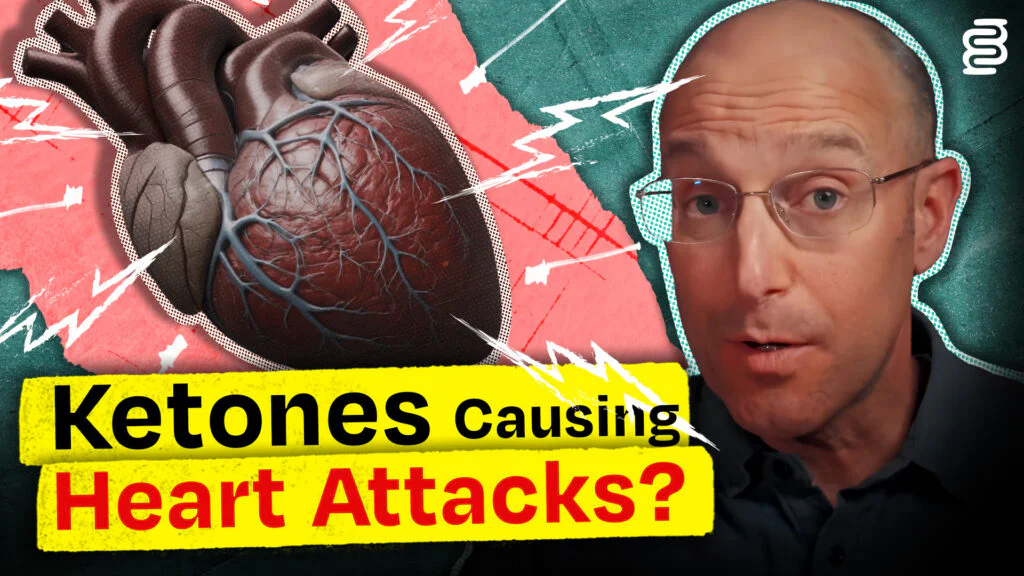
Can higher ketone levels really increase the risk of heart disease? Dr. Bret Scher takes a closer look at a recent study behind concerning headlines about ketones and cardiovascular risk, revealing why the findings don’t actually apply to nutritional ketosis or ketogenic diets—and why the distinction between correlation and causation matters when interpreting this research.
Read more

A cautious, and nuanced editorial about elevated LDL cholesterol while on a keto diet. Read more here!
Learn more

Have you wondered if there is a better way to predict the risk for heart disease than using LDL cholesterol? It turns out, there is. Discover why coronary…
Learn more

In this video, board-certified cardiologist (and Metabolic Mind’s Medical Director) Dr. Bret Scher dives into the latest science of triglyceride-rich particles and their impact on metabolic health. Learn…
Learn more
Can higher ketone levels really increase the risk of heart disease? Dr. Bret Scher takes a closer look at a recent study behind concerning headlines about ketones and cardiovascular risk, revealing why the findings don’t actually apply to nutritional ketosis or ketogenic diets—and why the distinction between correlation and causation matters when interpreting this research.
Read more
A cautious, and nuanced editorial about elevated LDL cholesterol while on a keto diet. Read more here!
Learn more
Have you wondered if there is a better way to predict the risk for heart disease than using LDL cholesterol? It turns out, there is. Discover why coronary…
Learn more
In this video, board-certified cardiologist (and Metabolic Mind’s Medical Director) Dr. Bret Scher dives into the latest science of triglyceride-rich particles and their impact on metabolic health. Learn…
Learn more