New Results: First RCT for Schizophrenia & Bipolar Disorder. Learn more.


Listen, Watch & Subscribe on:



Long-Term Safety of Ketogenic Diets – with Dr. Bret Scher
Listen
About the host


Bret:
Is it safe to be in ketosis or eat a ketogenic diet long-term? This is a question that comes up often with conflicting answers. An online search will result in concerns about nutrient deficiencies, eating disorders, and other poorly supported claims. So, what’s the real answer? The real answer is yes.
People can be in ketosis and eat a keto diet long-term. Now, that doesn’t mean everyone should. But if someone puts their treatment-resistant mental illness or their type II diabetes in a remission with ketogenic therapy, then there’s no clear evidence that continuing ketogenic therapy long-term is harmful.
Let’s get into the details.
Welcome to the Metabolic Mind Podcast. I’m your host, Dr. Bret Scher. Metabolic Mind is a nonprofit initiative of Baszucki Group where we’re providing information about the intersection of metabolic health and mental health and metabolic therapies, such as nutritional ketosis as therapies for mental illness.
Thank you for joining us. Although our podcast is for informational purposes only and we aren’t giving medical advice, we hope you will learn from our content and it will help facilitate discussions with your healthcare providers to see if you could benefit from exploring the connection between metabolic and mental health.
If you’ve improved your mental health or maybe even put your mental health disorder into remission with ketogenic therapy, do you have to worry about staying on it? At Metabolic Mind, we frequently get comments and questions surrounding the safety of long-term ketosis. So, I’m going to address this in detail, digging into many of the supposed reasons why someone shouldn’t be in ketosis long-term, including things like nutrient deficiencies, disordered eating, cardiac risk, or the claim that ketosis only works for six months and more.
But before we get started, please remember our channels for informational purposes only. We’re not providing individual or group medical or healthcare advice or establishing a provider patient relationship. Many of the interventions we discuss can have potentially dangerous effects of done without proper clinical supervision. So, consult your healthcare provider before changing your lifestyle or medications. And, in addition, please recognize that people may respond differently to ketosis and there isn’t one recognized universal response.
Now, let’s start with some perspective maybe, right? Where’s the burden of proof? If someone takes an anti-psychotic medication or a type II’s diabetes medication like insulin, and it causes weight gain, worsening metabolic health or your sexual dysfunction, but it helps reduce the psychotic episodes or lower blood sugar.
Then the general assumption from the medical establishment is that the benefits outweigh the side effects, and it’s safe to do long-term. They aren’t asking if it’s truly safe given the concerning side effects, but because the benefits, they seem to be okay continuing the medications long-term despite the adverse effects. We’ll now less replace those anti-psychotic medications or the insulin injections with ketogenic therapy.
All of a sudden someone may put their mental illness or their type II diabetes into remission without all the concerning medication side effects. So, why now all of a sudden would doctors and individuals wonder if this is safe long-term? I think it’s crucial to start from this framework of understanding the benefits before questioning the risks.
If ketogenic therapy were just one of dozens of choices that worked equally as well as the others and with similar side effects, and then we’d probably need a lower level of evidence of harm to be concerned. But that’s not what we’re talking about here. As published studies from Dr. Albert Danan and Dr. Shebani Sethi and others have shown people with serious mental illness for years or decades treated with aggressive standard medical care, they can improve their symptoms quickly and dramatically with ketogenic therapy.
So let’s look at it through that lens. Now, all of a sudden, the burden isn’t for someone to prove that this way of eating is healthy with long-term studies. The burden is probably the other way to prove it’s not. After all, it’s just food. It’s food that works as well or better than medications for many people with tremendous benefits. So, where’s the burden of proof for individuals who have dramatically changed their life? Now, we have some perspective.
But let’s get into the details here. Why do some people think long-term ketosis is dangerous? One reason is simply misinterpretation of the science. Some long-term observational studies report that those eating low-carb diets have a higher risk of premature cardiac or all cause death. But unfortunately, they define low-carb as 25% or even 37% of their calories from carbohydrates, which is nowhere near ketogenic therapy, which is usually 30 grams of carbs of less or less.
It simply isn’t accurate to assume that these data apply to ketogenic therapy. Another common concern is that there are no known populations that have lived in ketosis long-term. This isn’t exactly true. Hunter-gatherer populations have likely been in and out of ketosis long-term, and the Inuit tribes consistently ate a very low-carb, high fat diet.
Although there’s some speculation their genetics may influence whether or not they were in ketosis, but the point being, populations have been in and out of ketosis long-term. But what about other diets? Vegan diets? There’s a quote from the World Health Organization that the evidence on the long-term health impacts of vegetarian and vegan diets remain incomplete.
So, the same can be said about long-term knowledge of vegan diets, right? And certainly the same can be said about the standard American diet. We know no healthy population has ever followed that diet long-term. There seems to be a disconnect in the questioning, and it’s not significant evidence against the safety of long-term ketosis.
And again, we have to ask, where’s the burn of proof? I’m going to keep asking that question. Okay, where’s the burn of proof? But here’s another important topic that comes up frequently, nutrient deficiency. To dig into this, I did a search of popular online resources and public published articles to come up with the top potential nutrient deficiencies on a ketogenic diet.
The first is fiber, which is interesting because there’s actually no body requirement for fiber from our diets. There are official recommendations for how much fiber we should eat, but importantly, the data for this is derived from studies comparing versions of high carb diets. So, the data suggests that if someone’s eating a high carb diet, eating more fiber is likely beneficial, which makes sense, especially when you think about the ultra-processed foods that are high carb, low fiber, right?
We shouldn’t be eating those, but the same data don’t exist for true low-carb diets. So, it’s very speculative to say that low fiber intake is harmful for those in ketosis. And remember, ketogenic diets include above ground vegetables, avocados, nuts, all of which are good sources of fiber. So, a ketogenic diet doesn’t even have to be a really low fiber diet. So, that one doesn’t really make sense.
Another is phytonutrients, which are found in veggies and fruits. And, again, there’s no body requirement for phytonutrients. So, studies point to their antioxidant properties and, therefore, assume they must be beneficial. But wouldn’t the amount of anti-antioxidants you need be predicated by the amount of oxidation in your body?
And aren’t there other ways to get antioxidants? And the answers are yes and yes. So, once again, we see this potential deficiency is not really an issue. Okay, but then there’s this list of specific nutrients, which I find amazing that anyone would publish these because, basically, they’re all incorrect. So, let’s go through them quickly, one by one.
The first is thiamin, which is found predominantly in fortified whole grains, but it’s also in meat and pork and fish, right? All very common on a ketogenic diet, right? And how about folate? Also found in whole grains, but also in leafy green vegetables, peanuts, seeds, liver. All found on a ketogenic diet.
Vitamin A is commonly thought of as being in carrots, but it’s also in organ meats, fish and leafy green vegetables. All on a ketogenic diet. Vitamin E commonly in seed oils, but also in almonds, peanuts, greens, and bell peppers. Again, all common on a ketogenic diet. Vitamin B6, which again, most Americans get from fortified cereals is also in liver, tuna, salmon, dark leafy green vegetables.
And then I saw calcium listed, which I couldn’t believe as this is common in dairy and sardines, almonds. Okay, enough said about that. And potassium, which is thought to mostly be in veggies, but is also in meat and avocados. So, all of these commonly cited nutrient deficiencies are simply wrong. There’s no convincing evidence that a well formulated ketogenic diet is deficient in any of these nutrients.
All right, so now let’s transition briefly to a big one. And is there an increased risk of heart disease in ketosis? And we have a whole video dedicated to this one so you can watch that video for more detail. But in short, look, ketogenic diets can be vegan or vegetarian or Mediterranean or omnivore or carnivore or others.
,So they certainly don’t have to contain saturated fat and meat, but even when they do, the majority of the studies demonstrate no significant increase in LDL. And some even show a reduced calculated cardiac risk because of the dramatically improvement metabolic health.
It is a small minority who see a significant rise in their LDL, and we’re grateful for our ongoing research investigating this unique population and their unique physiology. But in short, there is no evidence that being in ketosis long-term is automatically going to raise your LDL and increase your cardiac risk.
In fact, there’s more evidence to the contrary. And again, if we’re citing studies that use 25% of the calories from carbohydrates or 40% of the calories from carbohydrates to suggest increased cardiac risk, that’s just simply false. That’s not ketosis. The data does not apply to ketosis, and we should not be combining it.
Okay, so we’ve gone through a lot, but there are two more that I want to touch on. And one, this is a quick one, that long-term ketosis will lead to disordered eating. And there is simply no evidence to support this. Any data that comes close is low-quality data that suggests really any diet can slightly increase the risk for disordered eating. But there’s no specific data for ketogenic diets. It simply doesn’t exist.
And the last one is that ketosis only worked for six months. Now, this claim comes from studies looking at weight loss, mostly not ketogenic therapy for brain-based disordered. And certainly not true for type II diabetes where Virta Health has published their two-year data, and they’ve presented at a conference their five-year data, both of which demonstrate impressive sustained benefits.
I won’t spend too much time on this, but one reason is poor trial design, I guess you could say. So, let’s take the DIETFITS trial. It’s an often sided study showing that low-carb diets don’t work long-term and are no better than low fat diets, but let me read from the trial design. It says the second component of the dietary strategy involved instructing participants to slowly add carbohydrates back to their diet in increments of five to 15 grams per day for periods of a week at a time with no set endpoint goal for a specific level of fat or carbohydrate.
So, let me say that last part again. No set endpoint goal for a specific level of fat or carbohydrate. So, what that resulted in was at three months, the low-carb group was eating 96 grams of carbs per day. So, right away it’s not ketogenic. And the low fat group was eating 205 grams of carbs. But at 12 months, the low-carb group was eating 132 grams of carbs per day, 132.
And remember, this study is often cited to demonstrate how low-carb and keto diets don’t work quote unquote long-term. Yeah, if you’re not eating low-carb, it’s not going to work. And they clearly were not eating low-carb at the end of the study. So, trial design makes a big difference. And the other part is that we know in studies ,adherence from any diet drops off, keto included.
But the question is not about that. The question we’ve been asking throughout this video is for those who remain in ketosis, is there any evidence of harm and the answer is simply no. But that’s why we recommend treating ketogenic therapy like any medical intervention. You follow with your healthcare team, you monitor for safety, you monitor for continued efficacy, and make sure you’re reaching your health goals.
You don’t have to assume, but there’s no evidence to suggest it is harmful. So, we can conclude that for those who claim ketosis is dangerous long-term, the data simply don’t support the claim. I hope you found this helpful. If you did, please and subscribe and share our content with others who you think may benefit from it. And please leave a comment as we would love to hear your experience, your thoughts, and your suggestions.
All right. I’m Dr. Bret Scher. Thank you so much for watching, and we will see you here next time at Metabolic Mind a nonprofit initiative of Baszucki Group. Thanks for listening to the Metabolic Mind Podcast. If you found this episode helpful, please leave a rating and comment as we’d love to hear from you.
And please click the subscribe button so you won’t miss any of our future episodes. And you can see full video episodes on our YouTube page at Metabolic Mind. Lastly, if you know someone who may benefit from this information, please share it as our goal is to spread this information to help as many people as possible.
Thanks again for listening, and we’ll see you here next time at The Metabolic Mind Podcast.
Listen, Watch & Subscribe on:

Emerging evidence indicates that ketogenic therapy can help treat mental illnesses such as depression, bipolar disorder, schizophrenia, anorexia, and others. But some may question whether it is safe….
Read more
This Metabolic Mind episode with Dr. Bret Scher explores whether carbohydrates are harmful to mental health. It explains how the impact of carbs depends on individual metabolic health, lifestyle, and goals—especially when using ketogenic therapy for mental illness. The discussion highlights how ketosis changes brain energy use, why some carbs can be beneficial, and how tools like CGMs can personalize dietary decisions.
Learn more
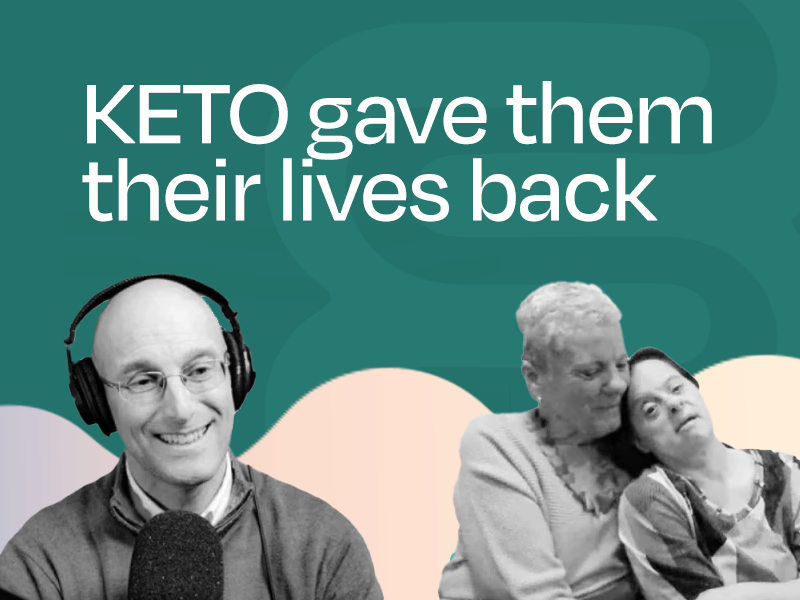
An inspiring story of how one family used a ketogenic diet to get their daughter and their lives back from the cognitive decline that comes with Down Syndrome….
Learn more

Keto Mojo is a brand of blood ketone and glucose monitoring kit designed for individuals following a ketogenic diet. It provides a convenient way to track ketone levels…
Learn more
Emerging evidence indicates that ketogenic therapy can help treat mental illnesses such as depression, bipolar disorder, schizophrenia, anorexia, and others. But some may question whether it is safe….
Read more
This Metabolic Mind episode with Dr. Bret Scher explores whether carbohydrates are harmful to mental health. It explains how the impact of carbs depends on individual metabolic health, lifestyle, and goals—especially when using ketogenic therapy for mental illness. The discussion highlights how ketosis changes brain energy use, why some carbs can be beneficial, and how tools like CGMs can personalize dietary decisions.
Learn more
An inspiring story of how one family used a ketogenic diet to get their daughter and their lives back from the cognitive decline that comes with Down Syndrome….
Learn more
Keto Mojo is a brand of blood ketone and glucose monitoring kit designed for individuals following a ketogenic diet. It provides a convenient way to track ketone levels…
Learn more