New Results: First RCT for Schizophrenia & Bipolar Disorder. Learn more.


Listen, Watch & Subscribe on:



First RCT of Keto for Schizophrenia & Bipolar Disorder: Results & Future Directions
Listen
About the host

About the guest


Julie:
There is a signal here that ketogenic therapy may improve positive symptoms, negative symptoms, and cognition.
Bret:
Welcome to the Metabolic Mind Podcast. I’m your host, Dr. Bret Scher. Metabolic Mind is a non-profit initiative of Baszucki Group, where we’re providing information about the intersection of metabolic health and mental health and metabolic therapies, such as nutritional ketosis as therapies for mental illness.
Thank you for joining us. Although our podcast is for informational purposes only and we aren’t giving medical advice, we hope you will learn from our content and it will help facilitate discussions with your healthcare providers to see if you could benefit from exploring the connection between metabolic and mental health.
A new trial was just published, which is the first randomized controlled trial looking at ketogenic therapy specifically for psychosis spectrum disorders, which includes schizoaffective disorder, schizophrenia, and bipolar disorder with psychosis. The study was a four-week randomized controlled trial that then extended into a four-month open-label non-randomized study.
So, it’s essentially two studies in one. And it’s really interesting to talk about the differences between the types of studies and why it was even done this way. But the end result is that they found impressive metabolic improvements and what appears to be psychiatric improvements as well. So, as with any research, especially early research, there’s so much to learn from it, both about the science of the intervention, but also how to design the trial.
So, to get into all of this, I’m joined today by Baszucki Group Director of Neuroscience, Dr. Julie Milder. And we talk about the details of the study, what it means for what we know about ketogenic interventions for psychotic disorders now and for future studies. So, I hope you really enjoy this interview with Dr. Julie Milder about this exciting new study.
Many of the interventions we discuss can have potentially dangerous effects if done without proper supervision. Consult your healthcare provider before changing your lifestyle or medications. In addition, it’s important to note that people may respond differently to ketosis, and there isn’t one recognized universal response.
Dr. Julie Milder, thanks so much for joining me again here on our Metabolic Mind.
Julie:
Thanks for having me.
Bret:
Yeah, so I’m excited to talk to you about this study, and it’s a really interesting study with a lot of lessons about how to design a study, how to interpret a study, right? And it’s two studies in one.
So, metabolic improvements with a ketogenic diet correlate with symptom improvement in psychosis, a randomized controlled trial, and it’s being published in Schizophrenia Bulletin. And I think there’s a, like I said, there’s a lot to talk about, but why don’t you lay the groundwork of this study?
Because there’s lots of things that we’re learning in metabolic psychiatry, and studies that are coming out as the first this and the first that. And this is the first randomized controlled trial for psychosis with a ketogenic intervention. So, tell us more about the background and the development of the study.
Julie:
Yeah. This is exciting because we know, as we’ve been seeing pilot trials published, one of the big questions is what happens when you have randomization with a control group? And so, it is important to ask that question, and this is our first step towards that, towards understanding that with specifically people with psychosis.
And so, in this study, the team had a, they actually had a grant from NIH to do a four-week randomized controlled trial, and the idea was they could recruit people with schizophrenia spectrum disorders as well as bipolar disorder type one. So, that’s across the diagnoses that include people with psychosis.
And it was-
Bret:
So, just for starters, that’s pretty cool. A grant from NIH to study this is not something we’ve heard a lot of. So, that from just on step one is really exciting.
Julie:
Absolutely. And when we discovered this was happening, we got very excited because there’s not a lot of NIH support for these types of studies, at least yet.
We hope there will be more now that we are building the evidence base. And when we met the investigators, we wanted to know more. We wanted to know how they designed it, why they chose certain things, and the design was locked into four weeks as an RCT. And so, we’ll come back to that. The four-week time point is important, and there’s a lot of lessons about doing it for four weeks.
But within that four weeks, they did randomize people across these diagnoses to either a ketogenic diet intervention with meals that were delivered or diet as usual. So, they were just asked to do what they normally do, and they compared the two groups What happened when we learned about this study was we said, “Gosh, from the anecdotes we’ve been hearing from folks and from our pilot trials, we’re not sure if four weeks is long enough.
Is there a way that we could supplement what’s going on in this study?” And this is how it became a two-phase trial basically. So, there’s four-week data, which is randomized control trial, diet as usual versus ketogenic diet. And then anyone who completed was offered the option to either continue the ketogenic diet if that’s the arm they were in for an additional three months. So, they had a total of four months of dietary intervention.
And if they were in the control group, they could then try it for four months. And this is really a wonderful way to incentivize people to complete a trial as well because they weren’t blinded. They knew if they were in receiving meals and trying a new dietary intervention, or they were just being followed on their diet as usual.
So, it’s a nice thing to say, “Hey, if you can get through one month, you can try it too at the end.” And so then over half of the people who completed the four weeks offered to go into the four-month extension. And in the four-month extension, everybody was on ketogenic diet. And so, that phase is more similar to some of the pilot trials that we’ve already seen published, which is four months on ketogenic diet, let’s see the outcomes at the end.
So, that’s why we have these two phases of the study that was a combination of funding. Started with NIH, and then Baszucki Group came in and supplemented in order to get that longer term data in anybody who wanted to try the diet for four months.
Bret:
Yeah, and I mean it really shows, I guess, the good and the bad of funding like this because it’s great that it got funded, but it was only enough for a four-week trial, which as you alluded to really isn’t long enough.
If you talk to any of the experienced clinicians, and like you said with the pilot data, I mean you really need eight weeks, 12 weeks to really start to see the benefit in the majority of the people because this adaptation period, getting your brain to run on ketones, metabolic adaptation and all that.
So, I guess the downside of the funding was it wasn’t enough for a longer RCT. So, when we hear “RCT gold standard evidence,” there’s more details that are important than just it was an RCT. So I like how you pointed that out. So, what were some of the findings for the four weeks? And then how does that compare to the longer extension, the four-month extension?
Julie:
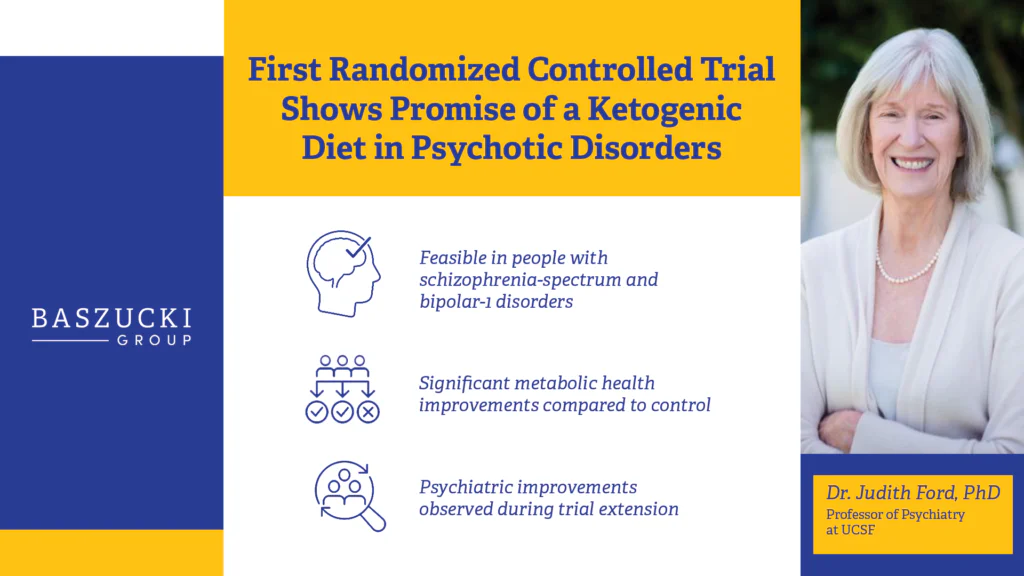
Yeah, the interesting part about the four weeks is that the primary endpoints were both related to metabolic health and psychiatric symptom improvement. And what was interesting was four weeks was enough to see changes in the metabolic markers. And so, that’s actually really interesting because that is a randomized control trial, ketogenic diet versus diet as usual, and they saw improvements in metabolic markers that were sustained at the four-month time point.
And so, there was that piece, and those were statistically significant at four weeks, the psychiatric markers. And they were looking at things that were pretty specific to psychosis, positive and negative symptoms, and as well as a cognitive battery that is specific to people with psychosis.
And it’s an overall cognitive battery. It takes into account all types of cognition and gives you a score. And then, they also did PHQ-9, which is used often for depression. And all of those, there were trends that looked like they were starting to improve at four weeks, but it was only statistically significant in those that did the four-month extension.
And so, this is where we look at that, to your point, about is four weeks really enough in a randomized controlled trial? From what we’ve learned, we would say probably not, and so, especially for psychiatric symptom improvement. So, for some things, it depends on your question. You may see improvements in some metabolic markers and things like BMI.
People became more metabolically healthy over four weeks, but their psychiatric symptoms didn’t statistically improve unless you looked at the four-month data from those who then opted to go into the four-month extension. And at four months, this is really interesting and builds upon the prior pilot studies in these populations, improvements in especially the things that are specific to psychotic disorders is really exciting.
In psychosis, it’s really difficult to impact specifically negative symptoms and cognition, and these are huge issues in this population. And they are looking for things. They are looking for things to help those aspects of illness. And there is a signal here that ketogenic therapy may improve positive symptoms, negative symptoms, and cognition.
And so, there’s a lot of excitement here around a potential future randomized control trial that could look at the same thing with a control group in context.
Bret:
Yeah, and just real quick for definitions. Positive symptoms tend to refer to the psychosis, the psychotic-type symptoms.
Negative symptoms, the big one people talk about is anhedonia. Just complete sort of a lack of enjoyment. And a lot of the times the, I guess you could say, the disease process brings that on, and the medications for psychosis can bring that on. So, not only does the medications not treat the negative symptoms, but sometimes can exacerbate the negative symptoms.
So, to find a nutritional metabolic therapy that can address both the positive and the negative symptoms really is encouraging. Now, of course, as you alluded to, that was in the non-randomized part. So, future studies will hash that out even more but so important. That really can’t be overlooked in terms of how important that is.
So, people like to have clean conclusions, and they say, “Oh, it was a negative trial. The randomized trial was a negative trial.” How would you respond to that?
Julie:
Yeah, I think this is… Thankfully, we have the four-month extension. I think it, because it makes the point, I think, that four weeks isn’t enough in serious mental illness in these trials.
And then when you look again, the metabolic effects, that was a positive study if you look at just the four-week data. Science isn’t clean, and I think that I really applaud the investigators for putting all this data together into one paper because I think that makes the story more compelling, and it gives us learnings about how we should be designing these trials moving forward.
And they acknowledge a lot of that in their discussion as well, which is they didn’t know some of this when they designed this trial. Again, this is a time where we didn’t have any published pilot trials yet, even when they designed this and when it got funded. So, who knew that four weeks wasn’t going to be long enough?
And we know better now.
Bret:
That’s such an important point. It’s being published after some of the pilot trials have been published, but it started before those were published. So, really they were, I guess you could say, going blind almost from a scientific standpoint. Now, but we also see people online and we share, they’re sharing their stories at Metabolic Mind’s THINK+SMART page and on videos we’ve done where they’re like, “Within days, within a week, my life was totally different and my brain was different and I was no longer depressed.
I no longer had, my mania.” And so, there are examples of that. So, I can see why somebody would say, “Oh, this happens right away.” And as we know, there isn’t always just one response. I guess excitement could be like this happens right away. But as we’re seeing in studies and in clinical practice, that’s the exception, not the rule.
Would you agree with that?
Julie: Absolutely, and I think with any, treatment, whether it’s dietary or otherwise, there’s going to be a spectrum of response. There are always people who are super responders all the way through the spectrum to those who won’t respond at all. And so I think with anything, especially in a trial, we need to allow sufficient time for an adequate trial of that therapy, whatever it is.
Some people, if you go to individuals, there probably are stories even within the trial of people who saw improvements very rapidly. The challenge with a trial is you’re looking for a group level effect. And so, you need to go long enough so that the average of the effect gets captured. And I think that’s really important because that’s the challenge with doing trials versus what’s happening in the real world.
In the clinic, people can follow an individual patient, and see how they’re doing over time. And if they get better rapidly, that’s great. If they want to try longer, they can. In a trial, we have to pick a time point. And again, to find a group level effect, what we’ve learned is that it really needs to be a minimum that we’re recommending of 12 to 14 weeks in a clinical trial to see that average response. And then, get an idea of what that looks like at really at least three months, if not longer.
Bret:
Good point. Now, I also want to circle back to what you were talking about with the results. We talked about the positive symptoms, the negative symptoms, but also you mentioned the cognitive tests, which I think is super interesting because that’s not something we’ve heard a lot about from maybe some of the pilot studies.
And hats off to Dr. Ford and her team for looking at the cognitive symptoms. Like how big of an issue is that in psychotic disorders and the treatment we have now? And are there other studies that have looked at this that you’re aware of?
Julie:
Yeah, it’s a big problem.
I have recently started attending conferences that are focused on psychotic disorders, and they talk about cognition a lot. It’s often overlooked, I think, in treatment. And it’s because the primary thing people are concerned with is the psychosis. But as you mentioned, a lot of the treatments for psychosis exacerbate some of the other symptoms of the illness.
And I think that when we also talk about quality of life, things that interfere with cognition are terribly hard on people to live with, whether it’s just working memory, trying to do daily tasks, executive function. And the biggest gap in treatment is looking for things that improve those cognitive deficits in addition to the negative symptoms, as I mentioned.
And so there is a huge opportunity here. I hear, “I don’t know of any other treatment modalities that are specifically looking at studying the impact on cognition in psychotic disorders.” But thankfully, in the studies that we are aware of in ketogenic therapy that are still ongoing, it’s something that’s being included.
And so, I think we’re going to learn a lot over the next couple of years as more of the trials, the randomized control trials for ketogenic therapy and psychosis, are completed and analyzed and published. We’ll be able to see a little bit more detail around what it means to potentially have an impact on cognition in this population.
Because I think, again, that downstream impact of cognition on global functioning and quality of life is huge.
Bret:
Yeah, it’s so important that you bring up quality of life. And look, I get it. The psychosis is acutely dangerous for the individual and for others. So controlling that, I get why that is first priority, but that’s not the end of the treatment priority.
Then, you start talking about quality of life, exactly like you brought up, and cognitive function really plays into that. So, with all the lessons learned from this trial, you are very well tapped into the research community here. At the time of this recording, how many randomized control trials for 12 weeks or longer are you aware of that are going on right now? Even though that number seems to continually change, which is a good thing.
Julie: Yeah, we have funded now 16 clinical trials that’s across diagnoses. That’s not just in psychotic disorders, but that includes those that also have bipolar or major depression, and then even anorexia nervosa. And most of the trials that include psychosis are, right now, the ones that are ongoing are combinations of diagnoses.
And so, when we think about psychiatry, one of the challenges is someone gets a diagnosis of, say, schizophrenia or schizoaffective disorder or bipolar I. The trials are currently more focused on how you group them according to their illness, which like this one, which is schizophrenia spectrum disorders and bipolar I, because we’re looking at the symptoms of psychosis.
And so, there’s interesting things going on in different, I would say, types of psychosis or categories of psychosis, like early psychosis. What happens if we intervene with someone who has had their first episode of psychosis? And again, that will capture multiple diagnoses, but looking at the illness from that sort of symptom bucket.
And there’s a lot going on. I think it’s really exciting that in the next, I would say in the next two years, we will have multiple randomized control trials completed that have all been at least 12 or 14 weeks long, and we’re going to learn a lot. And I think one of the most exciting things about this field is that, again, even though this study was just published, it began several years ago.
That’s how this happens in science. But we’ve had an explosive ramp-up of research. And so, we had a very active couple of years with pilot trials publishing. I think the next two to three years is going to be a ton of randomized control trial data. So, two years from now, and as more trials begin, we’re going to be in a completely different state with what level of evidence we have and what we can say about ketogenic therapies and their uses in serious mental illness.
Bret:
Dr. Julie Milder, thank you so much for joining me to go over this study and all the details that are so important to bring out of this. And, of course, what the future is likely going to show, and how exciting it is to be at this time of really an explosion of evidence for metabolic psychiatry. So, thank you.
Julie:
Thanks for having me. Always happy to talk about the science.
Bret:
Thanks for listening to the Metabolic Mind Podcast. If you found this episode helpful, please leave a rating and comment as we’d love to hear from you. And please click the subscribe button so you won’t miss any of our future episodes. And you can see full video episodes on our YouTube page at Metabolic Mind.
Lastly, if you know someone who may benefit from this information, please share it as our goal is to spread this information to help as many people as possible. Thanks again for listening. And we’ll see you here next time at the Metabolic Mind Podcast.
Listen, Watch & Subscribe on:
SAN MATEO, Calif.—(BUSINESS WIRE)—Published today in Schizophrenia Bulletin, a first-of-its-kind randomized controlled trial (RCT) from researchers at the University of California, San Francisco (UCSF), and funded in part…
Read more

The brain is the body’s most energy-intensive organ. Despite making up just 2 percent of the body’s mass, it consumes about 20 percent of its energy. Typically, the brain…
Learn more

In this Metabolic Mind Podcast episode, Dr. Bret Scher speaks with registered nutritional therapist and health coach Moira Newiss about a striking case report: a man with schizophrenia and psychosis who achieved remission through sustained ketogenic therapy while facing homelessness and major socioeconomic barriers. They discuss how fasting first introduced him to ketones, why early keto attempts failed due to carbohydrate cycling, and what changed when he stabilized therapeutic ketosis with a simplified two meal routine and affordable foods like high fat ground beef and tallow. The conversation explores real world implementation, medication system “success” versus patient defined recovery, and why this case challenges assumptions about cost, feasibility, and the potential of metabolic approaches in serious mental illness.
Learn more

Follow along with Lauren on YouTube as she undertakes a six-month adventure with ketogenic and metabolic therapies to treat her schizoaffective disorder.
Learn more
SAN MATEO, Calif.—(BUSINESS WIRE)—Published today in Schizophrenia Bulletin, a first-of-its-kind randomized controlled trial (RCT) from researchers at the University of California, San Francisco (UCSF), and funded in part…
Read more
The brain is the body’s most energy-intensive organ. Despite making up just 2 percent of the body’s mass, it consumes about 20 percent of its energy. Typically, the brain…
Learn more
In this Metabolic Mind Podcast episode, Dr. Bret Scher speaks with registered nutritional therapist and health coach Moira Newiss about a striking case report: a man with schizophrenia and psychosis who achieved remission through sustained ketogenic therapy while facing homelessness and major socioeconomic barriers. They discuss how fasting first introduced him to ketones, why early keto attempts failed due to carbohydrate cycling, and what changed when he stabilized therapeutic ketosis with a simplified two meal routine and affordable foods like high fat ground beef and tallow. The conversation explores real world implementation, medication system “success” versus patient defined recovery, and why this case challenges assumptions about cost, feasibility, and the potential of metabolic approaches in serious mental illness.
Learn more
Follow along with Lauren on YouTube as she undertakes a six-month adventure with ketogenic and metabolic therapies to treat her schizoaffective disorder.
Learn more