background logo image

First Peer-Reviewed Expert Consensus on the Use of Ketogenic Therapy for Serious Mental Illness

New publication in Frontiers in Nutrition provides the first expert-driven clinical framework for how to safely implement ketogenic metabolic therapy for schizophrenia, bipolar disorder, and major depressive disorder.

Diagnoses

Schizophrenia, Bipolar Disorder, Major Depressive Disorder

Study Type

Delphi Expert Consensus

Journal

Frontiers in Nutrition

Focus

Clinical framework for implementing ketogenic metabolic therapy (KMT) in serious mental illness

This publication represents the first peer-reviewed expert consensus on the use of ketogenic metabolic therapy (KMT) for people living with serious mental illness (SMI). Created through a modified Delphi process, this document offers practical insights into how to safely integrate KMT, providing clinicians with a structured framework as research in metabolic psychiatry continues to evolve.

Video loading...

Ketogenic Therapy in Psychiatry: What the Experts Agree On

How can doctors, psychiatrists, and other health practitioners implement keto for serious mental illnesses like schizophrenia, bipolar disorder, and depression?

Testimonial Image

We’re not saying everyone needs to do this, but I think we’re providing [a framework] for people who want to do this. We help identify the types of people who would most benefit from KMT, along with the most critical things that need to be measured, monitored, and thought about throughout the process. – Dr. Georgia Ede

I would have loved to have read this six years ago when I was starting to implement these types of practices. It would have given me the confidence to move forward even more quickly and with greater clarity. – Dr. Matt Bernstein


Diagram
Diagram

Expert Consensus on Ketogenic Therapy for Serious Mental Illness

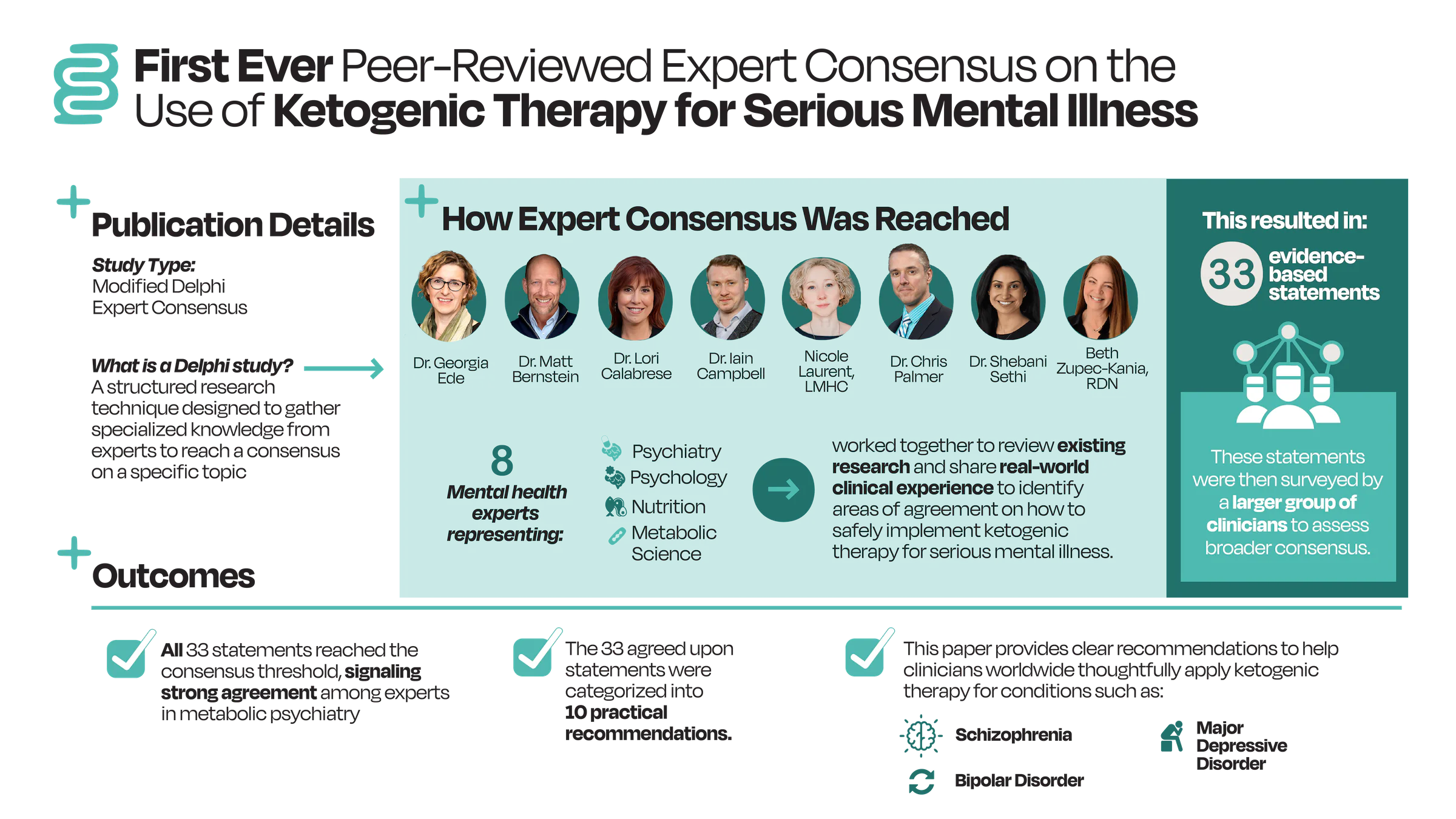
This peer-reviewed consensus paper, published in Frontiers in Nutrition, was created by a multidisciplinary panel of eight experts in psychiatry, psychology, nutrition, and metabolic science. Using a structured Delphi methodology, the group worked independently and iteratively to reach agreement on core principles regarding the implementation of ketogenic metabolic therapy (KMT) in individuals living with serious mental illness.

The panel reached consensus on 33 foundational statements, which are organized into five core topic areas:
• The definition of ketogenic metabolic therapy (KMT) in the context of serious mental illness
• The optimal candidate for KMT
• Monitoring and measurement standards for KMT
• Best practices in employing KMT
• Contraindications to KMT

The statements were then surveyed by a larger group of experienced clinicians to assess the level of broader consensus, resulting in all 33 statements reaching the consensus threshold.

Key Clinical Takeaways

The 33 statements were then used to create a list of recommendations, intended to inform key considerations for clinicians wishing to employ KMT for schizophrenia, bipolar disorder, and major depressive disorder.

Adjunctive Use:
KMT should be considered as an adjunct therapy to first-line treatments for major depressive disorder, bipolar disorder, and schizophrenia.

Who KMT is For:
A trial of KMT is appropriate for most adults living with these conditions, including individuals who cannot access, do not tolerate, or have not sufficiently benefited from first-line treatments.

Signs of Metabolic Dysfunction Not Required:
KMT is appropriate for individuals showing signs of metabolic dysfunction, but the absence of observable signs of metabolic dysfunction should not preclude individuals with schizophrenia, bipolar disorder, or major depressive disorder from a trial of KMT.

Team-Based Care:
Individuals using KMT to treat serious mental illness should be supported by a dietitian/licensed nutritionist or health coach trained in KMT and a prescribing clinician, or a prescribing clinician with training in KMT.

Safety Screening and Baseline Labs:
Prior to consideration of KMT, a thorough medical and psychiatric history should be taken to assess for absolute and relative contraindications (including rare inborn errors of metabolism affecting fatty acid transport/oxidation). Before initiating KMT, a baseline assessment including CBC, CMP, fasting lipid profile, vitamin D, vitamin B12, and a carnitine panel is recommended.

Ketone Targets:
Blood ketone levels should be monitored, especially in the initiation phase. While a BHB concentration of 0.5 mmol/L indicates a state of ketosis, many patients may require levels to be consistently maintained at 1.0 mmol/L or higher for best outcomes.

Trial Duration:
Barring any medical or psychiatric complications, for a trial of KMT to be considered adequate, a state of ketosis should be maintained for at least 3 consecutive months before drawing conclusions about effectiveness (unless earlier discontinuation is necessary).


Why This Consensus Matters:
As interest in metabolic psychiatry grows, clinicians need structured frameworks to implement ketogenic therapy responsibly. This paper is the first step in delivering expert guidance to clinicians who may want to add KMT as a tool in their toolbox.

Where to Learn More

→ Read the Full Publication

If you are a clinician, consider sharing this paper with colleagues exploring metabolic approaches in psychiatry.

If you are a patient or family member, consider sharing this interview and the paper with your care team to support an informed discussion about whether metabolic strategies may be appropriate in your individual case.

Related Content

Keto for Depression
Topic Page

Keto for Depression

Examine depression through a metabolic lens. This page introduces research suggesting that disruptions in the brain’s ability to generate and use energy may contribute to depressive symptoms, and explores how targeted lifestyle and metabolic strategies, including ketogenic therapy, are being studied as potential additions to conventional care.

Keto for Bipolar
topic page

Keto for Bipolar

Explore how metabolic psychiatry is reshaping the approach to bipolar disorder. This hub offers clinical insights, ongoing research, and personal stories highlighting the potential of ketogenic therapy to improve outcomes for individuals living with bipolar disorder.

Keto for Schizophrenia
topic page

Keto for Schizophrenia

Discover the connection between brain metabolism and schizophrenia. This page explores how ketogenic metabolic therapy may address core biopathologies, offering a promising adjunctive approach that has shown potential to support symptom reduction and, in some cases, sustained remission.

Keto and Psych Meds
topic page

Keto and Psych Meds

Learn how metabolic interventions can complement psychiatric medications. This page explores the evolving conversation around medication use, reduction, and synergy with ketogenic therapy; always with a focus on safety, collaboration, and individualized care.

Managing Major Mental Illness with Dietary Change: The New Science of Hope
Free cme

Managing Major Mental Illness with Dietary Change: The New Science of Hope

Harvard-trained, board-certified psychiatrist Dr. Georgia Ede offers a free AMA PRA Category 1 CME-approved training program designed for health professionals eager to explore metabolic psychiatry