New Results: First RCT for Schizophrenia & Bipolar Disorder. Learn more.


Listen, Watch & Subscribe on:



The Future of Mental Health Care: Training Doctors in Ketogenic Therapy
Listen
About the host
About the guest

Deanna:
I had a wait list of, I think, it was 16 or 17 families by last year, that said, can you find me someone who can do this? And when I said, oh gosh, I don’t know what clinicians around me can do this. A light bulb went off, and said, we’ve got to capacity build here. We’ve got to figure this out.
Bret:
Welcome to the Metabolic Mind Podcast. I’m your host, Dr. Bret Scher. Metabolic Mind is a nonprofit initiative of Baszucki Group where we’re providing information about the intersection of metabolic health and mental health and metabolic therapies, such as nutritional ketosis as therapies for mental illness.
Thank you for joining us. Although our podcast is for informational purposes only and we aren’t giving medical advice, we hope you will learn from our content, and it will help facilitate discussions with your healthcare providers to see if you could benefit from exploring the connection between metabolic and mental health.
If you’ve thought about starting a ketogenic diet or ketogenic therapy for mental illness, but have a hard time finding a clinician, or if you’re a clinician wondering how you could get involved and learn how to do this, hopefully we have something for you today. I am joined by Deanna Kelly, who’s a Doctor of Pharmacy at University of Maryland, and she’s starting an innovative study about training and teaching clinicians how to start a ketogenic diet on themselves, and doing it as a study to measure their competence and sort of what they need.
How they’re doing to then be able to apply that to their patients. it’s totally innovative. It’s called Live It, Launch It, and Deanna’s going to tell us all about it. Now, you may also know Deanna Kelly, she is the Professor in Psychiatry for Mental Illness Research at University of Maryland, and we’ve interviewed her before about an inpatient treatment program for patients with schizophrenia that, unfortunately, got shut down by the Maryland Department of Health.
And so, we have episodes about that. So, she gives us an update on how that’s going in her always positive and optimistic manner, which she has. And then, we also talk about her other area of expertise, which is the metabolic consequences, the metabolic side effects, of psychiatric medications, and the use of GLP-1s, how that plays in versus ketogenic therapy.
So we really talk a about a number of different things in this short interview with Deanna Kelly, but mostly about this innovative, really cool research study that hopefully will help expand the ability to apply ketogenic therapy to so many other clinicians. I hope you enjoy this interview with Deanna Kelly. Many of the interventions we discuss can have potentially dangerous effects have done without proper supervision.
Consult your healthcare provider before changing your lifestyle or medications. In addition, it’s important to note that people may respond differently to ketosis, and there isn’t one recognized universal response.
Hello, Deanna. Welcome back. Thanks for joining me again at Metabolic Mind.
Deanna:
Hi. Good morning. Thanks for having me.
Bret:
Yeah, it’s so good to see you again. And you’re always busy with so many different activities. So, I know you’ve got a CME activity that you’re going to record soon. That’ll be fantastic about the metabolic consequences of psychiatric care.
You’ve obviously got your study that you’ve been working on with some hurdles that we’ve talked about. So, maybe we’ll get an update on that? But the main reason for this interview today is your Live It, Launch It new activity. So, I want to hear all about that. So, tell us, tell us what Live It, Launch It is, and why it’s important for us to know about it.
Deanna:
Yeah. Thanks so much for asking. So, this is really exciting for us. This is really what I think of as a capacity building project. And really, it came about because of the clinical trial that we were running with the ketogenic diet, which we’ll come back to. But during that time, during the initial months of getting that study started, we had tremendous outpouring from the community around us.
People asking like, how do I get a clinician? How do I find someone to help me know what to do? Or even the clinicians involved are thinking like, I don’t really know enough. I don’t feel confident with what I’m doing. I don’t even know where to begin.
And it just, over the past year, it’s really hit me. We don’t have a good way to help besides sending people off to get trainings or here and there, but people in their busy lives just don’t have time to do this. So, we decided to do this project called Live It, Launch It. So, in Maryland, we are piloting a project with 40 people where we’re actually going to have them learn what a ketogenic diet is and how to do that, and how to help for mental health, but then also have the chance to live it.
And so, that’s the unique part of it is that we’re hoping that, and I’ll talk more about my like the educational initiatives I’ve done before, like the competence of actually learning how to do it, and feeling competent can change behavior and help people feel more comfortable because knowledge itself doesn’t necessarily help people dive in.
And that’s really with the Launch it part. Like we’re hoping people live it, understand it, they could launch it.
Bret:
Yeah. This is so cool. So, clinicians are going to actually get themselves into ketosis, follow a ketogenic diet, live the ketogenic lifestyle, see what it does for them.
Experience firsthand the, maybe, some of the struggles, maybe some of the difficulties and some of the benefits. And then, learn how to implement it into their practice. So that, I think, that’s so cool.
Deanna:
Yeah. And it’s couched in a research study. So, we are studying this whole process. So. We are actually going to study things like self-reported competence.
Like how confident are you in all these different domains? And like I said, in the educational space, when we teach people and give them knowledge, there’s lots of data that says you can teach them everything you want, but that doesn’t change behavior. So, we’re the step in between is can you feel knowledgeable, but then can you feel competent? If you’ve lived it and you feel like you can help someone, do it, then you can implement it more. And so, yeah, we’re helping, we’re going to be measuring things like self-reported competence in different domains.
But then, for the Live It piece, people have the opportunity to get labs. They’ll have labs done. They’ll have self-reported mental health and physical health measures as well. So. They can see in a period of time how that actually might translate into like how they feel so that they can then, in turn, share their experiences with the people that they might treat or educate themselves.
Bret:
Yeah. And I think that’s such a great idea. I’ve interviewed so many people, so many clinicians, and the majority of them, or I can’t say the majority of them, but a high percentage of them has said I tried keto for something, and then, I realized how amazing it was. And then, I realized I could do it with my patients, and it was a lot of that personal journey.
Really helped people embrace it and probably feel more competent in helping their patients, take it. So, I think that’s such an amazing step. Now, how many clinicians do you hope to enroll for this?
Deanna:
Yeah so, we had set it at 40, and we had 40 people sign-up. So we had about 60 some people who contacted us.
We, obviously, since it’s a clinical trial, we have inclusion-exclusion criteria. If people did not meet criteria for the ketogenic diet, if they’ve done it before, if they’re currently, if they’re pregnant, other reasons why. But we had an outpouring of support. We had a wait list, and then we went through the process of informed consent.
We have, I believe as of yesterday, we have 40 consents. So, that’s the 40 people will participate. I believe most people will be doing the entire two phases, the educational plus the live it, the launch or the, sorry, the lived experience part. But I think a few people, based on some of the inclusion criteria can’t do it all, but we, for all intents and purposes, we have 40 people ready to go.
So, I’m excited that we’re on track, and we had such an outpouring of support.
Bret:
That’s amazing. Are they all mental health professionals or are they across the gamut or what’s the makeup?
Deanna:
Yeah, no, it’s across the gamut. So, we’re located in Maryland at the Maryland Psychiatric Research Center.
And the idea grew out about, through my own communities. There’s people in my own backyard who do this, and I don’t know how to get connected, get everybody connected. But we have some people locally, but we have people from all over the United States. So, many states are represented.
We will be able to send lab slips to them. We’ll send the Keto-Mojo to them. Everyone’s going to get a packet that’s going to be mailed to them, and it’s going to come with, here’s everything you need to get started, et cetera. But we do have, in terms of clinicians, I don’t have the final breakdown.
I’ll, hopefully, have that in another week or two where I can look at it. I believe we have the gamut of psychiatrists, psychologists, social workers, nurses, physician assistants, pharmacists, other mental health specialists. So, that’s going to be the fun part, is that the multidisciplinary piece of this, we’re going to learn from this too, right?
As researchers, we’re going to understand the different disciplines, what they like, what they don’t like. And I think then, as the broader community helps people adapt, we’ll have data to help see what do they like, what do they don’t like? How do people see this different?
Because everybody’s going to approach this, or everyone’s going to come with different experiences, and they’re going to teach it a little different. So, it’s going to be fun to learn from each discipline on what’s helpful, what’s most important for them to take forward.
Bret:
Yeah. And I love that they’re all keto naive, too.
Like they haven’t done it before. So, it’s going to be a new intro for all of them, which is, it was super cool. But what’s the structure of the education? Is it like an app, is it online coaching? Is it, tell us a little bit more about that structure.
Deanna:
Yeah, no, actually we’ve partnered with Denise Potter, who’s a registered dietician.
She has worked with the Charlie Foundation and, obviously, some experts. From there, they’ve put together a keto mastery class for psychiatry, and that’s how we’ll start. We’re going to really start with a developed class. I know there’s other people in this space doing fantastic trainings. We selected this because it’s asynchronous. People can go online, they can look at the, there’s about four hours. There’s group question and answers that people will be able to come back to.
But then, we’re going to work with the dietician group, the broader group from Denise Potter’s program, and we’ll have everybody go through some dietary consults so everyone will understand, like, how do I log my food? How do I select my food? How can I learn a couple of techniques? Should I use a keto calculator or should I not use that? How can I, what are my best, what are my strategies?
Everyone’s going to use the the chronometer or the chronometer, however you say it. And people are going to log their foods, be able to pick their macros, and see how that works for them as well. And so, we’re going to start, that’s really part of the educational process we’ll be doing before and after assessments of how much did you learn? And how competent are you during that process?
And that’s the basis for getting started. Once we get started, we will be doing weekly group meetings with the dieticians and with the group so that we can talk to each other, talk about what’s working, what’s not, and I’m going to be part of this group as it happens, too. I’m going to be along every step of the way. So excited about it.
Bret:
Oh, so cool. Yeah, yeah. That you can take part in it. That’s great. And how long is the intervention or how long is the study period?
Deanna:
So we have, it’s about a four-week period. People have to complete their asynchronous-like learning and go through that process. And then, we’re doing a four-week dietary intervention.
So, while we know that’s not an ideal time to for everybody, but it gives people, these are busy clinicians, right? These are people, who are giving up their time to fill out assessments, to jump in, to meet like people’s days. We’re all busy. And so, I’m really grateful that people can squeeze this in.
We’re trying to make it as easy and user-friendly as people, as can do, but we’re going to be about four-weeks that people be doing the dietary intervention together.
Bret:
Yeah, I love this. I’m so passionate about educating clinicians and that’s why we’re doing, various CME projects like I mentioned that you’re involved in, but.
I mean that only goes so far in educating them. It’s that real life experience that it just takes it to the next level, which is, challenging to do on a large scale, but here you are showing with 40 people here is a model that we can do it. So I’m really curious to see the outcomes of this, and to see how they’re.
their confidence and their feelings of competence change during that, even though it’s a short time period. Can they change enough in that short time period to then feel more confident recommending it to their patients? I think it’s such an amazing model that if it works, could be.
Could be implemented. could you see like expanding this to even more and more clinicians?
Deanna:
Oh, I would love to. I would love to take what we learned from this. And actually, I’m hoping that people give us feedback, too. Like we’re having data collection tools where people can weekly sort of give us information on oh, this might work for a patient. I really need to think about how to deal with this with my patients. What are those steps? We need to know as we could rule this out to be an easy way for people to learn, and the best way for people to learn and implement that.
So, we’re going to learn ourselves so that the next steps could be just that. And so, that the broader community could learn from this. Not just me, like I have selfish, I want everybody around me to learn how to do it because I have witnessed the sort of the power of it and understand the efficacy.
But I want everyone else to be able to benefit from the data we get in-house so that their educational programs and the way that everyone else, like this spreads nationally, or even globally, on helping with anything we can on the educational front.
Bret:
Yeah, and I guess I probably should have started with this, but tell us about your experience and what led you to and wanting to know more and implement ketogenic therapy for treating mental illness.
Like how did that work for you?
Deanna: Yeah, so I think a while back, when I first started the keto diet, I think I talked to you a little bit. But I had originally, I’ve been in the mental health, schizophrenia, in particular, research for 28 years.
So, looking for new treatments and looking for holistic treatments because medications are just not the answer. I’ve looked at metabolic side effects for a lot of my career. Was first to publish on the area of antipsychotic weight gain and diabetes in our young patients with like risperidone, even some of our first, second generation antipsychotics.
And it’s been really a passion of mine to improve care in this space. And while looking for dietary interventions and while going down the road of looking at subgroups of people, who respond differently and helping people find personalized treatment, I actually had a family friend, who had a daughter with intractable seizure disorder, who was treated with a ketogenic diet.
And the understanding that mechanism was really an interesting road for me because like how does this work? I’m just hearing about, this is maybe six or seven years ago, how I’m hearing about this for the first time? And then, I started to understand how this works for mental health as well as some neurologic issues.
And we were really excited to get started last year with a ketogenic diet. And as a lot of your listeners know, we were halted in the state of Maryland because of new changes in policies to the way things are funded. But nothing, because of the study itself, and we’re actively trying to work with the state administration to possibly change that and put some changes in place so we can get started again.
But that’s how that came to be. I’m a fighter so I’m not giving up because the science will win. The science and the changing how people feel, will win out. And I just want to make sure we can get that message out there. And this is part of the capacity to help everyone around us to learn what to do to get started.
Bret: You’re so positive and so energetic about this. I love it. So, people want to hear more. We have, I think, two or three other interviews that you can go back to learn about the study as it was ongoing, and then as it got stopped.
But yet, the drug trials were allowed to continue, but the dietary intervention trial was not allowed to continue. And then the big sort of outreach, and talk about the community coming together to really try and educate.
Psychiatrists and even primary care doctors receive extensive training in how to prescribe medications, but almost none in how to safely reduce them. And yet, for millions of people, tapering psychiatric medications is an essential and often overlooked part of their treatment plan.
Georgia:
There is a real art and a science to reducing psychiatric medications. That if you reduced too quickly, then you could have serious withdrawal symptoms on your hands.
Sometimes, medications will help at first, and then they’ll lose some or all of their effectiveness over time.
Bret:
So, in part one of this series, we’ll explore why so many people face this decision, and what risks and misunderstandings surround it. So, this concept of relapse versus withdrawal, of how do you help people approach that to try and determine is it a recurrence of the symptoms and the diagnosis or is it a withdraw from the medication?
And then in part two, we’ll dive into the how, the principles, the pitfalls, and what it really takes to taper safely. Tapering psychiatric medications isn’t about rejecting treatment. It’s about redefining success because sometimes fewer medications, or even none at all, can mean a full or healthier life.
So, join us October 1st for this two-part series on tapering psychiatric medications, an honest conversation clinicians were never taught to have and patients desperately need.
Powers that be that decided to not allow the study to continue. and you can see some movement. I guess, you’re not up and running as of now, but do you think there’s been a favorable impact that this might end up resuming soon?
Deanna:
Yeah, so I just want to thank everyone out there who had played a role in this. Like I was blown away when we, if you look on change.org that Dr. Chris Palmer started, independent of my work, 21,000, almost 22,000, people signed up saying that they support, and almost 1200 people commented about how this has impacted their lives.
Just that, in and of itself, was powerful, right? That data right there says this matters to people. This and one door closed, another one’s opening here. But we, I am actively working with the state. There’s new change in this, the health department, some of the changes in the health department.
I do think that what matters in the state of Maryland is trying to make sure people have good care, people have access to care. And this is an idea of access to care, of new treatments that could really help people, could help people do well, could help people get out of the hospital, et cetera. Those conversations are actively happening.
I have faith in this process. I can’t guarantee we’re going to have this overturned or not, but that’s where I can, that’s where I can lead you down right now is that we’re actively in the middle of this negotiation. So, hopefully. But I wanted to tell you, I just wanted to let you know, we were able to look at some of the very early data because it got stopped as we were just getting started.
But we are getting ready to publish a case report from our first person who went through the study. And that’s been submitted for publication. But I just wanted to note that in our person, that the first person to go through this study entirely, was someone who had many antipsychotics on board, including two like clozapine and olanzapine, both with metabolic side effects and we’re going to talk more about that.
But difficult medications that cause a lot of side effects. And our person in a very short period of time had a 69% decrease in their HOMA-IR. So, they went from type II diabetes to in the normal range in that short period of time with antipsychotic treatments on board, like clozapine, olanzapine.
That’s just a little snippet of what we had seen. I was excited that we had that result. This just lends itself to show the support that this could be a powerful intervention. That’s just the, on the metabolic side, that’s not even the hint that symptoms are improving as well.
Bret:
Yeah, that’s remarkable. And it really is timely, though, because there was a recent study, a randomized controlled trial about using a GLP-1 semaglutide, for people who are on antipsychotic medications, to see how it impacts the metabolic consequences of those medications.
And there was significant weight loss. normalization of blood sugar and over 80%. So, it was pretty dramatic. So, it could be another use for these. A little bit difficult to get expensive medications that have some side effects. But in certain people, in the right population, have pretty profound results.
So, how do you balance that? The bright, shiny new medication with the dietary intervention that could show the same thing, but isn’t getting the same support to study? Like how do you balance those?
Deanna:
Yeah. You are, we are dealing with medications that have a lot of research and development and money behind them.
So, there’s a lot of marketing that happens. And I’ve seen this in other areas of my career, like with the medication, other medications that have been generic, and they’ve been hard to get out and get to people who need them. And I’ve seen this access-to-care issue all through my career and have actually worked a lot of my career to try to like get access to care.
Of course, like there’s a lot of excitement because there’s money in this, and I’ll see it as this, is that medications can be very good. I’m a pharmacist. That’s my training and this is, this is what I’ve studied with my career, but they’re not the end all be all.
And this is how I got into the field. If they were, I wouldn’t be talking about diet with you because it wasn’t my expertise. You’d be talking to the dieticians, not to a pharmacist. But because I have been doing research, and I’ve been seeing what’s been powerful and what’s been working, I know that not everyone, not every single person, is going to do really well in an antipsychotic or even the other treatments that you start to pile on to.
So, these people that are on these GLP-1 agonist, that’s great. Like we might have some people, this is going to be what’s really important for them and it starts to jumpstart and get people, but not every single person is going to do well on that. There’s side effects, there’s pancreatitis. I’ve already seen pancreatitis in cases locally.
There’s other things to watch out for. And as we add every antipsychotic or other psychotropic or other medication to the next, we bring about potentially other side effects, too. So, it’s a breakthrough. It’s really great that we have that, but we have to understand that the understanding, the core of what’s going on, is possibly more powerful than just treating, and we’re also with the GLP-1 agonist.
We’re losing, part of the efficacy of it is the loss of weight. I find it interesting is even in my experience so far in some of my patients, even without weight loss, we can see the metabolic improvements on the keto diet. So, that’s a different sort of mechanism.
It’s a different way we’re getting to the underpinnings of metabolic dysfunction, in and of itself. And we need to get the word out there about keto, but we have to recognize that there are people that aren’t going to be able to do that, and GLP-1s will have their place for sure.
But we see this with all new medications that come to market. And at the end of the day, we need to make sure we continue to fight for an access to care for other things that don’t have the same backing and funding ,as the shiny new meds too.
Bret:
And like you alluded to, there’s also the potential to treat not just the metabolic side effects, but the underlying psychiatric condition as well. As we’ve seen from Shebani Sethi’s publication, Albert Danan’s publication, that they can.
The people with schizophrenia, as well as bipolar disorder and major depression, but they can reduce their medications and improve their symptoms after starting a ketogenic diet. Now, obviously, we need broader, bigger, randomized controlled trials, which are ongoing right now to learn more about it.
Deanna:
Right, and there’s hints, too. Like we think of psychosis as just someone with schizophrenia, as having just hallucinations, delusions, et cetera. But there’s a whole host of other symptoms that go along with that, like the idea of negative symptoms of lacking your desire and motivation to get things done, communicating, and going to school and having a job and interacting with others, like that’s big.
Those are big factors that impact your functional capacity and how what you’re doing in life. And those things matter. When you talk to families and the moms of people with schizophrenia, for example, they’ll say, I really, want my son to come out of his room and to get a job and to interact.
I want him back. I want that back. So, these negative symptoms have not been treated previously. And so a GLP-1 is an agonist is not going to treat negative symptoms. In fact, they might actually make that them worse potentially. But potentially, like we didn’t do look into that. But there’s a hint from some of Judy Ford’s data from California. And there’s a hint from even our case report that we might, and Shebani and others, they’ve obviously shown some global symptom changes. But even the negative symptom side, these other domains that we don’t think about, and that there’s no FDA treatments for.
This could be a space where we could make a difference in with a ketogenic diet. Because it’s getting to this underlying pathophysiology that could also improve negative symptoms potentially. So that’s my hope is, and we saw that hint in the case for publishing as well.
Bret:
Yeah. Such an important point. Because like you said, we do talk more about the psychosis symptoms and a lot less about the negative symptoms. But equally as important to treat, if not more. And I was saying, there are ongoing randomized controlled trials, but what’s so interesting is it’s a dietary intervention.
It doesn’t have to be a pill that’s FDA-approved. So, people could start it under clinical guidance, and that’s why treating, or sorry, training the clinicians is so important so that they could get comfortable doing it, do it safely as an add-on to standard of care. Like you don’t need randomized controlled trials necessarily to do that for a diet to really impact someone’s life.
Deanna:
We don’t have to wait for FDA-approval here. Certainly, we want evidence space, but their evidence is accumulating. There’s a lot of data out there, people can get started and try this without having to wait for a drug to come to market. And yeah, people need to know how to do it.
And I had a wait list of, I think, it was 16 or 17 families by last year that said, can you find me someone who can do this? And when I said, oh gosh, I don’t know what clinicians around me can do this. A light bulb went off, and said, we’ve got to capacity build here. We’ve got to figure this out.
Bret:
So, yeah. So, that takes us full circle back to your study that you’re doing to train those 40 clinicians to learn how to do it, to live it, learn it or sorry, live it, launch it, which I think is amazing. So, you have to promise me you’re going to come back and tell us the results when you accumulate the data and have it ready to publish.
Deanna:
Absolutely. We’ll be excited, and there’s so many people excited about this. I have a new post-doctoral fellow coming from American University. She’s a Nutritional Neuroscience, PhD, which is a new PhD out there. And, Bret, I sure hope that this field continues to grow because people like her, and train the field in different and novel, innovative ways when we combine nutrition and neuroscience together as a degree.
Like that’s, so we have, we’re just growing the educational realm. We’re growing the future clinicians in this space and the future researchers, too. Yeah, excited.
Bret:
I really appreciate your passion and your tireless work in this area.
So, thank you so much. And thank you for joining me to tell us, tell the world, about this. So, I look forward to seeing you again.
Deanna:
Yeah, thanks again for having me today.
Bret:
Fellow mental health clinicians and healthcare providers, you now have access to a suite of free CME lectures on metabolic psychiatry and metabolic health.
Each of these CME sessions provide insight on incorporating metabolic therapies for mental illnesses into your practice. These CME sessions are approved for a MA category one credit, CNE nursing credit hours and continuing education credit for psychologists, and they’re completely free of charge on mycme.com.
Thanks for listening to the Metabolic Mind podcast. If you found this episode helpful, please leave a rating in comment as we’d love to hear from you. And please click the subscribe button so you won’t miss any of our future episodes. And you can see full video episodes on our YouTube page at Metabolic Mind.
Lastly, if you know someone who may benefit from this information, please share it as our goal is to spread this information to help as many people as possible. Thanks again for listening, and we’ll see you here next time at the Metabolic Mind Podcast.
Listen, Watch & Subscribe on:
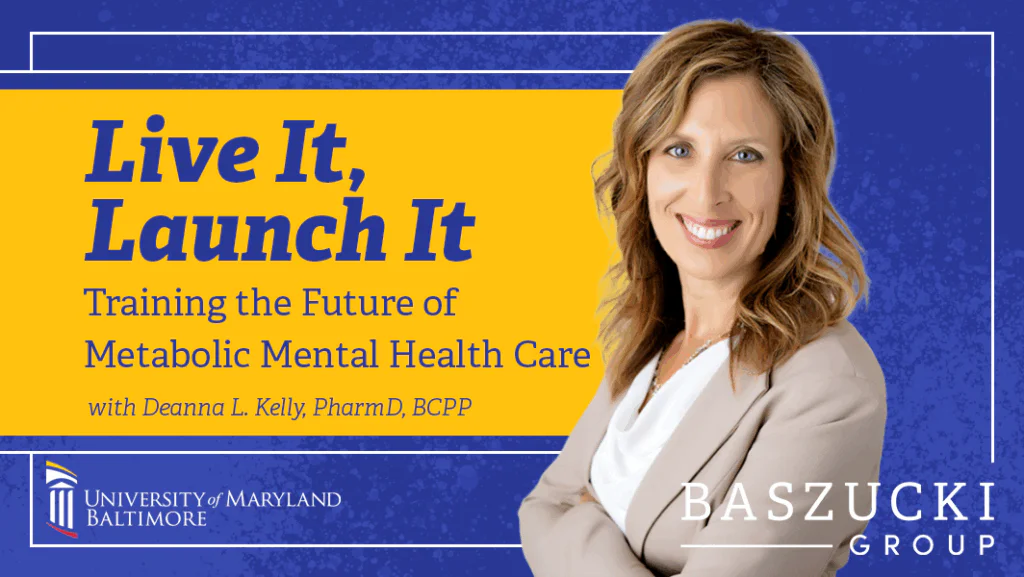
SAN MATEO, Calif.–(BUSINESS WIRE)–Baszucki Group today announced a partnership with University of Maryland School of Medicine for an innovative training initiative that will build capacity for delivering ketogenic…
Read more
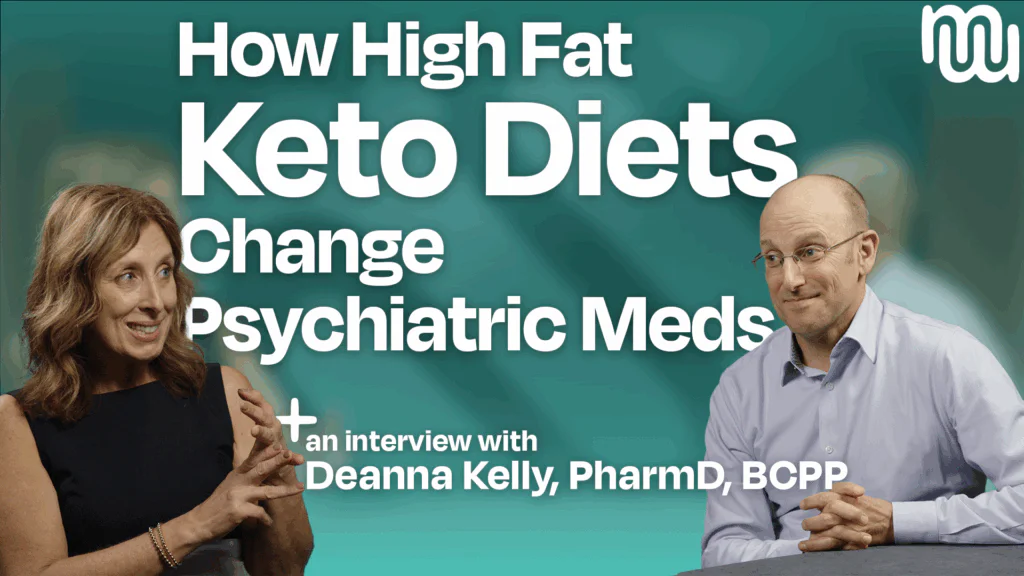
Pharmacist and psychiatry professor Deanna Kelly explains how high-fat and ketogenic diets alter psychiatric drug absorption and metabolism. She discusses risks with quetiapine, lithium, and the new xanomeline–trospium combination, how medications can disrupt ketosis, and why communication with pharmacists is critical for safe, effective metabolic therapy.
Learn more

Visit Dr. Georgia Ede's website to help you discover the powerful connection between your psychiatric or medical diagnosis and your diet.
Learn more
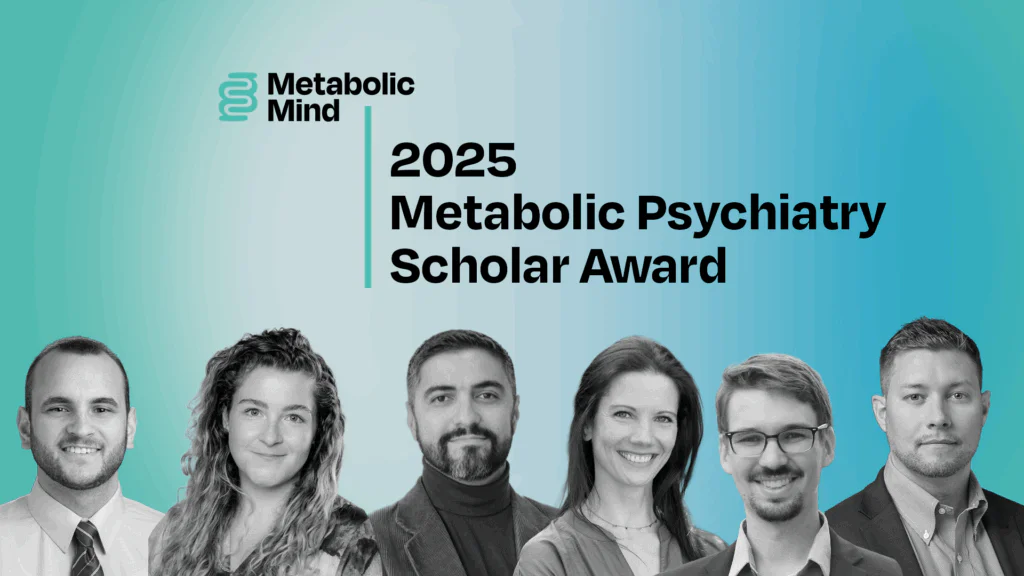
Baszucki Group is proud to announce the six recipients of the first-ever Metabolic Psychiatry Scholar Award, a new initiative that supports exceptional early-career scientists and clinicians working to…
Learn more
SAN MATEO, Calif.–(BUSINESS WIRE)–Baszucki Group today announced a partnership with University of Maryland School of Medicine for an innovative training initiative that will build capacity for delivering ketogenic…
Read more
Pharmacist and psychiatry professor Deanna Kelly explains how high-fat and ketogenic diets alter psychiatric drug absorption and metabolism. She discusses risks with quetiapine, lithium, and the new xanomeline–trospium combination, how medications can disrupt ketosis, and why communication with pharmacists is critical for safe, effective metabolic therapy.
Learn more
Visit Dr. Georgia Ede's website to help you discover the powerful connection between your psychiatric or medical diagnosis and your diet.
Learn more
Baszucki Group is proud to announce the six recipients of the first-ever Metabolic Psychiatry Scholar Award, a new initiative that supports exceptional early-career scientists and clinicians working to…
Learn more