Announcing the new McLean Center for Metabolic Psychiatry Learn more.


Listen, Watch & Subscribe on:


Dr. Peter Ballerstedt on Animal Foods & Malnutrition
Listen
About the host

About the guest


Peter:
There’s a difference between adequate and optimal.
Bret:
Excellent point.
Peter:
And there’s a difference between maintaining and restoring when so many people, certainly in the US but now globally, are metabolically deranged in some way.
Bret:
Welcome to the Metabolic Mind Podcast. I’m your host, Dr. Bret Scher. Metabolic Mind is a non-profit initiative of Baszucki Group, where we’re providing information about the intersection of metabolic health and mental health and metabolic therapies, such as nutritional ketosis as therapies for mental illness.
Thank you for joining us. Although our podcast is for informational purposes only and we aren’t giving medical advice, we hope you will learn from our content and it will help facilitate discussions with your healthcare providers to see if you could benefit from exploring the connection between metabolic and mental health.
Please remember that our channel is for informational purposes only. We’re not providing individual or group medical or healthcare advice or establishing a provider-patient relationship. Many of the interventions we discuss can have potentially dangerous effects if done without proper supervision.
Consult your healthcare provider before changing your lifestyle or medications. In addition, it’s important to note that people may respond differently to ketosis, and there isn’t one recognized universal response
Peter Ballerstedt, thank you so much for joining me.
Peter:
Thank you, Bret, for the invitation.
Bret:
Of course. Now, I’m always fascinated every time I hear you talk, every time I get to interact with you, because you bring these two worlds together. The agrarian world, the cattle world, and the health world, and you really try to help kind of bridge that gap and show how they’re so related.
So, with that as the introduction, you were there last night at The Cholesterol Code screening. And I want to get your impression of the documentary, and how you think it impacts your world of bringing these two sections together.
Peter:
I was so pleased to be there. I think it’s so well done. I’m thinking of ways to publicize it, and expand its reach.
Bret:
Yeah.
Peter:
There’s a mental health issue within the rural populations. The stress that families and operators are under. So, I think that the message that diet can influence mental health positively or negatively is really important for the rural audiences that I’m trained to serve. I think that in addition to that, people who are in, let’s say, the ranching communities that are producing animal-sourced foods, it’s good news because it turns out that animal-sourced foods can be a featured part of diets that can restore health in really profound ways.
And finally, I have personal experience in my family with mental health issues. I also have some experience with addiction and recovery. And so, this interaction between nutrition and mental health and recovery is one that I just find to be an enormously encouraging message that I want to find more ways to publicize.
Bret:
Yeah, I think your answer is fascinating because the documentary is called, Cholesterol Code. You didn’t say one word about cholesterol, which shows there was so much more in there about the impact of nutrition, of ketosis, the benefits of it, and how we weigh the benefits against that one lab test, the LDL.
And you mentioned animal-sourced foods, and as it was said in the documentary, ketosis doesn’t have to be animal-sourced foods. But once you cross that line and start talking about animal-sourced foods, you really set yourself up for a lot of criticism from mainstream nutrition, mainstream medicine.
What are they getting wrong? Why can’t they see what we saw last night about the healthy impact of diets containing animal-sourced foods?
Peter:
As you well said last night, there’s probably lots of answers. I think the chief one, though, is this concern about LDL cholesterol or raising cholesterol in some way.
There’s also been other stories about how red meat leads to cancer and all of those, to some extent, zombie myths. That no matter how much information is available to refute, it just won’t die. And so, it keeps coming back. I think that there’s some other questions that people have, but I think there’s information that we could put in front of people to answer some of those concerns.
But the biggest issue is so many people are challenged with some form of chronic illness. And this is a global issue. And this cuts across all income level countries. And we’re dealing with the topic of malnutrition properly, or more broadly understood, than is typically discussed. And so, if we’re going to meet these goals for supporting sustainable development around the world, proper nutrition ought to be part of that conversation.
And I think that a really good case can be made that this is a critical, maybe new, set of lenses to look at a lot of topics through because it changes everything. We have been given the received wisdom of what constitutes a healthy diet. And then, a lot of models are built on that. A lot of policy is built on that.
And I’m going to raise my hand and say, are we sure? And then, there’s the other question of, okay, so you’re saying that this is a healthy diet for people to eat to maintain metabolic health. Fair enough. We could have that conversation, but we don’t live in that world now. We live in a world where the majority of people are not metabolically healthy.
And the diet that restores metabolic health, may very well not be the same one. And so, people should be given the freedom to explore that themselves. And I think that was one of the most powerful things about the documentary is real-life people.
Bret:
Yeah.
Peter:
Free-living human beings going through that experience as well as what they had to deal with as part of that.
And if that gives more people permission and encourages more people to do their own investigation, I think that’s one of the goals that Dave himself mentioned.
Bret:
Yeah. Such an important point, to do your own investigation on yourself. And if your goal is improving your health, reversing a medical condition, and you do it, like everybody should be applauding that.
We shouldn’t be worried about the specifics of the diet if they are improving their health and improving their lives. So, that’s diet as it applies to health. I wish we could all agree on that, and get over our preconceived notions and biases of what a healthy diet is, to applaud improved health.
But then, there’s that other layer of the environment. And something that in the medical world maybe we don’t talk as much about. But you could say, it doesn’t matter if you’re improving your health, if you’re destroying the environment. And it really boils down to being that simplistic.
You eat animal source foods. You’re destroying the environment. And we’re a society that doesn’t like nuance. We like the boogeyman. We like to know who the enemy is. We like to be black and white. But you, obviously, you often bring up more nuance about that topic. Which I know is a talk in itself. And I’m going to ask you to summarize in about 30 seconds, but tell us about that.
Like, where do we get that wrong?
Peter:
We get it wrong on so many levels.
Bret:
Yeah.
Peter:
But there is no feed-food competition. In other words, the feed that’s fed to livestock is not a significant drain on the food supply for humanity. There’s the land use question, but the majority of the land that’s used to raise livestock is not suitable for the production of human edible crops.
We have this either/or mindset in so much of society today. Agriculture’s no different. But there is no sustainable food system without livestock, in general, and ruminants in particular, for reasons that I’ve gone into in greater depth elsewhere, and happy to do again. Part of this is built on the notion that it’s bad for you, and it’s bad for the planet.
Bret:
Yeah.
Peter:
So, we need to acknowledge that the former needs to be critically examined. And then, I would say, “Okay, you’re saying that there’s going to be these negative impacts in 2100 when we already know that 52% of humanity’s malnourished today?” And then, there’s other statistics that we could cite about how malnutrition is the driver of chronic illness, and chronic illness is the driver of the unsustainable healthcare burden.
So how do we put the production of the nutrient-dense, to use a phrase, foods via animal agriculture, whatever its impact, how do we put that against? What is the societal impact of the healthcare industry? What’s the economic impact of the healthcare industry? What’s the environmental impact of the healthcare industry?
Bret:
And that’s a question people don’t ask.
Peter:
It’s not well-quantified. There’s some data points. The point is it has an impact.
Bret:
Yeah.
Peter:
And if it’s true that if we could lessen the burden of chronic illness, we would lessen the burdens of healthcare industry. Then how do we incorporate that into a more reasoned conversation about this?
Bret:
And I want to come back to the term you’ve used a couple times, malnourished. I think when people hear the term malnourished, they think of someone who’s incredibly skinny and, just underweight. But we have a epidemic of people being malnourished and overweight with type 2 diabetes. So, tell us about that.
How do you define that as malnourished?
Peter:
I guess one definition is that a diet that doesn’t support proper human development and function.
Bret:
Yeah.
Peter:
Now, I’m a forage agronomist. I’m a ruminant nutritionist. So, forgive me if I’ve transgressed anywhere, but I think that’s a good working definition.
Unfortunately, the prevailing wisdom comes in and says, “Oh, obesity is the result of overnutrition.” And but if we understand that obesity is a disorder of fat accumulation, and that’s driven by chronically elevated insulin, then a diet that chronically elevates insulin ought to be classified as one that’s malnutrition.
There’s a whole question of ingestive behavior being influenced by the quality of the diet. So, if I’m feeding a human being a diet that doesn’t include sufficient indispensable digestible amino acids, then maybe that induces eating more in an attempt to get what the body somehow senses it needs?
It’s a questionable area, but it’s out there. So yes, indeed, we have the conventional thought that this is overnutrition. I’ve even heard people say that evidence of how good we’re doing in our food system is how much obesity we have.
Bret:
Wow.
Peter:
Because they say. “Look, there’s so much food that people are overeating.”
Bret:
Yeah. Calories equals nutrition.
Peter:
No, exactly. They’re not one and the same. Malnutrition is not synonymous with caloric deficit.
Bret:
Yeah.
Peter:
And we can find all kinds of evidence of various forms of lack. So the rate of anemia within women of childbearing age in the US, to say nothing about globally.
Bret:
Yeah.
Peter:
Or the rate of stunting in children. And but even the sort of stereotypical famine child image, where you have the bloated belly and the skinny arms and legs, kwashiorkor. There are people talking about subclinical kwashiorkor, and how much of what we’re seeing is really some manifestation of a low-level deficiency in some of these indispensable amino acids.
So, we haven’t been taught to think about protein quality properly.
Bret:
Yeah.
Peter:
And so then, we’ll talk about food systems, but we’ll talk in terms of yield of protein, really crude protein, not utilizable protein for humans. Or again, as you mentioned, we’ll talk about calories. Is 100 calories from sugarcane the same metabolic importance as 100 calories from say, pork fat?
No. Or olive oil?
Bret:
They’re going to have very different effects.
Peter:
Very different metabolic effect, especially if somebody’s metabolically deranged. And yet, we talk about them the same.
Bret:
Yeah.
Peter:
And finding venues where we can have longer conversations rather than the sound bite. But there’s some really fascinating work that’s going on that’s really hopeful across a large span of disciplines, that I think if we could get people to understand that if animal-sourced foods are further restricted, that will harm public health.
If we, and I mentioned already that livestock agriculture is essential for sustainable food systems, and animal-sourced foods are part of our ancestral heritage and traditions. And so, those are foundational things that I work from. I hope that if somebody doesn’t agree with my dietary choices, they still, as Adele Hite taught me, we can agree on the importance of providing adequate essential nutrition for as many people as possible.
Bret:
Yep.
Peter:
And we should focus on maintaining metabolic health, those two goals. Far be it from me to ever entertain the idea of editing Adele’s work.
Bret:
Please.
Peter:
I’ll just suggest that there’s a difference between adequate and optimal.
Bret:
Excellent point.
Peter:
And there’s a difference between maintaining and restoring.
Bret:
Yeah.
Peter:
When so many people, certainly in the US. But now globally, are metabolically deranged in some way. That’s probably not the good word to use.
Bret:
I really appreciate your level of discussion. You definitely take things a couple layers deeper than the average discussion. And really bring in the nuance and the complexity that we need to understand to really get this right for individuals and for our population, and for our environment and our world.
So, thank you very much for bringing that discussion. I really appreciate it.
Peter:
Thank you, Bret. I really appreciate all the work that’s going on. If you have any experience with people who are dealing themselves with mental illness or someone in your family, I really want people to learn about the importance of metabolic health in mental health. And I want this message to get more widely distributed.
I can think of very few things that are more important. And so, I’m more than pleased to have the opportunity to just contribute a little bit have people rest easier in following a diet that produces all these benefits and improve the quality of their lives.
Bret:
Yeah.
Peter:
It’s my pleasure.
Bret:
Thank you. Thank you for that.
Thanks for listening to the Metabolic Mind Podcast. If you found this episode helpful, please leave a rating and comment as we’d love to hear from you. And please click the subscribe button so you won’t miss any of our future episodes. And you can see full video episodes on our YouTube page at Metabolic Mind.
Lastly, if you know someone who may benefit from this information, please share it as our goal is to spread this information to help as many people as possible. Thanks again for listening, and we’ll see you here next time at the Metabolic Mind Podcast
Listen, Watch & Subscribe on:

Investigative journalist Nina Teicholz reveals the unthinkable: that everything we thought we knew about dietary fat is wrong.
Read more
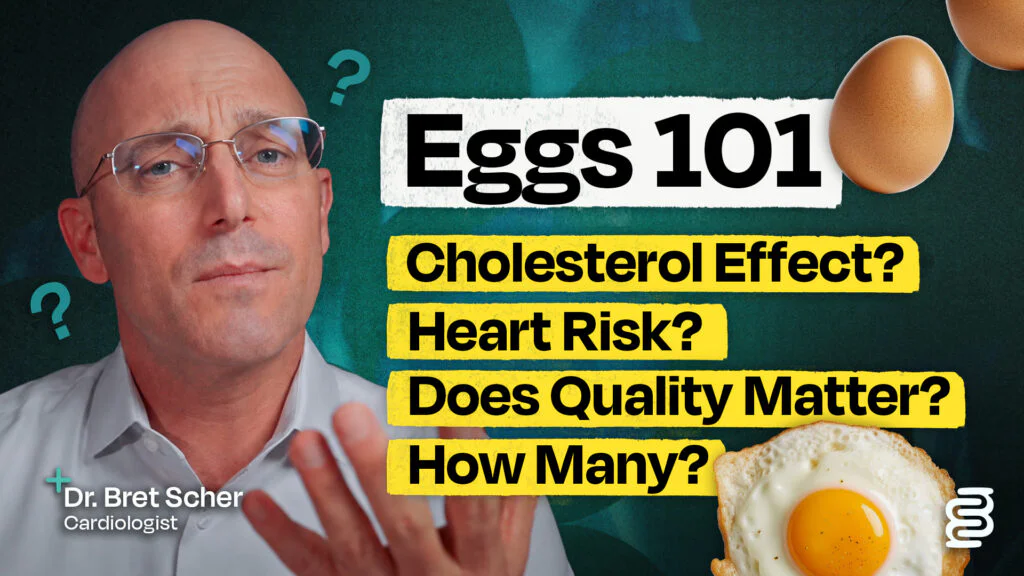
Dr. Bret Scher tackles the long-running debate over eggs and cholesterol, explaining that while eggs can mildly raise LDL for some people, this doesn't automatically translate to increased heart disease risk. He breaks down why headlines warning against eggs rely on weak observational data with tiny effect sizes, and highlights eggs' impressive nutritional profile, including protein, choline, and fat-soluble vitamins, arguing overall diet quality matters far more than egg consumption alone.
Learn more
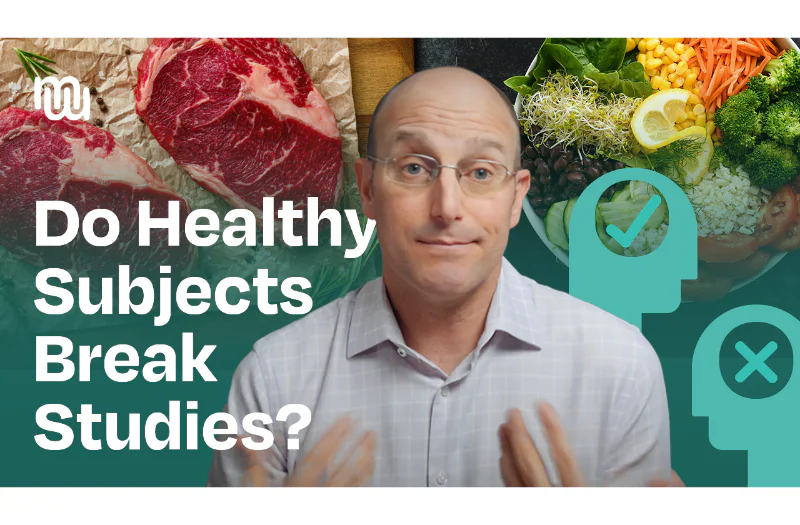
Did you know that being healthy can actually skew the results of scientific studies? It’s called “healthy user bias,” and it plays a major role in how we…
Learn more
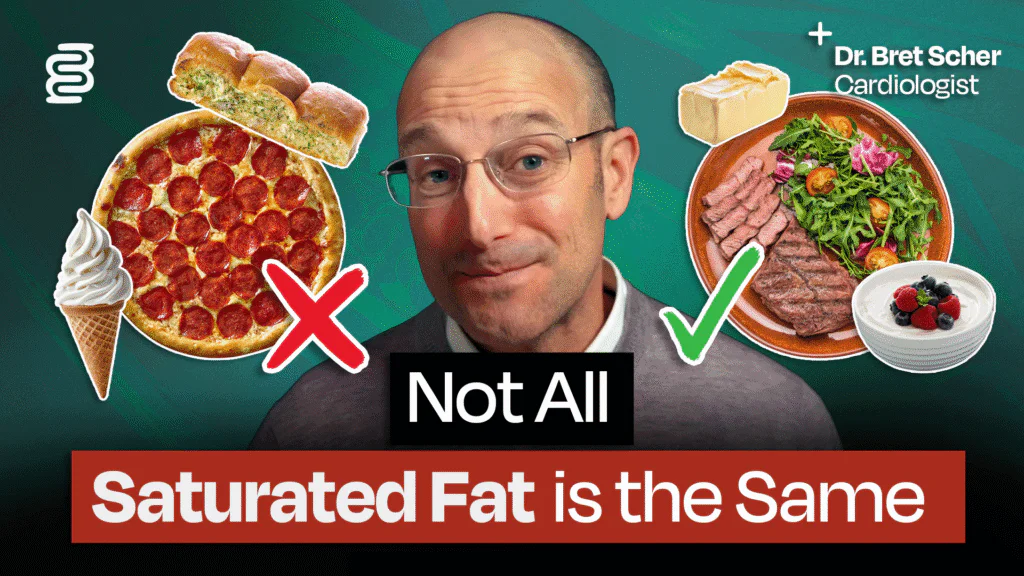
In this Metabolic Mind episode, Dr. Bret Scher analyzes the latest dietary guidelines and the science behind saturated fat. He reviews observational studies, randomized trials, and keto research to explain why saturated fat from whole foods may not be harmful in a low-carb context, and why focusing on overall diet quality and metabolic health matters more than strict saturated fat limits.
Learn more
Investigative journalist Nina Teicholz reveals the unthinkable: that everything we thought we knew about dietary fat is wrong.
Read more
Dr. Bret Scher tackles the long-running debate over eggs and cholesterol, explaining that while eggs can mildly raise LDL for some people, this doesn't automatically translate to increased heart disease risk. He breaks down why headlines warning against eggs rely on weak observational data with tiny effect sizes, and highlights eggs' impressive nutritional profile, including protein, choline, and fat-soluble vitamins, arguing overall diet quality matters far more than egg consumption alone.
Learn more
Did you know that being healthy can actually skew the results of scientific studies? It’s called “healthy user bias,” and it plays a major role in how we…
Learn more
In this Metabolic Mind episode, Dr. Bret Scher analyzes the latest dietary guidelines and the science behind saturated fat. He reviews observational studies, randomized trials, and keto research to explain why saturated fat from whole foods may not be harmful in a low-carb context, and why focusing on overall diet quality and metabolic health matters more than strict saturated fat limits.
Learn more