New Results: First RCT for Schizophrenia & Bipolar Disorder. Learn more.


Listen, Watch & Subscribe on:


Do Eggs Actually Cause Heart Disease?
Listen
About the host


Bret:
This is Metabolic Mind Bitesize. I’m Dr. Bret Scher. Here’s a big question. Are eggs bad for you because they raise cholesterol? It’s one of the most common questions I get as a cardiologist about nutrition and diet, and probably one of the most debated food topics out there. And the honest answer is that for most people, eggs can raise cholesterol a little bit.
But here’s what that headline almost always leaves out. Raising cholesterol and harming your health are not the same thing. And when it comes to eggs, the data tells a much more nuanced, and ultimately, I think, reassuring story than most people have been led to believe. So today, I want to help you see the egg and cholesterol debate from a more practical perspective, cutting through decades of nutritional confusion to help understand what it means for an individual and their dietary choices. Because that’s what’s often lost in the translation from the science to the individual.
And in the end, that’s what it comes down to. What does this mean for me in my life with my diet? So, to understand why eggs became so controversial in the first place, we need to go back a few decades. The logic seemed straightforward at the time. Eggs are high in dietary cholesterol. Dietary cholesterol must raise blood cholesterol. And high blood cholesterol must cause heart disease. Therefore, eggs cause heart disease.
Seems simple and straightforward, but that’s the problem. It’s too simple. That chain of reasoning really shaped dietary guidelines for a generation, and egg consumption was restricted. Low cholesterol diets were promoted, and millions of people swapped whole eggs for egg whites or just avoided them altogether.
The problem is that chain of logic has not held up under scientific scrutiny. And the story of eggs is actually, I think, a useful example into how nutrition science can go wrong when we oversimplify our thinking or when we rely on low-quality data and when we follow one biomarker instead of actual health outcomes.
So, let’s start with what the evidence actually shows about eggs and cholesterol because being precise here matters. So, for most people, eating whole eggs can mildly raise total cholesterol, but that includes a little bit of LDL and HDL. So, both go up, and the ratio between them tends to remain stable or actually improve.
But that does not by definition mean heart disease risk increases. In fact, much of the data says it doesn’t. Now, there is a subset of people, sometimes called egg hyper-responders, who see more pronounced increases in both LDL and HDL when they eat eggs or other cholesterol-containing foods, like shellfish.
And that’s because they don’t down regulate liver production of cholesterol as well. It’s driven partly by genetics. But even here, the evidence for clear negative cardiovascular outcomes from egg consumption is not strong. But the situation warrants individual attention, like anything. Now, we’ve all seen the headlines and the social media posts that eating half an egg increases the risk of diabetes, heart disease, even death.
But unfortunately, the data there is so weak and contradictory that the headlines are really indefensible, and I find that problematic. So, in an observational study that has clear healthy user-bias, low-quality food frequency questionnaires, no control for diet quality, and a minuscule effect size or hazard ratio, there’s no way to make meaningful conclusions from those studies about you as an individual.
So, some critics will cite studies suggesting eggs are harmful, but they don’t point out the hazard ratios are like 1.08, which is so tiny, or the health user-bias or any of the other study weaknesses. And just as a reminder, if you’re unfamiliar with hazard ratios, they like are about the effect size or how important it is. And smoking and cancer has a hazard ratio of 20, not 1.20, but 20.
And here we’re talking about 1.08 to 1.2. So, I’ve got to be honest, I find it really difficult to understand how a hazard ratio that small is being presented as clinically meaningful when in reality, for these observational low-quality studies, anything below two is highly suspect for being clinically meaningful.
Okay, now to be fair, the evidence is slightly stronger if someone has type 2 diabetes or other cardiac risk factors, and eats a standard American low-quality diet. In that setting, eating more eggs is associated with an increased risk in the studies. But the message isn’t to eat fewer eggs. It’s to clean up the overall diet.
In my opinion, removing the refined carbs, the sugars, the low-quality fats are likely a much more impactful change than removing eggs. And remember that eggs have played a big part in low carb diets that have been shown to reverse type 2 diabetes and reduce calculated cardiac risk. So again, we have to ask, is it the eggs or the overall unhealthy diet?
And again, there are plenty of studies demonstrating that eggs are associated with better or at least neutral health outcomes. And that also comes from, tends to be, low-quality observational studies, but observational studies where the healthy user-bias is against eggs. So, the absence of harm is noteworthy in that setting.
And importantly, it highlights that the science is not one-sided by any means. In fact, the American Heart Association, a long proponent of low cholesterol diets, has officially stated, and I quote, “Evidence from observational studies conducted in several countries generally does not indicate a significant association with cardiovascular disease risk.”
Does not. That’s from the AHA. Yet, that doesn’t stop the dramatic headlines and soundbites, which don’t have a meaningful implication to an individual trying to decide how eggs could impact them. And it’s important to recognize what eggs actually are nutritionally because this is part of the conversation that also frequently goes unmentioned.
Eggs are one of the most nutrient-dense whole foods available to us. A single egg has about six grams of highly bioavailable complete protein with an excellent amino acid profile, including leucine, that’s particularly important for muscle growth. And that matters for everyone, right? We all want good muscle tone, but it also matters especially as we age and the risk of sarcopenia increases.
Eggs are one of the best dietary sources of choline, a nutrient that’s important for brain health. And to be honest, can be challenging to get from other dietary sources. And eggs also provide fat-soluble vitamins, including A, D, E, and K2. They provide selenium, B12, riboflavin, and more. It sounds like a superfood supplement or a mega vitamin, but it’s not.
It’s an egg. Cheap, easy, ubiquitous eggs. Okay, but coming back to cholesterol. Yes, eggs can raise LDL. Not for everybody, but in some people. So, if you believe that any elevation in LDL, no matter how small for whatever reason, is something to be very concerned about, then maybe you shouldn’t eat eggs. Or at least, you should monitor your lipids while eating eggs, and see how it changes.
But if you focus more on your dietary context, the size of your LDL particles, the degree of elevation, the underlying metabolic health and so forth, then eggs can absolutely be part of a healthy diet. Now, don’t get me wrong, guess you don’t need to eat eggs. They’re not a required food if you don’t enjoy them or have an allergy or choose not to eat them for personal reasons.
Build a healthy diet without them. But for most people, eating whole eggs as part of a whole foods dietary pattern is not something to fear or avoid based on the current evidence. The minimal cholesterol effect does not appear to translate into meaningful clinical harm for the vast majority of people, and the science backs that up.
And on the flip side, the nutritional benefits, the protein, the choline, the fat-soluble vitamins, the healthy fats, they’re genuinely valuable and can be a challenge for many to easily replicate from other inexpensive sources. So, when deciding on an individual basis, most people, I think, will find no issue with eating eggs.
Now, one question I often get though is how many eggs are too many? And I don’t know the answer to that. There’s no clear answer. Most of these observational studies look at maybe one or two per day max. But the key is for each individual to see how their health changes. People report eating a dozen eggs per day with no meaningful change in the health markers.
And the New England Journal of Medicine even published a case report of an 88-year-old man eating 25 eggs per day with normal blood lipids and no known heart disease. So, what’s the upper limit? I don’t know. But remember, a low-quality observational study is less important to someone than their own individual response.
I think that’s a key take-home. Now, what about the quality of eggs? Does that matter? Yes and no. If someone has the means, I think it’s worth choosing eggs from pasture-raised or regenerative ag chickens. Although, there are no studies comparing them head-to-head to prove they’re healthier. I guess you can say it just makes sense that if chickens are eating better, then their eggs will be healthier.
But again, I say, don’t let perfect be the enemy of good, as as eggs can get expensive, right? And even standard eggs, which are much less expensive, are still packed with protein and vitamins that your body needs. So, the fear of eggs was built on an oversimplification of human physiology. Dietary cholesterol raises blood cholesterol somewhat, but that relationship is more nuanced than we once believed. And blood cholesterol levels are themselves only one piece of a complex cardiovascular risk. And now, it seems even the American Heart Association acknowledges this scientifically.
So, as a cardiologist, I’m far more interested in the totality of someone’s dietary pattern, their metabolic health, their physical activity, and other lifestyle factors, sleep, stress, et cetera. More interested in those than how many eggs they eat. But when someone is eating a whole foods diet built around quality protein, healthy fats, vegetables, minimal processed foods or refined carbs, eggs absolutely fit into that picture.
Personally, I love eggs for me and my family. My personal biology and the scientific data support that. So, what about you? Have you found any positive or negative health effects from eating eggs? What do you think about the perspective I presented here? Let us know, as we love to hear from you. And if this was helpful and you want to learn more, you may also want to check out our video discussing the study on eggs and dementia in Alzheimer’s, where they actually appeared to be protective.
You can watch the video for more details. So, thank you for watching. I’m Dr. Bret Scher. For more practical evidence-based content on nutrition and metabolic health, visit us at metabolicmind.org, a non-profit initiative of Baszucki Group.
Listen, Watch & Subscribe on:
A powerful plan to improve mood, overcome anxiety, and protect memory for a lifetime of optimal mental health.
Read more
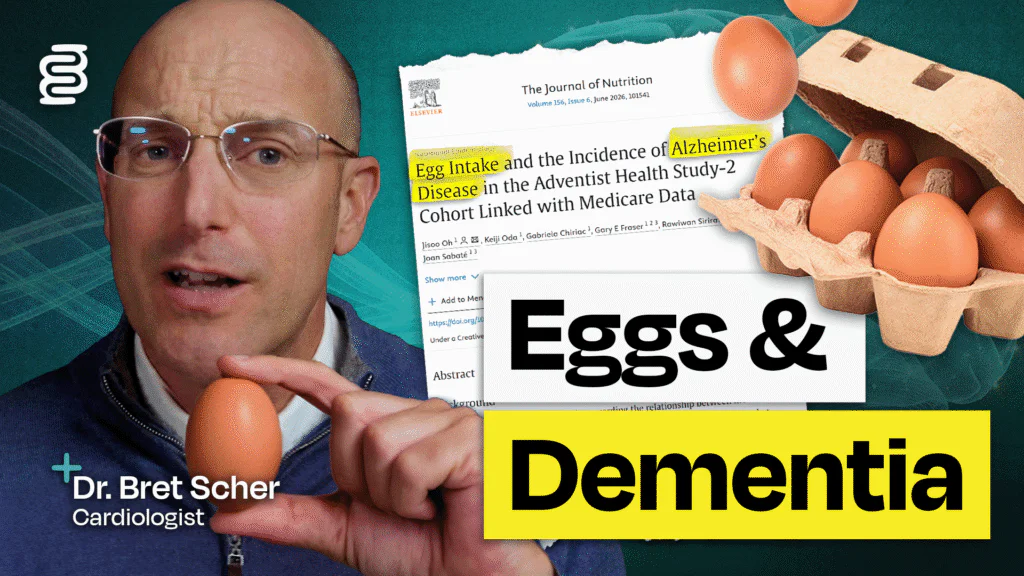
Dr. Bret Scher unpacks a new observational study linking higher egg consumption to lower dementia risk, arguing the more interesting story lies in the baseline data: people eating the fewest eggs were actually healthier by nearly every measure yet showed no clear dementia advantage. He argues this weakens the case against eggs, revisits the outdated dietary cholesterol fears, and highlights eggs' nutrient density, despite noting the study's partial funding from the National Egg Board.
Learn more
Why should we rely on a blood test to assess heart disease risk when we can see the disease itself? Transcript: Introduction to Carotid Intima-Media Thickness test (CIMT).Have…
Learn more
Dr. Bret Scher challenges the idea that one low-fat, high-carb diet works for everyone, arguing it rests on weak evidence and has hurt collective metabolic health. He explains that people respond differently to different diets, and for those with insulin resistance, low-carb and ketogenic approaches can be especially effective. Rather than one "best" diet, the episode calls for personalized nutrition that helps each person find a sustainable approach that works for them.
Learn more
A powerful plan to improve mood, overcome anxiety, and protect memory for a lifetime of optimal mental health.
Read more
Dr. Bret Scher unpacks a new observational study linking higher egg consumption to lower dementia risk, arguing the more interesting story lies in the baseline data: people eating the fewest eggs were actually healthier by nearly every measure yet showed no clear dementia advantage. He argues this weakens the case against eggs, revisits the outdated dietary cholesterol fears, and highlights eggs' nutrient density, despite noting the study's partial funding from the National Egg Board.
Learn more
Why should we rely on a blood test to assess heart disease risk when we can see the disease itself? Transcript: Introduction to Carotid Intima-Media Thickness test (CIMT).Have…
Learn more
Dr. Bret Scher challenges the idea that one low-fat, high-carb diet works for everyone, arguing it rests on weak evidence and has hurt collective metabolic health. He explains that people respond differently to different diets, and for those with insulin resistance, low-carb and ketogenic approaches can be especially effective. Rather than one "best" diet, the episode calls for personalized nutrition that helps each person find a sustainable approach that works for them.
Learn more