New Results: First RCT for Schizophrenia & Bipolar Disorder. Learn more.


Listen, Watch & Subscribe on:



Can Insulin Resistance Raise Suicide Risk?
Listen
About the host


Bret:
Welcome to the Metabolic Mind Podcast. I’m your host, Dr. Bret Scher. Metabolic Mind is a non-profit initiative of Baszucki Group, where we’re providing information about the intersection of metabolic health and mental health and metabolic therapies, such as nutritional ketosis as therapies for mental illness.
Thank you for joining us. Although our podcast is for informational purposes only and we aren’t giving medical advice, we hope you will learn from our content and it will help facilitate discussions with your healthcare providers to see if you could benefit from exploring the connection between metabolic and mental health.
Can poor metabolic health lead to an increased risk of suicide? This is a critical question, and a new paper published in Translational Psychiatry suggests it might. This study showed a correlation between metabolic dysfunction and increased suicide risk. And it adds fuel to a paradigm shift that’s rapidly growing in both clinical and scientific circles that mental health isn’t just brain chemistry.
It’s deeply intertwined with metabolic health. But like many observational studies, there are some caveats we need to acknowledge. So first, let’s talk about the study. The researchers used these large population data sets looking at biomarkers of metabolic health, things like blood glucose and insulin levels and lipid profiles and body mass index and other markers of insulin resistance, and they assessed their association with suicide risk.
They observed that people with worse metabolic parameters had higher rates of suicidal ideation, attempts, and even death from suicide. And these associations persisted even after they adjusted for confounding factors, like age and sex, socioeconomic status, and mental health diagnosis. In plain language, among people studied, poor metabolic health tends to coexist with greater suicide risk.
But as with any observational study, we need to acknowledge that correlation is not causation. That means the study doesn’t tell us that insulin resistance causes suicidal thoughts or attempts, but it does tell us that they often occur together. Now, this is somewhat stronger than the nutritional observational studies we frequently talk about since it’s based on lab data and not food recall.
But still, with hazard ratios, or you could say the effect size below two, the data is a clue, not a verdict. But even though it doesn’t prove cause and effect, the study is important for a few reasons. And first, it raises awareness of this under-explored connection, right? The overlap between metabolic and mental health. And not just any component of mental health, but one of the most concerning with suicide risk.
It also suggests new avenues for research. Longitudinal studies, interventional trials, experiments that test whether improving metabolic markers can reduce suicide risk and other severe psychiatric symptoms. And it challenges us to think beyond the brain when it comes to psychiatry, right?
Blood sugar and insulin, inflammation, energy metabolism, they’re all crucial parts of the story for mood disorders, also bipolar disorder, schizophrenia, and many more. And that can lead us to asking the questions: What if treating insulin resistance and metabolic dysfunction could reduce suicide risk?
We’ve seen ketogenic diets dramatically improve symptoms in depression, bipolar disorder, schizophrenia, improve cognition, and other effects. And we’ve seen metabolic therapies reduce inflammation, stabilize energy delivery to the brain, reduce oxidative stress, improve neuroplasticity, and other important mechanisms.
So, it’s not so far-fetched to believe that improving metabolic health with ketogenic therapies and other metabolic therapies could reduce suicidal thoughts and actions. Think about it. Can you imagine a future where psychiatrists routinely monitor HbA1c, fasting insulin, triglycerides, waist circumference, and where therapeutic options include metabolic nutrition, exercise prescription, and insulin sensitizing strategies?
I sure can. I think that should be the future of psychiatry. So, even though this study doesn’t prove insulin resistance leads to increased risk of suicide, it should get our attention and make us realize the important connection between metabolic and mental health and lead us to strive for the day when measuring and treating metabolic health becomes first line in psychiatric evaluation and treatment.
Thanks for listening to the Metabolic Mind Podcast. If you found this episode helpful, please leave a rating and comment as we’d love to hear from you. And please click the subscribe button so you won’t miss any of our future episodes. And you can see full video episodes on our YouTube page at Metabolic Mind.
Lastly, if you know someone who may benefit from this information, please share it as our goal is to spread this information to help as many people as possible. Thanks again for listening, and we’ll see you here next time at the Metabolic Mind Podcast
Listen, Watch & Subscribe on:

Key Takeaways We reach for coffee to wake up, wine to unwind, and our phones to take the edge off a long day. These habits feel normal, even…
Read more
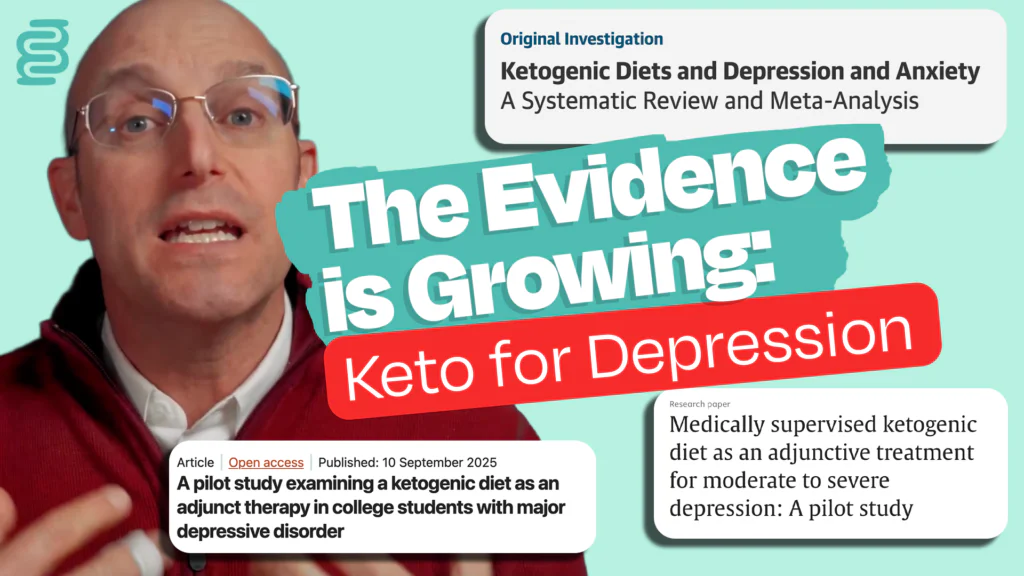
New research highlighted by Metabolic Mind suggests that ketogenic therapy may be a promising adjunctive treatment for depression. In this episode, Dr. Bret Scher reviews a remote 14-week pilot study, the KIND Trial, and a larger meta-analysis showing that ketogenic diets may help reduce depression symptoms, anxiety, and anhedonia, while offering new hope for people who have not responded fully to standard treatments.
Learn more

People with serious mental illness face a dramatically higher risk of premature death, but psychiatric symptoms themselves aren't the leading cause. In this conversation, Dr. Margaret Hahn and Dr. Sharmili Tharanajah explore how cardiovascular disease, metabolic dysfunction, and psychiatric treatments contribute to this risk, and what clinicians can do to better protect both mental and metabolic health.
Learn more

Read the full New York Post article here! Desperate for answers, Matthew’s parents — Roblox co-founder David Baszucki and novelist Jan Ellison — turned to Dr. Chris Palmer,…
Learn more
Key Takeaways We reach for coffee to wake up, wine to unwind, and our phones to take the edge off a long day. These habits feel normal, even…
Read more
New research highlighted by Metabolic Mind suggests that ketogenic therapy may be a promising adjunctive treatment for depression. In this episode, Dr. Bret Scher reviews a remote 14-week pilot study, the KIND Trial, and a larger meta-analysis showing that ketogenic diets may help reduce depression symptoms, anxiety, and anhedonia, while offering new hope for people who have not responded fully to standard treatments.
Learn more
People with serious mental illness face a dramatically higher risk of premature death, but psychiatric symptoms themselves aren't the leading cause. In this conversation, Dr. Margaret Hahn and Dr. Sharmili Tharanajah explore how cardiovascular disease, metabolic dysfunction, and psychiatric treatments contribute to this risk, and what clinicians can do to better protect both mental and metabolic health.
Learn more
Read the full New York Post article here! Desperate for answers, Matthew’s parents — Roblox co-founder David Baszucki and novelist Jan Ellison — turned to Dr. Chris Palmer,…
Learn more