Announcing the new McLean Center for Metabolic Psychiatry Learn more.


Listen, Watch & Subscribe on:



Dr. Ford Brewer on the Future of Heart Health & The Cholesterol Code
Listen
About the host

About the guest


Ford:
Two-thirds of heart attacks occur in people that don’t have that much occlusion. And so, that’s not really what we’re trying to get. We’re trying to get less than occlusion, but more than average.
Bret:
Welcome to the Metabolic Mind Podcast. I’m your host, Dr. Bret Scher. Metabolic Mind is a non-profit initiative of Baszucki Group, where we’re providing information about the intersection of metabolic health and mental health and metabolic therapies, such as nutritional ketosis as therapies for mental illness.
Thank you for joining us. Although our podcast is for informational purposes only and we aren’t giving medical advice, we hope you will learn from our content and it will help facilitate discussions with your healthcare providers to see if you could benefit from exploring the connection between metabolic and mental health.
Please remember that our channel is for informational purposes only. We’re not providing individual or group medical or healthcare advice or establishing a provider-patient relationship. Many of the interventions we discuss can have potentially dangerous effects if done without proper supervision.
Consult your healthcare provider before changing your lifestyle or medications. In addition, it’s important to note that people may respond differently to ketosis, and there isn’t one recognized universal response
Dr. Ford Brewer, thank you so much for joining me.
Ford:
Thank you so much, Bret, for having me.
Bret:
Yeah.
Ford:
It’s very exciting. And the stuff that you guys did, contributed to last night. Absolutely incredible.
Bret:
Thank you. Let’s talk about last night. So, it was a exclusive screening of The Cholesterol Code documentary. And give us your impression, first time you saw it.
So, what’d you walk away with? What’d you think?
Ford:
I will start out with this because that’s where I was, my brain was going a minute ago, Baszucki Group and the guys that you’re working with right now, making a huge impact on diet and mental health.
Bret:
Yeah.
Ford:
I haven’t shared this very often, but in med school, I was diagnosed with manic depressive.
So. Very excited to hear about what you guys are doing. Georgia Ede, Chris Palmer.
Bret:
Yeah.
Ford:
Who was, both of who were, in the video as well as you last night.
Bret:
Yeah. That’s right.
Ford:
So bottom line, as I often do, I got down a bunny hole, but let me go back to your question. To me, one of the biggest things that happened last night was taking something that’s fringe, and fringed by most standards. Your typical doctor says, “Let’s go look at the LDL and treat it.”
And even at your group, you’re a cardiologist, the Cardiology Standards Committee, American Heart Association, has said it’s bigger than that. It’s having a conversation with a patient and to do risk assessment.
And that’s not what most folks do.
Bret:
Yeah.
Ford:
They say, “Okay, what’s your cholesterol?” It’s a 70-year-old smoker, or a guy that quit smoking 10 years ago. I’ve got this and this, and you need a statin. And it should be more complicated than that.
Bret:
Yeah. So, let’s talk about that. So, we’re talking about cardiac risk. In your practice, you focus on, evaluating people’s cardiac risk.
And even though, you could say, maybe the center stage was cholesterol, there was another center stage of cardiac imaging that was in the documentary. So, what did you think about the way cardiac imagery was portrayed, and do you think that would impact someone’s practice after watching this documentary?
Ford:
You would hope so. One thing that surprises me a lot is, how as much focus as people have on plumbing, and you might agree with me that it’s, I think you would, that it’s really, plumbing is important, but metabolism is what drives the plumbing.
Bret:
Yeah, that’s a good way to say it.
Ford:
So, getting your plumbing fixed is sort of like getting your plumbing replaced in your house. When the inlet is full of junk, and it’s just continuing to pepper more junk back into your house after you got it replaced.
Bret:
Yeah.
Ford:
So, you got to go to the root cause. But you’re a cardiologist, and you mentioned it to me once, I think back at the low carb thing. You said, you looked at me funny and said, “Aren’t you doing that weird,” you didn’t say weird, but I could tell, “CIMT?”
So, I do a little bit of CIMT. I learned it in the past from a fellow named, Brad Bale. Now, a lot of people that watch my channel, would comment and say, “Why didn’t you use CIMT?” And I recently did a video on what’s the best way to image. The best way is not necessarily the least expensive.
I think what you guys were doing in the video, I think CT angiogram with AI analysis is clearly the definitive study. Now, you and I both know if somebody looks really clear, you don’t really want to do that. You don’t need to do it annually. It’s a significant expense. But it’s a wonderful study.
I’m glad to see us focusing on that. I’ve been saying from day one, that’s where it’s going to go. It’s the gold standard.
Bret:
Yeah.
Ford:
I’ve had my first one recently in December. I can’t share results because I don’t have them yet.
Bret:
Okay.
Ford:
But I’m not sure that I would have done it, had it not been for the channel.
Oh. I’m all about educating our folks.
Bret:
Yeah. So, you brought up CIMT, carotid intima-media thickness, and I apologize if I gave the impression that I thought it was weird because I use it, and I’m a fan of it.
Ford:
Oh, I didn’t know that.
Bret:
Yeah, I’m, a fan of it.
Ford:
Oh, that’s interesting.
Bret:
Now, interestingly, I also made a recent video talking about calcium scores and CT angiograms for cardiac imaging.
Ford:
Yes.
Bret:
And the number one comment we got on that video was, “What about CIMT?” And it wasn’t my intention to make a comprehensive cardiac evaluation, but that’s certainly a test that should be discussed. So, tell us briefly, what is a CIMT, and, how do you use it in your practice?
Ford:
Okay. So it’s a great question. To get back up about 30,000 feet, it’s an ultrasound. It’s nothing but an ultrasound. Carotid artery, as you and I know is right here in the neck. So, why would you be doing an image of the neck, and you’re looking for heart? Actually, this has impact for strokes as well.
Bret:
Yeah.
Ford:
Which most people begin to think about and say, “You know what? I’d almost rather die from a heart attack than have a stroke and be paralyzed for a decade.” But the difference is an AI, or not an AI, but an IT analysis after the end. It’s the same technology that they used to use, and still do occasionally, looking at ultrasound to see plaque in the neck. But it goes back to a couple of studies, like CAFES-CAVE. I don’t know if you’re familiar with him. It was done in Italy about what? Ten thousand patients about 10 years ago?
Bret:
Yeah.
Ford:
Where they were looking at them and saying, “We know if you’ve got impact on your flow that you’re at high risk.”
Bret:
Meaning there’s a plaque big enough to limit the flow.
Ford:
Correct. And when I use the term plumbing, that’s what I’m talking about.
Bret:
Yeah.
Ford:
Something that’s impacting the flow.
Bret:
Yeah.
Ford:
We’ve always known that it’s very significant increase in risk.
We’ve also always known, and the Heart Association Standards Committees recently, about four years ago, said, I think I heard you mention it, “If you’ve got zero plaque, you really don’t need a statin either.”
Bret:
Yeah. Well, from a calcium score. So, with a calcium score of zero, they can re-risk stratify you, which often means no statin is needed based on their calculations. Yeah.
Ford:
I’d argue with that because guys that study plaque a lot, like myself.
Bret:
Yeah.
Ford:
And some others, have said, “Yeah, but what if it’s all soft plaque?”
Bret:
That’s the question.
Ford:
And yeah, that’s exactly the case.
Bret:
Yeah.
Ford:
Calcium score is not really the correct study for that. Calcium score is fantastic.
Bret:
Yeah.
Ford:
And to get a good CIMT, that’s the two problem, back to CIMT, the two problems with CIMT are, number one, it’s so hard to get a good one. And number two, even when you get a good one, people focus on the amounts, the numbers. What’s your, quote, “arterial age,” and that’s really subjective in terms of interpretations.
Anyhow, back to the CAFES-CAVE study. What they found was, whereas you may have an eight or 10 or more increase in risk, once they can see plaque that impacts flow. The question is plaque that does not impact flow, and they saw huge increases in risk there.
Bret:
Yeah.
Ford:
So, that’s the whole point behind the CIMT. Finding plaque that doesn’t really impact flow, but clearly impacts risk.
Bret:
Yeah.
Ford:
And we know that from stress tests. As the standards committees have all said, “We’re doing way too many stress tests. And by the way, stress tests don’t predict heart attacks.”
Bret:
All they’re going to pick up is a narrowing that is severe enough to limit the blood flow, but won’t tell you anything about whether you have 10, 20, 30, 40% buildup of plaque there, which is really what you want to know for prevention. So, it’s hard, you’ve said it a couple times, it’s hard to get a quality CIMT, which is a big part of the barrier of using it more.
Ford:
It is. It’s the biggest part.
Bret:
It’s not just the standard ultrasound that any radiology facility can do. So, why is it so hard?
Ford:
You’ve got some chicken and egg issue. Number one, you’ve got the “garbage in, garbage out” research thing, where people that didn’t know how to do these, very poor quality, did them and published junk. Garbage. So, folks like the standards committee look at that and they say, “This is junk. We’re not going to use it.” Insurance companies, on the other hand, look at what the standards committees say, and they say, “It’s not reimbursed by insurance.”
Bret:
Yeah.
Ford:
So, there’s a good reason, and the reason is it’s junk.
Bret:
Yeah.
Ford:
So that’s, to me, you don’t get something reimbursed by insurance, and you’re not going to get 99% of doctors out there ordering it or learning it. If they’re not ordering it, they’re not going to learn it.
Bret:
So, what should someone look for if they say, “I want to get one, but I want to make sure it’s a good quality and I want to make sure it’s going to help me better understand my risk?”
What are the things they should look for?
Ford:
There’s only a, there are few enough companies to where I could name a couple of them. CardioRisk, who’s located out here out west in Utah. Vasolabs has done some good work. They’re located back east.
Bret:
Yeah.
Ford:
So, couple of things that you want to look for is to make sure that they focus on calcification.
Bret:
Okay.
Ford:
Another thing to look for is to ask them specifically, “No, do you do CIMT?” Because I’ve mentioned it, I’ve talked about it a lot on my channel. A lot of people will come to me and they actually, they say, “I’ve already had one.” And I say, “Where did you get it? You know, where this is going?”
Bret:
Yeah.
Ford:
“Oh, I got it at my local cardiologist office, or more likely, my local imaging office.” And you pull it up, and it’s an ultrasound.
Bret:
Just a standard ultrasound without the CIMT part, yeah.
Ford:
And the ultrasound, like we said, is okay, but it only hits when you’ve got 50% or more occlusion.
Two-thirds of heart attacks occur in people that don’t have that much occlusion.
Bret:
Yeah.
Ford:
At least according to the Princeton Longevity Center.
Bret:
Yeah.
Ford:
And so, that’s not really what we’re trying to get. We’re trying to get less than occlusion, but more than average.
Bret:
Yeah.
Ford:
And that’s where it gets tough. And that’s what you don’t get when you go to the local X-rays R Us.
Bret:
You mind if I transition for a second?
Ford:
Sure.
Bret:
And talk about you?
Ford:
Oh, yes.
Bret:
You mentioned…
Ford:
i’d love to.
Bret:
You mentioned you were, you had the diagnosis of manic depression, now usually referred to as bipolar. What’d you do about it? What’d you, how’d you get things straight?
Ford:
I actually had about a maybe five, 10-minute discussion with Hannah. And she got fairly technical, and I’ll refer to a couple of her things. She kept talking about hypomania.
I never got psychotic. I had a case of what you’d, what they label as medical student syndrome.
Bret:
Oh.
Ford:
My third year of medical school. When you start actually seeing patients, and all the really bad stuff is, quote, “malaise,” like cancers and stuff like that, the metabolic issues.
Bret:
Yeah.
Ford:
So, everything that came up, I decided, maybe I have this because I’m just, either I’m too tired, or I’ve got energy that I can’t control?
Bret:
Ah.
Ford:
And I will still have episodes with that. For the most part, when I went to med school and I saw a psychiatrist there for that, he said, he tried me on Stelazine.
I don’t know if you remember that.
Bret:
That’s old school.
Ford:
This was 40 years ago.
Bret:
Yeah.
Ford:
And I tried it for a couple months. It helped immensely, but I was scared to death about being on any kind of medication. And I’ve not covered any of this on my channel, by the way.
Bret:
Yeah.
Ford:
And thanks for asking.
So, I tuned up my metabolism then. Third year of medical school, you’re not really watching your health at all. You’re eating pizza. Oh my God.
Bret:
You’re not sleeping. You’re eating anything you can grab in the cafeteria, anytime you can grab it. And muffins and donuts and yeah.
Ford:
So, as a part of that, I got healthier then. The big thing though was when I went low carb, I discovered that I was pre-diabetic enough to create plaque.
Bret:
Yeah.
Ford:
In my late 50s, well, mid-50s, and so I started looking, and you know where I went first. Not LDL. My LDL was a nice 90, 85, 95 on a routine basis. So, that was never a problem for me until I went really low carb and it went up to 180.
So, it was when I started managing that pre-diabetes, things just instead of this, the hypomania followed by a depressive, I didn’t get that many depressive, things. My psychiatrist in med school said, “Yeah, you’re one of those guys, and we see them all the time that, especially in very successful folks, where they’re hypomanic most of the time. And then, every now and then, they’ll crash.”
And that’s what you did, your third year of med school. So, I’ve been a little bit blessed by maybe having a little bit of extra energy most of my life.
Bret:
Okay.
Ford:
But again, I haven’t had a chance to speak to you that much about it, but I talked with Hannah and some of the other folks from the Baszucki Group.
I’m just so excited about seeing the focus on mental health.
Bret:
Yeah. I’m glad to hear it helped you as well improving lifestyle, improving your diet, going low carb.
Ford:
Yeah.
Bret:
It’s just, we can’t hear enough of these stories, for sure.
Ford:
I’m sure.
Bret:
So, you’ve mentioned your channel a couple of times.
Tell us about your channel for those, if they haven’t seen you before or seen your channel, and maybe it’s that extra energy that’s helping you be so prolific in your channel, too. So, tell us what it is and what your focus is.
Ford:
We started off very prolific. We’re a little bit less prolific now and focusing a lot more on quality.
It’s a channel. We changed the name. We found out years ago that people searched by my name. That was what they remembered, not the other PrevMed Heart Risk or any of that. It’s Ford Brewer, F-O-R-D Brewer. Ford like the car.
Bret:
Yeah.
Ford:
Brewer like Milwaukee. And we’re all about this.
It’s low carb. Like most folks in the low carb community, you don’t see 100% agreement between all of us on everything. For example, I’m the weirdo about plaque and defining exactly what plaque looks like and what kind of risk that that creates or where it’s showing that you’re decreasing risk, like getting calcification.
Another place that’s a little bit weird for our channel is that we actually use medications. GLP-1s, for example, and I was asking Hannah this morning. Does Baszucki Group, do you guys, have a single policy against or for? You talk to most YouTube low carb content creators, and I think partially because it’s so popular now, most of them are adamantly against GLP-1s.
Bret:
Yeah.
Ford:
We use them, and I think a couple of things. Number one, one of the criticisms is that you lose muscle.
I’ve gained about 20 pounds of muscle since I started a GLP-1 three or four years ago.
Bret:
Oh, yeah?
Ford:
Yeah. And it’s really much more about how much exercise and the right kind of
exercise that you do than anything else.
Bret:
Well, and that’s it, right? Is it the GLP-1 as the end-all-be-all treatment, see you later? Or is it we’re going to use this as a tool, but institute other tools as well to make sure it’s being used appropriately, responsibly, and improving your overall health, metabolic health, body composition?
So, when you ask if we at Metabolic Mind or Baszucki Group have a position, I guess we don’t have an official position. But that would be my personal position that they are a tool.
Ford:
They are a tool.
Bret:
And should be used, but not as the end-all-be-all treatment, stand-alone treatment. That’s where I think it fails us more than it helps us.
Ford:
I couldn’t agree more. I hear you say that. And it just reminds me, it takes me back to statins.
Bret:
Yeah.
Ford:
There may be times that statins are appropriate. That’s another place where my channel’s a little not in agreement with everybody else.
Bret:
Yeah.
Ford:
But the bottom line is the overuse and abuse.
Bret:
Yep.
Ford:
I get it. I’ve made a living out of hiring and managing the quality from primary care docs. They’re very busy. They got too many things going on. Insurance has really made a lot of their life very difficult. But again, the right thing to do is the right thing. And bringing somebody in, taking seven minutes, which is the average, and throwing a statin or now a GLP-1 or a statin and a GLP-1, is not the right thing to do.
Bret:
I appreciate that perspective, and thank you for joining me. I’m glad you’re able to experience all this excitement here at CoSI and at The Cholesterol Code last night, and I look forward to seeing more on your channel. So, thank you.
Ford:
Thank you. I appreciate it.
Bret:
Thanks for listening to the Metabolic Mind Podcast. If you found this episode helpful, please leave a rating and comment as we’d love to hear from you. And please click the subscribe button so you won’t miss any of our future episodes, and you can see full video episodes on our YouTube page at Metabolic Mind.
Lastly, if you know someone who may benefit from this information, please share it, as our goal is to spread this information to help as many people as possible. Thanks again for listening, and we’ll see you here next time at the Metabolic Mind Podcast
Listen, Watch & Subscribe on:
Dr. Bret Scher examines a new trial showing the drug olezarsen dramatically lowered triglycerides and ApoB, yet produced zero reduction in coronary artery plaque. He uses this as a case study for a broader point: lowering a lab number with a drug isn't the same as fixing the underlying metabolic dysfunction that caused it, drawing parallels to blood sugar, blood pressure, and weight management medications.
Read more

Is coconut oil clogging your arteries, or could it actually reduce your risk of heart disease? Transcript: The controversy surrounding coconut oilIs coconut oil going to give you…
Learn more
A cautious, and nuanced editorial about elevated LDL cholesterol while on a keto diet. Read more here!
Learn more
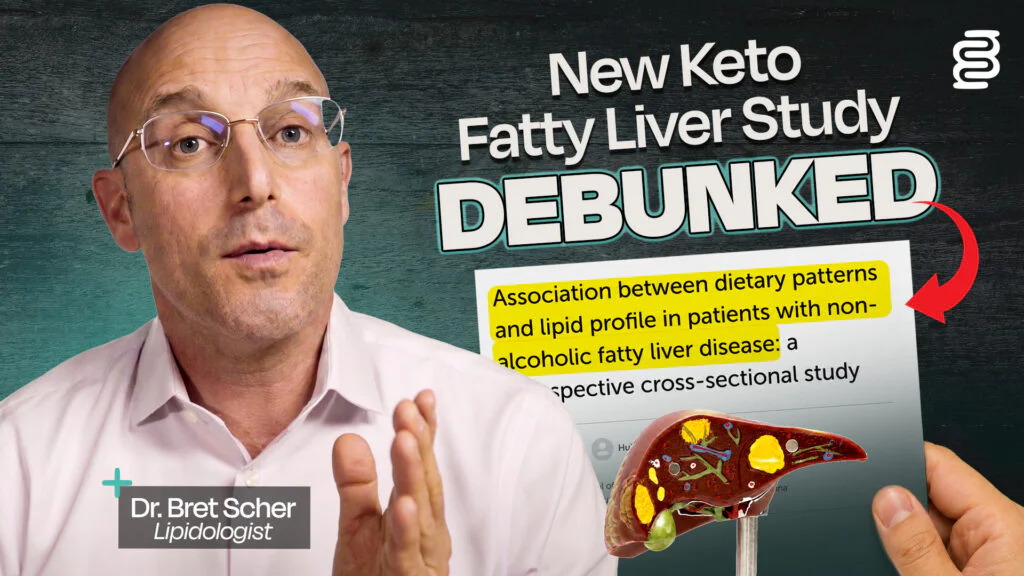
In this Metabolic Mind Bitesize episode, Dr. Bret Scher tackles a new study claiming ketogenic diets worsen fatty liver disease, a finding that appears to contradict prior research showing keto helps treat fatty liver. He breaks down why this retrospective cross-sectional study from China is deeply flawed, from never verifying ketosis to ignoring reverse causality and baseline differences, then contrasts it with a much stronger body of randomized controlled trial evidence showing the opposite conclusion.
Learn more
Dr. Bret Scher examines a new trial showing the drug olezarsen dramatically lowered triglycerides and ApoB, yet produced zero reduction in coronary artery plaque. He uses this as a case study for a broader point: lowering a lab number with a drug isn't the same as fixing the underlying metabolic dysfunction that caused it, drawing parallels to blood sugar, blood pressure, and weight management medications.
Read more
Is coconut oil clogging your arteries, or could it actually reduce your risk of heart disease? Transcript: The controversy surrounding coconut oilIs coconut oil going to give you…
Learn more
A cautious, and nuanced editorial about elevated LDL cholesterol while on a keto diet. Read more here!
Learn more
In this Metabolic Mind Bitesize episode, Dr. Bret Scher tackles a new study claiming ketogenic diets worsen fatty liver disease, a finding that appears to contradict prior research showing keto helps treat fatty liver. He breaks down why this retrospective cross-sectional study from China is deeply flawed, from never verifying ketosis to ignoring reverse causality and baseline differences, then contrasts it with a much stronger body of randomized controlled trial evidence showing the opposite conclusion.
Learn more