New Results: First RCT for Schizophrenia & Bipolar Disorder. Learn more.


Listen, Watch & Subscribe on:



Depression and Metabolism: What This New Study Reveals
Listen
About the host
About the guest

Fabiano:
And we were quite terrified, right? And you know that when you get a grant, if you don’t deliver, you need to give the money back. And we had research, a research fellow on board. We had all the purchases of all the supplies. So, we were quite concerned about that.
Bret:
Welcome to the Metabolic Mind Podcast. I’m your host, Dr. Bret Scher. Metabolic Mind is a nonprofit initiative of Baszucki Group where we’re providing information about the intersection of metabolic health and mental health and metabolic therapies, such as nutritional ketosis as therapies for mental illness.
Thank you for joining us. Although our podcast is for informational purposes only and we aren’t giving medical advice, we hope you will learn from our content and it will help facilitate discussions with your healthcare providers to see if you could benefit from exploring the connection between metabolic and mental health.
Welcome to Metabolic Mind. I’m your host, Dr. Bret Scher. Today we have a special episode spotlighting two influential figures in this field. First, I’d like to introduce our guest host, Dr. Julie Milder. She’s the Director of Neuroscience at Baszucki Group. Julie brings a wealth of knowledge and a fresh perspective to the discussion synthesized from her extensive experience at the intersection of neurology and metabolic science.
Also featured in this episode is Dr. Fabiano Gomes, a psychiatrist and researcher and the recipient of Baszucki Group’s first ever Metabolic Psychiatry Scholar Award. He recently published a pilot feasibility trial of a ketogenic diet for depression that showed exciting results. Fabiano’s innovative work has opened new avenues for future therapies, providing hope for those affected by metabolic and neurologic conditions.
I hope you enjoy this episode with Dr. Julie Milder and Dr. Fabiano Gomes. Many of the interventions we discuss can have potentially dangerous effects if done without proper supervision. Consult your healthcare provider before changing your lifestyle or medications. In addition, it’s important to note that people may respond differently to ketosis, and there isn’t one recognized universal response
Julie:
Hi, Fabiano. Thank you so much for agreeing to chat with me today a little bit about a few things, to highlight some things that have been going on in your career. For those who don’t know me, I am Julie Milder, Director of Neuroscience at Baszucki Group. And I have the pleasure of working with our researchers all over the world as we advance the field of metabolic psychiatry.
And today, I’m joined by Fabiano Gomes. So first, Fabiano, do you want to just introduce yourself briefly to those who may not know you?
Fabiano:
Yes, of course. Thank you so much for having me today, Julie. Always a pleasure to talk to you. I’m Fabiano Gomes. I’m a psychiatrist. I was trained in clinical psychiatry, psychotherapy.
I always had an interest in metabolism. And I started doing research around my second year of residency, researching mood disorders with a focus in bipolar disorder. Like almost 20 years ago, around 20 years ago, we had a lot of interest, still have, in biomarkers, right? In mood disorders research, including the idea of why, trying to understand why people with bipolar disorder usually presents with cognitive impairment, and a lot of medical co-morbidities.
And back then, I was interested again in metabolism. And ,then I started looking into insulin resistance metabolic syndrome, and other cardiovascular co-morbidities in people with bipolar disorder. And that’s how I did my master’s, and then my PhD. And since 2020, I relocated to Canada, and I’ve been working now at McMaster University at the Mood Disorders Program.
So I’m a clinical psychiatrist and clinician scientist here at MAC.
Julie:
Wonderful. We’re so pleased to have you in this community. And the first thing I want to do is congratulate you on the recent publication of the pilot trial, that study ketogenic diet in depression. Can you tell me a little bit about how you got involved in that study?
Fabiano:
Yes. So, when I moved to Queen’s University in Canada, I was working with a professor called Elisa Brietzke, right? She’s a dear colleague. Also, a trailblazer in this space of immunology and mood disorders. And she was starting this project on a ketogenic diet in both depression and bipolar disorder.
And when I arrived, I had the opportunity to– we come, and then we need funding, right? To do our research, really excited to get back to doing research. And I applied for a grant from the Brain & Behavioral Research Foundation, BBRF, that usually grants and awards the NARSAD grants. And we put forward an application for ketogenic diet as a treatment for midlife women.
So, the idea was to investigate the clinical effect on both mood symptoms, but also perimenopausal symptoms. We thought that would be an interesting patient population. A lot of, really a gap in opportunities for treatment. So, we applied for that grant, and we were successful. We also had a small grant from the Canadian Menopausal Society.
That was also helped us putting together the study. This was supposed to be a subset of the study. So, the idea was to pilot in people with depression, and we would try to understand if there was an effect also on perimenopausal symptoms. So, it was just before COVID hit. So, we put the applications, and then we got awarded. And then, we had this beautiful plan of doing all these in-person assessments and following up with patients quite closely. Bringing them to the clinic.
And then, we had to pivot, and we decided to do it all online. It was quite a challenge, but also really rewarding. We had a research bag that we would pack all the supplies to the participants. I would even drive to their houses and leave in the porch, on the porch, or eventually, send it by regular mail.
And we finally, after almost five years, we were able to finish the pilot study. So, a lot of challenges and barriers. But in the end, we were able to finalize the study. It, as you mentioned, it was recently published in the Journal of Affective Disorders. And we can talk a bit about the findings and the results as well.
Julie:
I do want to come back to the unfortunate timing, and how you had to shift from in-person to remote because I think there’s a lot that we could learn from that experience. So, I want to come back to that. But first, just share a high level, what were the results of your study for those who may not have read the paper?
Fabiano:
Exactly. it was a pilot feasibility trial. So, when we started, there were not a lot of studies about this. We had mostly case reports. So, our idea was to see, will people with depression actually be able to commit to the diet? Would be interested in the diet and commit to the diet?
What type of interventions we would have to have? Is it like the standard ketogenic diet that we use for epilepsy? Do we need to change anything? So, it was an exploratory study as well. So, we had around almost 90 participants or potential participants that reached out to us. Most of them wouldn’t either meet criteria that was basically being depressed, having tried at least one specific treatment for depression for that specific episode. So, some level of treatment resistance, right?
That was the initial thought. But in the end, we were able to recruit 11 participants. Our study had an interesting design that it’s not necessarily used, that we have what we call a run-in period. So, after the patient is recruited, we give them a two-week period to try to get into ketosis, right? And only those that actually get into ketosis are followed for the 12 weeks.
So, it’s a 14-week trial, but the first two weeks are basically a run-in period. We would follow them, monitoring ketones, and those that would be able to get above 0.5 millimoles per liter of ketones, we would include in the trial. And a bit for our surprise, eight participants were able to start. So, we had three dropouts.
We call dropouts because that’s how we call that in a scientific way, but were actually people that a couple of them didn’t even try. Like they really did. It was not for them, right? And one dropped out due to some side effects. They really didn’t adapt to the diet. But eight participants were included in the trial, and all of them were able to complete the 12 weeks.
So, we had a really good adherence to the treatment, to the proposed treatment. And regardless of any efficacy, because we are not really powered or even designed to do efficacy, we found that over 70% of the measures of ketones were above 0.5. That was the cutoff, the lowest cutoff we established, right?
And on average, it was even higher than that. It was around 1, 1.5, the mean levels. So, at the same time, was not really high levels of ketones. But patients were quite persistently in a nutritional ketosis state. So, we were really happy with those results about people actually being able. People with depression, the mean MADRS score was around 29.
So, patients with we can even say severe depression, at least moderate to severe depression. So, it was patients that were really struggling with depressive symptoms, but they were able to– those that were able to go get those two weeks of run-in period to actually start and complete the trial.
So, we were really happy with that. We had some good clinical results as well most patients responded to the trial. Also, we had some good effect on anxiety symptoms and even anhedonia, which is the loss of pleasure, right? Which is also a specific symptom that it’s a bit hard to treat in people with depression.
So, also not a lot of side effects. So, really benign side effects basically related to some nausea, diarrhea, constipation that was managed. One important aspect I think was that it’s also related to this, is that we provided a lot of support for our participants. So, they were seen at least weekly for the first month. And after that, either weekly or biweekly, depending on their needs.
We have on board an amazing registered dietician, Jennifer Fabe. She has over 20 years of experience in ketogenic diet for epilepsy, and she’s also been now a pioneer in mental health as well. And she provided great support to all our participants, right? And she has a method of starting the ketogenic diet in a lower ratio. And then, in the second week, I took notes because I don’t know it by heart.
So, in the second week, we would start on 50 to 70% calories from fat. And in the second week, up to 85% of calories from fat. In a way of making it really reasonable for people so they were really not crashing on a diet, right? So, this was also something that we believe helped us in being quite successful with the study.
Julie:
That’s wonderful. And I think where we’re at in this field is that these pilot studies that are designed for feasibility are really important because it’s one of the first question is whether this is a feasible thing, to ask of people is to make this kind of a change, because it’s a behavior change.
It’s lifestyle change. And food is so central to community and culture. And so, I think it’s really important to understand the feasibility. The other piece is that in order to think about reaching more people with this type of intervention, being able to deliver it in a trial or otherwise virtually, is actually really important.
So, I know that wasn’t what you originally intended to do in this study, but I think that one of the things that is really powerful about it is that you were able to complete it with adapting to a virtual world. So, I would love to hear a little bit more about how you think it was successful. What were the things you did that you think helped make it successful, even if people weren’t coming in-person for all their visits and had to really adapt?
Because I think that the potential for dropout would be much greater in a virtual experience. So, what were the keys to that success, do you think?
Fabiano:
That’s a great point, and we were quite terrified, right? And you know, that when you get a grant, if you don’t deliver, you need to give the money back. And we had a research fellow on board.
We had all the purchases of all the supplies. So, we were quite concerned about that. But honestly, as you mentioned, I think now it’s one of the biggest strengths of our study, is that we were able to deliver it virtually. And again, it was 100% virtual. So, that brings a lot of challenges. For example, how do you weight the participant, right?
So, we had to purchase a scale, and deliver the scale, because we can’t rely that someone has a scale at home. During COVID, people were not leaving their houses, right? So, we had a scale, like a weight scale, delivered to the participants. We had to pay for it, of course. And it was also an incentive.
We’d give the scale to the participants, right? So, it was one of the benefits of being in the study. We also had this kind of… We had to develop this infrastructure, too. We had literally this bag that we would pack. All the reader, all the strips. We had a binder with all the recommendations for the participant so they could track their mood, almost like a CRF to the participant, right?
So, they had their own version with them. And we also recorded a series of videos about how to weight yourself, how to actually do your ketones, how to use all those devices, how to see your waist circumference, right? And of course, at some point in the initial and baseline visit, would also would explain all of that to the participants.
But they had like that, all that recorded on videos that they could also review if they wanted. It took us a few, a couple of months to kind of transition and also to get approval to do that virtual. Actually, that was one of the requirements for the IRB for us to be able to online.
We were really not allowed to bring participants at all. We were starting to use Zoom. So, we had virtual appointments, check-ins over phone. And we did, again, everything virtual. And I believe that, again, this is one of the strengths of the study showing that we can safely deliver not only do the research, because now people are doing more and more, but also deliver the intervention, right?
We do believe that it would be eventually nice to have some in-person components, for example, to do a more thorough assessment. We really want to implement other biomarkers, like EEG. if we do MRI and other imaging techniques, we really need patients to come. But if we’re thinking more about a clinical study, we do believe that it’s completely possible to do it entirely online.
Julie:
It’s wonderful. I do think it’s incredibly powerful because this is the hard part. So, I feel like if you wanted to go back to where you say you want someone to come in for more extensive baseline, or even a post or even one visit over the course of 12 to 14 weeks, you figured out the hard part. So, it could be easier to bring back just a few in-person visits and be able to do the rest.
So, it’s really wonderful because I think it’s something that we all need to learn about.
Fabiano:
Another thing that we also believe would be nice to have in-person, we know that the community is great, we really would like to get patients and participants eventually together, right?
This wasn’t a group intervention. So, it was all individual. But we know that for scalability, we will need to do probably also virtual. And we do think that the group in a virtual setting. And another thing that might be interesting is cooking sessions, right? So, if it’s part of the intervention, I think doing it in-person also would be nice.
Julie:
Yeah. It’s wonderful, and that all these future ideas. I want to shift to your Metabolic Psychiatry Scholar Award. So, this year, this last year, Baszucki Group launched our first really early to mid-career investigator award program, the Metabolic Psychiatry Scholar Award. And we were really excited by the breadth of applications we received.
It was a look in to both advance the evidence in metabolic psychiatry as well as scale clinical capacity. And so, congratulations on being one of our inaugural awardees in this program. And your proposal is really going to be tackling both, which is really the research and the scaling of clinical care in metabolic psychiatry.
So, tell us a little bit about your goals for your Metabolic Psychiatry Scholar Award.
Fabiano:
No, we were really super excited first when we heard about the call. And we thought, “Okay, now that’s our call. So, let’s hope that we can really tackle this.” And we really were able to put an application that was our dream application.
So, I’m based here at St. Joe’s Healthcare Hamilton, that it’s the second-largest provider of mental healthcare in Ontario. We have a clinic that we see patients with different diagnosis. And we have a really comprehensive treatment program from both, like in-patient, outpatient, neurostimulation, psychotherapy, but no lifestyle intervention that was integrated.
We do have great recreation therapy that does physical activity. We have cooking groups, but nothing is really integrated, right? So, our idea is to come up with a clinic, and we are working since we were awarded on developing the clinic protocol. So, it will be a lifestyle and metabolic psychiatry clinic.
Patients, and now I’m talking about patients because it’s real people, right? It’s not only research participants. So, patients will be referred to this clinic. We’re going to do a comprehensive assessment about their lifestyle, and we’re going to really match them to their needs regarding lifestyle, including nutritional counseling.
And people that are ready and already interested, we will have… we’ll be offering low-carb and ketogenic diet. And for some patients that maybe are not there yet, we’re going to offer them basic nutritional treatments to improve their quality of diet and improve their nutritional literacy. And we hope that at some point they will be more, not only willing, but able to get into metabolic ketogenic therapy.
The novelty of this clinic is we are really trying to make sure we provide the support that the patients need, right? So we’ll have our dietician that will be doing both the assessments and also will be implementing the diet. And the Baszucki Award was really important because we were able to finally secure funds to protect our time to do this important work.
Unfortunately, especially here in Canada, researchers are not allowed to use grant money to secure their time. And as clinicians, I need to see patients to have my salary. So, this was… It looks like a bit mundane, right? But it’s really important, this. So now, we really will be able to dedicate time to this project.
In parallel with the clinic, we have a really nice infrastructure here at St. Joe’s that it’s part of the CAN-BIND network, where we do see participants, and now participants for research studies. And we do a really deep phenotyping of these studies. And we also have collection of different types of biomarkers. Not only blood-based biomarkers, but imaging, electroencephalogram and other genetic markers.
And our idea is to recruit patients from also this network, and then offer them the option of having been treated with a ketogenic diet. And we will have pre- and post-assessments for all the biomarkers. So, we’ll have a more clinical step where we’ll be implementing the diet and assessing, again, feasibility, adherence in the real world, and with a more clinically focused program outside of a trial.
And also in parallel, we’ll have biomarkers, and data and measurement-based care to understand the clinical effects, right? And have more, again, real world data to support the implementation. This is what we think about the Baszucki Award, and what will be the initial steps.
But once we have the clinic and everything running, our idea is to run also experimental studies to explore the use of exogenous ketones, not only ketogenic diet. And also get into different populations like ADHD, comorbid anxiety, and so on.
Julie:
That’s wonderful. It’s really one of… One of our goals is while we know we need research and we need to continue to build the evidence around the use of metabolic therapies in psychiatry, we also know that there are people out there asking right now, “Where can I go to access this type of holistic care?”
And so, it’s really exciting for us to see the first real attempt at building this in Canada, and I think having access to the CAN-BIND Network is really wonderful. Can you just say a little bit about that network for people who might not be familiar with it?
Fabiano:
Yes, of course. So, the CAN-BIND Network is the Canadian network that investigates biomarker in depression.
So, it has almost a dozen sites across Canada, and also Michigan and Texas. So, we had some expats from Canada that went to those universities. And then, they brought also the network with them. So, we have several different studies that have already been published focusing on biomarkers in depression, biomarkers especially of prediction. Now, we have a really large study that it’s testing if we can, for example, start different treatments based on those biomarkers, if they will be more effective.
So, it’s a network that has a lot of expertise in clinical trials, longitudinal studies, and using several different biomarkers. And one of the good things, I think, we are here in Canada. As we have universal healthcare, and it’s a public system. And for our patients, there’s no cost, right?
Because we are in a public system. So, I think it’s also a good opportunity to test that. Some challenges regarded to income, how people are going to buy the foods. So, we are also thinking about that. How you can do keto on a budget? How we can work with food banks?
So, I think there’s this also a piece of, kind of, making sure that we can implement, again, I’m using this word a lot, in the real world, right? Not only in the clinical trials. It seems like in the clinical trials has been pretty straightforward. We’re seeing tons of patients being able to complete the trials. but when the trial is over, what to do with these folks, right?
And we really want to tackle that gap.
Julie:
That’s so important. And I’m just excited to see what you build, and what you learn. And I know that this award itself is just a drop in the bucket for you, but it allows you to get all this work started. If all goes well and you get things up and running, and you have patients coming in. And you have research that’s ongoing. What’s your long-term vision for this work?
Fabiano:
Great question. I’ve, again, in this space of metabolic lifestyle and really evidence-based treatments for a while, right? We were able to launch this program. So, now, the way we’re calling it, it’s a program within our clinic. And my goal is to really expand this to have a clinic, right?
That will be a metabolic psychiatry clinic, that we would be able to, for example, recruit people with different diagnosis. Now, we are a bit constrained by the mood disorders category here in the program. We do have another partner here that was a research fellow at our trial, Professor Cristiano Chaves.
He’s working at, in the schizophrenia unit. So, we have been partnering with him. So, if we’re able to show the hospital and our community that this treatment is not only effective, but quite powerful, we’re really hoping to get support to expand, not only from a program within the mood disorders clinic, but also to a clinic.
And again, with the clinic, we have more infrastructure. We can get funded from also the province to keep building services. And one important thing is that we really want to build capacity not only here but everywhere. So, as part of our program and in the program level, we are building a training program.
So, we have already had in the past few months, some dietary interns that are undergrads in nutritional science and that will be dieticians. They’re coming here helping building the program. So, they did already a needs assessment. They really understood, or trying to understand, what, are these folks, right?
Who are these people with severe mental illness, people with severe depression? That this is already an important gain here because most of the students, they have sometimes experienced themselves with family. But they don’t have training in mental health as a dietician in mental health facilities, for example.
And we really want to make sure we offer spots for undergrad students, medical students, and our residents. We plan to develop a curriculum of metabolic psychiatry for the residency program here at MAC. We will have a discipline, a course in the graduate program about nutrition metabolic psychiatry.
And once we get everything running, the idea is to have rotations and placements for trainees that will be part of our program.
Julie:
That is-
Fabiano:
So, I want to have a clinic.
Julie:
Yes. And I want to say just like, the forethought about the training piece, I think, is so important because It’s something that we are talking about a lot, which is how do we get anyone access to this information?
Because many, as you said, they’re not even exposed to this as a part of their traditional training. And so, providing these opportunities where then if someone is interested to come in is really, I think, that’s super exciting. And talk about scaling. That’s how then you get more people interested, more people trained. And wherever they are, wherever they land, hopefully, it’s something that they are able to continue carrying into their careers in some way.
And so, I think it’s a wonderful. It’s a wonderful way to think about scaling capacity is providing training opportunities. So that-
Fabiano:
And this is so important, Julie. For example, sometimes people do reach out through like social media and they’re like, “Oh, can you please refer me to someone that, I mean a dietician that has experience?” And even within the ketogenic diet community, sometimes people are concerned about referring, right?
Because it’s really something that it’s not everyone that has some training and experience on that, and you need to have, right? So, the idea that people would be able to maybe attend our courses, our trainings. And then, eventually, we’ll be able to certify them on say, this person, they had this kind of theoretical background that we provided, and then they came and they did a rotation, they saw patients, and we really can certify that we can trust those folks.
They can go and do private practice if they want, or they can go to another institution, eventually a public institution. And also, start a new program, right? So, I think this is a really important piece. If we really want to make sure that this treatment becomes like mainstream, we probably do need more studies, maybe multicentrical studies. Multicentric studies with maybe hundreds of patients.
But we also need to make sure that we have the manpower, right? The people to actually run the services. So, I think we need to work on both ends. And we are really excited, and we are really hoping that we’ll be able to accomplish this here at MAC and St. Joe’s.
Julie:
That’s really exciting. And thank you for telling me more about it and so we can share it with others. And congratulations on the publication of the pilot.
I know that took a long time given the change in structure with having to go to remote during COVID. And now, the Metabolic Psychiatry Scholar Award. Congratulations for all of that. I know we’re super excited to partner with you and help you succeed,. So it’ll be really exciting to see how all this– how everything goes.
So thank you so much, Fabiano. It was wonderful to chat with you.
Fabiano:
Thank you very much, Julie. See you next time.
Bret:
Thanks for listening to the Metabolic Mind Podcast. If you found this episode helpful, please leave a rating and comment as we’d love to hear from you, and please click the subscribe button so you won’t miss any of our future episodes.
And you can see full video episodes on our YouTube page at Metabolic Mind. Lastly, if you know someone who may benefit from this information, please share it as our goal is to spread this information to help as many people as possible. Thanks again for listening, and we’ll see you here next time at the Metabolic Mind Podcast
Listen, Watch & Subscribe on:
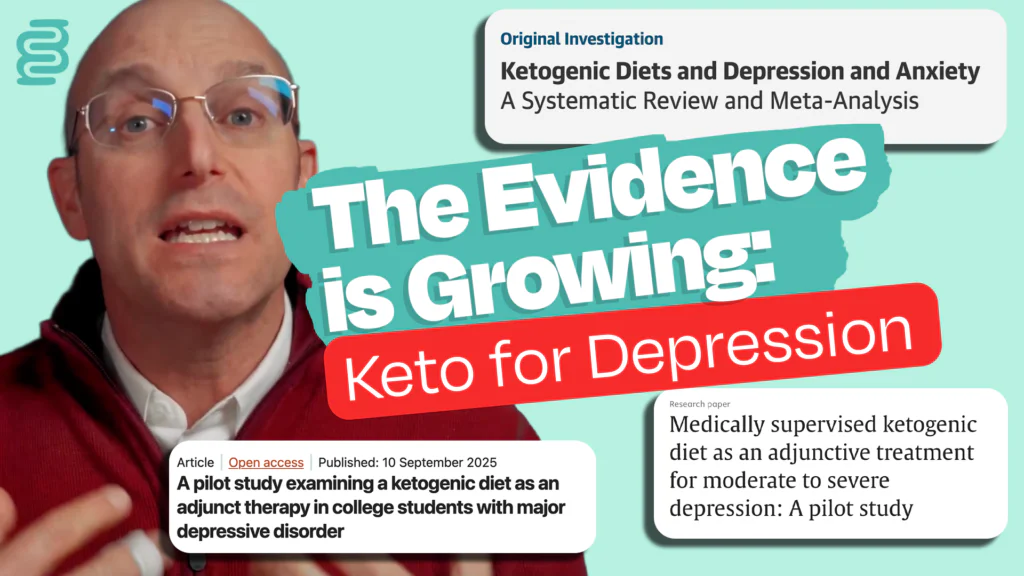
New research highlighted by Metabolic Mind suggests that ketogenic therapy may be a promising adjunctive treatment for depression. In this episode, Dr. Bret Scher reviews a remote 14-week pilot study, the KIND Trial, and a larger meta-analysis showing that ketogenic diets may help reduce depression symptoms, anxiety, and anhedonia, while offering new hope for people who have not responded fully to standard treatments.
Read more
In recent years, personal experience and scientific evidence have begun to converge around a simple insight: mental health and metabolic health are deeply connected. From family stories of…
Learn more

In February, Robert F. Kennedy Jr., the US secretary of health, made a characteristically bold claim. A doctor at Harvard University, he proclaimed, “has cured schizophrenia using keto diets”. If you happened to be passing Harvard University that day,…
Learn more
A new Delphi consensus paper published in Frontiers in Nutrition provides clinicians with practical guidance on using ketogenic metabolic therapy for mental health. Developed by experts across psychiatry, nutrition, and research, the paper outlines candidate selection, safety protocols, and monitoring standards to help healthcare providers confidently integrate ketogenic therapy into clinical practice as interest and research in metabolic psychiatry continue to grow.
Learn more
New research highlighted by Metabolic Mind suggests that ketogenic therapy may be a promising adjunctive treatment for depression. In this episode, Dr. Bret Scher reviews a remote 14-week pilot study, the KIND Trial, and a larger meta-analysis showing that ketogenic diets may help reduce depression symptoms, anxiety, and anhedonia, while offering new hope for people who have not responded fully to standard treatments.
Read more
In recent years, personal experience and scientific evidence have begun to converge around a simple insight: mental health and metabolic health are deeply connected. From family stories of…
Learn more
In February, Robert F. Kennedy Jr., the US secretary of health, made a characteristically bold claim. A doctor at Harvard University, he proclaimed, “has cured schizophrenia using keto diets”. If you happened to be passing Harvard University that day,…
Learn more
A new Delphi consensus paper published in Frontiers in Nutrition provides clinicians with practical guidance on using ketogenic metabolic therapy for mental health. Developed by experts across psychiatry, nutrition, and research, the paper outlines candidate selection, safety protocols, and monitoring standards to help healthcare providers confidently integrate ketogenic therapy into clinical practice as interest and research in metabolic psychiatry continue to grow.
Learn more