New Results: First RCT for Schizophrenia & Bipolar Disorder. Learn more.


Listen, Watch & Subscribe on:



Collaborative Science: How Individuals are Enhancing Research – with Dave Feldman
Listen
About the host
About the guest

Bret:
Welcome to the Metabolic Mind Podcast. I’m your host, Dr. Bret Scher Metabolic Mind is a nonprofit initiative of Baszucki Group where we’re providing information about the intersection of metabolic health and mental health and metabolic therapies, such as nutritional ketosis as therapies for mental illness.
Thank you for joining us. Although our podcast is for informational purposes only and we aren’t giving medical advice, we hope you will learn from our content and it will help facilitate discussions with your healthcare providers to see if you could benefit from exploring the connection between metabolic and mental health.
Engineer and citizen scientist, Dave Feldman, just hosted the Collaborative Science Conference, CoSci Conference, to help reframe how we do research and to help fund his studies for the lean mass hyper-responder. The result, a huge success. So, let’s hear about it.
Dave Feldman, welcome back to Metabolic Mind. So great to see you again.
Dave:
Likewise, Bret. Thank you for having me.
Bret:
Of course. So, we were just together in Las Vegas where you can add another part of your resume. You’ve gone from engineer to citizen scientist to published researcher to scientific study coordinator, I guess, to now conference organizer.
At the CoSci Conference, or Collaborative Science Conference, and there’s a lot in that word itself that I want to get into. But now that you’ve put on this conference, like how are you feeling? What’s your post-conference takeaways?
Dave:
Wow. it’s really a rush of emotions. I, first and foremost, I feel enormous gratitude because unlike a lot of conferences, you’re already aware of this, it’s everybody’s pitching in.
Everyone’s giving for real. The speakers, especially, all have come on their own dime and contributed their time or were sponsored by somebody else. All of the volunteers and, of course, all of us who’ve organized it to bring it together. We’re not taking a single penny from the money raised.
It’s all heading out towards what is, in fact, a bonafide charity event. So it’s like, we wrapped it in a conference, but in reality, it’s all just to try to get this money together to help fund this next study that we’re hoping to do soon.
Bret:
Yeah, and I think that’s what really ties it all together.
The term collaborative science conference, like you really are, we’re all coming together. Everybody who was there was collaborating to help make science work. And I think that’s a really important point to make about this conference. There were sort of two themes, like one is the theme of the study about LDL, lean mass hyper-responders, lipid energy model.
There’s all that. But the other part is, let’s just do science better, or at least, differently in a more collaborative way outside of the system. So, I want to talk about that part first because we’ve had talks about the LDL, about the lipid energy model, about the lean mass hyper-responders that I highly recommend everybody go listen to if they haven’t.
But let’s talk about this concept of how can we do science better. And that was a theme throughout the entire conference. And look, systems are systems, right? We have a system for how we fund research, how we do research. It doesn’t mean it’s completely broken, but we can do better. So, what is your takeaway from that part about how this community can help do science better?
Dave:
Yeah, that’s a big part of my journey in that, beyond the all of what you and I have already chatted about all this time with regard to lipids and the research that you’ve described. It’s clearly is the process itself, how best to accomplish getting the research done. And it’s, I think, a lot more of a complex problem than many people on the outside realize because I was on the outside.
You’d hear that a study came up and you wondered, why is this study conflicting with, say another study that’s out there? What’s really going on behind that? And then, as you get a little bit deeper into it, you find that there are a lot of, there are a lot of different, let’s say, players involved at very high levels from the publisher, to the source of the funding, to the academics that are themselves reviewing it.
All of these different forces play a part. But really, the funding is one of the most powerful and most important ones because, as I was getting into the space and I felt like lean mass, hyper-responders should be getting a lot of research around them, or at least the triad itself of high LDL, high HDL and low triglycerides.
Given how common it’s in the space of those people going on a ketogenic diet, I found it was hard to just get money to study that. And I was told forthright many times over, that part of the reason is they tend to be a healthier population. So, the data’s not as interesting as, frankly, data that can be coming from a population that might be more metabolically challenged or to show results in a faster way.
And so there were usually two channels of data, or two channels of funding that would hear over and over again. One is any funding that in some way has a business model associated with it, either because you have some drug that it can help modify based on how the trial goes, certain markers for certain outcomes, or if it comes from the NIH, if it comes from some government agency, depending on what country you’re in.
And unfortunately, then you’re at the whims of wherever they feel they want to prioritize money, and how they want to spend it. And that often doesn’t head towards things like low-carb diets in the same fashion, or at least in the way that we would like to apply it. And as, because you were there five years ago on a Houston stage, I just, I said, what the heck?
I’m just going to see if I could crowdfund it. I’m going to just ask the community, at large, a third option and see if I could just get them to send us the money to this new, bonafide public charity that we opened, called the Citizen Science Foundation. They could just give us the money so that we would then pay a research center, which we have lundquist to do this first study.
And that’s what’s so exciting is we’re having this conversation. After all that data has now been completed, our first study has been fully funded. We’re now raising money for the second study. So, proving this model works, this is a way to both get money and to make these studies happen that we want to have happen without being subject to these larger forces that have a lot more control over that.
Bret:
Yeah, I think that’s such, such an important lesson and takeaway from your journey so far, especially when you’re asking questions that a lot of people frankly don’t want asked, right? You’re asking questions that go against conventional wisdom in medicine, which makes it that much harder to get the funding, to get the support, to get the researchers.
But you’ve shown you can do it with a different model. And that if you’re asking the right questions and in the right manner, you’re going to get the support from the community. And that’s exactly what you’ve done. But, so tell us what you think, how that plays in asking the question that a lot of people don’t want to ask.
Like how much harder did that make it for you to accomplish what you’ve accomplished?
Dave:
It’s a little bit from each column. You’re absolutely right. And the documentary we’re shooting manages to catch a lot of that in real time. That there is actually a lot of resistance to not just to asking this question, but to quite literally studying it with bonafide scientists who are certainly qualified to accomplish that.
But then again, and this is what I really loved about the conference, I myself am surprised at the level of true, genuine support to make this happen. I’ve never had a single person who’s been writing us a check saying, okay, but I really need for this to turn out the way I hope it will.
I’m writing this check to you because I feel confident that it’s going to lean in the direction that we need it to or anything along those lines. That’s the part I’ve been impressed by is that from the smallest donors to the largest. If you can win their trust that you’re being a faithful inquisitor.
That you, yourself, you want the real question answered, then it’s amazing how much support comes forward to make it possible. And that’s what I’ve appreciated is. Yes, do we have a lot of resistance to this question being asked, and for that matter, being researched? Without doubt. Do we at the same time, seem to have an incredible amount of wind at our backs to push it forward.?
Definitely, this conference, you could feel it in the room more so than any other time I’ve felt it chatting online like we’re doing now. You can have all these great conversations on Twitter. You can be in forums like the lean mass hyper-responder Facebook group, and that just does not compare to so many of us physically coming together to not only show our support, but to raise the money right there physically in one place.
Bret:
Yeah, over 300 people all there to support the collaboration of science around the second study now that you’re proposing. And the way you structured the conference, I think really highlighted the importance of individuals looking for questions for themselves, exploring for themselves, and then how to bring that to the community.
And so, there were speakers that could have been at any continuing medical education, CME medical conference, giving a talk. But then, you also had the individuals sharing their stories, sharing their experiences, their end of one citizen scientist experiments, which is exactly how you started.
So, I’m curious how you felt that part went, having those individuals go up and share their story with the community?
Dave:
Easily, one of my favorite features of our conference. It was something we talked about in theory many times before. And it did carry some risks in that you never, many of these citizen science speakers had never been on a stage presenting before.
And I did my best, typically offline, to try to coach them to some degree just on some of the basics with regard to speaking. And yeah, there was always potentially going to be a risk. There might be somebody who might say something untoward, who knows? That said, I have to concede it’s easily one of my favorite things about our conference, is we gave opportunities for people to speak for the first time on their insights, on their stories.
I had a lot of data to share, such as Darius, for example. He makes me proud because he’s often in the lean mass hyper-responder model Facebook group showing a lot of his CGM data, and he’s showing a lot of his blood work. And this time around, we gave the stage to him so that he could provide his analysis, and it was fantastic.
Then you have stories like Matthew Baszucki’s. Wow. It was just beautiful to be able to have him on stage as well. Jessica Apple flew 27 hours from Tel Aviv to come and give her talk, and she did not disappoint. I thought it was just amazing. So, I am really heartened by how well that part of it worked out. And it’s, what I also really love that you probably couldn’t see, is that a lot of these folks also, many of them were networking with other people there.
Where, again, it could be another story of another citizen scientist who finds another way to make a contribution that helps us all. Yeah, that’s my hope.
Bret:
Yeah, and I think such, you highlighted three amazing examples. But what another thing those examples do is remind us all why we’re doing this, right?
We’re doing this for the individual, whether we’re doing it as clinicians, as researchers, or just as supporters. It’s for the individual, and that really brings it home. Like for someone like Matthew to not have the ability to transform his life in this way would just be heartbreaking.
And so we want everybody to have access to that. All right, so another interesting part about this conference, a conference about collaboration, about science, ends up in Sin City, Las Vegas. So, what was, why Las Vegas? What happened there?
Dave:
Actually, many people don’t know this. I literally live here in Las Vegas. And so, there’s another component to this, which is that it’s actually really easy to fly here.
A lot of people also don’t realize this. The casinos here, they supplement tickets. So, that’s why it’s often cheaper to fly to Vegas than most other cities. Now, I’ll throw a couple caveats. One, we are fairly new to this, and making a conference. And what we didn’t realize was that at the same time, this last weekend was something called March Madness, and unfortunately, that drove up the cost of tickets and the cost of hotel.
We did have a good hotel block. So, there was a decent discount that a lot of people could work with. But, it’s true. Some folks after our hotel block ran out, and especially as plane tickets went up, said that they wouldn’t be able to make it because of how expensive it was. And then, there was one other oddity. Something very unusual about this conference that’s worth a funny mention, which is that it was raining outside through most of this, which is actually unusual for Vegas.
When there’s prolonged, like two days of rain, it just almost never happens. And as a few times on stage, I was like apologizing, like guys, you’re not actually in Seattle. This is Las Vegas. But that said, I really do, I like this town for a lot of reasons.
Again, it’s fairly easy to fly to. But also, there are a lot of conventions that are held here. So, there’s a lot of options. We can hold a venue, we can hold an event at a much cheaper price if we’re just a little off the strip than probably many other major cities.
Bret:
Yeah. And when you’re having a fundraiser, cost definitely matters.
Yeah. and so I think the other point though to bring it back is, I said earlier that research science does a lot of things right. it’s set up well to study general populations, whether it’s the 10,000 person randomized controlled trial for a drug trial or the a hundred thousand person retrospective analysis about something, frequently nutrition.
Those types of science, though, certainly have their flaws. And what’s lacking is the person to say, what does this mean for me? And I think this gets back to that citizen scientist, right? What does this mean for me or my specific situation? And that’s exactly what you are doing with this lean mass hyper-responder study.
So, I want to bring that up as such a victory to say, yes, as individuals, we can make a difference. We can provide what general research isn’t. So, I’m curious if you have that same impression about how important it is for that individual, and what other advice you have for others who are in this situation who want to know how does this apply to me as an individual?
Dave:
Yeah, actually, this is another point that can’t be understated, and I love that you’re bringing this up. Because often I feel as though we’re getting the impression we need to wait for studies in spite of, our own individual circumstances are our own. They’re for us to work with. And because of that, we have to take ownership, not just of our health, but in the information gathering that helps us to improve our health.
We can’t just assume that any broad study will apply to us in the same way once we’re hearing it from anywhere. Certainly we want to continue to work with our medical professionals, our doctors, et cetera, but no one will take ownership of your health like you will. And so, in that way, this is where I like when people are sharing their stories of their individual health journeys, and they’re approaching it like scientists applying scientific principles, controlling for all other variables, but then they change this one thing.
That speaks to my heart because it’s quite literally where my origin story starts, is you want to care a lot about not just the research that’s out there that really can inform your decision. You do want to do your own research with yourself, and we shouldn’t shy away from that. We should encourage people to be mindful, yes, of safety, but at the same time to understand the importance of scientific principles as can be applied, as can be applied to their own understanding of their own health.
Bret:
Yeah, yeah, very well said. So, now the conference is over, and it was by all means, a huge success. And as you hinted at the conference, it’s probably not the last one. It’s probably the first of many, which would be very exciting.
But what that means is the conference is over, but the work is just beginning or continuing. So, what is next on the horizon for the study? You’ve already started for future studies? What can we see next from you?
Dave:
So, we have two different things. One that I don’t say too much out loud because I’m not making, I’m trying to find funding for it without asking people.
But I may actually have an individual funder for it, which is the extension, maybe doing a study extension on the one I just mentioned that we’ve completed, the lead mass hyper-responder study. The one that we’re publicly raising funds for is the triad study, and that one will, the one, it will be a bit costly.
So, I haven’t explained at what point we would start, or for that matter, how many people would be using. As I mentioned this at Low-Carb Denver last year, it’s more of a, let’s see how much we can raise. And then at a certain point, depending on how much we’ve raised, I try to find out how many people we can make, how many people we can assemble for that amount of money that we have.
So, that we have hit an important milestone now that we’re after, we’ve raised what we could for CoSci. I’ll be sitting down with Matt Budoff, and I’ll be talking to him about that very thing. I’ll be saying, okay, here’s how much we have in our research war chest, as it were. What could we make happen with this?
And it may be something where I try to raise a little bit more, depending on what their statistician says for what we can power against. How we can recruit most affordably, but still be scientifically sound. All of those decisions will be getting figured out here, possibly in the next week or two.
Bret:
So, decisions regarding like enrollment criteria, who you’re looking for this study, are those still yet to be determined?
Dave:
Yeah, there’s a, I can say some things which I already did at Low-Carb Denver last year, which is we do know it’ll be a more relaxed eligibility compared to the current one.
We do know that we want to have a control group. But beyond that, I really can’t say too much more because it depends on what they say internally in Lundquist makes the most sense. The good news is, and this part’s important, we also have a different context than we had before the lean mass hyper-responders study we just did.
We know that at least while we don’t have the final analysis completed, the safety concern is not nearly the same as it was before. And why that’s important is for us to get this next study started, it’s helpful for the same IRB that we were chatting with to have that data in hand to say we can do more relaxed criteria.
And by that, a population that might be considered marginally higher in risk than our original lean mass hyper-responders. Because we now know that this really does seem to be a different population given ongoing data so far. And that’s something that is hopefully going to make this go a lot faster and improve on our odds of getting IRB approved.
Bret:
Excellent. I really appreciate all you’re doing for the world of science and certainly for the world of lean mass hyper-responders, and I’m very excited to hear that this probably was not the last of these conferences because it was so magical and memorable and powerful for so many people.
So. Thanks for all you do. And I can’t wait to see what’s next from you.
Dave:
Thank you so much for having me, Bret. And again, thank you for being one of our featured speakers here at CoSci. It was, it was a pleasure to have you.
Bret:
Oh, it was my pleasure. Thanks. Thanks for listening to the Metabolic Mind Podcast.
If you found this episode helpful, please leave a rating and comment as we’d love to hear from you. And please click the subscribe button so you won’t miss any of our future episodes. And you can see full video episodes on our YouTube page at Metabolic Mind. Lastly, if you know someone who may benefit from this information, please share it as our goal is to spread this information to help as many people as possible.
Thanks again for listening, and we’ll see you here next time at The Metabolic Mind Podcast.
Listen, Watch & Subscribe on:
A cautious, and nuanced editorial about elevated LDL cholesterol while on a keto diet. Read more here!
Read more
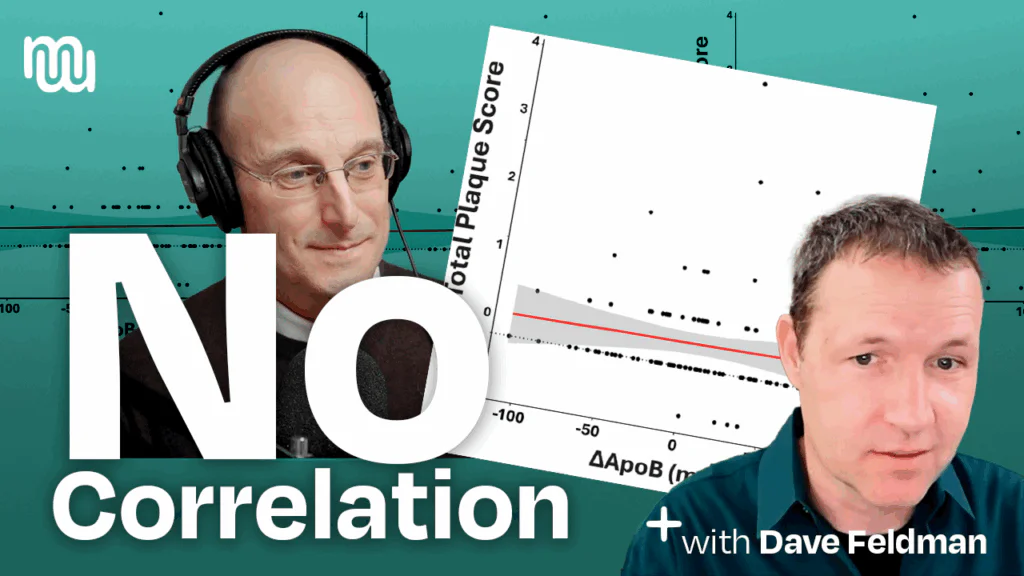
Engineer-researcher Dave Feldman walks through the lean-mass hyper-responder (LMHR) keto-CTA trial: 100 metabolically healthy keto eaters with very high LDL/ApoB had coronary CT angiograms at baseline and ~1 year. Key finding: changes in plaque (including non-calcified plaque) did not correlate with LDL or ApoB; the best predictor of progression was pre-existing plaque. Keto itself wasn’t shown to drive plaque, and saturated-fat intake and cumulative on-diet LDL exposure didn’t track with ApoB or plaque change either. Plaque did rise modestly for some—about what’s seen in treated cohorts—while a few even regressed; interpretation should be individualized with imaging (CAC/CTA) guiding care and standard therapies used when plaque is present. Limitations (e.g., no longitudinal control group) mean more studies are needed; Dave’s team is launching follow-ups and invites open, civil debate—“don’t confuse arsonists with firefighters.” Resources: CitizenScienceFoundation.org and cholesterolcodemovie.com.
Learn more
A JACC: Advances study comparing lean-mass hyper-responders on ketogenic diets to matched controls found no significant difference in coronary plaque by CCTA despite about five years of much higher LDL exposure. The findings question a one-size-fits-all lipid hypothesis, elevate imaging-based risk assessment over LDL alone, and point to metabolic health, HDL/triglycerides, and particle composition as key factors. Results are preliminary, with longitudinal and mechanistic analyses forthcoming.
Learn more
Sensational headlines about health topics are everywhere these days. For example, one recent headline claimed that the keto diet will increase your risk of heart attack. Is this…
Learn more
A cautious, and nuanced editorial about elevated LDL cholesterol while on a keto diet. Read more here!
Read more
Engineer-researcher Dave Feldman walks through the lean-mass hyper-responder (LMHR) keto-CTA trial: 100 metabolically healthy keto eaters with very high LDL/ApoB had coronary CT angiograms at baseline and ~1 year. Key finding: changes in plaque (including non-calcified plaque) did not correlate with LDL or ApoB; the best predictor of progression was pre-existing plaque. Keto itself wasn’t shown to drive plaque, and saturated-fat intake and cumulative on-diet LDL exposure didn’t track with ApoB or plaque change either. Plaque did rise modestly for some—about what’s seen in treated cohorts—while a few even regressed; interpretation should be individualized with imaging (CAC/CTA) guiding care and standard therapies used when plaque is present. Limitations (e.g., no longitudinal control group) mean more studies are needed; Dave’s team is launching follow-ups and invites open, civil debate—“don’t confuse arsonists with firefighters.” Resources: CitizenScienceFoundation.org and cholesterolcodemovie.com.
Learn more
A JACC: Advances study comparing lean-mass hyper-responders on ketogenic diets to matched controls found no significant difference in coronary plaque by CCTA despite about five years of much higher LDL exposure. The findings question a one-size-fits-all lipid hypothesis, elevate imaging-based risk assessment over LDL alone, and point to metabolic health, HDL/triglycerides, and particle composition as key factors. Results are preliminary, with longitudinal and mechanistic analyses forthcoming.
Learn more
Sensational headlines about health topics are everywhere these days. For example, one recent headline claimed that the keto diet will increase your risk of heart attack. Is this…
Learn more