New Results: First RCT for Schizophrenia & Bipolar Disorder. Learn more.


Listen, Watch & Subscribe on:



The Truth About Psych Meds: Two Things Can Be True (From APA)
Listen
About the host


Bret:
I’m here at the American Psychiatric Association annual conference, and there’s a conversation happening in the hallways and in the session rooms that really deserves a wider audience and an important look. So, psychiatric medication de-prescription is all everybody’s talking about, and that’s a loaded word, de-prescription, because the discussion is about when to taper psychiatric medications, how to taper, who should be making that decision.
And it’s probably one of the most underserved questions in mental health care right now. So, de-prescription and tapering sort of one in the same in this discussion. But let me give you some context. So, the administration, government administration, recently called for greater discussion about de-prescribing psychiatric medications, and that’s created some genuine controversy here at the APA.
Now, on the one hand, APA leaders openly acknowledge that there is a clear over-prescription of psychiatric medications, particularly antidepressants. And that’s sort of a mainstream clinical observation coming from within psychiatry itself and that many people are already aware of. But on the other hand, they still acknowledge that these medications can be necessary and life-changing for many people.
So, for some patients, the right antidepressant or mood stabilizer or antipsychotic is the difference between stability and crisis. So, how do we hold both of those truths at the same time? How do we have an honest conversation about over-prescription and responsible tapering without inadvertently encouraging people to stop their medications when they may still need them?
So, that tension here at the APA is what I’m feeling, and what a lot of people are experiencing. But just throwing blame around doesn’t solve the issue. So, let’s talk about it, and see how we can fix it. So, the framing that I think matters most is that when it comes to tapering or de-prescribing, the general advice, the social media content, the governmental decrees shouldn’t be directed at the individual patient.
It has to be directed at the prescribing clinician. So, what that means is every prescription for a psychiatric medication should come with a plan. Not just a plan for starting the medication and titrating the dose up, but a plan for reassessing whether the medication is needed in the future, at what dose, and under what circumstances it might be appropriate to start tapering.
Now, you can call that de-prescribing, or you could simply call it responsible prescribing. And that conversation isn’t happening enough, and that’s what has to be recognized. And the absence of that conversation is part of what creates the over-prescribing problem in the first place. When there’s no built-in checkpoints. Medications that were started for an acute episode can become indefinite prescriptions by default. Not by an active clinical decision, but by default.
And the other part to consider is, as new treatments are added, potentially such as ketogenic and metabolic therapies, then the need for medications may change. But if clinicians aren’t looking for that, they’ll never see it. And that’s just not good, responsible medicine. And fixing it requires, I guess you could say, a cultural shift in how clinicians approach the prescribing relationship from the beginning.
So, another topic that came up repeatedly in conversations here at the APA is the lack of quality research on how to safely taper psychiatric medications. So, what should the optimal tapering schedule look like? A lot of people talk about hyperbolic tapering, but with clinical experience, not with research.
How do we distinguish withdrawal symptoms from relapse? How do we identify which patients are most likely to do well with tapering versus those for whom discontinuation carries real risk? So, we cover a lot of these questions actually in our tapering hub at metabolicmind.org, but much of this is informed by clinical experience with a great need for quality research still.
And this is a massive opportunity. The National Institute of Mental Health, NIMH, has the platform and the resources to fund rigorous clinical trials in this area. And that research is urgently needed, and the field should be demanding it. But then, there’s another question, and this is equally important.
The question is: taper to what? Because if we’re simply removing a medication without addressing the underlying biology that led to the symptoms in the first place, we’re really not setting the patient up for success. And this is one powerful example, I guess you could say, in the lack of foresight in this area.
One speaker kept referring to the quote-unquote “lucky 10% of people with bipolar disorder who can safely stop their medications.” So first, that assumes only 10% can stop and 90% have a lifelong dependence. But second, using the term “lucky” as if there was no biologic reason for them to be able to stop. They were simply “lucky.”
For me, this is where metabolic psychiatry and ketogenic therapy could have a vital role, and I want to be careful because the evidence base is still developing, right? The clinical decisions are really complex, but what we have is a growing body of clinical experience from practitioners, like Georgia Ede and others, who have worked with patients using ketogenic and metabolic therapy as part of a broader approach to mental health, including in some cases, tapering psychiatric medications.
And the mechanism makes biological sense. Ketosis changes how the brain transforms and uses energy. It can reduce neuroinflammation, may support the kind of metabolic stability that gives patients a better foundation from which to consider tapering. So, instead of just hoping that they’re “lucky,” they can take active steps to improve their brain metabolism and see how that impacts their symptoms and possibly their need for medications.
So, this is not saying that people should taper their medications. That’s not what we’re saying. That decision is deeply individual. It carries real risks if done incorrectly or without clinical supervision. So, that should always be made in partnership with a qualified healthcare provider who knows the patient’s history well.
What we can do, though, is make sure that patients and clinicians,  clinicians as well remember, who want to explore the question have access to good resources. So again, I can refer you to our tapering resource hub at metabolicmind.org. It provides information that is designed to support informed conversations between patients and their care teams.
Not to replace the conversations, but to support them. All right, so let’s wrap this up, put a little bow on it. We need honest acknowledgement that overprescription is real while holding equal space for the reality that these medications can be helpful and life-changing for many people. We need responsible prescribing where clinicians build de-prescription or tapering planning into the treatment relationship from the start.
We need NIMH and other research bodies to prioritize tapering research studies. And we need to take seriously the question of what we can do to support the underlying biology of mental health, not just manage symptoms. We don’t have all the answers. The research is not where it needs to be, but the patients are here right now asking real questions and needing our support.
So, the most responsible thing we can do is be honest about what we know, transparent about what we don’t know, and committed to building the evidence base that our patients deserve and providing them with the information to have the informed conversations. So, I hope this was helpful. If it was, please like and subscribe, and please leave us a comment on your thoughts about medication tapering and medication management.
Thank you for watching. I’m Dr. Bret Scher. We will see you here next time at Metabolic Mind, a non-profit initiative of Baszucki Group,
Listen, Watch & Subscribe on:
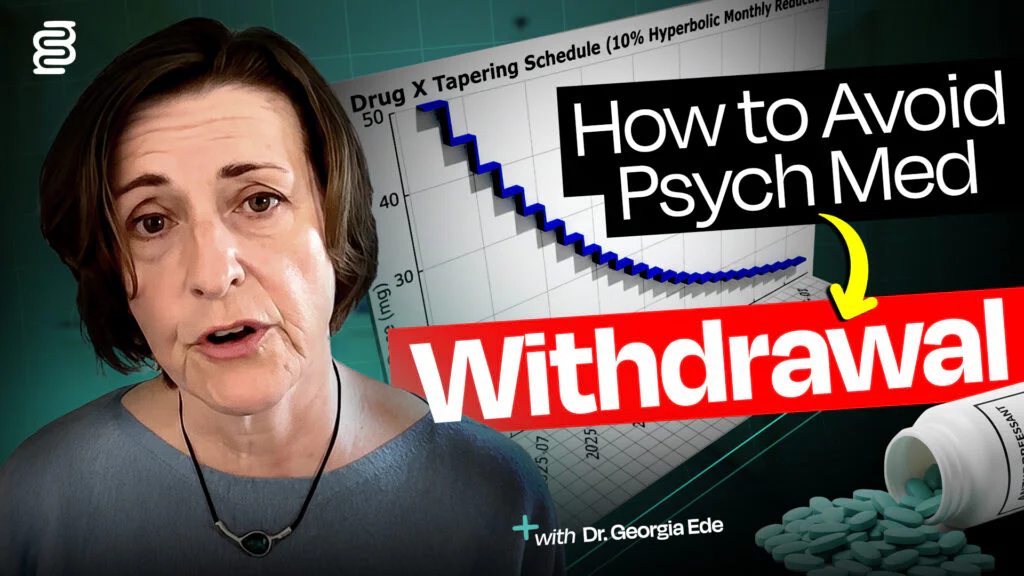
In part two of Metabolic Mind’s series on psychiatric medication tapering, Dr. Bret Scher and psychiatrist Dr. Georgia Ede explain why deprescribing is highly individualized, why common “cut in half” approaches can backfire, and how hyperbolic tapering better matches how the brain responds to dose changes. They discuss practical tools like compounding pharmacies and tapering strips, warning signs of withdrawal, the difference between acute and protracted withdrawal, and why strengthening overall brain health through sleep, stress management, nutrition, exercise, and therapy can improve the odds of a safer taper.
Read more

We at Metabolic Mind believe that there’s a strong connection between mental and metabolic health. But where did this belief come from? In this article, we’ll answer this…
Learn more
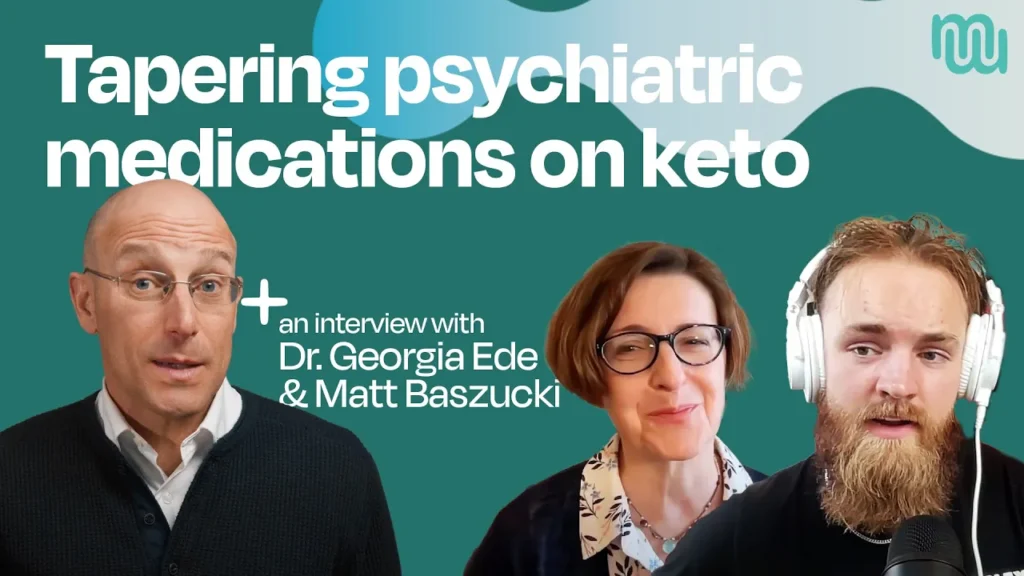
This Metabolic Mind episode dives deep into how to safely manage and taper psychiatric medications when starting a ketogenic diet for bipolar disorder, depression, schizophrenia, anxiety, and other mental health conditions. Harvard-trained psychiatrist Dr. Georgia Ede explains why meds should never be stopped abruptly, how to choose which drug to taper first, and why ultra-slow, individualized dose reductions are often safest. Lived-experience advocate Matt Baszucki shares his detailed journey using therapeutic ketosis, sleep tracking, and a compounding pharmacy to gradually reduce antipsychotics, benzodiazepines, and lithium over several years—without relapsing into mania. If you’re considering keto for mental health and wondering what it means for your medications, this episode offers practical, real-world guidance you can discuss with your clinician.
Learn more

As mental health challenges grow more complex, a new approach—metabolic psychiatry—is gaining momentum by targeting the brain’s metabolic health through interventions like the ketogenic diet. Read more here!
Learn more
In part two of Metabolic Mind’s series on psychiatric medication tapering, Dr. Bret Scher and psychiatrist Dr. Georgia Ede explain why deprescribing is highly individualized, why common “cut in half” approaches can backfire, and how hyperbolic tapering better matches how the brain responds to dose changes. They discuss practical tools like compounding pharmacies and tapering strips, warning signs of withdrawal, the difference between acute and protracted withdrawal, and why strengthening overall brain health through sleep, stress management, nutrition, exercise, and therapy can improve the odds of a safer taper.
Read more
We at Metabolic Mind believe that there’s a strong connection between mental and metabolic health. But where did this belief come from? In this article, we’ll answer this…
Learn more
This Metabolic Mind episode dives deep into how to safely manage and taper psychiatric medications when starting a ketogenic diet for bipolar disorder, depression, schizophrenia, anxiety, and other mental health conditions. Harvard-trained psychiatrist Dr. Georgia Ede explains why meds should never be stopped abruptly, how to choose which drug to taper first, and why ultra-slow, individualized dose reductions are often safest. Lived-experience advocate Matt Baszucki shares his detailed journey using therapeutic ketosis, sleep tracking, and a compounding pharmacy to gradually reduce antipsychotics, benzodiazepines, and lithium over several years—without relapsing into mania. If you’re considering keto for mental health and wondering what it means for your medications, this episode offers practical, real-world guidance you can discuss with your clinician.
Learn more
As mental health challenges grow more complex, a new approach—metabolic psychiatry—is gaining momentum by targeting the brain’s metabolic health through interventions like the ketogenic diet. Read more here!
Learn more