Announcing the new McLean Center for Metabolic Psychiatry Learn more.


Listen, Watch & Subscribe on:


Q&A: Can You Fast and Still Get Enough Protein & More
Listen
About the host

About the host


Bret:
Welcome to the Metabolic Mind Podcast. I’m your host, Dr. Bret Scher. Metabolic Mind is a non-profit initiative of Baszucki Group, where we’re providing information about the intersection of metabolic health and mental health and metabolic therapies, such as nutritional ketosis as therapies for mental illness.
Thank you for joining us. Although our podcast is for informational purposes only and we aren’t giving medical advice, we hope you will learn from our content and it will help facilitate discussions with your healthcare providers to see if you could benefit from exploring the connection between metabolic and mental health.
Those with type 1 diabetes have a higher incidence of serious mental illness than the general population.
Erica:
My husband and I were curious if baking salmon or any other fatty fish would make the omega nutrient less effective.
Bret:
One of the really interesting things with ketosis is it tends to not lower the metabolic rate, nearly the same as other ways of weight loss.
We’re doing something we’ve never done before at the Metabolic Mind Podcast. Our first ever giveaway, and there’s a reason behind it. As we plan future episodes of the Metabolic Mind Podcast, we want to hear from you. What topics are you most interested in? What do you want to hear more about? And how can we make the podcast more useful for you?
So, we’ve put together a short listener survey. And as a thank you for taking a few minutes to fill it out, you’ll have a chance to win our Metabolic Mind grand prize package worth around $250. It includes a Keto-Mojo glucose and ketone meter and test strips, sugar-free Liquid IV, Metabolic Mind swag, Archer Meat Sticks, and copies of Brain Energy by Dr. Chris Palmer and Change Your Diet, Change Your Mind by Dr. Georgia Ede, plus a few other goodies.
We’ll choose one grand prize winner, and then also five runners-up will each receive a $50 Amazon gift card. The survey is open through September 15th. So, if you’re watching on YouTube or listening on the podcast, you’ll find the survey link in the show notes.
And if you’re following us on Instagram, just head to the link in our bio. But most importantly, your feedback will help us shape where the Metabolic Mind Podcast goes next. So, please take a few minutes to fill it out and good luck. And we’ll announce the winners on September 18th.
Welcome back to another Metabolic Mailbag episode here at Metabolic Mind.
Once again, I’m joined by our producer, Erica. So, thank you so much for joining me today, Erica. Good to see you.
Erica:
Good to see you, too, Bret.
Bret:
Another opportunity for us to dig in to all these questions we’ve been getting. And we’ve been getting so many questions, and such good ones. It’s just why we have to keep doing these episodes so that we can get to all these questions.
So, remind everybody how they can send us their questions. And then, we’ll jump right in and start answering them.
Erica:
Yes. If you have a question for Dr. Scher, you can send it to, you can go a couple of places. One, you can go to our website, which you should go to anyway because it’s fantastic, and there’s a ton of great resources there. And it’s metabolicmind.org/questions.
You can also email us at info@metabolicmind.org, or you can DM us on social media because you’re probably scrolling many hours a day there anyways. So, why not send us a message while you’re there?
Bret:
Perfect. And as you may know, we’ve had guests for the Q&As before. Dr. Georgia Ede’s been on quite a few.
We had Templeton Stewart, and we’re happy to have others, too. So, if you have other people in mind, let us know that as well. So, what do you got on the list for us today, Erica?
Erica:
Okay. We have some very juicy questions for you today. They’re on the more challenging side. So, I’m excited to dive in.
Okay. Our first question is, “Would a therapeutic keto diet be recommended for a type 1 diabetic with bipolar? Also, is there a connection between type 1 diabetes and mental illness?” So, what do you think, Dr. Scher? Type 1 diabetes with bipolar.
Bret:
Yeah. So, first to get to the second part of that question. Yes, there is an association between type 1 diabetes and serious mental illness, bipolar disorder.
Erica:
Are you serious?
Bret:
Yeah, it’s may not be known to everybody. But when you look at the literature, there is this association. So, is it causative? What are the exact mechanisms, right? Like all that is being researched and can be debated. But it’s pretty clear those with type 1 diabetes have a higher incidence of serious mental illness than the general population.
So, there definitely is something there. So, for this individual asking is there an association, the answer is yes. And actually, I’ve had a couple interviews about type 1 diabetes. A big one was with Dr. Andrew Koutnik, and we did talk about that sort of mental health aspect of type 1 diabetes.
That could be worth going back to listen to. But the second part of that question, would someone recommend a ketogenic diet or a ketogenic therapy, more importantly, for someone with type 1 diabetes and bipolar disorder? And the answer is absolutely yes with very careful clinical guidance. So, whether you’re using ketogenic therapy to treat bipolar disorder, you should have clinical guidance for sure.
If you’re using a ketogenic therapy to treat type 1 diabetes, you should absolutely have clinical guidance. So, put the two together, very important to have clinical guidance. Why? One of the concerns, and actually, when I look back at my journey through ketogenic therapy, in the very beginning, I would tell people, “Oof, type 1 diabetes. I’m not going to touch that.
That’s too risky.” Now, I’ve come full circle, and it’s like absolutely, people with type 1 diabetes can absolutely benefit from this. But the need to adjust your insulin on an ongoing basis, and really pay attention to your blood sugar levels, and really pay attention to how you’re feeling and that you’re getting enough calories and all that, those are real because the risk of hypoglycemia or diabetic ketoacidosis are very real in that situation. But absolutely, perfectly doable for someone who’s going to really test, really pay attention, and has good clinical guidance.
And then with bipolar disorder, we know ketogenic interventions can help with bipolar disorder. And we’re learning so much more about that through the ongoing research. So, put the two together, and absolutely, as long as you’re being smart about it and have experienced clinical guidance.
Erica:
I’m curious, though, what changed your mind on the matter?
Bret:
Really just talking to experts. Because when I first heard about it, and you, if you read the literature, would say it was a contraindication. And I get it, right? There’s such a risk and a concern. It’s like the third rail. Don’t touch it, don’t. But then I started talking to clinicians and individuals who have been using keto for type 1 diabetes, and saw the immense benefits that are there, and got a clearer picture of the risks.
Yes, there are risks, but they’re perfectly manageable. Now, it has to be the right patient, right? If it’s someone who’s not so good about checking their ketones and their blood sugar and adjusts their insulin every now and then, that’s not the person to use ketogenic therapy for their type 1 diabetes.
But someone who can be much more vigilant about checking their blood sugar, adjusting their insulin, doing it on a regular basis, absolutely, that person can really benefit. You can really eliminate a lot of the hypoglycemias and really shrink the variation in the glucose. And unfortunately, the goal, quote unquote, “goal” hemoglobin A1C for someone with type 1 diabetes is 7.0, which is a markedly abnormal hemoglobin A1C, but the concern is any lower and you risk hypoglycemia.
But for people, like Andrew Koutnik and people like Dr. Ian Lake, people who are using ketogenic therapy to treat their type 1 diabetes, they have hemoglobin A1Cs of 5, 5.2, 4.8, completely normal hemoglobin A1Cs. So, it’s remarkable how effective it can be.
Erica:
Okay. Thank you for that great question.
And our next question is, “I have a friend who has Parkinson’s disease, among other diagnoses. She says that when she eats too much protein at one sitting, more than two ounces, the protein inhibits her Parkinson’s medication making her tremors worse, and she takes her Parkinson’s medications every two hours.
How can she start keto without much protein?” So Dr. Scher, what is she to do? How does she take her medication, go on a keto diet, but limit her protein intake?
Bret:
Yeah, so I assume the medication they’re talking about is levodopa. That is a medication that is impacted by protein intake, and you need to space it out.
Interesting that she has to take it every two hours because you want to space it out, like an hour or two, taking the medication and eating protein. But if you have to take it every two hours, that’s obviously very challenging to do. So, the first thing, though, is that a keto diet does not have to be a high-protein diet.
So, as long as you’re getting that one to 1.2 grams per kilo of reference body weight ,that’s perfectly reasonable. Now, if you can only do it two ounces of a protein food at a time, you would just have to spread it out throughout the day. So, don’t try and eat OMAD or two meals a day or even three meals a day.
You might have to throw small protein snacks in there throughout the day. But it, again, it doesn’t have to be a high protein diet. And that’s an assumption a lot of people think, “Oh, keto means high protein.” But they don’t really know what high protein means. But in reality, it’s adequate protein. Really up to 1.6 grams per kilogram of reference body weight.
And I know people don’t always like those terms, but that’s usually how it’s defined. That’s an adequate or a moderate protein diet. Not a high protein diet. but for this individual, stay on the lower end of the protein if you need to. And definitely space it out with little protein snacks during the day.
Erica:
So, what kinds of foods then would you suggest that aren’t going to be too high protein and that will be satiating so she doesn’t feel deprived?
Bret:
Yeah, that’s a great question. Deli meats are a good one. They’re just easy to grab, and have in the fridge and eat as snacks. You can have Greek yogurt.
Plain Greek yogurt. Love a Greek yogurt. Tends to have a decent amount of protein, right? Yeah, so that’s a good one as well. You could do protein shakes. But if you have to limit the amount, those usually are pretty dense in protein. So, you would have to have a small amount of that. Yeah, and there are lots of little, whatever you eat during the day, you can have as snacks.
Any leftovers, any cooked meat, ground beef, fish, whatever, you can have those for little snacks. It doesn’t have to be, quote-unquote, “snack food.” It can just be leftover meals, too.
Erica:
Yes. I love that you’re a big fan of eating non-meal specific foods at all times of the day.
That’s my favorite. Yes.
Bret:
Yeah.
Erica:
Breakfast for dinner, for breakfast, snacks throughout the day. Why not?
Bret:
Absolutely. That’s right. You say that to kids and they think, “Pancakes for dinner!” No, that’s not exactly what I’m talking about. Hang on a second. But, yeah, you get the gist.
Erica:
That’s awesome.
All right, next question: “I recently listened to Bret’s podcast on omega-3 research reports. My husband and I were curious if baking salmon or any other fatty fish would make the omega nutrient less effective. Would love to hear your views on this.” So yes, Bret, does cooking a protein at a high temperature affect the quality of the nutrient?
Bret:
Yeah, it’s a good question. So ,the way I understand this is that It doesn’t affect the omega-3s that are still there. But you can, actually, you can cook off some omega-3s, theoretically. But what you’re also doing is you’re dehydrating the fish. A lot of the water comes out. So, you’re concentrating the omega-3s more.
But the impact, the effect, of the omega-3s that you have are probably the same whether you have it sushi or whether you cook it. But the concentration is going to be different, if that makes sense. So, it’s not the same, because people say, “Look, if you have a bottle of omega-3s and it sits in the sun, it can get rancid. So, why doesn’t applying heat and cooking fish do the same thing?”
But it doesn’t. And that’s the beauty of a whole food versus a supplement that is extracted and then put in a solution and whatever. It’s a little less natural, and a little more sensitive to the elements. But cooking fish, you still get basically unadulterated omega-3s from that.
So, always stick with whole food. Sushi’s great, but you can cook it, too. That’s okay.
Erica:
That’s so good to know because I have no desire to go on a raw diet. And I feel so much better now. Thank you.
Bret:
Very good. Yeah, and so people who haven’t heard that should go back and listen to that. Because it was about a study that looked at omega-3 supplements and suggested there was maybe an increased risk of dementia.
Now, there are lots of problems with that. We don’t know exactly why they were taking the supplement, right? Maybe they had a higher risk at baseline? The study didn’t do this. But one of the questions that came up was if you take a rancid fish oil, could that be more harmful than beneficial? So, if you are taking fish oil, absolutely, you got to be careful that you’re getting a reputable brand. You’re not buying it from Amazon so you don’t know if it was sitting in a warehouse for months and months. That you store it properly. You smell it before you you take it.
All those things are important when taking fish oil or omega-3s.
Erica:
And same thing for your pets as well, if you give them an omega-3 supplement, because they can also often be rancid. So, if you’re an animal lover like me, check.
Bret:
I’m guessing your doggos are on omega-3, is that right?
Erica:
Yes, all of them.
Bret:
Very good. Yes. All right.
Erica:
All right. So, our next question. “Thank you for your great channel.” Oh, thank you so much. “I’d love to ask these two questions.” So, I have a two-parter here. “First of all, I’m worried that with regular fasting,” this person does intermittent fasting, 24. “I might not be getting enough protein over the long term.
That’s why I like to supplement.” So, this person is on a vegetarian keto diet and does intermittent fasting. The question is, because I’m paraphrasing, it’s very long, does it make sense to use amino acids outside of her fasting window to make sure that she’s still getting enough protein? Does that make sense from your perspective, or does it interfere with the fasting or longer fasts?
Bret:
Yeah, it’s a good question. I think this question, one, is interesting because it brings up this concept of fasting and protein and fasting and health. Is intermittent fasting good? And the answer is, yeah, maybe, depending on what you’re trying to accomplish.
But one of the things it can do is it shortens the window for you to get adequate protein. So, what are your protein goals? How are you getting protein? If someone’s vegetarian, eating a vegetarian or a vegan diet already, it’s a little bit more challenging to eat your protein. Not that you can’t. You certainly can, but a little more challenging.
So, add on top of that intermittent fasting, and now you certainly are making it more challenging to get adequate protein. One thing you can do is if you eat two meals during your eating window, add a protein snack in between there, a protein shake or something if you can. Now, it sounds like what this person was asking, though, can I take amino acids while I’m fasting, and is that going to, quote-unquote, “undo the fasting”?
And again, that comes down, back to like why are you fasting, right? If you want complete no nutrients autophagy, then maybe amino acids are going to undo that. But if you’re only doing it for 14, 16 hours, there’s not a whole lot of literature to suggest that you’re really hitting autophagy pretty deeply in that window anyway.
If you’re doing it to, give you a sustainable way to reduce calories and just lower your insulin levels, then adding a little bit of amino acids in that window probably isn’t going to impact that. You will get a little bit of an insulin bump from the amino acids, potentially, but not much at all.
So, if that’s the reason, then maybe it is okay to do. So again, it goes down to the reason for the fasting, and what else are you do during the day to hit those protein targets. But when people come to me and they say, “Yeah, I just can’t eat enough protein.” And I say, “How are you eating?
What are you doing?” And they’re, “Oh, I have a six-hour eating window.” I’m like, “Okay, that’s probably why you’re not hitting your protein target. So, let’s figure out why you have that six-hour eating window. What else you can do about it?” And you don’t have to do it every day, right? Maybe one day you eat three meals a day with a snack and you have much more protein. And the next day you do intermittent fasting with a little bit less protein, right?
You don’t have to do it the same way every single day.
Erica:
Does intermittent fasting boost ketone levels?
Bret:
It can, absolutely. Yeah. So, that’s another benefit for it for, especially for people who have a hard time getting their ketone levels up and know they feel better with higher ketones. Then, intermittent fasting can help with boosting ketones.
Erica:
All right, part two of this question is, “Based on my experience with yo-yo weight gain, I’ve learned that it’s important to eat at least my basal metabolic rate. Does that also apply to keto?” So first of all, can you explain what is a basal metabolic rate?
Bret:
Yeah. So basal metabolic rate, resting metabolic rate, technically, they’re not exactly the same thing, but they’re used frequently interchangeably. And it’s basically like, how many calories you burn during the day just existing, not exercising, not doing different activities, but just breathing and just existing.
What is your calorie requirement for neutrality, you can say. And one of the interesting things is like when you lose a lot of weight, especially with calorie restriction or with GLP-1s, your resting metabolic rate goes down. It’s like a survival mechanism, you can think of it.
Your body’s saying, “I’m losing all this weight. This must be a time of scarcity or famine, and I don’t want this to continue. So, I’m going to lower my metabolic rate so I require less.” It’s not exactly that way, but that’s the way people like to explain it. And that’s also why people can struggle maintaining weight loss and why they gain weight really quickly. Because if you lower your metabolic rate, it works against you.
Now, one of the really interesting things with ketosis is it tends to not lower the metabolic rate nearly the same as other ways of weight loss, and that’s certainly one of the benefits of it. And Dr. David Ludwig has done a lot of research on this and published on this, that metabolic rate can actually increase or can stay the same with ketogenic eating.
So, when this person says I eat, do you eat your metabolic rate? The first thing is making sure you have an accurate measurement of your metabolic rate, your resting or basal metabolic rate, and that’s not easy to do. There are formulas and things,. What is your age? What is your weight? And those are just guesstimations.
if you really want to know, you’ve got to go into a facility, wear the mask, breathe into it, that has the device that’s truly measuring what your resting metabolic rate is. So, if you’re using that as a guide, I just say really make sure it is accurate and not going off of some formula, especially if you’re eating a ketogenic diet, because that really does change things.
Erica:
Is there a way to know if their body is switching into starvation mode?
Bret:
Good question. In the extreme, yes. You would feel cold. Your hair might start falling out. You’ll probably feel a little fatigued. Those are the ones that pop into my mind right away.
But yeah, that’s in the extreme. So, you could still be, quote-unquote, “a little bit in starvation mode” without those. But if you’re experiencing those, that’s a sign you’re probably not getting adequate calories. And your body is saying, “Hang on, we want to make sure this doesn’t get to a dangerous point. So, let’s start to shut things down a little bit.”
Erica:
Okay. So be cautious and make sure that you’re taking good care of yourself there. Thanks so much for the question. All right. Our next question is, “If two meals contain about the same amount of protein.” Okay, wait, I’m really excited about this question because I have the same one.
Bret:
Okay.
Erica:
Here we go. It almost sounds like that if train A takes off from one station and train B takes off. Okay, “If two meals contain about the same amount of protein, why might a protein shake leave someone feeling hungry, while eating meat leaves them feeling satisfied? Is this related to digestion, hunger hormones, or something else?”
Bret:
Yeah. Great question because it comes down to the question of what causes hunger and what causes satiety? And it’s more than one thing, right? So, protein content is definitely part of that, but so is volume. If you have a huge salad with just tons of lettuce, big volume, chances are you’re going to feel full.
It may only be for about a half an hour. Frequently, that was the old joke, you go to these all-you-can-eat salad bars, and you walk away stuffed. And then you’re starving an hour later. But it’s because that volume, it takes up your stomach and for temporarily, you feel full. So, think about the difference between a protein shake and a big steak.
That volume in your stomach, for one, is going to be very different, even if the protein is the same. So, that can certainly be part of it. Part of it is also psychologicalThe psychology of drinking is different than the psychology of eating. So, that’s going to fill you up a little bit differently, too, make you feel full differently.
So, I like this question because you might hear protein is satiating. In general, that is true, but it points out perfectly how you’re getting your protein can influence the degree of satiety that you get from it. More volume is good. Eating is good. Not that protein shakes are bad, but you just understand they’re not going to make you feel as full as eating a big old steak.
Erica:
So, all of those keto snack bars that are say, oh, 30 grams of protein, but they’re this big, right?
Bret:
Yeah.
Erica:
And you don’t feel full afterwards. But is it, what happens if on top of that, you go and eat more? Then, are you eating too much protein? Does this backfire?
Bret:
Yeah, you might, especially because they pack a lot of calories in those, in the bars or in the shakes.
And so then, if you’re not satiated and you eat more than you otherwise would, then yeah, maybe if you’re trying to lose weight, that could go against your weight loss goals or metabolic health goals. Yeah, so there is that concern. I guess the other thing to put in there, though, is what is the protein source?
So, some protein sources, like even whey protein, can trigger a little bit of an insulin rise. And if that happens, that can drive hunger to a degree, too, especially if it causes your blood sugar to drop a little bit because insulin goes up, blood sugar goes down. That could cause a little hunger, too.
The protein source matters, as well. But yeah, so there’s a lot to think about. It’s just not so simple as just drink your protein.
Erica:
All right. Thank you for that question. And with that, we are wrapping today’s Metabolic Mailbag episode. Thank you so much, as always, Dr. Scher, for your expertise.
And again, if you’d like to submit a question, you can do so at metabolicmind.org/questions.
Bret:
Great. And thank you, Erica. It’s always good to see you and be able to discuss all this with you. And thank you all for your questions. Keep them coming, and we’ll see you here next time at Metabolic Mind.
Thanks for listening to the Metabolic Mind Podcast. If you found this episode helpful, please leave a rating and comment as we’d love to hear from you. And please click the subscribe button so you won’t miss any of our future episodes. And you can see full video episodes on our YouTube page at Metabolic Mind.
Lastly, if you know someone who may benefit from this information, please share it as our goal is to spread this information to help as many people as possible. Thanks again for listening, and we’ll see you here next time at the Metabolic Mind Podcast
Listen, Watch & Subscribe on:

Explore metabolic therapies with Steven who put his bipolar 2 disorder into remission. Discover tips for beginners & pros on diet, lifestyle & wellness.
Read more

In this powerful Metabolic Mind Podcast episode, Dr. Bret Scher interviews researcher and bipolar disorder advocate Dr. Iain Campbell, who combines lived experience with scientific expertise to explore the promise of metabolic therapies for mood disorders. Campbell shares how a ketogenic diet profoundly improved his bipolar symptoms, inspiring him to study brain energy, insulin resistance, mitochondrial function, and ketogenic interventions through a new four-year fellowship at the University of Edinburgh. He discusses stigma, the limitations of standard medications, emerging clinical research, and why metabolic psychiatry may offer a transformative new path for people living with bipolar disorder. A must-listen for anyone interested in ketogenic diets, mental health innovation, and the future of psychiatric care.
Learn more

Understanding how to balance protein intake while on a ketogenic diet can be essential for those using this dietary approach to treat a psychiatric condition. Here are six…
Learn more
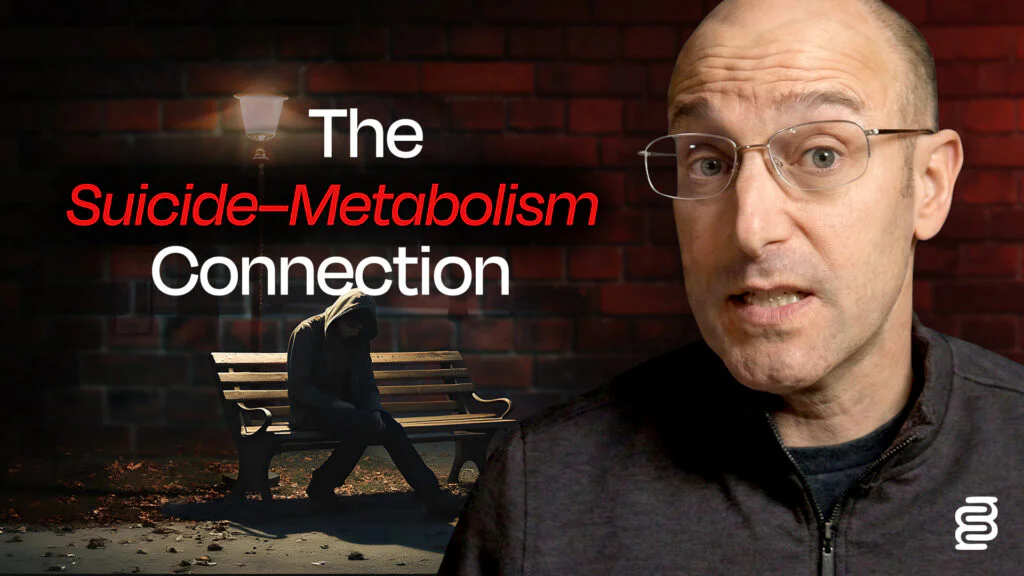
Dr. Bret Scher examines a new Translational Psychiatry study finding that poorer metabolic health, measured through blood glucose, insulin, and lipid markers, correlates with higher rates of suicidal ideation, attempts, and death, even after adjusting for confounders like age and mental health diagnosis. While the study can't prove causation, he argues it strengthens the case for treating metabolic and mental health as deeply connected rather than separate domains in psychiatric care.
Learn more
Explore metabolic therapies with Steven who put his bipolar 2 disorder into remission. Discover tips for beginners & pros on diet, lifestyle & wellness.
Read more
In this powerful Metabolic Mind Podcast episode, Dr. Bret Scher interviews researcher and bipolar disorder advocate Dr. Iain Campbell, who combines lived experience with scientific expertise to explore the promise of metabolic therapies for mood disorders. Campbell shares how a ketogenic diet profoundly improved his bipolar symptoms, inspiring him to study brain energy, insulin resistance, mitochondrial function, and ketogenic interventions through a new four-year fellowship at the University of Edinburgh. He discusses stigma, the limitations of standard medications, emerging clinical research, and why metabolic psychiatry may offer a transformative new path for people living with bipolar disorder. A must-listen for anyone interested in ketogenic diets, mental health innovation, and the future of psychiatric care.
Learn more
Understanding how to balance protein intake while on a ketogenic diet can be essential for those using this dietary approach to treat a psychiatric condition. Here are six…
Learn more
Dr. Bret Scher examines a new Translational Psychiatry study finding that poorer metabolic health, measured through blood glucose, insulin, and lipid markers, correlates with higher rates of suicidal ideation, attempts, and death, even after adjusting for confounders like age and mental health diagnosis. While the study can't prove causation, he argues it strengthens the case for treating metabolic and mental health as deeply connected rather than separate domains in psychiatric care.
Learn more