New Results: First RCT for Schizophrenia & Bipolar Disorder. Learn more.


Listen, Watch & Subscribe on:



Can a Keto Diet Help People Suffering from Depression? – with Dr. Erin Bellamy
Listen
About the host

About the guest

Bret:
Welcome to the Metabolic Mind Podcast. I’m your host, Dr. Bret Scher. Metabolic Mind is a nonprofit initiative of Baszucki Group where we’re providing information about the intersection of metabolic health and mental health and metabolic therapies, such as nutritional ketosis as therapies for mental illness.
Thank you for joining us. Although our podcast is for informational purposes only and we aren’t giving medical advice, we hope you will learn from our content and it will help facilitate discussions with your healthcare providers to see if you could benefit from exploring the connection between metabolic and mental health.
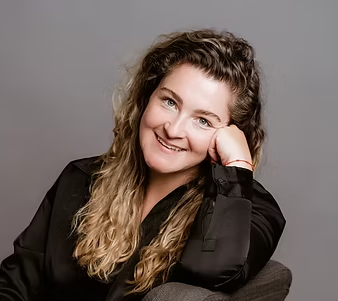
Could ketogenic therapies rooted in a ketogenic diet help with symptoms of depression? And how would that be similar or different to symptoms of, say, bipolar disorder or schizophrenia or other serious mental illness? Let’s find out within this interview with Erin Bellamy, who recently completed her PhD focusing on ketogenic therapy for depression. You can find her on Twitter or X at ErinLBellamy, or at her new website ikrt.org for Integrative Ketogenic Research Therapies. So, let’s get into this interview with Erin Bellamy. But first, before we begin, please remember our channel is for informational purposes only.
We’re not providing individual group medical or healthcare advice or establishing a provider patient relationship. Many of the things we talk about can be very dangerous if done without proper clinical supervision. So, always consult with your healthcare team before changing your diet or your medications or your lifestyle specifically to treat a medical condition.
Alright, so with that as the disclaimer, let’s hear this interview with Erin Bellamy.
Erin Bellamy, thank you so much for joining me on Metabolic Mind.
Erin:
Thank you. It’s great to be here.
Bret:
Yeah, now I’m really curious to hear more of your story and your experience because you started your PhD program and looking into using ketogenic therapy for depression, like all the way back, what in like 2016, where there was, I guess you could say a very small movement beginning at that point but pretty small.
So, you were really on the forefront of this. So, I’m curious. Why don’t you start by just filling us in on what got you interested in this, why you wanted to do a PhD, and what was your experience like in the beginning?
Erin:
Yeah, absolutely. So, it has been a long time. 2016 is a lifetime ago, I feel. So, my background is psychology and in the UK in order to become a psychologist, you have to go into the NHS and get some experience working with people who have mental health conditions. And during my undergrad and my master’s, I always had actually an interest in eating disorders.
So, I was always reading research about diets, the latest diet, the Mediterranean diet and what they were doing for people. And around 2015, 2016, I came across the Atkins, the New Atkins For a New You book, and Atkins diet, low-carbohydrate diet, ketogenic diet. I did a little bit of research and I saw that some research was going on within the diabetes community and that the low-carbohydrate diet, ketogenic diet seems to be showing some promising results.
Alongside that, I had moved into the NHS, the National Health Service, and I was working on acute inpatient psychiatric units to try and gain some experience. And some of the listeners might be familiar with these services. It’s where people go when they’re really quite unwell, really unsafe in the community. They need some extra support and people can stay there for a couple of days, couple of weeks, couple of months, even up to a couple of years.
And I was helping to look after these people, and I was using my psychology experience and gaining psychology experience while working with them. And I was looking at their diet and I was thinking about what I had been reading about the ketogenic diet and diabetes. And a lot of the people that I was working with had type 2 diabetes. And so I was putting two and two together and thinking, maybe it might help their diabetes.
But at the same time, I thought, I wonder if there’s any research on ketogenic diets, low-carbohydrate diets and mental health? So, I went digging. And I think for anybody who’s spoken to me over the past six to eight months, I’ve probably already told this story. But I found that one study from 1965 where they put a group of females who had schizophrenia on a ketogenic diet and all of their symptoms improved.
And then they reintroduced the standard diet and all of their symptoms came back, their delusions and hallucinations. And I thought, oh my gosh, I’ve hit the jackpot. This is the research I’m looking for. Brilliant, let me find some more. Went digging. Thought I was a terrible researcher because I couldn’t find anything.
Bret:
And you would assume there would be. If you see like this one study with such great results, you’d be like, why isn’t there a follow-up study? So, you probably were like, what am I missing? What happened here?
Erin:
Yeah, exactly. I was putting in all my search terms going, what, where is it? 1965 was a long time ago, right?
What’s happened? I couldn’t find anything. And I started thinking, okay, antipsychotic medications came in the seventies, maybe the lead just went dry? I wasn’t quite sure, and I thought, I can see what is happening within the diabetes community. People are improving with this.
So, at least the people, the patients that are on my ward that I’m working with, they have side effects that is causing metabolic syndrome, and they have increased risks of diabetes. It could at least work for them, and then perhaps, even have some mental health improvements? But, I’m a psychology graduate.
I can’t do anything with this information if the research isn’t there. It’s just a nice idea. And so, I couldn’t go down the clinical psychology route because if I was to then start working with individuals, what am I going to say? Here’s a diet. There’s no research. Only this one study in 1965.
So, I thought, okay, the only way to do this is to actually go and do the research myself. So, that’s what I did, in 2016, when there were a couple of people around the world starting to think about this for mental health, but we hadn’t been connected yet. I reached out to diabetes.co.uk who had this online platform where they were taking people on a low-carbohydrate diet for their type 2 diabetes.
And I asked if I could collaborate with them and create an online digital intervention using the ketogenic diet, low-carbohydrate diet for depressive symptoms and for depression. They agreed. I found a university that would support me. I self-funded it. Did it part-time alongside my work in the National Health Service, and then ultimately, alongside my clinical work.
And off I went. It took me seven years, but I’ve just come to the end of it now. And it’s been a long road, and a lot has changed. A lot has changed over the past years.
Bret:
Yeah, it’s a great origin story, especially how, it’s great and depressing, right? You had to be so much of a self-starter. You had to do all this work on your own and create it because it didn’t exist.
That’s amazing. But the other hand, it’s frustrating that why didn’t it exist? But now, we’re seeing a different environment. So, I guess that’s one thing. When you look back to how you started in 2016, to how the environment is now, how have you seen it changed?
Erin:
It’s incredible.
First of all, I felt like I was in my little silo. I felt like I was in an echo chamber drumming the drum, and nobody was listening. I think the people around me were just totally fed up of listening to me talk about ketogenic diets and mental health. But then, gradually over the years, finding this community. And the community growing both with clinicians, researchers, but also just lay people, members of the public that have been trying this and have actually found that, maybe they started doing it for weight loss? And they found that actually their mental health improved and they were starting to feel better.
And that group of people have just, they are so enthusiastic, I think, because of what they have experienced that it’s just incredible. It just seems to be growing exponentially. And then, of course, with Dr. Christopher Palmer’s book, Brain Energy ,and Dr. George Ede’s book coming out in January. I think really we’ve got this fantastic movement. And then, of course, Metabolic Mind that’s navigating and coordinating everything as well.
Really, I just think it’s a bit quite unstoppable. But maybe I’m, maybe I’m exaggerating because I’m still so passionate about this area? I’m not sure, but its just grown leaps and bounds over the past couple of years, it has.
Bret:
Yeah, and I think your experience shows a lot about what, I guess, you could see the field is going through.
And one, the realities of how hard it is to do nutrition, high-quality nutrition studies, especially without a lot of funding available, recruiting patients, and making sure the interventions are equivalents with different diets. And how they do it, takes money. It takes time. It takes effort. It takes support.
It’s not easy to do and I think your, maybe your study showed a lot of that, but then also the amazing clinical benefits people are seeing. And so trying to, where does the research catch up with the clinical benefits and how do you handle that? So, tell us from the clinical side, you’ve been working with patients for a while now. Like what are, what are some of the main surprising benefits you’ve seen or maybe some and then some of the challenges?
Just give us a little bit more about your experience there.
Erin:
Yeah, definitely. I think one of the, something that actually came out of my research, and I have seen it then also clinically, which I was most surprised about, is that you can see benefits in mental health.
Symptoms and physical health symptoms, of course, but mental health symptoms, even with low level ketosis and simply cleaning up the diet, moving into a low-carbohydrate approach before you even get to ketosis. I’m seeing people’s mental health improve, which I didn’t, not that I didn’t think about that previously.
But I really thought, you’ve got to have the ketones. It’s the ketones that are doing, they’re providing that energy. That they’re the little nuggets that we need, and we need lots of them. Let’s get them. And though, I think that is very true for many people, I’ve switched in the way that I practice now. And some people want to jump straight ahead and go straight into ketosis, fine. But I like to start slow and just clean up the diet, move to low-carb, start getting people comfortable with the process, and they start to see improvements with that low-carb approach.
And then gradually, we move into ketosis and start to build-up the ketones and then start to monitor for more improvements that way. I think that was the biggest surprise for me. And then in terms of difficulties, I think the difficulties still remain the same. The same that I saw in my research and still the same that maybe I had read in the research previously, which is, do you know lifestyle obstacles, birthdays, Christmases, things like that, getting into ketosis initially for some people is a little tricky.
But I think what we have now, which we didn’t have before, is we have ways to overcome these obstacles. So there are, we know how to use electrolytes to manage the keto flu. Or moving into ketosis, we know what to expect. We can set those expectations with people with social situations. Just educating people around owning their dietary choices. it’s very easy to say, I’m a vegan. I’m a vegetarian. I’m gluten-free. Okay, sure. I just don’t eat carbs right now.
And that’s, this is what I’m doing so we can still go out and have a great time and I can pick what I want to eat, and it’s going to be fine. We have ways to manage those difficulties now, whereby I think previously, maybe we didn’t? We were just stabbing in the dark to see what worked.
So, I think they’re the biggest things at the moment, definitely.
Bret:
Yeah, so many good points in there, and I think you’re right. And you bring up a good point that for a lot of people just cleaning up your diet is going to help. But then, the question is that going to help the maximum amount or can you achieve more by going into ketosis?
And that’s why I think I like your approach of being, going in a stepwise manner. One, because it makes getting into ketosis a little easier to tolerate for a lot of people. But two, you start to see the benefits, and then you can see is there a difference with higher ketones? Because as Iain Campbell showed in his research study, higher ketones did tend to correlate with improved mood, but clinically experiencing improved mood even without ketones.
So, it doesn’t have to be ketosis that you can have improvements before that. So, I think that’s a really important finding that you related. And in terms of the challenges, yeah, I can just think, in 2016, if your reaction was, I don’t eat carbs, I eat a keto diet, there’d be probably a bigger eye roll to that for most people than there would be in 2023.
So, times certainly have changed from that standpoint.
Erin:
Definitely, and I think, now people are, I think with all of us talking about it nonstop and trying to push this movement forward, people are a little bit more open to the fact that nutrition can impact mental health. And so therefore, we got a lot of work to do. But therefore, people are more open to the fact that, okay, the ketogenic diet, or other diets, may impact mood, and we need to be appreciative of that.
It’s not just ketogenic diet for diabetes or ketogenic diet for epilepsy. The ketogenic diet can be used in this way, and therefore, you just got to keep pushing forward with this to tell more and more people so that they feel open about it and accepting of it.
Bret:
Yeah, but a lot of people will maybe hear about it and say, how do I get started? What do I do? Like my doctor’s not on board, my therapist isn’t on board. How do I go about starting this? And so you’ve come to the point where you’ve now said, I’m going to do something about it. So, you started IKRT.org, Integrative Ketogenic Research and Therapies.
So, tell us about that. And what your goal is there, and what your experience has been so far.
Erin:
Yeah, absolutely. So, it is a bit of a tongue twister, as I said to you earlier, but that’s just how it is. IKRT is much easier to say. So, I have always planned to work with individuals to improve their mental health.
That was always my goal. I just had to take the sidetrack to go and do the research and then come back. And so setting up IKRT, I just wanted to have a place where people could come, they could work with me directly, and also work with a very trustworthy dietician that I have to implement ketogenic metabolic therapies. Not just the ketogenic diet for weight loss, ketogenic metabolic therapy specifically for mental health conditions.
And just like you said, people are saying, I’m trying. I’m waiting for a metabolic psychiatrist. I can’t find one. What do I do? How do I, how long do I have to wait? We’re trying to train people right now. We are, but it’s going to take some time. And people don’t, people that are not feeling right now, don’t have the time to wait.
And if they can work with a professional who knows what they’re doing and who’s working with other professionals who are also in this area, they have a much better chance of being able to implement this safely and effectively to monitor their mental health symptoms and see if they improve.
And so with IKRT, that’s what I do. So, from the very beginning, somebody comes to me. We run all the baseline blood tests, we go through all the medical history, go through all of the symptoms, discuss what good mental health would look like for them because it depends. And then work with them to implement the ketogenic diet or work with them to clean up the diet, move to low-carb and then into ketogenic diet.
Track the ketones remotely daily so that we’re correlating how, and tracking mood as well and other symptoms and correlating how they, or how they correlate with each other, and tracking those over time. And then using a couple of different like psychological measures to track those mental health symptoms to see if they’re improving.
And then alongside that, collaborating with their mental health team. Now in the UK, not everybody has a psychiatrist. Some people only work with the GP and they have antidepressants from the GP. They haven’t seen a psychiatrist. Other people do have a psychiatrist. And so, I will work with the GP or the psychiatrist.
I don’t believe right now, though it would be ideal, it would be fantastic if there were tons of metabolic psychiatrists out there, but that’s not the case right now. So, their psychiatrist doesn’t have to be gung-ho about a ketogenic diet. I will give them all of the information that they need. And as long as they’re supporting their patient with the medical side of things, with the medications, and they’re aware of what to change and when, if necessary. then we’ll work closely together over that 12 week period to implement it.
Help them through any lifestyle obstacles and things like that, and track the changes over time. I think a lot of people think that, oh, you’re just implementing a ketogenic diet for fat loss with people. What are you doing? Whereas, actually, it’s a lot more complicated than that. But I try my best to make it as easy as possible for the individual and just support them the whole way.
Because sometimes ketones might be up, and they feel great. Other times, the ketones might be up ,and they feel a little bit wobbly, but it could be because the electrolytes are off. And so just helping to educate them to spot those issues so they know that for themselves. So, they ultimately can be independent and be able to maintain this long-term if they are feeling good.
Yeah, so yeah, that’s where we are with IKRT.
Bret:
Good, and I like how you mentioned about coordinating with the care team because I think that’s so important, especially until more clinicians are trained in this, to have somebody who can speak the language. You can speak the language of the therapist, speak the language of the psychiatrist, speak the language of the patient, and help coordinate the care to make sure everybody’s on the same page.
I think that’s so important. Now, one of the things you’ve also mentioned though is expectations. And I guess how to phrase this question, can everybody expect to improve similarly, right? Like you talked about a study in schizophrenia. We have ongoing studies for bipolar disorder, right?
Depression probably gets talked about a little bit less in terms of ketogenic therapy. So, do you think a patient whose diagnosis is depression can stand to benefit as much as someone whose diagnosis is schizophrenia, schizoaffective disorder, bipolar disorder, and what have you seen for the timeframe of improvement, if that’s the case?
Erin:
Yeah, absolutely. So, this is great. And it’s really something that I talk to with my clients about because I think expectations are all over the place with bipolar disorder and schizophrenia. We have some fantastic case studies and some fantastic research results coming through now showing great improvements in quite a short period of time.
Perhaps that could be due to the mechanisms of the ketones, and how the mechanisms are working on the mechanisms of bipolar disorder or schizophrenia. Maybe they’re a little bit different perhaps to how they work within depression? But then, when you look at depression on the whole, unfortunately, we have this, what I like to coin an umbrella term.
I think depression is an umbrella term because underneath it, there are subtypes. We have melancholic depression, atypical depression, some other different types of depression, and they all have different symptomatologies and different symptoms. Within that, for example, within atypical depression, the symptoms might be increased hunger, increased hunger and cravings, increase in weight as well.
But then with melancholic depression, still under depression, it’s complete absence of hunger, losing weight. And so, I think we’re in a sticky situation there because if you have two people with depression, just with different subtypes, and they have very different symptomatologies and very different experiences with the atypical.
I think there’s a lot of, I don’t think, there is research to show that there’s a lot of overlap with metabolic syndrome. And so, I think if people out there have depression with atypical subtype, they may lean more favorably for a ketogenic diet. However, we know from the work of Dr. Chris Palmer and Dr. Iain Campbell and so on, that overall, these ketones are improving our metabolic health.
On the surface that they’re improving our metabolic health on the whole, and providing us with energy. And so when you look at depression, you have to look at the individual and their subtype and what they’re experiencing. And so I think everybody can benefit from either a short or long stint in ketosis because of the increase in brain energy.
We could all do, we could all do with a bout of it. However, I think those people that have the atypical subtype depression or the treatment-resistant depression seems to respond more favorably to the ketogenic diet. Or not more favorably, but more quickly.
However, again, with the timeframe, as opposed to bipolar, schizoaffective disorder or schizophrenia, I have seen clinically that depression takes a little bit longer, but still within that 12 week mark. I’m not seeing results very quickly, but maybe after about 4, 5, 6 weeks, I’m starting to see improvements.
Some things improve quickly, but generally speaking, improvements are coming 4, 5, 6 weeks. The energy improvement is coming almost instantly, which I think is consistent with what most people see because of that uptake, the increase in ketones, increase in energy, but the anxiety, the mood is slowly improving over a period of time.
To round up, long story short is don’t get disheartened if you don’t see the results straight away. It’s not that you’re not doing something right or you’re doing something wrong. It may just be that you need. It’s just going to take a little bit longer. And as long as you’re working with somebody who’s monitoring everything with you and is looking out for the right things then, just stick with them, and monitor over time and look for that gradual improvement.
Bret:
Yeah, such an important point to really set expectations. And I like how you describe the subtypes of depression because we can’t think of depression as one thing, right? Just like cancer isn’t one thing. But we often do, we think bipolar is one thing.
Schizophrenia is one thing. Depression but it’s not. And as Dr. Chris Palmer has talked about is the criteria. It’s like billing criteria that we try and sandwich people or squeeze people into these diagnostic criteria when really it can be a constellation of different symptoms that is far more important to understand than just that the diagnosis.
And that may affect how quickly somebody responds or how somebody responds. So, I think that perspective is really important, especially for someone to say, oh, I have depression, therefore maybe I will or will not respond. No, we need to know a little bit more than that.
And so I like how you walk through some of those specific criteria.
Erin:
Yeah, and also we’re all so different, and we all have our own experiences. And how did we get to depression? Was it bereavement? Was it an adverse life event during childhood?
Was it inflammation? Maybe I have an autoimmune condition that’s then, or arthritis, and it’s then triggered a depressive episode. So, there are so many roots. I still think there are some we probably don’t even know yet that then come together to show the symptoms of depression.
And though I think that then lends to the fact that this is such a personalized approach. So, I don’t think we will ever have a cookie cutter, this is the ketogenic diet that you’re going to do, and you’re going to expect these benefits. It doesn’t work like that, just like cancer therapy or any other therapy is personalized to the individual.
Ketogenic metabolic therapy has to be personalized to the individual because you may also have some comorbidities, for example, where you overlap with another condition. You may even have you, maybe you have a combination of two mental health conditions and then maybe you also have some anxiety thrown in or some seasonal affective disorder?
All of those things need to be considered for you as the individual. And then a plan is put in place. Generally speaking, you’re still looking for ketones, right? But once you have the ketogenic diet as the foundation, then you start adding the other things that you think might be able to help that individual that’s personalized to them.
Bret:
Yeah, and the other part of personalized care is it doesn’t, ketosis, ketogenic therapy isn’t meant to completely replace medication or completely replace therapy or replace other treatment interventions. So, is that something as you see using it as a sort of adjunctive therapy to what someone’s already getting or experiencing?
Erin:
Yeah, absolutely. And I think you’ve raised such a good point. This is something that I come across time and time again. I understand because if I was on medication for anything, and if I didn’t feel like I needed to be on it or if I felt like I didn’t want to be on it, I would want to get off it as quickly as possible.
And I would want to if there was even the idea that I could try something else. I would try something else and then try and come off it. That’s exactly what I would do. And so, when people come to me with that same need, I have to explain to them, listen, first of all, we’re going to do this alongside your current standard of care.
There’s going to be no medication changes for the three months. You’re doing this because we’re changing this one thing. Your psychiatrist will change medications, but most likely it’s going to stay the same for this period of time. And then, if you are starting to see improvements, then you can talk to your psychiatrist about maybe reducing some of the medications. Tapering the medications in the way that they, only they, know how with you.
And that can take a very long time. A very small amount at a time. Sometimes you need to go up, sometimes you need to come back down. You can’t just come off your medication, and just do the ketogenic diet because it’s not safe. I’m not going to work with you if you do that either. It’s not safe at all.
But also what I like to say to people is, listen, the long-term goal is for you to feel better, and to live the life that makes you happy. You need to be able to have the energy to do the things you want to do in life. And if that means being on a ketogenic diet and still being on some medication, you’re feeling good.
You’re doing everything that you want to do. You’re getting out with your kids. You’re getting up in the morning. You’re doing your degree, whatever it is. If you’re still able to do those things and you’re still on a perhaps a low level of medication and the rest is the ketogenic diet, then that’s not so bad.
And some people might be able to come off their medication completely, other people might not. Or it might just take them a longer time. So, it really is about just setting those expectations. And the main goal is just for people to feel better. And if that does include some medications, then so be it.
And then just putting in all these other lifestyle interventions around them to support them metabolically.
Bret:
Yeah, such a great perspective that, you know, the medications don’t have to be the bad guy, especially if they’re making you feel better. But using them in conjunction with ketogenic therapy can really help you just get to that point of vitality.
Erin:
Yes.
Bret:
So, we’ve covered a lot and you’ve given a lot of great advice. But if you were going to boil it down to your quick pitch for someone who’s thinking about this, considering it,, what would you tell them to do to get started? Or what should they consider first? I know there’s a lot to say. So, it’s hard to boil it down sometimes, but I’m curious how you would.
Erin:
Yeah, I think you have to go, you have to look at it as you’re playing the long game, okay? And you need to look at this. This is an overall, this is an intervention that is going to, or a therapeutic approach, that’s going to help you physically and mentally overall. It’s going to hopefully improve all of these aspects of your health.
And so, in order to do that, you need to find somebody that you can connect with and work with, who knows what they’re doing, okay? And if you can’t find that person, you need to ask around to see if somebody will give you recommendations to find that person. And then slowly work with them to clean up your diet, and slowly clean up your diet, and move to maybe a low-carb approach and into a ketogenic diet.
And that would be the first thing if somebody came to me and said, how do I do this? That’s why I say, you need to find somebody you can work with that you get on with, that you feel you can trust, and that’s going to support you. And then, gradually, work with them to get yourself to that point of a ketogenic diet, and then go from there to monitor your symptoms.
Bret:
Yeah, and I think what you provide such a great example of is that person doesn’t have to be a psychiatrist. That person doesn’t have to be a dietician or even a therapist. It could, be any one of those things, or it could be someone like you who can help coordinate care through all that, and help somebody through this process.
I’m really excited to see you as a shining star in this field and, to see what you’ve been through ,and where you are now to really help people. So, thank you for joining us and, I encourage people to. Check you out at ikrt.org, and ErinLBellamy on Twitter or X.
So, thank you so much for joining us.
Erin:
Thank you so much, Bret. It’s been an absolute pleasure, and yeah, brilliant. Thank you.
Bret:
Thanks for listening to the Metabolic Mind podcast. If you found this episode helpful, please leave a rating in comment as we’d love to hear from you. And please click the subscribe button so you won’t miss any of our future episodes.
And you can see full video episodes on our YouTube page at Metabolic Mind. Lastly, if you know someone who may benefit. From this information, please share it as our goal is to spread this information to help as many people as possible. Thanks again for listening, and we’ll see you here next time at the Metabolic Mind Podcast.
Listen, Watch & Subscribe on:
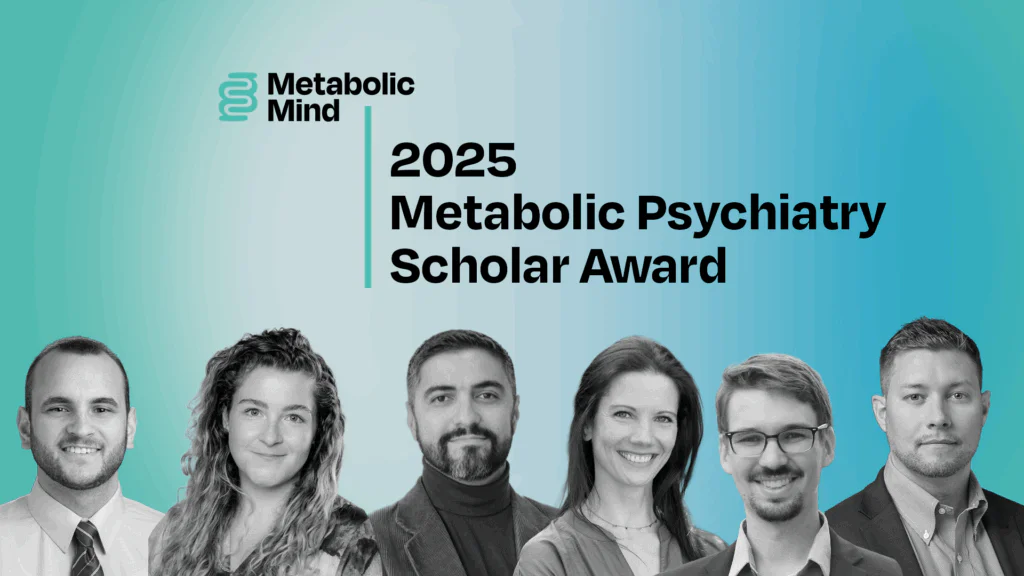
Baszucki Group is proud to announce the six recipients of the first-ever Metabolic Psychiatry Scholar Award, a new initiative that supports exceptional early-career scientists and clinicians working to…
Read more
College can be a time of rapid growth, but also intense pressure. For many young people, college is the first time they are setting out on their own….
Learn more
The promise of ketogenic therapy for treating mental illness is accelerating with the newly published findings of a pilot study at The Ohio State University, which showed remarkable…
Learn more
Research indicates that following a keto diet can be an effective form of metabolic treatment for depression, particularly atypical and treatment-resistant forms. Dr. Erin Bellamy has seen ketogenic…
Learn more
Baszucki Group is proud to announce the six recipients of the first-ever Metabolic Psychiatry Scholar Award, a new initiative that supports exceptional early-career scientists and clinicians working to…
Read more
College can be a time of rapid growth, but also intense pressure. For many young people, college is the first time they are setting out on their own….
Learn more
The promise of ketogenic therapy for treating mental illness is accelerating with the newly published findings of a pilot study at The Ohio State University, which showed remarkable…
Learn more
Research indicates that following a keto diet can be an effective form of metabolic treatment for depression, particularly atypical and treatment-resistant forms. Dr. Erin Bellamy has seen ketogenic…
Learn more