Announcing the new McLean Center for Metabolic Psychiatry Learn more.


Listen, Watch & Subscribe on:



The LDL Debate: A Vascular Surgeon Weighs In
Listen
About the host

About the host


Lily:
All we had to do was manage ApoB, right? Then, we would’ve fixed heart disease 20, 30 years ago. I don’t think that it’s ApoB. I think it is fitness. I think it is social connection and meaning in the world. I think it is joy and sleep and stress. This is your body. This is your health. This is your one short and precious life.
You get to be the driver.
Bret:
Welcome to the Metabolic Mind Podcast. I’m your host, Dr. Bret Scher. Metabolic Mind is a non-profit initiative of Baszucki Group, where we’re providing information about the intersection of metabolic health and mental health and metabolic therapies, such as nutritional ketosis as therapies for mental illness.
Thank you for joining us. Although our podcast is for informational purposes only, and we aren’t giving medical advice, we hope you will learn from our content and it will help facilitate discussions with your healthcare providers to see if you could benefit from exploring the connection between metabolic and mental health.
There are few things as polarizing or as controversial in social media circles as LDL cholesterol. About treating it, not treating it. What does it mean for vascular risk, heart disease, mortality, especially for someone maybe who’s metabolically healthy? Today, I’m joined by Dr. Lily Johnston, where we can really get into this.
Dr. Johnston is a vascular surgeon. So she spends her day operating on diseased blood vessels. But she also has a passion and a focus and a medical practice on cardiovascular prevention. So more of the upstream preventing people needing the surgery. So her perspective on the role of ApoB, of LDL, in cardiovascular disease and what that means in the bigger picture. What else is contributing? How do you factor in LDL in different populations and from a population-based research to an individual?
These are all really interesting questions, and she has a great perspective on it. We’re not going to answer every question. There are still lots of unanswered questions, and I think that’s the right approach. If we pretend to have all the answers, if we pretend to know exactly how much LDL contributes for everybody, that’s where we really get into trouble.
So I hope you enjoy this really balanced and thoughtful discussion with Dr. Lily Johnston. Many of the interventions we discuss can have potentially dangerous effects if done without proper supervision. Consult your healthcare provider before changing your lifestyle or medications. In addition, it’s important to note that people may respond differently to ketosis, and there isn’t one recognized universal response.
Dr. Lily Johnston, welcome to Metabolic Mind. It’s great to see you again.
Lily:
Great to see you, Bret Scher. Nice to meet you. Nice to see you.
Bret:
Yeah, so I’m excited to have you on to just talk about, we’re just talking about, vascular disease, cholesterol, LDL, all the controversies that have come up, and how you see them.
We can get into a discussion about how we see things similarly or differently. I really appreciate your perspective on this topic, which is really a hot topic, and an important one. But first, before we get started, tell me something you think mainstream medicine just really gets wrong that you wish were different.
Lily:
I wish we could be better at treating the individual. Mainstream medicine, I wouldn’t say, gets it wrong. But with guidelines, with protocols, we are trying to have a rising tide that lifts all ships, and that means standardizing care. But I think there’s a lot that gets lost when we do that. And the art of medicine is looking at the individual in front of you, and understanding when sometimes the guidelines are not good enough or when they don’t apply, and how to individualize care.
And doctors have been trying to do this for a very long time, and there’s an art to it. But I think in an effort to try to standardize everything and protocolize everything and bring up the bottom end of that distribution, as it were, to improve the bottom part of care, we lose a lot at the top.
Bret:
Yeah. I think that’s a perfect answer to really segue into our discussion about vascular disease, about LDL.
Lily:
Yeah.
Bret:
About what guidelines say, and maybe why that’s right for some people and not right for others. And so it’s a great segue. But first, okay, you are a vascular surgeon. I mean, you are many things, but your profession, one of your professions, is a vascular surgeon.
What does that mean? Tell us what a vascular surgeon is and what a vascular surgeon does.
Lily:
Yeah. A vascular surgeon is a fancy plumber. So we all have pipes that bring blood to and fro from the heart. And when they leak or when they get clogged, a vascular surgeon comes in to fix it. So, we have 60,000 miles of arteries in the body. And the heart surgeons and the cardiologists, like yourself, you guys get the territory that’s right around the heart and the big blood vessel that just leaves the heart called the ascending aorta.
The neurosurgeons and the neurointerventionalists, they get the ones in the brain. Every other pipe in the body, pretty much, that’s a blood vessel belongs to a vascular surgeon. So if there’s a narrowing or a blockage in the arteries that are in the neck or in the legs or in the arms, that becomes a vascular surgery problem.
We also help manage bleeding. So a leaky pipe that might be somewhere or an aneurysm that has burst or ruptured or might in the future. All of that is a vascular surgery issue, but we’re just fancy plumbers.
Bret:
And by fancy plumbers, it means cutting open the artery, taking plaque out or bypassing the blockage, or actually putting in stents.
So lots of different techniques to help improve blood flow.
Lily:
Correct.
Bret:
Now, when you fix an artery, quote-unquote, “fix an artery,” you’re basically fixing one segment of an artery. So what’s going on with all the other arteries when you fix one segment of an artery?
Lily:
Yeah, that’s a great point because as this is a systemic disease, and one of the biggest unanswered questions is why it manifests in one vascular bed before another, right?
Why do you sometimes have it in the coronaries where the legs are totally fine? Why do I sometimes see it in the legs or in the neck, and the coronary circulation is okay and doesn’t need treatment yet? But what we know, especially for my patients with peripheral arterial disease, meaning an artery usually in the leg but it could be the arm, who has that problem, right?
If I fix the leg and I do a bypass, the overwhelming odds are that they will still succumb to a heart attack or a stroke sometime in the nearer future than if they did not have this disease. And so it’s not usually the leg problem that is the major overlying issue. It’s heart attack and stroke still.
So we know that this disease is everywhere, and one of the frustrations I had with my career when it was just the vascular surgery component, was that it just felt like playing Whac-A-Mole, right? You go after this one thing and you get the one thing. But then in the hospital after fixing the carotid artery in the neck, patient has a heart attack. And now they have an NSTEMI. And now they have to have this other intervention. And then they have this, and then they have this other thing. And it’s just on and on.
And it was very disheartening to feel like I had done my best to fix one part of this problem. And yet, the patient was still so vulnerable to having an issue in another vascular bed that I couldn’t control.
Bret:
So now, in addition to your role as a surgeon, you’ve added another component to your practice of trying to help people upstream and to help them in a more systemic way.
So briefly, tell us about that mindset for that practice and how it differs from your surgical mindset.
Lily:
The idea behind the prevention practice, and I’ve started calling it cardiometabolic prevention but we could call it a lot of different things, is that there’s a huge runway. We know that the formation of plaque or the junk that builds up on the inside of the artery that tends to rupture and cause these events like heart attack, stroke, or limb loss, that takes decades, right?
Years and years to form. And so surely there’s an opportunity to intervene before we get to a point where we’re talking about, you could have an open operation or you could have a stent, right? When it’s just a surgical practice, those are my options for patients, or maybe hospice, like watchful waiting, but it’s not going to get any better and lots of significant consequences if we do not intervene.
But why on earth haven’t we gotten better at figuring this out upstream? Where is the time? Where are these decades going? And to a first approximation, I think part of what we’re going to get into are the people who say, “Look, we’ve tried giving these medicines for years and years, and we still have an overwhelming burden of disease. So obviously that’s not working.”
And that leads to a conversation that we’ll get into. But my take-home from that is it works a little, but there are so many other things that cause the formation of plaque. And every person is a little bit different. Plaque is the end result of a number of different things that might be going on.
And in 2026, I think insulin resistance and diabetes is a huge component of that. And it was certainly leading to a huge number of amputations in my original practice. And that was, in many ways, the big emotional impetus for me to start in on this. It wasn’t even the plaque in the arteries.
It was the foot infections that were costing people their legs, and I had to be the bearer of that bad news. And many of these patients had never been told that it was even a possibility that they could put the disease into remission with lifestyle. And so I felt like that was just an enormous disservice to the world and became an evangelist, or somebody passionate about trying to help.
Bret:
Yeah, and so it brings up this dichotomy or, probably a false dichotomy, of metabolic health and LDL cholesterol, as like the two main risk factors. And when we look back, when I look back on how I was trained, it was so heavily focused on LDL. And from the metabolic health standpoint, it was you have diabetes or you don’t.
And if you have diabetes, it’s a risk factor. If you don’t, it’s okay. And then we treat LDL. Now, things have changed over time. But I would dare to say in practice, more often than not, it is practiced that way, and we can talk about why. Does that reflect your experience as well? Maybe not you personally, but like education and you know.
Lily:
Yeah, I would say certainly, from an educational standpoint, it has become one of a couple of risk factors, right?
Smoking was the big one a couple of decades ago, right? And my dad is a cardiac surgeon, and in his era, it was predominantly smoking. And that was a different disease in some ways than it is if it’s related to diabetes, right? Different arteries are actually affected, and in different ways. Now, we also have more knowledge of things, like elevated homocysteine and Lp(a) and polygenic risk and some other pieces of this whole puzzle that come together. Autoimmune disease, adverse childhood events, and other pieces of trauma and mental health that come into play.
All of this combines in ways that we don’t, I would say, fully understand yet. But certainly at least from a risk factor standpoint, we can walk backwards and think of a number of different pathways into atherosclerosis that are different than how I was really trained initially.
Bret:
Yeah. But one way we were definitely trained was LDL is causative of cardiovascular disease, and probably the most important thing you can do is to lower LDL, assuming they’re not smoking, right?
That’s obviously a big one that has improved significantly with public health measures and so forth. But treating LDL, and when we were being trained, when I was early in my career, that did not seem controversial at all. I don’t remember much pushback at all. Again, does that reflect your experience in training and early practice?
Lily:
Yeah, absolutely.
Bret:
Yeah. So how and when did it become controversial to treat LDL aggressively to lower cardiovascular risk?
Lily:
I think as into the 2010s, 2020s, people start thinking about how much improvement are we getting and what are the risks of the interventions we have to lower LDL cholesterol, and people start writing about this.
And whether that’s Nina Teicholz or whether that’s Prof Noakes or any number of the big influential, Gary Taubes, names in kind of the low-carb space in particular, there were a lot of important questions raised about the efficacy of these interventions that we have for lowering LDL cholesterol, particularly in the face of a helpful metabolic intervention that may butt up against that stated goal of mainstream medicine.
Bret:
Yeah, and I like how you said that they were important questions. And I think that’s where a lot of the discussion sort of gets lost, right? The asking important questions versus jumping to conclusions on either side. So let’s start with some of these questions. is the reduction of cholesterol essentially risk-free for the individual?
Lily:
That depends on how you define risk, right? If you want to use a dietary intervention, what is the dietary strategy that probably best lowers LDL-C? Probably the portfolio diet, or a diet that has a reduction in saturated fatty acids, an increase in soluble fiber, an increase in nuts, pulses, legumes, and sometimes plus/minus plant sterols, reduction in animal products.
That has been demonstrated to reduce LDL-C. If you are on a therapeutic ketogenic diet for your bipolar disorder, the risk to you is pretty high potentially in terms of remission and recurrence of your symptoms. For the average person who is otherwise well and was using a low-carbohydrate intervention or a higher-fat approach for an experiment, a trial, and didn’t notice any significant change, the risk to changing your nutrition that way is probably low.
So that’s one issue. The big question, the elephant in the room, were statins. And there was a lot of mistrust because many patients experienced symptoms when they were taking those medications, particularly I would say, the older generation of those drugs and at very high doses. And they were told by their doctors that either the symptoms were in their head, or they didn’t matter, or it was worth it to reduce their risk down the road and they just needed to suck it up.
And for all of those reasons combined, there was a huge loss of trust in the medical establishment. And again, the voices of curiosity and questioning got a lot louder about, “Hey, is this real? Are these drugs benign, and is it really worth it? How much benefit are we getting for the cost?”
Bret:
So yeah, you brought up two important points.
One, the nutritional approach, and second, the statin approach. So let’s rewind to the nutritional approach for a second. Because what’s interesting is, yes, you can lower your LDL with a nutritional approach, but you have to ask, “What else is happening with that?” So you mentioned the potential of you’re using ketogenic therapy for a certain mental health condition, but also just what happens to your weight?
What happens to your energy?
Lily:
Yep.
Bret:
What happens to your cravings? What happens to your hunger? Those are things that we don’t really ask a lot about. And those are some clear benefits to low-carb eating that maybe some people would say, again, “You just have to suck that up in order to eat the right diet for your heart.”
How do you, see that?
Lily:
And then you have a Cochrane review that says that reduction in dietary saturated fat didn’t actually reduce cardiac events, didn’t reduce all-cause mortality, right? And then we get into this, some saturated fats are okay, but not all saturated fats.
Whole-fat dairy seems to be maybe protective, and fish is okay. And then, you start wondering, okay, how confident are we that these dietary strategies that are touted by, I won’t name names but let’s say big establishment organizations, as maybe this greenwashed approach to a plant forward or whole food plant-based approach?
I hear what you’re saying compared to a standard American disaster, that is an improvement. And for some of my patients, that is a strategy that is working very well for them. They feel great on that. Their energy intake is managed. They don’t have a food addiction that they’re battling, right?
They’re not using the “Oreo vegan-approach” to processed plant-based foods. So they’re doing fine. They’re thriving. Okay. I’m never going to take that away and say, “Oh my gosh, you have to go toward animal-based ketogenic approach just because, right? It works for other patients.”
No, I think that is one of these areas where we individualize. And yes, can I tell a patient if they come to me and say, “Doc, I don’t want to use medication. I only want to use lifestyle-based approaches to reduce my ApoB or my LDL cholesterol. What can I do?” I have to volunteer, yes, this particular series of dietary interventions has been shown to lower your ApoB and your LDL-C.
We can do that. Again, at what cost is very individual and depends on why people eat the way they do, and people eat the way they do for lots of reasons, right? Cultural reasons, emotional reasons, family and scheduling, logistical reasons, cost reasons, taste reasons, dietary intolerances. All kinds of reasons people come to a way of eating that have nothing to do with their heart or vascular health.
Bret:
And so you phrase that as if someone says, “I want to take a dietary approach to lower my LDL.” What if somebody says, “I want to take a dietary approach to improve my cardiovascular health and reduce my cardiovascular risk. Do you see those as the same thing?
Lily:
Maybe. It depends on, again, where are their risk factors?
If their biggest overwhelming risk is insulin resistance or type 2 diabetes, then yeah, no, I would not necessarily recommend a portfolio-based diet or necessarily a low-fat diet as the way to achieve that. That’s not what, that’s not how I would go.
Bret:
Okay. And then the second part of your answer was about statins, and I like how you referenced there were statins that caused severe muscle symptoms and have been taken off the market. And now newer generations have less of a risk.
And other drugs, like simvastatin, that were used at 80 milligram doses. That is no longer used at 80 milligram doses because it caused real significant symptoms. And a lot of times people were told to suck it up and deal with it, and the benefit is worth it. How do we define the benefit, right? It’s a 30% risk of heart attacks by taking statins over five years, or it’s a 1.5% risk.
Like how do you have that conversation with a patient about what benefit they get? And it doesn’t have to be just statins, right? We could, we could talk about ezetimibe. We could talk about PCSK9 inhibitors and so many others. But how do you have that conversation about how much benefit am I actually getting from this medication?
Lily:
Exactly. So I had this conversation with a patient this morning, and she is in overall very good health. She exercises every day, her weight is optimal, and body composition looks good. A1C is five, fasting glucose is 77, and most of the things in her health are going great. She has an LDL-C calculated of 64 milligrams per deciliter. And she is APOE33 and has some concerns about brain health, but no significant family history of premature cardiac events. So nobody in her family has keeled over at age 40 or 45 or 50 from a heart attack or stroke, but she has a lot of type 2 diabetes in her family.
And another person in her life who’s invested in her health thinks that she’s already on five of rosuvastatin and 10 of ezetimibe. So a low dose, low intensity or it’s a moderate intensity for rosuvastatin, but low dose statin therapy and ezetimibe. And somebody says to her, “You need to be on Repatha.
I need your LDL-C to be 55 milligrams per deciliter or less.” And she’s 65 years old. And to which I say, I don’t know how much benefit we are really going to get. Now, is there, for that particular person, the cost is negligible, right? It’s achievable. If I said it was really important, they would do it. And if I said I thought this was going to prolong your life by 10 years, they would do it.
But I actually haven’t looked at this patient’s arteries yet. And so for me, the way that I’m going to adjudicate that is to actually get some imaging and say, “Okay, do you have soft plaque? Do you have evidence of arterial inflammation that might benefit from reducing that ApoB burden even further?” But honestly, by most people’s definition, she’s at goal, right?
She’s less than 70 milligrams per deciliter. And whether you want to, say she’s ultra-high risk, I don’t even know why we would say that she’s ultra-high risk. Again, I have no proof that she has plaque at all yet anyway. And her family history is for type 2 diabetes and renal failure, not premature cardiac events without that ancillary history.
So for me, I lean heavily on imaging to help adjudicate that for patients. But this is again, this question of like, how many people like that do I need to treat and get them from 65 milligrams per deciliter down to 55 to, or 50, or whatever it’s going to be if we add Repatha to her regimen to really see a good result?
And she’s also, by the way, on hormone replacement therapy. So she’s got some estradiol on board. And she’s got a lot of good things going for her that I just, it’s hard for me to, as much as like, I am painting myself in this corner because I defend the role of ApoB in plaque progression. I’m not actually as low for everybody as possible that should all be in the drinking, water and we should all walk around with an LDL-C of 40 just for the heck of it.
I don’t know that I think that’s worth the risk for all patients.
Bret:
Yeah, why not? Like, why shouldn’t we? Because there’s clearly a group that thinks that, Mendelian randomization studies, long-term follow-up studies of cholesterol therapy and even short-term aggressive studies. It’s hard to find a published paper in that type of study that shows a significant risk from lowering LDL.
Now, that’s separate from case series and individual reports and clinical experience. But in that body of literature, it’s hard to find a severe risk, isn’t it?
Lily:
And I don’t think that there’s this, people always come to us and say, “Cholesterol is essential for the body’s function.
What if I get my LDL this low? It’s going to be a problem, right?” To which I say, no. Every cell in your body that needs cholesterol synthesizes its own. And what circulates in plasma is really not the same as suppressing your body’s need for actual cholesterol molecules for cell membrane function, for hormone synthesis.
Like none of that has been shown to be a big issue. I think that there is risk in missing the forest for the trees, right? And saying, “Okay, great. We’re going to be so focused on the LDL-C goal that we’re going to neglect everything else.” There may be some untoward consequences, like the insulin resistance component that comes up with higher intensity statin therapy.
I don’t think that’s as big an issue with the PCSK9s. But I have to say, when I looked at it in the literature, it was equivocal. It wasn’t nothing. And I just think that, again, from a societal perspective, numbers needed to treat are going to be high enough that it’s, is the cost going to be worth it to us, right?
Right now, with PCSK9s being as costly as they are, I’m not sure that the cost to the system or to my patient personally is necessarily worth that risk when I think that the chances of them individually benefiting are pretty low.
Bret:
And I think that’s such an important point. You have a study that shows 1.5%.
I’m just using sort of average numbers.
Lily:
Yeah.
Bret:
1.5% average absolute reduction over five years. So translating that to one individual when that is from a 10,000-person study is very challenging. And it doesn’t come at no cost either, financial cost or even there’s the psychological cost of, “I wasn’t taking a drug before, now I’m a patient taking a drug.”
That’s a real cost, or the potential for side effects. And so I think that has to be balanced. And that’s very easy to say it has to be balanced, and a little bit harder to do. Now, I’ve heard you say, as a vascular surgeon, you take, you tend to take, care of patients who are sicker than a primary care internal medicine doc in terms of their vessels.
And you definitely take care of patients who are sicker than the average influencer does. So tell me more about that comment, and why you think that’s important.
Lily:
Yeah, so the patient I was just talking about, that is somebody who’s coming to me for prevention.
She is actually not part of my surgical practice. That is somebody who does not have, as I said, plaque as far as I know. Now let me put my other hat on, and put my surgeon hat on. Every patient who walks into my surgical clinic has plaque. When you come to me with plaque and it’s at a place where you are at risk for losing your leg, you bet we’re going to pull out all the stops to stabilize that plaque. And it’s maybe less about the absolute circulating level of your ApoB and much more about the local plaque biology.
Are they related? We think so, but I don’t know for sure. And if it is what it takes to save your leg or save your life, sure, we’ll do it. And there’s a patient on my service right now that was seeing me as a secondary prevention patient. He’s already had a four-vessel coronary bypass operation. So he’s had his chest cut open and blood supply to his heart rerouted.
And I met him, and he has about a 60% narrowing in one of his carotid arteries. He had a plaque rupture event. And it’s now a string sign, meaning there’s just a trickle of blood flow getting up there. He had a small mini stroke. And now he needs that fixed. Guess what? He was my patient. He was on aspirin.
I had him on a PCSK9 inhibitor. And his measured LDL-C is, I don’t know, 30 maybe, 40. It’s well below the 55 milligram per deciliter target. He was on an aspirin, and he still had a plaque rupture event. So I don’t think anybody is going to argue that this is the solution to the problem, right? He has something else going on that underlies all of this.
That’s why he needed a coronary bypass. And it’s why he still had plaque rupture even though I was doing everything I knew how to do to prevent this from happening for him. We still have residual risk that has to be managed. And when I see people with active plaque, severe plaque that is narrowing more than half the lumen or the space in the artery, you have to acknowledge that at some point the consequences to that problem are so devastating, right?
A stroke is devastating. A heart attack can be devastating. That is really, in my opinion, where risks do grossly outweigh benefits, and we are so lucky in 2026 that we don’t have to be restricted to statins anymore, right? We have so many other options for lowering ApoB or lowering LDL-C and atherogenic particles that we can really listen to patients when they say, “I don’t feel well on this.
Can we try something different?”
Bret:
And then, there’s also pushback generally in the social media world that LDL has a purpose, right? It’s not just there to cause plaque and cause heart attacks and strokes. It has a purpose. So at some point, lowering it has to be detrimental, doesn’t it?
Because you’re getting away from that initial purpose.
Lily:
So yes and no, right? What is the average LDL cholesterol of a teenager who is growing their brain, the most cholesterol-rich organ in the body, and is flooded with sex hormones, also synthesized from cholesterol? It’s low to normal, right? And when they’re a baby and growing that brain, it is even lower.
We’re talking 50 milligrams per deciliter, right? Or less sometimes. So yeah, what is circulating in the plasma is very different than what is present at the tissue or organ level. And this is a very difficult thing to convince people of because all that they know is what we can measure, and they assume that is equivalent in the rest of the body.
But the brain is protected by this blood-brain barrier most of the time, and all of the individual organs that need cholesterol can make their own. And they are not necessarily impacted by the hepatic synthesis reduction that is related to statin therapy or PCSK9 inhibitors that are pulling more particles out of circulation, right?
All of the cells that need it for their cell membranes can still synthesize it. The brain can still synthesize it. We just don’t have evidence, and again, look to your genetic Mendelian randomization studies, right? Are those patients who are genetically at low levels of LDL-C their entire lives, do they have lower IQ?
Do they have lower sex hormone levels? Do they have some inability to function in the world based on their lower circulating plasma ApoB, LDL-C? Best evidence says no, they’re not.
Bret:
And yet, so I totally agree with that comment. And yet interestingly, in one of the Mendelian randomization PCSK9 genetic mutation studies, that’s a mouthful, published in the New England Journal of Medicine, did not show a mortality benefit.
Now, there’s arguments about was it powered, was it adequately powered? Was there not enough people to see an effect size? But with that dramatic of a reduction, like in such a, the average LDL I want to say was like in the 50s, if I’m remembering it correctly, and not have a mortality benefit, it either isn’t there or is so small maybe that the trial didn’t pick it up.
Does something like that raise a red flag for you? Or how do you see that?
Lily:
Again, I see this as you’re always going to lose if the focus is ApoB or LDL-C in isolation. For sure, heart disease is still the leading cause of death and disability in America and around the world. To the extent that is true, would you expect to see some improvement in all-cause mortality if you have somebody with low levels of ApoB their whole life?
Sure. Is there potentially some unintended consequence, right? Maybe that’s partly underlying your question. Is there some impairment then in immune function or some other process, like we’re trading improvement in cardiovascular disease for a detriment in cancer-related mortality or infection-related mortality? I think the jury’s probably out on that.
It’s not clear to me that there’s an obvious consequence genetically. There has, this issue has been raised again, at the intervention level, right? If you give the drug, does that impact it? And certainly we’re seeing this in the anti-inflammatory pathway, right? We’ve seen this with canakinumab looking at reducing inflammation to try and reduce cardiac events.
It works, but at the cost of increasing infection risk. When we try to drug a pathway, we often have this unintended consequence problem. But I have to say that, as somebody who treats cardiovascular disease surgically, certainly when people come with that as a symptom or that as the active problem, sure, that’s a big focus.
When I step back and look at the prevention side of things, what do I think are the biggest levers for improving somebody’s quality and health span, right? Not necessarily lifespan, but their health span. Because last time I checked, none of us are getting out of this alive. So I have not yet ever seen an intervention that has proven to eliminate mortality.
And at that point, what are the things that I think move the needle the most? I don’t think that it’s ApoB. I think it is fitness. I think it is social connection and meaning in the world. I think it is joy and sleep and stress and all of these other things. Now, if we are actively on the path to having a heart attack or stroke, is that going to impair all of that?
You bet, and that needs to be dealt with. And for patients who come to me, 50 years into a health span and have this as an active problem, yes. Reduction in ApoB is one of many things that I will target as in an effort to prevent that from being the thing that derails them. But again, I just, if it’s only ApoB or only LDL-C in isolation, no wonder we’re not seeing this improvement, right?
Or that is only one part of this bigger picture. And so I’m never surprised when I find that in a trial or a genetic study does not show a significant overall impact in like eliminating cardiovascular risk with LDL or ApoB reduction because it’s not the only thing.
Bret:
I love that perspective. That is a wonderful statement.
I want to clip that and circulate that around because I think that perspective is just so important. It truly is like missing the forest for the trees that when we focus so much on one marker and not the things that are really the most important things in life for health quality, for life quality, and for longevity.
So I think that is so well said. Now there’s, everybody likes to throw around the straw man argument. It’s totally a straw man to say metabolic health or sleep or joy or ApoB. We never said it was just ApoB. And I always cringe when I hear that because I hear from patients all the time, “I went to my doctor, and all they talked about was LDL.”
And whether that’s true or not, that’s certainly their perspective. So the amount of time spent was clearly highly focused on LDL, and patient after patient. Do you think that tide is turning because of this discussion, or do you think we still have such a long way to go to broaden the focus from just LDL to everything you just mentioned and this broader concept?
Lily:
I think the sad truth is that LDL is the easiest target of anything because it responds so beautifully well to pharmacologic intervention or even lifestyle intervention for patients who are really dedicated to pursuing that, right? If you read some of the message boards online where patients are really trying actively to reduce their ApoB levels through diet, people are actually pretty successful when they really stick with it.
So it’s not like it’s hard to move that needle. It’s actually quite simple. And I think, again, we get stuck in this, “I have 15 minutes with a patient. What can I accomplish in 15 minutes?” The fastest, easiest thing to achieve is reduction in ApoB, even blood pressure, right?
Which is pretty, it has a lot of therapeutic inertia, meaning a lot of people get a medication. But when they persistently come to their doctor’s office and it’s 130s, systolic 140s, “Oh, it’s just “white coat hypertension.” I’m sure it’s normal at home. We don’t need to escalate your therapy.” Blood pressure is another great target that is often even missed and not escalated appropriately.
Whether that is additional lifestyle intervention for that problem or additional medication as needed, but we get stuck on what’s easy and what’s measurable. And unfortunately, ApoB has become such a straightforward pharmacologic target that it becomes the victim of what I have time to manage in my busy day.
And so you and I are lucky that we have created other practices where we have a lot of time to spend with people talking about the rest of this stuff, but the rest of the stuff is hard. And it doesn’t necessarily respond in even quasi-linear fashion, right? In terms of dose response effect, whereas ApoB unfortunately does.
Bret:
Yeah. And I think that’s such an important point because, yeah, just talking about what is metabolic health and how do you improve metabolic health is a half-an-hour discussion. What is LDL and how do you take a pill is a 30-second discussion. So two totally different perspectives on how to approach those, but yet equally, if not more important, would be the metabolic health discussion.
Do you think that’s going to change with GLP-1s, that now there is a med that, quote-unquote, “improves metabolic health,” even though really you can, depends how you define it and look into it, but do you think that’s going to change? That more people are going to focus on that now that it’s easier potentially?
Lily:
I hope so. I hope that the conversation broadens because, again, if all that we needed to do was lower ApoB, we would have solved this problem, right? My patient wouldn’t be in the hospital.
Bret:
Wait, say that again. Say that again.
Lily:
If all we had to do was manage ApoB, then we would have fixed heart disease 20, 30 years ago, right?
We’ve known how to manage this. And the counterargument is well, we just weren’t going low enough. But nevertheless, we can go low enough today. And my patient who’s in the hospital with a TIA had a circulating LDL-C of somewhere between 20 and 40 milligrams a deciliter, right? There’s no way that is the only problem, right?
It’s just not possible. There’s still a lot of residual risk. So to the extent that the GLP-1s are an exciting target and have broadened the conversation about all atherogenic particles, the triglycerides among them, and about inflammation and about the insulin resistance component, there’s a stat that floats around that we miss maybe half the cases of diabetes when we only screen by A1C.
And so how many patients are walking around with severely impaired fasting glucose or severely elevated? Fasting insulins because we’re not actively monitoring that in the right way, or we’re not checking LPIR, which is this NMR measure of insulin resistance that comes from a more advanced lipid panel?
How are we evaluating metabolic health in the broader scheme of things? Because again, yes, reduction in ApoB for patients with known plaque, I think, is part of a much bigger strategy, and it’s, I won’t ever say that it’s not relevant, but I think I will always lose if it is the only thing I treat.
Bret:
Yeah. Well said. Now let’s turn this around for a second here. Someone’s metabolic health is perfect. Low fasting insulin completely, 110 over 70 blood pressure, triglyceride to HDL ratio of one, LPIR less than 25 and has an elevated ApoB, pick your number, anywhere from 140 to 200.
Does that ApoB matter? Is that ApoB atherogenic? Does that ApoB put the person at risk? I know it’s not a yes or no answer, but walk us through that.
Lily:
This, it gets down to a matter of philosophy. So the best evidence that we have today suggests that over time, that risk is probably cumulative. But it, again, depending on how old you are, what your family history is, let’s say everything else is totally stone-cold normal.
What are the odds that you will develop plaque and develop it prematurely? I would say low, right? But not zero. And some people will go on to develop plaque. There are a couple of options to how you approach this, and one says any risk factor that we know of should just be managed because the cost or the risk to managing it is reasonably low.
So take your berberine. Reduce your saturated fat. Take your low-dose statin, whatever it takes. Why wouldn’t you get it as low as possible for as long as possible and just eliminate that source of risk? Other people say, “I was not on a medicine and now you want me to be on a medicine. Now you want me to medicalize this and make this a problem.
How many people like me do you have to treat this way to prevent one heart attack, one stroke, or one death?” The answer is a fair number. And the solution I have come to for this is serial imaging, right? And there are people who argue, why would you wait until there is a growing problem before you fix it, right?
Those are the people who say as low as possible for as long as possible. This is a no-brainer. Just eliminate that source of risk, no matter how problematic it really is. No matter how small the absolute risk reduction might be. And other people who say, “Okay, but if it’s never going to be a problem, why would we incur any risk with treatment?”
And you could look at now prostate cancer, right? Low-grade prostate cancer, elevation in PSA. Somebody gets an MRI. They get a biopsy, and it’s indolent, right? Slow-growing, not doing much. We know radical prostatectomy is pretty morbid. We know that hormone suppression for men is super morbid. There is a school of thought now that says it is okay to watch this and see what happens.
What is going to be the natural history of this disease? Because we know we actually have a chance to intervene. It is slow and indolent enough that if we see progression, there is still an opportunity to intervene before it becomes catastrophic. I view atherosclerosis the same way. Yes, on the one hand, waiting until your coronary calcium score goes up to, 300 is probably not great, but if we catch it at 10. If we catch it at 30, yes, there’s more risk than if it were zero. But at that point, I feel a lot better about the risk-benefit of managing it.
And then particularly if we’re actually going to go a step beyond that and say, “Let’s look for soft plaque, and let’s get this before it is actually going to rupture.” Then I feel even more confident that I know what the trajectory of this patient is if left untreated versus treated. And that is how I am navigating that today in 2026.
Maybe my philosophy on that will change as I get older and wiser. But for now, that is how I am choosing to approach it.
Bret:
I think you’re pretty wise. I’m not going to call you old, but I’m definitely going to call you wise. So I think you’re pretty wise as is. Wanto to sort of wind down, begin winding down a little bit here. So I’m going to present with you, present you with a question.
Lean mass hyper-responders, so individuals in ketosis, relatively lean and metabolically healthy with a dramatically elevated LDL cholesterol with high HDLs and low triglycerides Are they at risk because they have high ApoB and LDL, therefore need to be treated? Are they not at risk because they have excellent metabolic health at this point in time?
Or is this an unknown that absolutely should be studied and found intellectually fascinating, or some other answer? Where do you stand?
Lily:
I stand that this is as yet unknown, right? We have Dave Feldman, Dr. Soto-Mota, the Dr. Norwitz and, the group that is really actively pursuing this and looking into it.
And it really, if you’ve followed any of the social media controversy behind it, there are a lot of different ways to slice what already exists in terms of the data. And I think it’s still an unanswered question where we’re really going to come out in the end. I still maintain that, again, without a control group, it’s hard to know if their risk wouldn’t be lower if their ApoB were lower, particularly for those who start with pre-existing plaque.
And that is not any denigration of the therapeutic impact of a ketogenic diet or the impact that it has on metabolic health. It is to say, for some people who, again, went 50 years of life with a different pattern of eating and a different level of metabolic health and different genetics and a different set of circumstances who start with plaque, I’m not convinced yet that the circulating ApoB levels that are elevated in that population are benign despite otherwise significant improvements in their other biomarkers.
Bret:
Yeah. I think that’s a very good perspective because we can’t, I think, we can’t talk about this group of people as if they’re one group of people because, again, they’re individuals with different past histories. They went on ketogenic diets for different reasons. They had different metabolic health in the past.
They have different levels of plaque. So how can we group them just as one and assume them, assume that they’re going to act uniformly? And so I think that’s absolutely fascinating and should be studied and should be looked at.
Lily:
Yeah.
Bret:
But with that caveat that they’re not one group. And we need to learn more about the specifics of the individual and then about the group as a whole.
And yeah, a study without a control group is not going to give you all the answers. I think it’s amazing that they got the study that, you know, as you mentioned, Dave Feldman and his team that he brought together to study it. Amazing that they even got it done, right?
Lily:
Yeah, absolutely.
Bret:
Nobody was studying it. Nobody was funding it. They had to crowd raise it. They had to get it together on their own. And they’re getting a lot of pushback about how this isn’t a perfectly designed study, which I think we need to step back and have a little perspective on. What’s your take on that?
Lily:
I am so grateful to Dave and the Citizen Science Foundation for asking the question and having the wherewithal to crowdsource fund this kind of science. I wish this was something that was more common because, again, there are real questions about the degree to which ApoB plays a role in cardiovascular events in some populations, and it’s not a bad.
Question is not a bad word. And curiosity and humility is not a bad thing. We have to be able, as scientists, to acknowledge that what we know is incomplete. What we know should be challenged. And it is okay to come and ask a question and say, “Look, this is a group of people who seem to behave differently.
I wonder what will be their trajectory?” That’s a great question. And whatever the answer turns out to be, it’s worth asking. And it’s worth defending a process to get those answers.
Bret:
All right. Before we close, I want to circle back to the patient I mentioned before who comes to see me, comes to see you, and feels like with their prior doctor, all they were talked about was LDL or ApoB.
So say they’re going to go back to see that doctor. That’s their insurance-based doctor that they’re going to see. They feel like all they were talked about is LDL. What is your advice to that patient?
Lily:
I want that patient to tell their doctor something personal about themselves and make this something other than the 14th patient in a 30-patient clinic day, and really make it personal.
And then ask, “Doc, what are four other things, besides my LDL, what are four other things that might impact my cardiovascular health?” And make them answer that question. And I don’t really care what the four other things are. But if you just have to come up with a few others, then at least we open the door to talking about something besides LDL cholesterol.
And again, it’s not to say that ApoB is irrelevant because it may not be. But it is to say that it’s certainly not the only thing, right? We could all agree that I think blood pressure over time is a really important contributor to cardiovascular health. We could all agree that fitness is a pretty important contributor to cardiovascular health.
However else you want to round out that list, let’s at least open the door to the possibility that there are other things that are equally or maybe more important than ApoB that we should be talking about. Triglycerides, insulin resistance, the list goes on, right? Somebody said there’s 250 things.
I don’t even think I could make a complete list of 250, but it’s more than ApoB. And if you force your doctor to see you as a human being who has, I don’t know, a wedding coming up or grandkids that you go play soccer with every weekend or something, that makes you a human, not just a number on a lab panel. And then ask a bigger question. I think that will hopefully open the door to a better, more productive conversation.
Bret:
I love that answer so much. I love first, setting a number so they don’t get away with just giving you one alternative. So set a number, four, whatever it is, other things they have to think about. I love that. And then what can I do about those things so they have to think about a solution. But also to the personal aspect of it. Because it’s so easy to walk in and nowadays not even look at the patient, right?
Just look, you look at the computer, “Okay, here’s your med list. How you feeling?” Not even take the time to look at them. But when you make it personal, they look up. They look you in the eye. They see you as a human. And then maybe they’ll take a breath and actually have a conversation and get to know you a little bit better, rather than just looking at your med list and seeing you as labs in a med list.
So I think that’s super important. So once again, a great perspective. I appreciate that. So as we wind down, any last advice or anything else you want to bring up? And then how can people find you? Because I know you’ve got a YouTube page I want people to check out. So last comments, and then where do we find you?
Lily:
The last sentence is this is your body. This is your health. This is your one short and precious life. You get to be the driver, and your own decisions matter more than whatever your doctor tells you. But listen to your doctor and hear what they have to say, and make your own decision with the best evidence that we have today.
If you want to hear more from me, you can find me on YouTube, Lily Johnston MD, is my channel there. I’m also on LinkedIn and Instagram and have a book coming out in November that talks a lot about the need for this personalization and this connection both on the doctor side and on the patient side.
It’s called Disconnected.
Bret:
Very good. We’ll definitely keep an eye out for that book when it comes out. I highly recommend the YouTube page. Dr. Lily Johnston, it’s been a pleasure. Thank you.
Lily:
Thank you so much, Bret.
Bret:
I really appreciate Dr. Johnston’s perspective. For her role as a vascular surgeon, seeing the sickest of the sick who have such diffuse and severe vascular disease that it needs to be treated surgically, to also wanting to treat as a preventative physician to help people from getting to that point, she really sees it from both perspectives.
And yes, she sees ApoB has a role. But I think she really, again, I’m going to use the word perspective a bunch here. She put it, helped put it, into perspective of other things. I just absolutely loved her answer about what influences longevity, and that ApoB is not first on her list for longevity. But all those other things that we would think of maybe as squishy, about exercise and sleep and joy and meaningful connections that are so important in life. And yet ,we talk about ApoB, ApoB, ApoB. That maybe that helps put it into perspective as well.
But I think it is clear, we are not at the point where we can say lowering LDL is harmful without a benefit. Clearly not. We cannot say LDL has a role, and therefore, should never be lower. No, we cannot say that, right? The data is clear that in the studies that exist, lowering LDL reduces cardiovascular risk.
But by how much, and for whom specifically, and at what cost? Those are the questions we need to get to. Not just whether it is good or bad to have it, to lower it, right? It’s not a binary discussion. That’s why I hope you enjoyed this perspective that Dr. Johnston provided, and check out her YouTube page.
She does a lot of other videos about her perspective and answering different questions. so if you’re interested in learning more and digging deeper and really getting into the details and the nuance of this conversation, check out her YouTube page, all right? We’ll see you here next time at Metabolic Mind.
Thanks for listening to the Metabolic Mind Podcast. If you found this episode helpful, please leave a rating and comment, as we’d love to hear from you, and please click the subscribe button so you won’t miss any of our future episodes. And you can see full video episodes on our YouTube page at Metabolic Mind.
Lastly, if you know someone who may benefit from this information, please share it as our goal is to spread this information to help as many people as possible. Thanks again for listening, and we’ll see you here next time at the Metabolic Mind Podcast.
Listen, Watch & Subscribe on:
Have you been told you have high cholesterol and need to start a statin to prevent a heart attack? You're not alone. Every year, millions receive this news from their doctors—often with a sense of fear and urgency. But it turns out that cholesterol isn’t the best way to determine your risk of cardiovascular disease.
Read more
Dr. Bret Scher tackles the long-running debate over eggs and cholesterol, explaining that while eggs can mildly raise LDL for some people, this doesn't automatically translate to increased heart disease risk. He breaks down why headlines warning against eggs rely on weak observational data with tiny effect sizes, and highlights eggs' impressive nutritional profile, including protein, choline, and fat-soluble vitamins, arguing overall diet quality matters far more than egg consumption alone.
Learn more
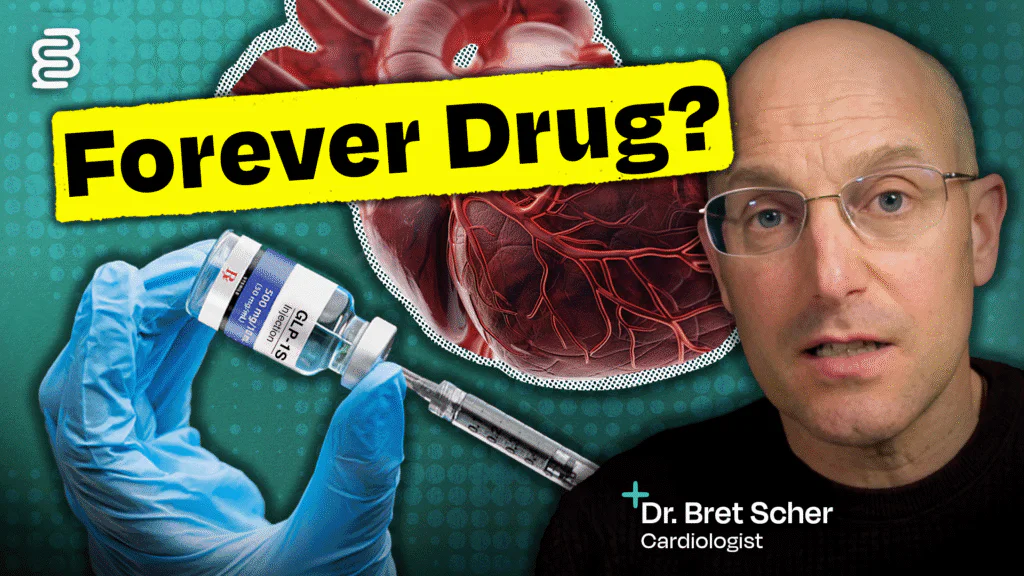
Dr. Bret Scher examines a new BMJ Medicine study showing GLP-1 medications like semaglutide reduce cardiovascular risk, but only after 18 months of continuous use, and those benefits disappear within 18 months of stopping. He argues this reveals GLP-1s manage symptoms rather than fix underlying metabolic drivers, and makes the case for pairing these medications with sustainable nutrition and lifestyle changes rather than accepting lifelong dependence as the default.
Learn more
In this Metabolic Mind episode, Dr. Bret Scher addresses the claim that ketogenic diets are bad for heart health. He explains why many studies misrepresent keto, how cholesterol responses vary, and how ketogenic diets can improve key markers like triglycerides, HDL, insulin resistance, and blood pressure. Learn why metabolic health is central to heart health and how keto may play a role.
Learn more
Have you been told you have high cholesterol and need to start a statin to prevent a heart attack? You're not alone. Every year, millions receive this news from their doctors—often with a sense of fear and urgency. But it turns out that cholesterol isn’t the best way to determine your risk of cardiovascular disease.
Read more
Dr. Bret Scher tackles the long-running debate over eggs and cholesterol, explaining that while eggs can mildly raise LDL for some people, this doesn't automatically translate to increased heart disease risk. He breaks down why headlines warning against eggs rely on weak observational data with tiny effect sizes, and highlights eggs' impressive nutritional profile, including protein, choline, and fat-soluble vitamins, arguing overall diet quality matters far more than egg consumption alone.
Learn more
Dr. Bret Scher examines a new BMJ Medicine study showing GLP-1 medications like semaglutide reduce cardiovascular risk, but only after 18 months of continuous use, and those benefits disappear within 18 months of stopping. He argues this reveals GLP-1s manage symptoms rather than fix underlying metabolic drivers, and makes the case for pairing these medications with sustainable nutrition and lifestyle changes rather than accepting lifelong dependence as the default.
Learn more
In this Metabolic Mind episode, Dr. Bret Scher addresses the claim that ketogenic diets are bad for heart health. He explains why many studies misrepresent keto, how cholesterol responses vary, and how ketogenic diets can improve key markers like triglycerides, HDL, insulin resistance, and blood pressure. Learn why metabolic health is central to heart health and how keto may play a role.
Learn more