Announcing the new McLean Center for Metabolic Psychiatry Learn more.


Listen, Watch & Subscribe on:



Could GLP-1s Help Treat Bulimia and Binge Eating?
Listen
About the host

About the host

About the host

About the host
About the host
About the host

Paige:
All these women keep reaching out to me, and the one thing, the only one thing, they all have in common 100%, is say they cannot talk to anyone about this, because guess what? I have a really stigmatized disease, like all mental health issue is, and I’m using a stigmatized treatment.
Bret:
Welcome to the Metabolic Mind Podcast. I’m your host, Dr. Bret Scher. Metabolic Mind is a non-profit initiative of Baszucki Group, where we’re providing information about the intersection of metabolic health and mental health and metabolic therapies, such as nutritional ketosis as therapies for mental illness.
Thank you for joining us. Although our podcast is for informational purposes only and we aren’t giving medical advice, we hope you will learn from our content and it will help facilitate discussions with your healthcare providers to see if you could benefit from exploring the connection between metabolic and mental health.
Could GLP-1s be the next new treatment for bulimia or binge eating disorders? At first, it might sound a little crazy, but that’s starting to change. I’m joined today by Paige Gordon, who shares her personal experience of using a GLP-1 medication to completely put into remission her treatment-resistant bulimia.
And I want to read this from Paige’s website to tell you a little bit about her. “Paige Gordon works and lives at the intersection of storytelling, scientific curiosity, and systemic disruption. Drawing on her lived experience with bulimia, she advocates for biologically informed approaches to eating disorder research and treatment with a particular focus on the neurobiological underpinnings of binge eating disorder.”
So, there’s a lot there, but I find that so interesting: the biological, the neurobiological underpinnings of binge eating disorder.
And the way GLP-1s are potentially helpful in this eating disorder leads to that. And joining her on this interview is Dr. Michael Lutter, who is a MD-PhD psychiatrist specializing in eating disorders. He practices at Precision Psychiatry, who also specializes in the genetics. So, he brings in the genetic reasoning of why GLP-1s could be effective.
So, of course, none of this is medical advice. This is very early exploration where there isn’t yet the research. But this is part of what I love, is exploring these potential new options, especially for disease processes that don’t have really good treatment options. So, for those individuals and their families and loved ones who really are struggling to find a treatment to get their life back, could this be one of them?
I don’t know. But based on this interview, there certainly is something there that deserves more exploration. So, I hope you enjoy this interview. Many of the interventions we discuss can have potentially dangerous effects if done without proper supervision. Consult your healthcare provider before changing your lifestyle or medications.
In addition, it’s important to note that people may respond differently to ketosis, and there isn’t one recognized universal response.
I’m thrilled to be joined today by Dr. Michael Lutter and by Paige Gordon. Thank you so much for joining me.
Michael:
Oh, thank you for having us.
Paige:
So fun to be here.
Bret:
And I get the pleasure of asking you both this question that I love to start my shows with. So Paige, let’s start with you. What is something you think modern medicine gets wrong that you really wish were different?
Paige:
Oh, that’s such a good question. I would say that we’re treating to averages when we should really be having some more precision-focused medicine.
Bret:
Yeah. That’s something I agree wholeheartedly with, that you don’t want to be average. Most of us aren’t average. And guidelines don’t always encompass the individuality of who we are.
So, that’s so important for us to constantly think about, I think. So yeah, thank you for saying that. All right, and Dr. Lutter, how about you? How would you answer the same question?
Michael:
Oh gosh, it’s hard to follow such a beautiful, succinct answer. I’ve been thinking a lot about kind of that question lately.
I would probably say just within the mental health field that we need to rebuild it around the entire structure to better suit young men. I think the system is failing young men. For whatever reason, they don’t engage in it. So, I have something like 900 clients. I have a lot of male patients I love to work with.
They do a great job. But if you would look at like the top 10 or 20 patients I have, my problem patients, the patients who don’t follow up, who don’t take their meds, who don’t reach out to me, who just disappear, it’s probably 19 out of 20 are young men. There’s something about the system that does not engage them. And part of that’s on them, but part of that’s on us.
Bret:
Yeah, it’s a good point. Whenever there’s a clear failing, you could say, and the question is always, whose fault is it, right? And just like you say, if the teacher has one person getting an A and everybody else failing, it’s probably not the students’ fault. It’s probably the teacher’s fault, right?
So sometimes, we have to look into ourselves and into our system and say, “Why is this specific group not doing well, and what can we do to change that?” So yeah, I appreciate that answer. But I need to start by saying, this interview came from a unique place for me. It came from The Wall Street Journal, which I wouldn’t think I would get a Metabolic Mind interview from.
But there was an article in The Wall Street Journal featuring you, Paige. You were center of this article, but also referenced you, Dr. Lutter, as well. And it was about how this amazing woman found GLP-1s and helped her disordered eating. And it’s something that hasn’t been talked a lot about, how GLP-1s could fit into this.
So Paige, give us a little bit of the background of what were the symptoms you were living with and struggling with? What have you tried that worked or didn’t work, and what led you to GLP-1s?
Paige:
Yeah, thank you. So, I’m so glad to be on the podcast, and I’m glad you read that article. But I am a recovered bulimic, and what that means is that I binged. And then, I vomited, and I purged.
And I started purging when I was around 18 years old. I’m now 44 years old. I’ve been in recovery for about four years. And it was really, at first, a choice as a tool to control my weight. I had gained 40 or 50 pounds in high school, which in and of itself, isn’t a problem. For me, it was a symptom of my binge eating.
So, this was in the 90s, and that wasn’t something that was in the DSM yet. So, even if I had asked for help, I don’t think anyone would’ve known what to do with me. But I just had this voracious appetite that I just couldn’t quash. And I just kept on gaining weight, and it wasn’t just overeating.
I really was binging. I would go to the donut shop before school, and I would literally eat a dozen donuts before first period, that type of thing. So no surprise I gained weight. And yeah, at first, it was a choice. And to me, it was a very maladaptive solution to a problem I was having that made it a lot worse.
But it was once you opened that Pandora’s box, it was really hard to close because once it became easy to do. What most people listening right now probably don’t realize about bulimia is it’s not like that violent thing that most people experience when they’re vomiting. Once you do it for a little while, it gets actually, unfortunately, very easy to do. And you can just do it almost sitting up. And it’s silent and it’s quick and it’s very reflexive.
So, once you start getting in the habit of doing It’s really hard to stop.
Bret:
I’m curious though.
Paige:
Yeah. So, those are my…
Bret:
You said it’s it started as a choice. You said that a couple times. It started as a choice. So, my guess is it progresses to a point where you don’t see it as a choice.
So, tell me about that.
Paige:
Yeah. it progressed pretty quickly. Once a week turned into twice a week, turns into once a day, turns into twice a day. And then, suddenly, overtook my life. So, that happened relatively quickly. I think I started purging the beginning of my senior year. And by the end of my senior year, it was completely, it felt completely out of my control.
The bingeing was already out of control, it felt before that. But then, now the purging, I couldn’t stop. So, I did, to when you asked me what treatments I tried, very quickly, when I graduated high school, I flew myself to John Hopkins University. And I enrolled in their eating disorder program, like myself.
Raised my hand and I said, “I need help.” So, I was always the person that I knew I had a problem, and I asked for help there. And they put me on medication, and I was treatment-resistant, is I guess what they would call me. And then, I went off to college, and I went into a program there, too.
I also volunteered myself into an intensive outpatient program. So, for your listeners, that means that I would be going every day for a couple hours, had a treatment team. We would make dinner together, that sort of thing. And I did that pretty much for the entire time I was in undergrad, but I was never getting any better.
And it just, I felt like a failure. I just could never control my urges. It just seemed like an overwhelming impossibility. And it was so frustrating because I knew what I was doing and I couldn’t stop myself from doing it. And that just made me feel like a more terrible person, and it just kept going and going.
Bret:
Yeah, so despite the medications, despite the therapy, despite being part of this group, those urges just wouldn’t go away. Nothing seemed to really address that. So, Michael, you’ve been in the eating disorder fields for a while. I’m sure you’ve seen this type of progress, or lack of progress, so many times.
What does that, how does that sit with you to hear that story? Is it something you see all the time, and is unfortunate, or what do you think?
Michael:
It is heartbreaking, yeah. The treatment outcomes are just not very good. As coming out of residential treatment, the relapse rate within a year is somewhere 40 to 60%, depending on what the study is.
The recovery rate for anorexia at, I believe, it’s either six or seven years is 32%. For bulimia, it’s a little bit higher, it’s 60%. Which, 60% at six years, it’s better than anorexia, but it’s still not acceptable. So, unfortunately, treatment resistance is almost the norm.
And those are the people who get access to treatment. Either through stigma or lack of awareness or lack of resources, a lot of people don’t even get into treatment,
Bret:
Yeah. You would think with Paige, it would be best case scenario because like she said, she raised her hand. She showed up.
Michael:
Yeah.
Bret:
And said, “I need treatment.” How many people do you see who weren’t in that position and almost have to be dragged in for treatment? What do you see the percentage is? I know this is probably tough to put you on the spot. What would you say the percentages of those would be?
Michael:
Certainly of the adolescents, most of them are getting drugged by their parents unwillingly.
And then, in the 18 to 22 range, your parents still can exert a lot of influence, especially if you’re in college. Your parents can decide to cut off. So, a lot of those patients are very ambivalent about going into treatment. Once you get into the older, into the 20s and 30s, a lot of those patients then are coming in, but they’ve, at that point, usually been sick for quite a while.
So, those behaviors are pretty well-entrenched at that point.
Bret:
So, Paige, you clearly were not new to treatment. You had been through many versions of treatment. So, tell us what eventually led you to GLP-1s. And then, what your experience was.
Paige:
It was a podcast, believe it or not.
Bret:
Really?
Paige:
Yeah.
Bret:
The power of the podcast.
Paige:
I was listening to a podcast. It’s called Science Versus. I don’t know if you’ve ever listened to it, but I love it. I listen to it because it has a bunch of citations at the end so I can go look up, the journals, myself because I have trust issues. But I was listening to this podcast, and it was four years ago or so, and it just happened to be on Ozempic.
It was by accident that I listened to it. And the thing that struck me about that podcast at the time is this woman was describing her experience taking the medication, and she lost weight but that wasn’t the thing that was a miracle to her. She kept talking about food noise, and I had never heard that word.
The way that she described it in the podcast, that episode, is she said when she got up in the morning, the first thing that she thought about was food. The first thing that she thought about when she got off work was food. It was her whole world revolved around food, and I just couldn’t believe it.
I was so dumbstruck. I actually had to pull over on the side of the road, and I started weeping. Because in the 22 years or so that, and that’s how long it had been, that I’d been in and out of treatment, no one had perfectly articulated the way that I felt the way that this woman did. I had always been told that the way that I felt had to be coming from a place of restriction, which always confused me because I went into treatment in a higher body weight.
So, I was like, “How could I be restricting? Are you sure? Like I’m pretty sure I eat a normal meal, and I’m still wanting to eat 12 donuts, but okay.” But anyway, I just couldn’t believe it. So, that’s where I heard about it. So, I just knew right away. I was like, she sounds, she has a completely different diagnosis than me, but she sounds just like me.
What is that? And so, I just from that, I decided to try it because it was coming from a place of desperation really. I was already actively killing myself. So, I thought, this can’t hurt. Like I can’t possibly make it worse. I did research, and besides having an eating disorder, I didn’t have any of the other contraindications for the medication.
And so, I just thought I would try it. It seemed like the way she was describing It wasn’t that it like got rid of her hunger. It was that it re-regulated it. And I’m like, wow. Would that help me? And so, I started taking it.
Bret:
Yeah, but isn’t that interesting? if you look at the printed contraindications, eating disorder is one of them, right?
Paige:
Yeah.
Bret:
So, was there a part of you that said. “Ah, maybe I shouldn’t do it because it’s not supposed to?”
Paige:
No.
Bret:
Or you were just so, it was so emotional that someone like got benefit in a way that you saw yourself in that it didn’t matter?
Paige:
The reason why I figured they said it was contraindicated was for people with restrictive eating disorders with anorexia.
I had never restricted. I never had been in a lower body weight. I never had body dysmorphia. So I knew, that goes back to my first answer to your question, that we’re treating to averages, not precision medicine. I knew I didn’t fit into that category. I felt really confident that I wasn’t going to abuse the medicine. That if I started taking it and I titrated it up and I started losing weight, that I would stop taking it.
I just didn’t have any worry about it at all.
Bret:
So, Michael, let’s bring you back to the same timeframe, four years ago. If we talked to the Dr. Lutter four years ago and said, “Hey, what about GLP-1s for eating disorders?” How would you react?
Michael:
Oh, I’ve been doing this for probably eight years.
Yeah, so the way I got into it is, I used to be in academics. And I had, for about eight years, I ran a research program. The very last study I had when I knew I was leaving academia, I had about $100,000 of startup money left. So, I literally just took all the samples I had in the freezer and sent them off for whole exome sequencing. And I’m just like, “I’m just going to blow my shot, right?
So, I sent everything off. So, we sequenced all of the genes, 20,000 plus genes for over 100 people. So, they had to split it into restrictors versus bingers. So, I get this list of restricting genes and binge eating genes. And there’s 100 genes on the binge eating list. And I go through, and I see glucagon is on the list. And I’m like, “Eh, I’m not that interested in glucagon.”
So, I keep going. And shortly after that, GLP-1 receptor comes up. And I start reading about it, and it talks about it being involved in glucose metabolism but also appetite. And I’m like, “Oh, this is very interesting.” So, I had never heard of GLP-1. This is like 2015. And I look it up, and it’s like GLP-1 comes from the glucagon gene.
So, I go back to glucagon, and I pulled the sequencing data, and sure enough, the mutations were exactly at the start of GLP-1, right? So, it was in the GLP-1 part of the gene. Not only that, it was in the part of the gene that was required for it to be cut out of glucagon. And then, that’s where as a scientist, the the lights just go on, the bells go off or whatever the phrase is.
Bret:
Yeah. So, you, you draw the genetic association.
Michael:
Yeah.
Bret:
And then, the next question is, so can you address that with medication? So, let’s get back to that. So Paige now, so you found it, you decided to try it. And what was your experience like? And then we’ll circle back to you, Michael, to see where you went.
Paige:
Yeah. My experience was so profound that if it hadn’t happened to me, knowing how sick I was and knowing how often times people with bulimia say that they’re well when they’re not, I wouldn’t actually believe me. That’s how profound it was. I started taking the medication, and a couple weeks in, my urge to binge completely disappeared. And if I didn’t have the urge to binge, I had absolutely no reason to purge.
I started eating more normally. I actually gained weight taking the medication. Because at that point, almost all my meals were binging because I had to eat such a high quantity of food to feel satisfied. I started eating desserts that, and I can sincerely tell you, one piece of cake tasted good instead of having to eat the whole thing.
It changed my mind in such a profound way that I knew right away that something seismic was happening to me in my brain. Because for the first time, I had a comparison point to what, like what, a calm brain was supposed to feel like compared to what it was going on before. And I just said, I’m like, “What in the world was so dysregulated in my brain before??
This is what they wanted Prozac to do. You know what I mean? And I just started reaching out to researchers. I was playing this like game of Russian roulette where I was like finding the academic institutions and guessing what their email address was. And I’m like, “Scan my brain. Take my blood.
Something’s going on here. We’re missing it. We’re missing something. We’re missing it.” And then, I found Dr. Lutter, who had already been chasing this for four years.
Bret:
That’s amazing. So, actually, have you had your gene sequenced? Do you, yeah?
Paige:
Yeah. And he was right. The first time I talked to him, he was like, “Based on your history and what you’re describing, I’m sometimes wrong, but I’m guessing you probably have one of these variants.”
And I was like, “Let’s test me.” And sure enough, he was right. I have one of these stupid rare variants that we think is associated with disordered eating, that shows up in like 0.1% of the population, that I have.
Bret:
I mean, the story is amazing, especially when you said you wouldn’t have believed it had happened if it hadn’t happened to you, that it was that profound.
Paige:
Yeah.
Bret:
And it’s been four years, and you say you’re in remission. So, I assume that means no hiccups, no challenges or?
Paige:
No. I tried to go off the medication a few times. Once I went off of it, because I had to have surgery, and you have to go off it when you have surgery, and I take semaglutide.
I take a very low dose. I should explain that to your listeners. I take much lower than what you would take for weight loss.
Bret:
Do you mind sharing the dose?
Paige:
Yeah, sure. I take one milligram of semaglutide.
Bret:
Okay.
Paige:
The starting dose for weight loss is 2.4, and it goes up to 7.2. So, that gives you the range of what a low dose I take.
And at usually at that dose, people aren’t losing weight. Anyway, I went off of it, and the half-life of semaglutide is a week. And like on day 10, I was just like a food vampire all over again, Came roaring back. Oh, yeah. And then, I tried to come down off of it a little bit, a few months ago, just to test it out because I had this theory.
I’m like neuroplasticity, am I making new habits, could it? And I went down .25, and it was going okay. But I could feel it like creeping back, like the urges creeping back a little bit. So, I was like, “Why am I screwing around with this? Let me just go back to my happy place of one milligram.”
So, I went back up, and I’m like, “Okay, we’re not going to be experimenting with myself anymore. We’re just going to keep it steady.” But I haven’t had to go up. And I know that does happen for some people. Sometimes, once the gastric emptying slows, they have to kind of up step at least once. Because now, I’m in this weird space where people are reaching out to me two or three times a week with bulimia nervosa, who are also using this off-label.
So I’m, besides Dr. Lutter, I’m probably the only person in the world that actually has an Excel file with 50 people’s histories and their doses. Because we’re working on trying to get randomized control trials. So, I’m like, “Okay, we got to get the dose right.”
Bret:
Wow. So yeah, you really have turned into a mentor for all these individuals.
Paige:
Yeah. I’m not giving people advice. I can’t. I’m not a doctor, but yeah.
Bret:
But even just to know someone else is going through this and someone else has experience with this and someone else to talk to about this. That can be so important, especially when you’re doing something that many will see, again, contraindicated or crazy or you can’t do that.
Paige:
Yeah. Or they say I’m just giving the disease what it wants. I’m like, do we say this to people with bipolar disorder? That the lithium is giving the mania what it wants? What are we even saying right now?
Bret:
Yeah. So Michael, then so, there’s this, the genetic variants. And clearly it appears from case reports that giving the GLP-1 agonist can help dramatically for some individuals with those genetic variants.
Do you think it will also help for people without the specific genetic variants, or is it only localized to this genetic mutation?
Michael:
That’s one of my areas of interest is to see the people it works for and the people it doesn’t. So, clearly the people with mutations in the GLP system, they respond very well to it, unless it’s in the GLP-1 receptor, which makes sense, right?
But if it’s in any other part of it, they respond beautifully. There are a few other mutations where people seem to respond to it. And then, there are a few people that don’t respond at all. And that, I’m trying to actively work out. What then are these pathways that don’t respond to GLP-1?
But it’s probably 40% of people with binge eating or bulimia respond exquisitely well to the medication.
Bret:
Wow. And so are there studies being done or being proposed to investigate this further?
Michael:
There are definitely groups that are looking at patients who don’t lose weight in response to GLPs. And there are trials trying to get underway to look at patients who to use it for treatment of say, bulimia or binge eating. And I’m trying to tag onto those groups to be the genetic component.
Like with the ketogenic diet study, trying to find people who don’t, why some people respond and some people don’t. So, that would be an interest of mine and to try to figure out exactly if we can start to predict who would respond and who wouldn’t.
Bret:
Yeah, it’s an interesting position to be in. As clinicians, it’s easy to say the randomized control trials haven’t been done. So, it’s not a thing yet versus look at the life it can change.
Look at how it could so dramatically give someone their life back and get rid of their symptoms. So, that can be a challenging position sometimes for a clinician.
Michael:
You say that, but in eating disorders, there’s no drug treatments for anorexia, right? So, that’s 100% off-label.
There’s one FDA-approved treatment for bulimia, right? So, I usually have people do Prozac first. I don’t usually jump straight to GLP-1.. And there’s one FDA-approved treatment for binge eating disorder, which is Vyvanse, right? Which I usually use first, unless somebody does not want to take a controlled substance.
So, people are like, the studies haven’t been done. But I’m like, look, almost everything we do is off-label, right? There’s a very small percentage of the patients I see respond to an FDA-approved treatment.
Bret:
Paige, you were that person, right? You got the FDA-approved treatments and did not have the response, and didn’t have it until you found semaglutide, right?
Paige:
Yeah. To Dr. Luder’s point, the third medication they put me on was Prozac. So, they gave me two off-label options first, which is interesting. I have have a family history of, bipolar disorder. So, I think they didn’t want to give me Prozac because they were afraid it might instigate mania.
Bret:
Did you get pushback when you tried to get a prescription for semaglutide?
Paige:
So, that’s its own story. I don’t recommend anyone trying this at home. But four years ago, probably still, it’s easy to get it on telehealth. I just did it. I didn’t tell anyone. I did finally come clean to my primary after I had taken it for a few years, mostly because I stepped into this advocacy role. And I was like, no one’s going to take me seriously if I’m still getting it online.
And I was expecting her to, I don’t know, maybe try to 5150 hold me or something when I told her I was taking it. I’m joking. But she looked at me, she looked at me, and she goes, “Is it helping?” And I’m like, “Yeah.” And she goes, this is before the randomized controlled trials had come out on alcohol use disorder, and she said, “I’m not surprised.
Most of my patients that take it for obesity say that they’ve stopped drinking.” She’s like, “I’m not surprised it’s helping you.” And then she said she needed to get an endoscopy of my throat and all that, and that opened up a whole other terror for me. But the guy came back and he was like, “I don’t even see me any evidence of her having an eating disorder.”
So, because I hadn’t purged for two years so my esophagus had healed itself. So, that was enough evidence for my primary, and she saw that I hadn’t lost any weight. She was like, “I have no reason not to prescribe this to you.” So, she gives it to me now. I just have to go in and get weighed every three months, which is annoying, but appropriate.
It tells me she doesn’t understand what it’s freed me from. I get it.
Bret:
Well that, you’re right. It is all too easy to get online. But hopefully, now with you being public, and Michael, with you talking about it and more people discussing it, anybody who’s interested wouldn’t have to get it online. That they could talk to their doctor. That they do have some resources to point them to, whether it’s just a podcast or whether it’s a Wall Street Journal article or a book or something to say, “Look, there’s something here about this.
I don’t want to do it behind your back. So, help me do it.”
Paige:
Yeah.
Bret:
That definitely seems to be the safer approach.
Paige:
That’s the basis of my advocacy work because, like I said, all these women keep reaching out to me. And the one thing, the only one thing, they all have in common 100%, they say they cannot talk to anyone about this. That they can’t talk to their doctor about it. They can’t talk to their friends and family about it because guess what?
I have a really stigmatized disease, like all mental health issue is, and I’m using a stigmatized treatment. So, it’s like a double whammy. It’s not very fun. And so, I’m really trying to make awareness within the eatting disorder community to at least consider this and read the research. Because I learned that it’s a very fragmented space and not very many people had read Dr. Lutter’s work.
Not many, very many people. And so, I’m, like sharing so now everyone just gets it. But I’m like, “We need to be open to this so people aren’t doing it the way that I did it.” And advocating for the randomized control trials, too.
Bret:
Yeah. And so Dr. Lutter, you brought up your role with Dr. Guido Frank and his study that he was doing on ketogenic interventions for anorexia.
So, it does seem there’s some crossover. Obviously, maybe a little bit of a genetic, a different genetic component. But this concept of food noise, that’s something we hear all the time with ketogenic interventions.
And then, you look at substance use disorder. There’s some studies on ketogenic interventions for substance, for alcohol-use disorder, and the same for GLP-1s. Do you think there could be some overlap here with ketones in the brain, metabolic health, metabolic dysfunction, all of that sort of fits with this picture too for treating, binge eating disorder?
Michael:
I do. We talk about it as like these groups. It’s anorexia or binge eating or bulimia. But it is quite a spectrum. We have, even with anorexia, we have restricting-type and binge purge-type. And then, you’ve got bulimia and binge eating and several other disorders.
So, I think within the realm of bulimia, I think there’s a clear evidence to try to make sense of studying this. In binge eating. I think it makes sense. Even within anorexia, binge purge subtype, for people who just can’t stop binge eating, I think it makes sense. And then, there’s the question of, you bring up the question then of ketones, right?
Because this is going to drive some metabolism through fat. What I have seen with restricting-type of anorexia in the genetics is overwhelmingly, the genetics point to deficits in ability to burn long-chain fatty acids, right? That’s what got me involved in the ketogenic diet study to begin with is, I was like, “I’m not sure this is going to work.”
But it worked way better than I ever thought it would. And I think that’s because the deficit in anorexia is an inability to burn long-chain fatty acids for energy. And I think anything that drives that, whether it’s a ketogenic diet or possibly a GLP-1, is worth investigating. Because I think it could make sense to turn on those pathways to rev up all of the machinery that it takes to burn fat for energy.
That seems to relieve a lot of the symptoms.
Bret:
Yeah. Very interesting. Yeah, and I know Dr. Tro Kalayjian published some case reports from his own practice of people, with binge eating disorder and binge eating thinking, improving with their ketogenic intervention. Now, that doesn’t again, prove it’s a treatment or say who it might work for or who it shouldn’t work for. But another tool in the toolkit for someone who’s potentially not responding to so many other therapies.
Michael:
And I’ll say, I will echo, that it works amazingly well for alcohol in some people. There’s a few people it hasn’t, that who report that it hasn’t done anything. But probably 70, 80% of patients I use it for, with that say that it helps a little or a lot sometimes, very dramatic findings.
Bret:
Yeah, but so interesting that it really is broadening or even completely changing gears for the treatment, right? You mentioned Prozac and Vyvanse and psychotropic medications. And now something that’s completely different and not even a psychotropic medication.
Although, I guess you could argue whether GLP-1s are truly a psychotropic medication, right?
Paige:
I think it’s a psychotropic.
Michael:
I see people argue that. It is It has a lot of effects.
Paige:
Yeah.
Bret:
And same for ketosis. if ketones are affecting the brain directly, then I guess you, by definition, it’s a psychotropic impact.
Although, I guess not usually talked about like that. So, broadening the discussion of what is a psychotropic intervention, right?
Paige:
GLP medications are affecting not only the fuel gauge, the thing that controls when you eat and if you’re hungry or full, but it’s also affecting the reward center through dopamine pathways.
So, it is, in that way, and why it helps with alcohol use disorder, we think, and that sort of thing, a psychotropic. That’s why I say that. It’s helped me level my mood out incredibly. I know it has.
Bret:
And great that you’re able to find such success on such a low dose. Because the flip side of that with the reward pathways and such, is case reports of people saying they’re just losing enjoyment, right?
They just, it’s hard for them to find any enjoyment where they used to have. Probably dose-related, but is that something you’ve experienced on the GLP?
Paige:
No. I think that has to do with underlying biology. So, if you think of that sort of stuff as a faucet in your brain, especially for someone that might have reward circuit dysregulation, more of addictive type personality, that dopamine reward circuitry, whatever amygdala, was firing not in a correct way.
And so, it turned down the dial just a little bit. ,So for someone that has an overactive situation like that, I think it’s going to affect it a little bit differently. For me, it was just exactly what I needed. But I could see that happening mostly, as I understand it, with tirzepatide. So the GLP-GIP, and in much higher doses, and it can be corrected if you take the dose down a little bit.
But I take such a low dose, but I could see just on how it’s leveled out my mood. I’m less reactive. Because I had that typical thing that goes with people with bulimia, which is mood dysregulation. I was more quick. Now, is that just how I was or is that because I had food noise all the time so I was just annoyed and pissed off?
I don’t know. I don’t know but yeah.
Bret:
So, with the people coming to you and sharing their experiences with you, have they mostly been using semaglutide or have some been using tirzepatide or others?
Paige:
That’s a great question. No. I’m not giving medical advice right now. So, don’t try this at home, guys.
But, I would say no, I’m using semaglutide, and most people are using tirzepatide. And I think it’s just because it’s more popular right now, and the literature is showing that tirzepatide seems to be doing something a little bit different with addiction tendencies. We have some case reports that it’s helping with shopping addiction, for example, and semaglutide doesn’t work as well for that.
Yeah, and but also everyone that’s using it well, to not instigate weight loss for the most part, except for one person out of 50 people, are using also a subtherapeutic dose below that 2.5.
Bret:
Yeah, and Michael, going back to the genetics. If it truly is both glucagon and GLP-1, then it seems like tirzepatide would be a little bit of a better fit.
Is that something you’ve seen?
Michael:
I would say, in general, tirzepatide works a little bit better with a little bit fewer side effects, yeah.
Paige:
I haven’t bothered changing because I’m like, “Don’t fix something that’s not broken.”
Bret:
If it ain’t broke, don’t fix it. Yeah. I can agree with that. I think that’s a good perspective.
This has been a super interesting discussion. And like you said, Paige, none of this is medical advice. This is just exploring your personal experience, and trying to draw some connections. But if people wanted to learn more about this, learn more about you, where could they go to find you, Paige?
And also, sorry, any last comments before you tell us where?
Paige:
Yeah. Thanks. I recently joined the board of the National Eating Disorder Association. And so, I always put that as a great resource for people. They have a wonderful screener on there that you can check to see if you feel like you have disordered eating. And then, it will have resources for you so I would like to say that.
I also, just as a last thought, as much promise as these medications have for people with disordered eating, they also have the potential to cause a lot of harm, especially if you’re using them in a restrictive-type eating disorder, or if you are using them for intentional weight loss. We know that people using them for intentional weight loss that have a history of anorexia, it can put them back into anorexia.
I want to be balanced with that. You do have to have caution. But my website is paigegordonauthor.com. And I love to hear from people, especially if you disagree with me. I’m up for debating. I don’t want it to be an echo chamber of just validating my own thoughts.
Bret:
And then you have a book coming out at some point.
I would, depending on when this is published, but it’s not out yet, but will be out, the new year?
Paige:
So, it’s January 12th, and Dr. Lutter wrote the foreword.
Michael:
I was part of the the, part of a group.
Paige:
Yes. So it’s called Searching for Full: How GLPs Changed My Eating-Disordered Life. I think my publisher picked that for a little bit of a rage bait for people.
But it comes out January 12th, and it’s distributed by Simon & Schuster. So, you can get it anywhere that you buy books.
Bret:
Great. Great. All right, and Dr. Lutter, for you, any last comments, and where can people find you to learn more about you?
Michael:
I just treat patients now. The research part is a hobby. So, I’m a full-time psychiatrist here in Texas.
But I am licensed to do telehealth in Connecticut, Georgia, Florida, Kentucky, Illinois, Arizona, Colorado, and Washington state. I do see people across the country. So, if anybody’s interested in learning more, my website is precision-psychiatry.com. And I’m always happy to chat with people and help inform them as best I can.
Bret:
Wonderful. Thank you both so much for joining me. And hopefully, we’ll hear more from you in the future. So, thanks again.
Paige:
This was so fun. Thank you.
Michael:
All right. Thank you.
Bret:
I always find it so interesting when you find a treatment completely off-label, seems to be completely off-kilter of what it’s normally used for, that can totally help someone just change their life. And then, as you walk it back, maybe it’s not so crazy after all?
Maybe it is related? And you try and draw the lines about how it’s related, which is obviously with Paige’s experience and Dr. Lutter bringing in the genetic component, I just find that so fascinating. And then, of course, it puts people at a position, as a clinician or as a patient or a loved one, what do we do without the trials being done, and how strongly can we recommend this?
And I really liked Paige. I thought her approach and the way she worded it and how careful and not giving medical advice, and we still have to be careful. And it’s not going to work for everybody, and there are definitely are some risks. It’s important to have that message, while at the same time seeing the hope it gives and how it can transform someone’s life.
So trust me, this is just the start of this conversation. This is going to go on and on, and we’re going to hear a lot more about this. But for now, I am just thrilled for what Paige has found and how she’s changed her life, and the work that Dr. Lutter has done. So, thank you for joining me. I hope you found this interesting, and we’ll see you here next time at Metabolic Mind.
Thanks for listening to the Metabolic Mind Podcast. If you found this episode helpful, please leave a rating and comment as we’d love to hear from you. And please click the subscribe button so you won’t miss any of our future episodes. And you can see full video episodes on our YouTube page at Metabolic Mind.
Lastly, if you know someone who may benefit from this information, please share it as our goal is to spread this information to help as many people as possible. Thanks again for listening, and we’ll see you here next time at the Metabolic Mind Podcast.
Listen, Watch & Subscribe on:

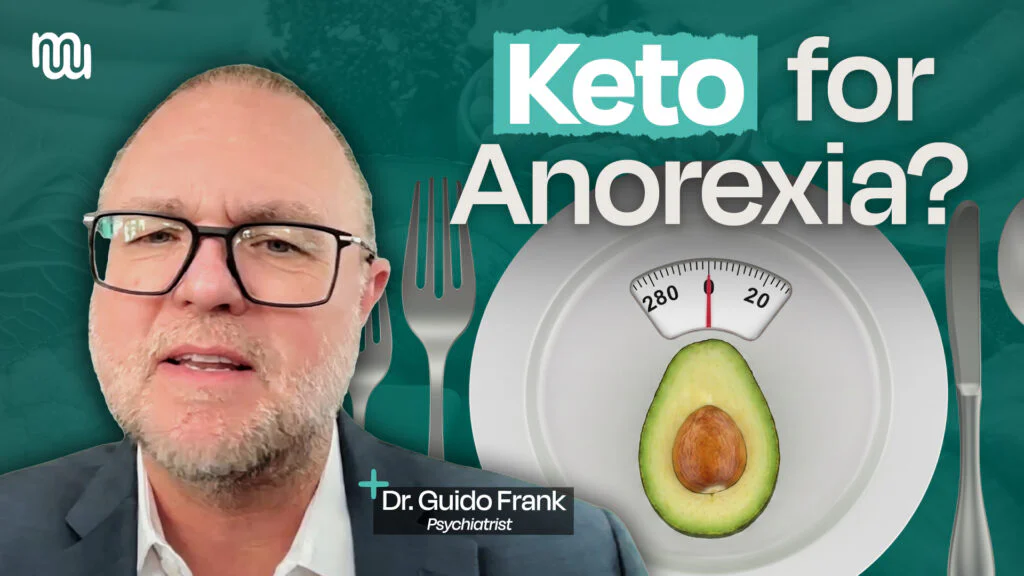
Dr. Guido Frank discusses his 22-person pilot study using a weight-maintaining ketogenic diet to treat anorexia nervosa, a condition with historically few effective biological treatments. By study's end, participants' scores fell below the clinical cutoff for anorexia, with weight remaining stable throughout, and Frank calls the results "astounding," stating he hasn't seen any other intervention work as well in his 25 years treating eating disorders.
Read more
Dr. Guido Frank discusses his newly published study in Communications Medicine testing a weight-maintaining ketogenic diet in adults with anorexia nervosa, a condition with historically limited biological treatment options. Of 22 participants, 82% completed the 14-week trial, and 72% showed eating and body-related concerns along with depression scores within the normal range, with no signs of symptom worsening or unwanted weight loss.
Learn more

In this powerful Metabolic Mind episode, host Dr. Bret Scher shares five deep, personal interviews with people who battled severe anorexia nervosa—some nearly dying, others cycling through conventional treatment for decades—who ultimately found remission after incorporating therapeutic nutritional ketosis into a broader healing journey. They describe how shifting to ketogenic or carnivore-style diets improved brain energy, reduced obsessive food thoughts and crippling anxiety, and allowed therapy, relationships, and life to finally take root. While not a one-size-fits-all cure and never something to attempt without expert supervision, these stories challenge the idea that anorexia is a lifelong sentence and highlight ketogenic metabolic therapy as a promising, hopeful avenue to explore with experienced clinicians.
Learn more
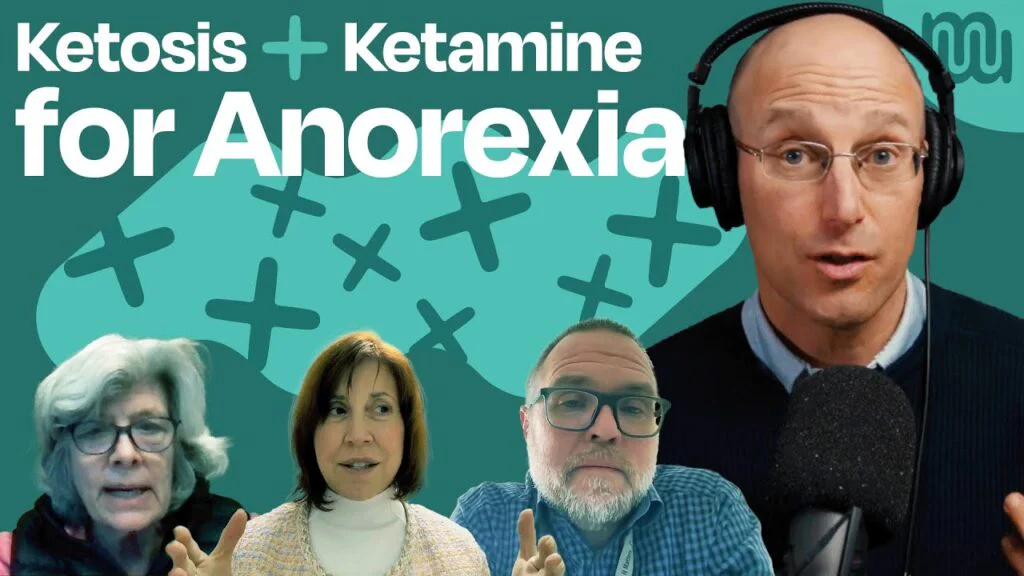
This episode explores a groundbreaking pilot study using a ketogenic diet and ketamine infusions to treat chronic anorexia nervosa, a condition with one of the highest mortality rates in psychiatry. Dr. Bret Scher talks with Dr. Barbara Scolnick, Dr. Guido Frank, and Dr. Lori Calabrese about how therapeutic ketosis, carefully supervised nutritional support, and targeted ketamine therapy helped five adults achieve meaningful and sustained relief from anorexic thoughts and depressive symptoms. The conversation highlights the metabolic mechanisms behind anorexia, why ketosis may stabilize the brain, how ketamine can expand cognitive flexibility, and what careful clinical oversight is required to replicate these results safely. This emerging metabolic-psychiatry approach offers hope for a population often left without effective options.
Learn more
Dr. Guido Frank discusses his 22-person pilot study using a weight-maintaining ketogenic diet to treat anorexia nervosa, a condition with historically few effective biological treatments. By study's end, participants' scores fell below the clinical cutoff for anorexia, with weight remaining stable throughout, and Frank calls the results "astounding," stating he hasn't seen any other intervention work as well in his 25 years treating eating disorders.
Read more
Dr. Guido Frank discusses his newly published study in Communications Medicine testing a weight-maintaining ketogenic diet in adults with anorexia nervosa, a condition with historically limited biological treatment options. Of 22 participants, 82% completed the 14-week trial, and 72% showed eating and body-related concerns along with depression scores within the normal range, with no signs of symptom worsening or unwanted weight loss.
Learn more
In this powerful Metabolic Mind episode, host Dr. Bret Scher shares five deep, personal interviews with people who battled severe anorexia nervosa—some nearly dying, others cycling through conventional treatment for decades—who ultimately found remission after incorporating therapeutic nutritional ketosis into a broader healing journey. They describe how shifting to ketogenic or carnivore-style diets improved brain energy, reduced obsessive food thoughts and crippling anxiety, and allowed therapy, relationships, and life to finally take root. While not a one-size-fits-all cure and never something to attempt without expert supervision, these stories challenge the idea that anorexia is a lifelong sentence and highlight ketogenic metabolic therapy as a promising, hopeful avenue to explore with experienced clinicians.
Learn more
This episode explores a groundbreaking pilot study using a ketogenic diet and ketamine infusions to treat chronic anorexia nervosa, a condition with one of the highest mortality rates in psychiatry. Dr. Bret Scher talks with Dr. Barbara Scolnick, Dr. Guido Frank, and Dr. Lori Calabrese about how therapeutic ketosis, carefully supervised nutritional support, and targeted ketamine therapy helped five adults achieve meaningful and sustained relief from anorexic thoughts and depressive symptoms. The conversation highlights the metabolic mechanisms behind anorexia, why ketosis may stabilize the brain, how ketamine can expand cognitive flexibility, and what careful clinical oversight is required to replicate these results safely. This emerging metabolic-psychiatry approach offers hope for a population often left without effective options.
Learn more