
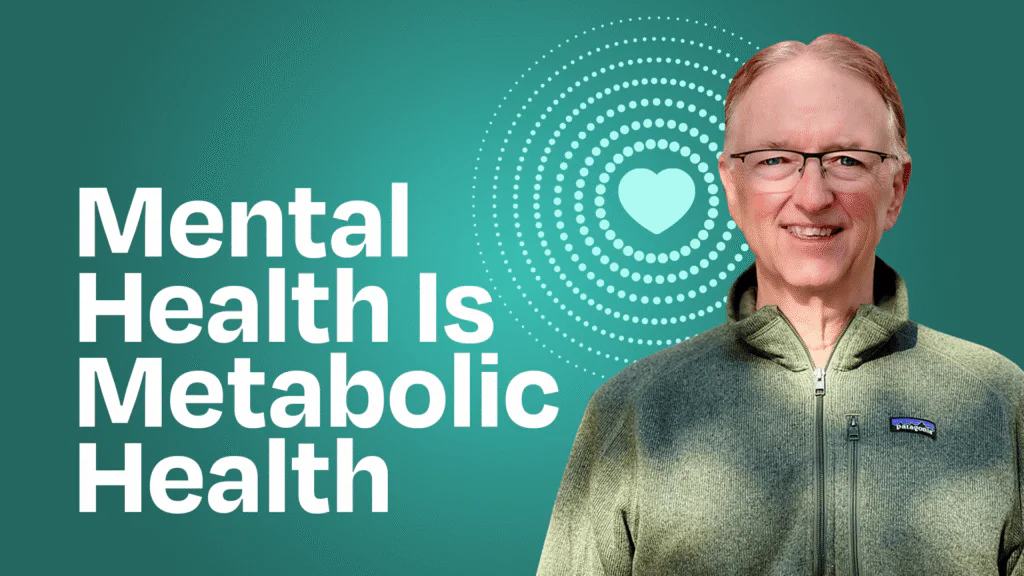
At 45, Dr. Eric Rodgers was used to thinking of himself as healthy. He was an optometrist, an avid runner, running one or two marathons every year. So when a routine health check ended with a diagnosis of prediabetes, the advice that followed was hard to square with the life he was already living: exercise more and eat less fat.
Eric could certainly change his diet. But exercise? He was already doing more of it than most people he knew. He left the appointment worried about where his blood sugar was headed and with the uneasy sense that the usual advice wasn’t going to be enough.
His physical health wasn’t the only thing troubling him. Around the same time, Eric was living with severe depression. Antidepressants had helped for a while, but as the stress in his life mounted, their effect seemed to fade. Over the course of three major depressive episodes, the last two accompanied by suicidal thoughts, he had reached a point that he remembers plainly: “I was getting pretty desperate. Just getting by every day.”
At the time, there was little reason for Eric to think his depression and his rising blood sugar had anything to do with each other. They belonged to different parts of his medical blueprint, with different symptoms and different treatments.
The prediabetes, however, presented him with a question he could act on. If years of running hadn’t protected him, what had gone wrong?
Eric began to wonder about food. And, like a lot of people trying to solve a health problem before the answer was waiting in a search bar, he went to a bookstore.
The Food Experiment
Eric’s first experiment was a vegan diet. He stuck with it for about six months, lost some weight, and felt a little better, though he found it difficult to maintain. Then, later in 2016, he learned about an animal-based ketogenic diet and decided to try something different.
By the following year, he was consistently eating a ketogenic diet while still taking his antidepressants. He was losing weight again, but he noticed something else.
“I guess I just kind of evened out,” he says.
Eric had changed his diet because of prediabetes, not depression. But the shift was noticeable enough that he wanted to understand it. Around that time, he came across an article by psychiatrist Dr. Georgia Ede about the connection between diet, metabolism, and mental health.
When he learned that Ede was heading to a conference on nutritional psychiatry in Bethesda, Maryland, he signed up. As an optometrist, Eric had never attended anything remotely like it.
“I’m starting to figure out that my diet is helping me,” he remembers thinking. “But I don’t understand it.”
At the conference, Ede sat with him through several presentations, including a talk by psychiatrist Dr. Chris Palmer about patients using metabolic approaches as part of their psychiatric treatment. Eric had spent months trying to make sense of what he was feeling. Now he was hearing a psychiatrist describe a way of thinking about mental illness that included metabolism.
“That was it,” he says. When Eric returned home, he continued his ketogenic diet and, over the next six to eight months, slowly began tapering his antidepressants. He did much of it on his own, a decision he says he would handle differently today.
“It was scary,” Eric says.
At the time, there were few resources for navigating ketogenic therapy alongside psychiatric medication. Today, Eric tells people to bring their prescriber into the conversation from the beginning.
“People absolutely shouldn’t have to do this alone,” he says. “It could be extremely dangerous.”
More Head Room

By then, the physical results were easy to see. Eric estimates he had lost 30 or 40 pounds. But when he tells the story now, the weight loss is almost beside the point.
“No, no, that didn’t matter,” he says. “It’s what happened to my mind. That’s what mattered.”
What mattered was a sense of calm he hadn’t known before. He could think more clearly and enjoy things more. Problems still came, but they no longer seemed to consume all the emotional capacity he had to deal with them.
Eric calls that capacity “head room.”
“When I was not well, there was no head room,” he says. “So when bad things happened, it was very difficult.”
Eight years later, bad days still happen. The difference, he says, is that they no longer take everything else down with them.
“Now bad things happen and I can take it in stride and move forward.”
What began as a search for answers about his blood sugar had opened up a much bigger possibility: his metabolic health and mental health were connected, and caring for one could have profound effects on the other.
The Health Risk Hiding in Plain Sight
In a systematic review and meta-analysis involving 52,678 people, researchers found metabolic syndrome in 32.6% of people living with serious mental illness. And compared with matched controls, they had a 58% higher risk of metabolic syndrome[*].
That relationship has many possible contributors. Psychiatric medications can affect metabolic health. So can disrupted sleep, changes in eating and activity, chronic stress, and barriers to consistent medical care.
In real life, those lines aren’t so clear. Mental and metabolic health can affect each other in ways that are easy to miss when they’re treated separately. Yet, many practitioners would never know to look at both.
A psychiatrist may be focused, understandably, on controlling hallucinations, mania, or suicidal depression. A primary care clinician may be watching glucose, weight, or cardiovascular risk. When those conversations never meet, important pieces of a person’s health can be missed.
That’s where screening becomes more than a box to check.
Someone can look functional and still be profoundly depressed. Eric was living that reality when he continued working through severe depressive episodes and suicidal thoughts. Metabolic problems can be similarly quiet until a blood test or physical exam brings them into view.
Looking at metabolic health along with mental health gives clinicians a better chance of seeing the person sitting in front of them.
One Week, Two Conversations
October offers an unusual convergence.
Mental Illness Awareness Week runs from October 4 through 10. National Depression Screening Day falls on October 8. Then, on October 10, World Mental Health Day and International Metabolic Health Day share the calendar.
For once, the calendar does what healthcare too often doesn’t: it puts mental and metabolic health side by side.
The converging of observances is especially relevant for people living with serious mental illness, who face elevated metabolic risk even as many continue to struggle to access adequate mental healthcare.
Screening for depression and other mental illnesses can identify suffering before it becomes a crisis. Screening for metabolic problems can catch physiological risks before they progress further. Neither replaces treatment, and neither tells us everything about a person’s health.
But together, they can start a better conversation.
What Metabolic Treatment Might Add
Eric began asking these questions before there was much clinical research on ketogenic therapy for psychiatric conditions. But that’s beginning to change.
In a 2024 single-arm pilot trial, researchers studied 23 people living with schizophrenia or bipolar disorder who also had pre-existing metabolic abnormalities. During a ketogenic intervention, participants experienced improvements in several metabolic measures, including weight and insulin resistance, while researchers also reported improvements in psychiatric symptoms, life satisfaction, and sleep quality[*].
The findings are promising, but they’re still early. The study was small and didn’t include a control group, which means it can’t establish that ketogenic therapy caused those changes. While compelling, larger controlled trials are needed.
For now, ketogenic therapy is best understood as an emerging adjunctive approach that may offer another option for some people when used alongside appropriate mental healthcare and with medical supervision.
Changes in diet and metabolism can affect medication needs and other aspects of medical care, which is why the safest version of this story today includes a clinician from the beginning.
Metabolic screening matters too, but it should not become a gatekeeper for who gets to discuss metabolic therapies. Standard markers can tell us whether someone has visible metabolic dysfunction in the body. They can’t reliably measure problems such as insulin resistance in the brain.
A normal metabolic workup may not answer every question about brain metabolism, but it does give clinicians another piece of the person in front of them.
More Room for Life
Eric has now followed a ketogenic approach for roughly eight years. He says he’s departed from his diet on only a handful of occasions, and when he has, he’s reliably noticed changes in his mood.
After spending years thinking about his physical health and his depression as separate problems, a shift in nutrition was the key that unlocked a connection between the two, and with it, more room for life.
For someone who once felt desperate simply trying to get through the day, feeling an expanded capacity for life is no small thing.
This October, as Mental Illness Awareness Week, National Depression Screening Day, World Mental Health Day, and International Metabolic Health Day bring attention to different dimensions of health, Eric’s story is an example of what may be possible when we look at mental and metabolic health together.
Explore more resources on mental and metabolic health, integrated care, and emerging metabolic approaches at metabolicmind.org/resources/.
How To Join In
To mark this week of mental and metabolic health observances, Hannah Warren, Community Engagement & Advocacy Manager at Metabolic Mind, is inviting the community to help spread hope and awareness by sharing resources on metabolic approaches to mental health.
Metabolic Collective has created a community flyer that can be shared with a local clinician, posted at a community center, café, or library, or passed along directly to someone who may want to learn more. It connects people with educational resources from Metabolic Mind and Metabolic Collective, including emerging research and metabolic approaches being explored for psychiatric conditions.
You can also help bring these ideas into your community by donating a copy of Brain Energy by Dr. Chris Palmer or Change Your Diet, Change Your Mind by Dr. Georgia Ede to a local library or Little Free Library.
However you choose to take part, snap a photo or video and tag @MetabolicMind and @MetabolicCollective so we can see how the conversation is taking shape in communities everywhere, and help inspire someone else to join in.